LAKEPORT, Calif. – The Lakeport City Council will hold a special meeting this week to take up several items of business related to city projects, delinquent utility fees and a final parcel map.
The meeting will take place beginning at 5 p.m. Tuesday, Aug. 8, in the council chambers at Lakeport City Hall, 225 Park St.
On the agenda is a public hearing on delinquent utility charges.
The council will consider adopting a resolution to confirm and approve the utility billing delinquency list and direct staff to submit the list to the Lake County Auditor-Controller’s Office for inclusion on the property tax roll.
The staff report said that approximately $22,654.01 in water and sewer bills was delinquent as of June 30.
Also on the agenda is the proposed award of the Giselman Street Overlay Project to Team Ghilotti Inc.
Team Ghilotti was the lowest bidder, at $279,305. According to Public Works Director Doug Grider’s report for the meeting, that’s roughly $35,000 more than the city’s engineer had estimated it would cost.
Grider said the project will take place after school is in session, and the city will work closely with the contractor to divert traffic to minimize delays during busy school hours.
“The contract is 30 working days although the significant portion of work impacting traffic will be completed in three consecutive days,” said Grider, with the anticipated start date Aug. 14.
In other business on Tuesday, the council will consider adopting a resolution approving the final parcel map for D & R Lake Properties LLC at 1930 S. Main St. and 10 Queen Ann Way, which is the undeveloped portion of the Victorian Village subdivision, according to Community Development Director Kevin Ingram.
The council also will consider authorizing the replacement of the city’s 8-inch well pump by Valley Pump & Motor Works Inc., which submitted the lowest bid of $40,685, Grider reported.
Email Elizabeth Larson at This email address is being protected from spambots. You need JavaScript enabled to view it.. Follow her on Twitter, @ERLarson, or Lake County News, @LakeCoNews.
CLEARLAKE, Calif. – The Clear Lake Chamber of Commerce and the city of Clearlake will host the second annual “State of the City” presentation and town hall on Wednesday, Aug. 30.
The town hall will take place from 5 to 8 p.m. at the Clearlake Community Center, located at 3245 Bowers Ave.
The program will begin at 5 p.m. with an open house featuring the opportunity to interact with and ask questions of the Clearlake Police Department, Code Enforcement, Public Works, Finance, Building Department, City Clerk, Clear Lake Chamber of Commerce, PEG TV and more.
The formal presentation by the Clear Lake Chamber of Commerce and the city of Clearlake will begin at 6 p.m.
Highlands Senior Service Center’s Chatterbox Catering will provide the appetizers.
“The Clear Lake Chamber of Commerce is excited to be working with the city of Clearlake to help inform the local business community about the positive changes being made,” said Chamber President Denise Loustalot.
“This is our second annual ‘State of the City’ meeting,” said City Manager Greg Folsom. “We have accomplished a lot and have a lot more in the planning stages and we want the community to know all that is happening.”
“It’s a great time to be mayor of Clearlake,” said Mayor Russ Perdock. “The city of Clearlake is rebounding and we are starting to see real changes for the better happening.”
The public is invited to attend and is encouraged to come early in order to have time to interact with the different departments to find out what programs are being offered and to get questions answered.
LAKE COUNTY, Calif. – The U.S. Environmental Protection Agency reported that new water quality criteria for mercury in California waters have been approved.
The new rules, developed by the State Water Resources Control Board, set mercury limits in fish tissue to protect human health and aquatic-dependent wildlife.
New protections also have been added for tribal cultural use and subsistence fishing.
In California, Gold Rush-era mining operations released millions of pounds of naturally occurring mercury, a potent neurotoxin, into state waterways. Once there, the toxic metal builds up in fish tissue and is consumed by people and wildlife.
To address that risk, the state’s new criteria set maximum mercury limits in fish tissue for various species caught for sport, subsistence and cultural practices.
“We commend the State Water Resources Control Board for working with numerous tribes and dischargers to develop and adopt water quality standards for protecting human health and wildlife throughout the state from the harmful effects of mercury,” said Alexis Strauss, EPA’s acting regional administrator for the Pacific Southwest. “By focusing on mercury concentrations in fish tissue, these rules will have a direct and positive impact on public health and the environment.”
The state’s new rules set five new water quality criteria for mercury in fish tissue for tribal subsistence fishing, general subsistence fishing, prey fish, sport fish and for fish commonly consumed by the protected California Least Tern.
The new criteria will help protect and inform the public about levels of mercury in popular sport fish like salmon, bass, sturgeon and trout.
“Salmon, bass, sturgeon and other popular fish like trout are sought after as a key food source by California Native American tribes, and other groups that depend on fish for sustenance, but are often contaminated by mercury. Mercury is found in many freshwater bodies in California, and is largely a legacy of the Gold Rush era, and difficult to deal with, but cannot be ignored,” said State Water Board Chair Felicia Marcus. “This approval is an important step in focusing attention on what can be done to limit exposures.”
The new mercury criteria will apply to inland surface waters, enclosed bays, and estuaries of the state, except for water bodies where approved site-specific objectives already exist, such as San Francisco Bay and Delta; Clear Lake; and portions of Walker Creek, Cache Creek and Guadalupe River Watersheds.
This week in history takes a look at Christianity in America and the protestant revivals that sparked a Great Awakening.
Aug. 6, 1801: Christianity in America today
Every Sunday millions of American Christians file into the pews of their local church, joining together in a millennia-long tradition of communal worship. It is a time-honored tradition; Sunday is for Football and God.
Or at least, it used to be.
According to a two-year long study conducted by the Hartford Institute of Religion Research, only some 20 percent of Americans actually attend Church every week, although another 20 percent say they do but actually stay home.
What on earth (or in heaven) is going on here?
I have no idea. I suggest you ask your local minister or priest for the answer (if you can remember his name).
At any rate, it appears that Americans are falling out of love with organized religion, or at least have become too lazy to pull themselves out of bed on Sunday morning. Each year an estimated 4,000 to 7,000 churches close up shop, their ministers growing tired of preaching to empty pews.
As we ride down, down, down the parabolic graph of church-going in this country, it might sooth our aching hearts to remember a time when religion mattered, a time when God’s Word washed forth from the fiery lips of traveling preachers and people flocked to hear its joy.
For that, we have to go to the beginning – not all the way to the Word, only to the settling of America.
The Enlightenment
As we know from our school lessons, Puritans, Quakers and other religious minorities seeking asylum from persecution in England and Europe flocked to America in the 16th and 17th centuries. These early Americans brought with them, alongside their children and luggage, their faith in God. Of course, each one of them had a particular notion of how that faith ought to be organized. In an irony as old as religion itself, these formerly persecuted refugees were quick to themselves become the persecutors. This was the age of witch trials and pernicious religious police.
The new century, the 18th century, found America (and all of Europe) struggling against a torrent of subversive ideas.
The Age of the Enlightenment had arrived and men like Isaac Newton, John Locke, Jean-Jacques Rousseau and Voltaire began to systematically chip away at the foundation of society.
All that was established sat precariously on its now unsteady base. The Old could either cling to its entrenched ideas and fight like a cornered animal against the New, or it could readjust to a new equilibrium, one that worked with the New rather than against it.
The revolutions and the schisms of the next century were the fruits born of this struggle.
Having just clawed its way through a century of bloody civil strife, one that saw the birth of Protestantism and its many branches, Christianity found itself once more in the crosshairs. This time, the Protestants stood alongside the Catholics on the chopping block.
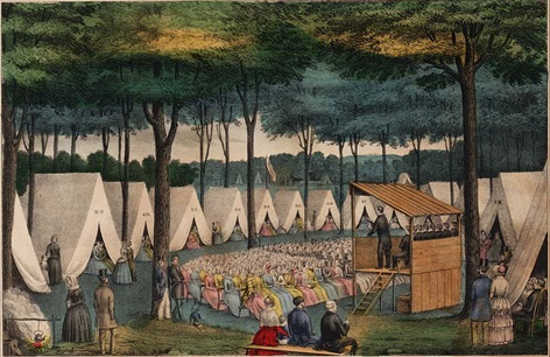
A tent revival during the Second Great Awakening. Public domain image. The Great Awakening
By the 1730s most American colonists identified with some branch of Protestantism – Calvinist, Congregationalist (former Puritans), Anglican take your pick.
Although adamantly separated from the Catholic Church, these branches still clung to the same pomp and ritual that characterized Catholic worship.
Sure, among the Protestants, the power to commune with God now lay with the individual, rather than an intermediary like a priest, but this was largely a theological distinction.
For the average congregant, worshipping in a Protestant church in 1730s America had all the emotional and religious intimacy as a court proceeding has today.
To rescue the individual from the hoary traditions of religion and bring a sense of personal guilt and need for salvation through Christ – these would be the goals of what would become known as the First Great Awakening.
Leading this crusade were protestant ministers like Solomon Stoddard and George Whitefield, men whose dynamic and impassioned styles of preaching ignited the fear and love of God in all who listened.
For the next decade and a half, wandering preachers in the Stoddard-Whitefield vein blazed holy trails through Europe and England. When they reached the American wilderness, they evangelized Indian, colonist and slave alike.
The fiery blast of religious fervor that announced the awakening’s arrival gave way to a slow simmer that lasted for the rest of the century.
The Second Great Awakening
With the creation of America following the Revolution came a clear separation of religion from the affairs of state.
This decisive delineation between earthly and heavenly powers had the effect of splitting adherents’ loyalties; on the one hand lay God and spiritual devotion and on the other money, earthly goods and social success. Some Americans, especially the educated elite, compromised between the two and argued that leading a moral life on earth, not church attendance, guaranteed salvation in the hereafter.
Meanwhile, population in the new country reached epic proportions, rising from one million in 1750 to nearly four million in 1790. These new people stretched the limits of the original 13 colonies and began the era of western migration that would characterize American life in the 19th century.
Amid this crisis of faith and demographic shift, the embers of the First Great Awakening glowed red, found fresh fuel and on this day in 1801 roared to life under the canvas tents dotting the fields of Cane Ridge, Kentucky.
The Second Great Awakening began just as furiously as the first, but spread farther afield. From the muggy magnolia groves of Georgia to the thickets of Kentucky poplar, revival tents rang with the voices of the saved. American Protestants exulted in their newfound faith, revived and reinvigorated with the knowledge of their dependence on God.
This first, massive revival event in Kentucky in 1801 attracted an estimated 20,000 men, women and children. At the pulpit stood seven or more ministers at once, preaching simultaneously to the seething crowds of worshippers. Those who experienced this unique, emotionally-charged form of worship would never forget it.
This new wave of religiosity in America had more staying power than the first, and carried the nation through half of the 19th century.
Membership to Methodist, Baptist and other evangelical churches rose steadily, looking to outpace the staid Congregationalists of the previous century in no time.
Antone Pierucci is a Sacramento-based public historian and a freelance writer whose work has been featured in such magazines as Archaeology and Wild West as well as regional California newspapers.
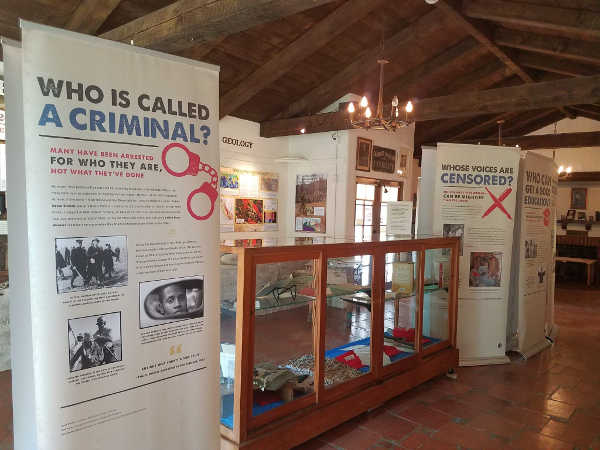
MIDDLETOWN, Calif. – The C. Gibson Museum and Cultural Center is hosting a traveling exhibit, “Wherever There's A Fight: A History of Civil Liberties in California.”
The exhibit, which continues through Sept. 16, was sponsored and brought to Lake County by the Friends of the Gibson Museum.
This exhibit covers the history and evolution of civil liberties and civil rights in California as part of the democratic process and covers the topics such as citizenship, slavery, voting, unlawful arrests and education.
It complements the Historic Courthouse Museum's newest exhibit, “Political Citizens,” offering a broader scope and perspective of Californian civil liberties.
“Wherever There's A Fight: A History of Civil Liberties in California” is part of Cal Humanities' Searching for Democracy initiative designed to examine the meaning of democracy today, as a partner to the National Endowment for the Humanities.
The exhibit will be available for viewing over six weeks and will be open to the public during the "First Fridays in Middletown."
The Gibson Museum’s hours are noon to 4 p.m., Thursday through Saturday.
For more information, contact the museum at 707-809-8009.
“Wherever There's A Fight: A History of Civil Liberties in California” covers the history and evolution of civil liberties and civil rights in California. Photo courtesy of Curator Whitney Petrey.
LAKE COUNTY, Calif. – Lake County's heyday of hot springs resorts occurred between 1875 and 1920. Some resorts were well-known prior to that, however.
Our county's hot springs history is remarkable and diverse. Back then, folks from the cities and countryside would flock to Lake County to soak and swim in the many and assorted spring waters that ran from hot to cold.
Many of the precious waters were bottled for consumption and boasted healing cures for whatever ailed one.
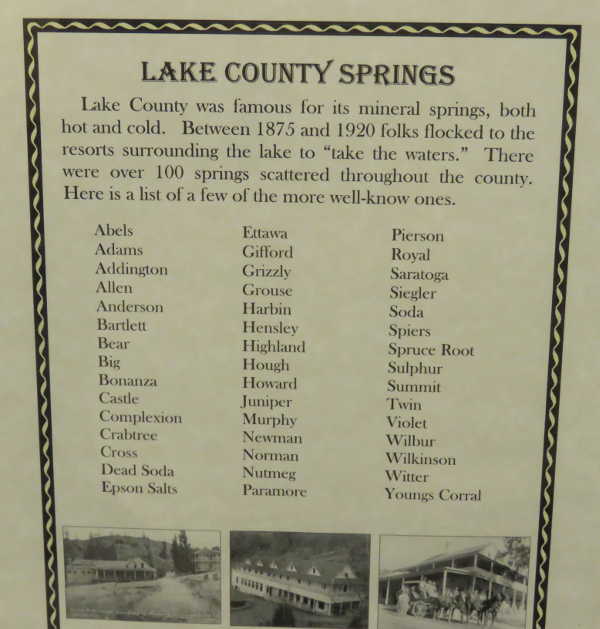
Lake County's spring waters or resorts numbered in excess of 100. They included Allen, Bear, Grizzly, Harbin, Royal, Siegler, Wilbur and many more.
California Indians took advantage of the many hot springs in what is now Lake County when the springs were used as gathering places and spiritual oases for centuries, long before the Euro-Americans “discovered” them.
Lake County's hot springs originated due to an intense heat deep below the earth's surface.
Layers of rock heat up which are situated above the molten rock. The magma is thought to be located about 4 miles beneath the earth at The Geysers, which is now known as the largest geothermal field in the world.
Since the rock is layered with fractures, water is heated naturally, creating hot springs and fumaroles across the land.
The book, "History of Lake County 1881" states:
"The springs of Lake County are a marvel, and to write of their beauty and usefulness would require the pen of a poet. They may be divided into three general classes, as follows: Pure cold water, cold mineral water, and thermal mineral water. Of the first there are thousands and thousands; every hill and mountain side teem with them, and the weary traveler and his thirsty beast find streams of pure water, cool and fresh, gushing from the wayside banks, and gathered into troughs for his convenience. The flow of these springs vary from a few gallons a day to barrels per minute. The largest flow, perhaps, in the county, is from the Howitzer Spring, the stream from which crosses the road a short distance north of the toll-house on Cobb Mountain. The amount of water which comes pouring forth from this place is something wonderful to contemplate, and, what is more strange, the yield seems to be always the same; winter's flood nor summer's drouth seem to have no appreciable effect upon it."
Anderson Springs was a popular destination for work-weary vacationers.
Anderson Springs began operation in 1873. There were accommodations for 30 at the hotel, and there were also bathhouses which utilized the nearby hot springs. One could also take a steam bath on the creek's hot spring.
Some of the springs at Anderson Springs were hot and some cold, with a total of nine different springs.The minerals which could be enjoyed included iron, magnesia, sulfur and combinations thereof.
Anderson Springs advertised, " No fog. No harsh winds. Sparkling trout stream bordered by trees. Ferns and flowers. Lovely wooded trails. Grand mountain scenery."
Harbin Hot Springs has a long resort history since it was settled by James Madison Harbin. In 1866, soon after his arrival, it became a destination resort.
It was a common site for travelers to pull in by stagecoach, having endured a nine-hour hour journey from San Francisco.
Besides “taking the waters,” guests had the option to play games such like croquet or bocce ball.
It was not uncommon for famous folks like heavyweight champion Jim Jeffries to train at Harbin in the early 1900s.
Another popular hot springs resort was Howard Hot Springs. They were located farther up Big Canyon Road, outside of Middletown, past the road from Harbin Hot Springs.
Their brochure boasted, "The door to health. We are sure that one visit is enough to convince you on your future vacations. Ask your doctor."
After World War I, when the Model T Ford car began to pop up across the country, the hot springs resort industry in Lake County declined. Then, folks chose to vacation where the highways led them.
Since Lake County was far off the beaten path, the numbers of hot springs resort vacationers diminished almost to the point of no return.
Kathleen Scavone, M.A., is a retired educator, potter, writer and author of “Anderson Marsh State Historic Park: A Walking History, Prehistory, Flora, and Fauna Tour of a California State Park” and “Native Americans of Lake County.” She also formerly wrote for NASA and JPL as one of their “Solar System Ambassadors.” She was selected “Lake County Teacher of the Year, 1998-99” by the Lake County Office of Education, and chosen as one of 10 state finalists the same year by the California Department of Education.
A short list of the hot springs of Lake County, Calif. Photo by Kathleen Scavone.
 How to resolve AdBlock issue?