LAKE COUNTY, Calif. – There are five dogs waiting for new homes this week at Lake County Animal Care and Control, including one that likes to give hugs.
This week’s available dogs include mixes of border collie, hound, Labrador Retriever, pit bull, shepherd and terrier.
Dogs that are adopted from Lake County Animal Care and Control are either neutered or spayed, microchipped and, if old enough, given a rabies shot and county license before being released to their new owner. License fees do not apply to residents of the cities of Lakeport or Clearlake.
If you're looking for a new companion, visit the shelter. There are many great pets hoping you'll choose them.
The following dogs at the Lake County Animal Care and Control shelter have been cleared for adoption (additional dogs on the animal control Web site not listed are still “on hold”).
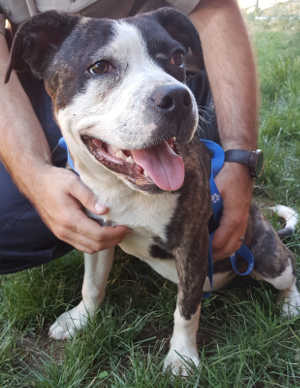
This female terrier is in kennel No. 10, ID No. 8151. Photo courtesy of Lake County Animal Care and Control. Terrier mix
This female terrier has a short brindle coat with white markings.
She’s in kennel No. 10, ID No. 8151.
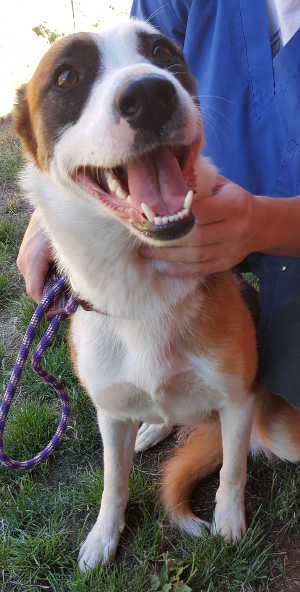
This female border collie mix is in kennel No. 12, ID No. 8091. Photo courtesy of Lake County Animal Care and Control. Female border collie mix
This female border collie mix has a medium-length tricolor coat.
Shelter staff said she loves to give hugs.
She’s in kennel No. 12, ID No. 8091.
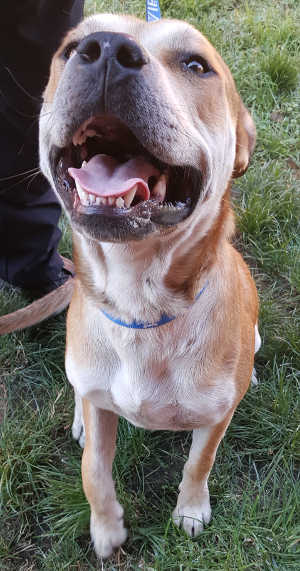
This male hound-shepherd mix is in kennel No. 17, ID No. 8142. Photo courtesy of Lake County Animal Care and Control. Hound-shepherd mix
This male hound-shepherd mix has a short tan and white coat.
He’s in kennel No. 17, ID No. 8142.
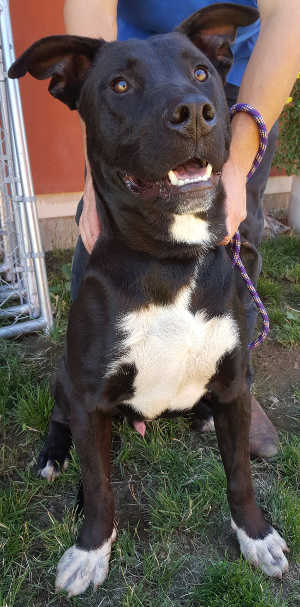
This male Labrador Retriever-pit bull terrier mix is in kennel No. 18, ID No. 8089. Photo courtesy of Lake County Animal Care and Control. Labrador Retriever-pit bull terrier
This male Labrador Retriever-pit bull terrier mix has a short black coat with white markings.
He’s in kennel No. 18, ID No. 8089.
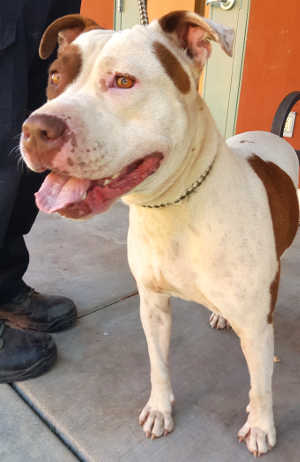
This female pit bull terrier is in kennel No. 21, ID No. 8097. Photo courtesy of Lake County Animal Care and Control. Female pit bull terrier
This female pit bull terrier has a short white coat with red markings.
She’s in kennel No. 21, ID No. 8097.
Lake County Animal Care and Control is located at 4949 Helbush in Lakeport, next to the Hill Road Correctional Facility.
Office hours are Monday through Friday, 11 a.m. to 5 p.m., and 11 a.m. to 3 p.m., Saturday. The shelter is open from 11 a.m. to 4 p.m. Monday through Friday and on Saturday from 11 a.m. to 3 p.m.
For more information call Lake County Animal Care and Control at 707-263-0278.
Email Elizabeth Larson at This email address is being protected from spambots. You need JavaScript enabled to view it.. Follow her on Twitter, @ERLarson, or Lake County News, @LakeCoNews.
Humanity’s farthest and longest-lived spacecraft, Voyager 1 and 2, achieve 40 years of operation and exploration this August and September.
Despite their vast distance, they continue to communicate with NASA daily, still probing the final frontier.
Their story has not only impacted generations of current and future scientists and engineers, but also Earth’s culture, including film, art and music.
Each spacecraft carries a Golden Record of Earth sounds, pictures and messages. Since the spacecraft could last billions of years, these circular time capsules could one day be the only traces of human civilization.
“I believe that few missions can ever match the achievements of the Voyager spacecraft during their four decades of exploration,” said Thomas Zurbuchen, associate administrator for NASA’s Science Mission Directorate, or SMD, at NASA Headquarters. “They have educated us to the unknown wonders of the universe and truly inspired humanity to continue to explore our solar system and beyond.”
The Voyagers have set numerous records in their unparalleled journeys.
In 2012, Voyager 1, which launched on Sept. 5, 1977, became the only spacecraft to have entered interstellar space.
Voyager 2, launched on Aug. 20, 1977, is the only spacecraft to have flown by all four outer planets – Jupiter, Saturn, Uranus and Neptune.
Their numerous planetary encounters include discovering the first active volcanoes beyond Earth, on Jupiter’s moon Io; hints of a subsurface ocean on Jupiter’s moon Europa; the most Earth-like atmosphere in the solar system, on Saturn’s moon Titan; the jumbled-up, icy moon Miranda at Uranus; and icy-cold geysers on Neptune's moon Triton.
Though the spacecraft have left the planets far behind – and neither will come remotely close to another star for 40,000 years – the two probes still send back observations about conditions where our Sun's influence diminishes and interstellar space begins.
Voyager 1, now almost 13 billion miles from Earth, travels through interstellar space northward out of the plane of the planets.
The probe has informed researchers that cosmic rays, atomic nuclei accelerated to nearly the speed of light, are as much as four times more abundant in interstellar space than in the vicinity of Earth.
This means the heliosphere, the bubble-like volume containing our solar system's planets and solar wind, effectively acts as a radiation shield for the planets. Voyager 1 also hinted that the magnetic field of the local interstellar medium is wrapped around the heliosphere.
Voyager 2, now almost 11 billion miles from Earth, travels south and is expected to enter interstellar space in the next few years.
The different locations of the two Voyagers allow scientists to compare right now two regions of space where the heliosphere interacts with the surrounding interstellar medium using instruments that measure charged particles, magnetic fields, low-frequency radio waves and solar wind plasma.
Once Voyager 2 crosses into the interstellar medium, they will also be able to sample the medium from two different locations simultaneously.
"None of us knew, when we launched 40 years ago, that anything would still be working, and continuing on this pioneering journey," said Ed Stone, Voyager project scientist based at Caltech in Pasadena, California. "The most exciting thing they find in the next five years is likely to be something that we didn't know was out there to be discovered."
The twin Voyagers have been cosmic overachievers, thanks to the foresight of mission designers.
By preparing for the radiation environment at Jupiter, the harshest of all planets in our solar system, the spacecraft were well equipped for their subsequent journeys.
Both Voyagers are equipped with long-lasting power supplies, as well as redundant systems that allow the spacecraft to switch to backup systems autonomously when necessary.
Each Voyager carries three radioisotope thermoelectric generators, devices that use the heat energy generated from the decay of plutonium-238 – only half of it will be gone after 88 years.
Space is almost empty, so the Voyagers are not at a significant level of risk of bombardment by large objects.
However, Voyager 1's interstellar space environment is not a complete void. It’s filled with clouds of dilute material remaining from stars that exploded as supernovae millions of years ago. This material doesn't pose a danger to the spacecraft, but is a key part of the environment that the Voyager mission is helping scientists study and characterize.
Because the Voyagers' power decreases by four watts per year, engineers are learning how to operate the spacecraft under ever-tighter power constraints. And to maximize the Voyagers' life spans, they also have to consult documents written decades earlier describing commands and software, in addition to the expertise of former Voyager engineers.
"The technology is many generations old, and it takes someone with 1970s design experience to understand how the spacecraft operate and what updates can be made to permit them to continue operating today and into the future," said Suzanne Dodd, Voyager project manager based at NASA's Jet Propulsion Laboratory, or JPL, in Pasadena, Calif.
Team members estimate they will have to turn off the last science instrument by 2030. However, even after the spacecraft go silent, they’ll continue on their trajectories at their present speed of more than 30,000 miles per hour, completing an orbit within the Milky Way every 225 million years.
The Voyager spacecraft were built by JPL, which continues to operate both. The Voyager missions are part of the NASA Heliophysics System Observatory, sponsored by the Heliophysics Division of SMD.
CLEARLAKE, Calif. – A man authorities say was responsible for the Thursday night shooting of a woman in Clearlake has been taken into custody in Southern California.
Marco Murillo, 22, was arrested Friday in Los Angeles County for the shooting, according to Det. Ryan Peterson of the Clearlake Police Department.
Police officers responded at 10:45 p.m. Thursday to the 15600 block of Sharpe Drive for an activated residential motion alarm, finding a 48-year-old female gunshot victim alone inside the residence when they arrived, Peterson said.
The Clearlake Police Department’s Investigation Unit was called in and took over the investigation. When the victim spoke with investigators, Peterson said she identified a person she only knew as “Marco” as the person who had shot her.
Peterson said detectives found that the victim’s 2003 Toyota Camry had been taken along with other personal belongings following the shooting.
He said a photograph of the person the victim knew as “Marco” was provided to detectives. That led to Murillo being identified as the suspect in this case.
The Lake County Superior Court subsequently issued a $3 million arrest warrant for Murillo’s arrest on charges of attempted murder, robbery, burglary, assault with firearm and vehicle theft, along with numerous special allegations, according to Peterson.
During the course of the investigation, Peterson said it was discovered that Murillo had fled to the city of La Puente in Los Angeles County.
He said the Clearlake Police Department contacted the Los Angeles County Sheriff Office Industry Station and notified them of Murillo’s possible whereabouts.
Deputies in Los Angeles County located the shooting victim’s stolen 2003 Toyota Camry a short time later, Peterson said.
Peterson said Los Angeles County Sheriff’s Office deputies conducted a stakeout of the area, spotted Murillo and took him into custody at about 2 p.m. Friday
When Murillo was arrested, he was discovered to be in possession of a handgun that is believed to be the weapon used to shoot the victim. Peterson said Murillo also had in his possession numerous other items believed to have been stolen from the victim’s residence.
Murillo is currently being held in Los Angeles County on the $3 million warrant pending further judicial hearings to bring him back to Lake County, Peterson said.
Peterson said no other details about the case are being released at this time in an effort to not hinder the investigation.
Anyone with information about the shooting is asked to contact Peterson at 707-994-8251, Extension 320.
LAKE COUNTY, Calif. – Friends are remembering the life and work of one of Lake County’s great artistic voices.
Sandra Wade, Lake County’s poet laureate from 2006 to 2008, died July 18 in Hailsham, East Sussex, England, where she had lived since leaving Lake County in 2014.
Wade was born in Hertfordshire, England, in 1944. In February 1970 she came to Lake County.
“Flew to California, thinking it would be for one year, and ended up living there for 40 years or so!” she wrote on her Facebook page.
Wade helped establish the Lake County Arts Council in the early 1980s, served as president of the Lake County Writer’s Guild, and also would be a part of the creation of the community radio station KPFZ 88.1 FM, where she hosted the weekly literature program “Accent on Words.”
She worked as a massage therapist and yoga teacher, and became well-known for her poetry.
Casey Carney, Lake County poet laureate for 2014 to 2016, described Wade’s poetry as “ranging from the elegiac to the political, and from the spiritual to the nuts and bolts of living.”
Carolyn Wing Greenlee, another Lake County poet laureate from 2004 to 2006 and a friend of Wade’s, said Wade began working in poetry long before she became the laureate.
“At the Lake County Fair, she established the Danish system of judging in which there was no lone first place,” Greenlee said. “All pieces that reached a certain level of excellence received a blue ribbon. It was an effective way to build the confidence of aspiring poets in our area. In the early ’80s, I was one of those.”
Greenlee said Wade also was a regular at the monthly Writers Circle she hosted at the Lake County Arts Council, later taking over the responsibility and hosting numerous workshops for both poetry and prose.
Wade was named Lake County’s fourth poet laureate in 2006, a post she held for two years.
Greenlee said she remembered Wade’s oral interview when she was being considered for the Lake County poet laureate post.
She said she and the other previous poets laureate – Jim Lyle and James Blue Wolf – questioned each candidate then listened to them read.
“The poets were strong writers with interesting proposed ways of encouraging poetry in Lake County, but that voice, that perfect pitch in both her poems and her reading, knocked us off our chairs. It was unanimous: Sandra Wade would be No. 4,” Greenlee said.
In her role as poet laureate, Wade spearheaded the introduction of the Poetry Out Loud program in Lake County’s high schools and attended poets laureate gatherings across the nation.
She also kept busy with writing poetry, such as the short work, “Hope,” written during her tenure:
“Hope rose bursting up out of the earth as a horse that lifts its head snorting from the great velvet nostrils submerged to take long draughts - the muzzle streaming now with water lifted up to air and light”.
“It’s her voice I remember most easily, and her bright eyes and silver hair. I can still hear the precise diction and soft sound,” said Greenlee. “Even when the words of a poem might be strong and acerbic, it still came in that gentle elegance and sturdy intelligence.”
In 2014, after 44 years of living in Lake County, Wade returned to her native England, where she continued her involvement in the arts community.
She joined the committee for the annual Hailsham Festival of Arts and Culture. There, she introduced that community’s first-ever poetry contest, just as she had done in Lake County.
Wade’s life, poetry and contributions to Lake County will be remembered from 4 to 5 p.m. Saturday during the “Wordweavers” radio program, hosted by Lourdes Thuesen on KPFZ 88.1 FM.
Thuesen said they will read and play recordings of some of Wade’s work, and share stories about her during the show.
Those wanting to share reminiscences about Wade are invited to call in during the program at 707-263-3435 or stop by the station at 149 N. Main St. in Lakeport.
“Sandra’s literary legacy, born of her zeal to encourage artistic expression, has influenced generations with the healing that comes from sharing with supportive community words offered with authenticity and no guile,” said Greenlee. “It was who she was, and we who knew her carry it in our own works and hearts always.”
Email Elizabeth Larson at This email address is being protected from spambots. You need JavaScript enabled to view it.. Follow her on Twitter, @ERLarson, or Lake County News, @LakeCoNews.
KELSEYVILLE, Calif. – The Kelseyville Pear Festival Committee is well under way with its preparations for the 25th annual Pear Festival, scheduled for Saturday, Sept. 30.
The festival originally started with a handful of vendors, a barbecue and a scarecrow contest.
Today it is attended annually by 10,000 to 12,000 people and hosts musicians and dancers, more than 100 craft and food vendors, an old-fashioned Main Street parade and fly over, a Lake County wine tent, pear pavilion, horse faire and a kid’s town recreational area.
Also featured are agricultural, historical and art displays throughout the town.
New this year is a Farm to Fork Kickoff Dinner served down the Main Street of Kelseyville on Friday, Sept. 29.
The dinner will be followed by a street dance featuring music by the Funky Dozen.
Local catering company, Rosey Cooks, will be preparing a three-course meal served family style, featuring the freshest of local ingredients. Local wine and beer will be offered at a nominal price.
Tickets for the Farm to Fork Dinner and Street Dance are $65 and can be purchased at www.eventbrite.com or from Oak Boutique located on Main Street in Kelseyville.
Additional information is available at pearfestival.com or by calling the Kelseyville Pear Festival office at 707-413-3503.
What are the primary differences between a will and a living trust (“trust”)?
Some primary differences are whether a probate will be necessary; the costs and fees involved; the kind of assets and legal affairs to be managed; and when the document takes effect.
A will is a “legal instrument” used to name an executor of your estate and to gift assets.
A will controls so-called probate assets – such as real property, personal property, and financial accounts – if they are held in the deceased person’s name.
It does not control any assets which pass automatically to designated death beneficiaries under insurance and retirement accounts, to assets that pass to surviving joint tenants or to assets held in trust.
In California, a will involves a court supervised probate when the gross value of the decedent’s estate is at or above $150,000. Debts are not subtracted when valuing the estate.
Since Jan. 1, 2017, only estates that are subject to probate are also subject to Medi-Cal estate recovery when a Medi-Cal recipient dies without a surviving spouse.
Probate begins with a petition for probate to admit the will and to appoint the personal representative. Typically, the person nominated in the will as the executor becomes the personal representative.
The probate requires the preparation of an inventory and appraisal of assets, the notification of creditors, the payment of all taxes, and the settling of creditor claims.
Probate ends with a petition to distribute assets to the beneficiaries pursuant to the terms of the will.
Once probate commences, the court appointed personal representative safeguards and inventories assets, notifies creditors, files tax returns and pays taxes, handles any unfinished legal matters, and ultimately distributes what remains to the decedent’s named beneficiaries according to the written terms of the will.
Probate takes five to six months at a minimum (usually longer) and may take much more if there are complications (e.g., creditor disputes, controversy over the terms of the Will, and valuation issues, etc.).
Executors and their attorney receive a percentage of the estate and sometimes more if extraordinary services are involved.
Next, let’s examine the trust.
A trust is a contract between the “settlor” (the person who creates – establishes – the trust) and the “trustee,” the person who agrees to hold certain property “in trust” for the benefit of “beneficiaries” according to the terms of the trust.
A trust controls those assets that are legally transferred (retitled) from the settlor to the trustee (such as one’s home and investment accounts).
Unlike the will, the trust commences once funded. When the settlor is disabled, resigns or dies, a new trustee (nominated in the trust) takes over, manages the trust assets, and administers the trust according to its terms.
Assets in a trust avoid probate at death and avoid conservatorships of the estate during disability.
A trustee still has to do most of the same tasks as inside a probate. However, it is usually more expensive, time consuming and aggravating to probate a decedent’s estate than to administer a decedent’s trust estate. That is why most people prefer the living trust.
So, when would you want a will versus a trust? Very simply put, a will is better for anyone with under $150,000 in probate assets.
With small estates, tangible personal property, financial assets and mobile homes can be transferred by way of the “affidavit procedure” (without court).
Above $150,000 a trust is usually preferred, as settling trust estates are usually less expensive and time- consuming than probate.
Nevertheless, everyone should still have a will. There are always assets held outside of a trust to which the will applies. That includes any bank accounts, vehicles and those assets which were not put in the trust.
Typically a person who has a trust uses their will to transfer these assets into their trust – hence the term “pour over will.”
Not everything is handled through the trust. Estate planning also requires powers of attorney to control financial, legal, and property affairs outside of what is held in one’s trust and an advance health care directive to handle health issues.
Dennis A. Fordham, attorney, is a State Bar-Certified Specialist in estate planning, probate and trust law. His office is at 870 S. Main St., Lakeport, Calif. He can be reached at This email address is being protected from spambots. You need JavaScript enabled to view it. and 707-263-3235. His Web site is www.DennisFordhamLaw.com.
 How to resolve AdBlock issue?