MIDDLETOWN, Calif. – The Middletown Area Town Hall hosted a visit with Congressman Mike Thompson at its Thursday night meeting.
With Congress in recess for the summer, Thompson is back in his Fifth Congressional District – which includes the southern half of Lake County, as well as all or part of Contra Costa, Napa, Solano and Sonoma counties – for a district work period.
As part of his time back home, Thompson is holding public meetings, and he said that in recent months he’s held more public meetings than ever before.
In the past, he held town halls but quit doing them because very few people would show up. Then he switched to telephonic town halls, which at first attracted tens of thousands of people before attendance for those also started to taper off.
However, since the November presidential election, Thompson said people are more engaged than ever, and he’s once again started holding town halls that attract hundreds of people at each event.
He’s also started holding coffee klatsch-style events, such as one he held in Lakeport earlier that same day that he told Lake County News drew about 50 people.
During his Thursday night update, Thompson touched on some of the big news from Washington, DC, including the failure of the recent effort to repeal the Affordable Care Act, which Thompson doubts is over.
That’s because President Trump continues to want the bill repealed, despite the fact that poll numbers show that people across the country don’t agree with him, Thompson said.
Thompson said Congress needs to figure out how both sides can come together to expand the ACA to better serve everyone.
Beyond the ACA, the focus is now shifting to tax reform, Thompson said.
He said there is bipartisan agreement on the need to reform the tax code, but he cautioned that there is a “stark difference” between a tax reform and a tax cut. Thompson said he won’t vote for a tax cut that’s not paid for or that hurts the middle class.
For this session of Congress, Thompson noted, “There's very little runway left to do any major policy.” That, he said, raises concern that there may be an effort to push through a combination of infrastructure and tax reform legislation that actually is a tax cut that could be disastrous.
Thompson then switched to the dilemma of escalating tensions with North Korea.
“I think it's serious. I'm concerned about it,” he said, noting there are many allies and US citizens in that region.
He said the country’s leaders need to be working overtime to talk people back from the brink, rather than taking part in the kind of rhetoric coming from the White House, which he said bothers him.
Thompson said of Kim Jong-un, North Korea’s leader, “He's a lot of things but I'm pretty sure he's not suicidal,” noting his affinity for good Cabernet and bourbon, the fact that he owns his own his private circus and enjoys hanging out with former basketball player Dennis Rodman.
If North Korea were to launch a first strike, the country and its leader would be annihilated, said Thompson, who is concerned that Kim will become fearful than the US will launch a first strike and decide to act first, taking people with him.
Thompson also pointed out that the US currently has no ambassadors for South Korea or Japan, and that’s important because the diplomats do the day-to-day work.
On Thursday night Thompson also touched upon his effort to reduce gun violence as part of his work as chair of the Gun Violence Prevention Task Force for the last four and a half years.
He said he believes expanded background checks nationwide will help keep guns out of the hands of criminals and dangerously mentally ill people who shouldn’t have them in the first place.
Background checks, he said, won’t solve all the problems but he thinks they should be the federal government’s first line of defense.
He said he’s particularly concerned about a strong push for two bills in Congress that he thinks are harmful to law enforcement and public safety.
One would allow anyone with a concealed weapon permit to carry in all states. Thompson favors systems like California’s, which allows local sheriffs or chiefs of police to issue them, whereas in some places all that’s required is a call-in system.
The second bill of concern would allow for over-the-counter sales of silencers, which don’t silence the shot, only disperse it. That makes it harder for law enforcement to pinpoint the location of shots, he said.
Overall, “The district's looking good,” said Thompson, who has been from one end of the five-county area to the other over the last few weeks.
“What I’ve seen in the district is heartening,” with people working hard, plugged in, and involved in their communities and future, he said.
During a question-and-answer period with community members, Thompson answered a variety of queries about involvement, health care, redistricting and immigration reform, with Thompson noting on the latter topic that he has received indications that a bill he’s introduced isn’t going to be granted a hearing this session.
He was also asked if he supports universal health care. Thompson received applause when he said he would like to see some form of single payer, and added that he hears from more and more doctors who would like to not have to argue with insurance companies.
“It’s not something that is pie in the sky,” he said of single payer.
Thompson also said he’s not afraid of “socialized medicine,” explaining that it treated him well when he was a wounded soldier during Vietnam. He said he also has friends in Canada, and he’s never heard stories about long lines for medical care from a Canadian.
However, such major changes in health care won’t happen overnight, he said.
He said the country needs to keep the ACA and fix it to make it better and more affordable for everyone. He’s also in favor of putting the public option back into the ACA and is the coauthor of legislation to expand access to Medicare to people over age 50
During the discussion, Thompson emphasized that he’ll fight to the mat anyone who wants to hurt his district.
Thompson emphasized that on key issues it’s important to reach out to fellow community members, write letters to the editor, and to call or write him, even if community members agree with his standpoint. Thompson said it’s good to know what people are thinking and that he has their support.
Visit Thompson’s Web site at https://mikethompson.house.gov/ to find out how to contact him about issues and access constituent services.
Email Elizabeth Larson at This email address is being protected from spambots. You need JavaScript enabled to view it.. Follow her on Twitter, @ERLarson, or Lake County News, @LakeCoNews.
The gold rush in the Klondike, not in California, is the focus of this week’s look at the past.
August 16, 1896
Gold! Gold! Gold in the Klondike!
All gold rushes start with that first, serendipitous discovery – the glitter of metal under the water, the tentative, outstretched hand against the cold nugget and the rise of excitement as the reality of the discovery takes hold.
In 1849, it was James Marshall along the American River. On this day in 1896, it was four would-be miners on the small tributary of the Yukon River called Rabbit Creek.
From the very beginning, the Klondike Gold Rush proved a different beast entirely from its California predecessor.
For starters, James Marshall hadn’t even been looking for gold on that cold winter morning in 1848 – he was building a sawmill. The same couldn’t be said for the northwest region of Canada, along the disputed border of Alaska, where gold was known to exist.
By 1896 an estimated 1,000 prospectors eagerly dug along the banks of the Yukon and its tributaries. Those who staked claims in the area during the 1870s and 1880s had little to show for their efforts. The gold they did uncover barely paid for the supplies needed to survive in the harsh climate.
That all changed when an American prospector named George Carmack, his wife Kate Carmack (whose native name was Shaaw Tláa), her brother Skookum Jim (Keish) and their nephew Dawson Charlie (Káa Goox) came across the sluggish waters of Rabbit Creek.
Posterity doesn’t recall which one of them made the discovery, but that first flash of gold in the river soon turned into a stream as the miners began digging and sluicing away. Nearby miners in the area who heard about the discovery made a beeline to the area began staking their own claims.
The region’s isolation, and the amount of snowfall during the winter of 1896, conspired to keep word of the discovery firmly within the confines of Yukon River basin—to the benefit of the few dozen prospectors who had already been working in the area.
The first shipments of gold entered the ports of Seattle and San Francisco in the Summer of 1897. They also brought with them the newly-minted millionaires who had made the discovery. The cat was out of the bag and the rush was on.
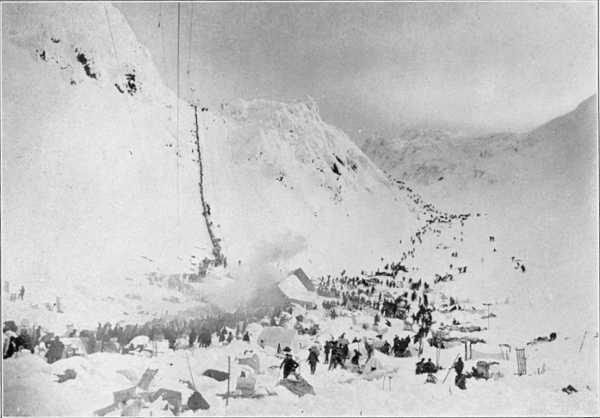
The Chilkoot Pass scales in 1898. Public domain photo.
Stampeders
In 1849, they were called Argonauts, a romantic allusion to the classical Greek myth of Jason and his team of adventurers who set out in search of the Golden Fleece.
But in 1896, they were called stampeders.
A half-century of civil war, economic depressions, two presidential assassinations and increased industrialization had stripped the veneer off the whole affair. By the time the Carmacks discovered the precious metal in Canada, North Americans had grown used to the boom and bust reality of gold rushes. Classical allusions were too pat, too inherently optimistic to describe the horde of people sweeping towards the northwest wilderness. A stampede indeed.
The siren call of wealth beyond imagining attracted a different class of people in 1896 than it had done in 1849.
The stampeders were largely single men, untethered to any one place – in this way at least, similar to those who went in search of California gold back in ‘49. The similarities end there, however.
By the end of the 19th century, the bulging urban centers of America had begun to birth a new class of men: factory workers. These perpetually underpaid men and women saw the news of gold to the north as nothing short of a godsend.
Those with little hope cleave that much more stubbornly to the faintest of hopes. The drive to strike it rich in the Klondike was appropriately likened to catching a disease. The name for this virulent strain? Klondicitis.
All that glitters
Within no time at all some 80,000 to 100,000 people infected with the fever set out for the Klondike. But where on earth was the Klondike?
In 1897 when the hordes of gold-seekers set out to the region, the Klondike wasn’t even yet a territory of Canada.
The primary towns of the region – if you could even call them by such a lofty name – were along the Yukon River and before the big discovery housed no more than a few thousand miners and natives.
For the stampeders eager for wealth, the path to the Klondike was along the Pacific coast by boat to one of the few coastal towns of Alaska.
From there, a tortuous hike over mountain passes brought them to Canada and the Yukon River. After a white-knuckled ride down the ice-choked river, the stampeders finally entered Dawson City, the new hub of the rush.
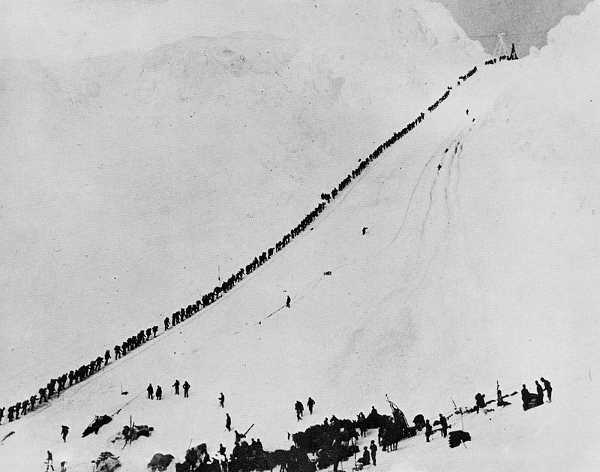
The most famous of the mountain passes that gold-seekers had to traverse was known as the Chilkoot Pass.
“Pass” is a bit too grandiose of a term for what essentially amounted to a small icy cleft in the coastal ranges that separated Alaska from Canada.
The first stampeders, led by native guides, cut steps into the ice-covered slopes leading up to the pass.
Eventually the installation of a length of rope for hauling oneself up each step made the climb marginally less deadly. At the top of the pass stood the Canadian Northwest Mounted Police, or NWMP, who acted as border patrol agents.
Canadians are nothing if not eminently practical and within a few days of the arrival of the first stampeders, the NWMP knew that these crazy Americans would get themselves killed in the Canadian wilderness of someone didn’t impose some order.
Therefore, NWMP ordered that entry into Canada would only be allowed to those stampeders who carried with them at least one-year’s supply of food and shelter.
So, in addition to pickaxes, gold pans, sluice boxes, hammers, nails, clothes and other knick-knacks for mining gold, the stampeders now had to carry what amounted to 1,000 pounds of provisions.
From the coastal Alaskan town of Dyea over Chilkoot Pass to the headwaters of the Yukon at Lake Bennett stretched a 33-mile long trail of overburdened, exhausted would-be gold miners. Each person’s nearly 2,000 pounds of supplies had to be hauled piecemeal, since the steep slopes leading to the pass made use of horses and mules nearly impossible. That didn’t stop some people from trying and today, Dead Horse Gulch stands as testament to their folly.
By the time the stampeders made it to the summit of the pass, the NWMP waited to charge an import fee for the very supplies they themselves had required each person entering Canada bring. Between just February and June of 1898, the Mounties collected $174,000 in duties, a sum that would today amount to about $4.9 million.
Between the cost of the required provisions, the duties charged by the Mounties, and the cost of a ticket aboard a steamship from Lake Bennett to Dawson City, most stampeders found themselves destitute at journey’s end. In fact, upwards of one-third of those who started out towards the Klondike turned back before arriving.
For those who stuck it out, their reward was sour. You see, by the time word had reached them in the summer of 1897, it was already too late, although it would take them the entire journey to figure it out.
By the time they arrived at the Klondike, those men and women who had risked life and limb at a chance to strike it rich found that most of the claims along the lode had been staked. Those that remained produced nothing. By the end of 1898 the rush was over.
Antone Pierucci is a Sacramento-based public historian and a freelance writer whose work has been featured in such magazines as Archaeology and Wild West as well as regional California newspapers.
"Happiness is a butterfly, which when pursued, is always just beyond your grasp, but which, if you will sit down quietly, may alight upon you."– Nathaniel Hawthorne
LAKE COUNTY, Calif. – Any place that you can think of is a potential home for an insect – in woods and water, at the desert and on a tropical island.
In North America alone there are around 100,000 species of insects. Mother Nature is fortunate to employ many birds and insects to aid in pollinating her plants.
Taking just a few minutes to observe a pollinator in action, one becomes compelled to watch and learn more about the lives of the little creatures.
Like bird-watching, observing pollinators such as butterflies and bees is fascinating fun. The many and varied insects and animals that pollinate plants are vital to both the ecosystems in which they reside and for all of humankind since they are essential in agriculture.
Pollinators, unfortunately, have been in crisis mode for at least a decade here in our country.
Beekeepers have noted major losses in hive production for a variety of reasons. Bees and other pollinators need plenty of blossoms, so you can aid them by planting a variety of blooms in succession so that there is almost always something blooming throughout the season.
Steer clear of harsh chemicals while gardening, and opt, instead, for an organic garden which employs companion planting.
Pollinators include wasps, ants, flies, hummingbirds, bats, moths and butterflies, to name a few. These useful critters budge pollen on flowers when they visit the plant for its pollen or nectar.
According to Birds and the Bees 101, pollen travels from the plant's male anther to the stigma, which is female, when fertilization of the ovules occurs.
Butterflies and moths, like bees, come in all shapes and sizes. One way butterflies can be distinguished from moths is through their antennae.
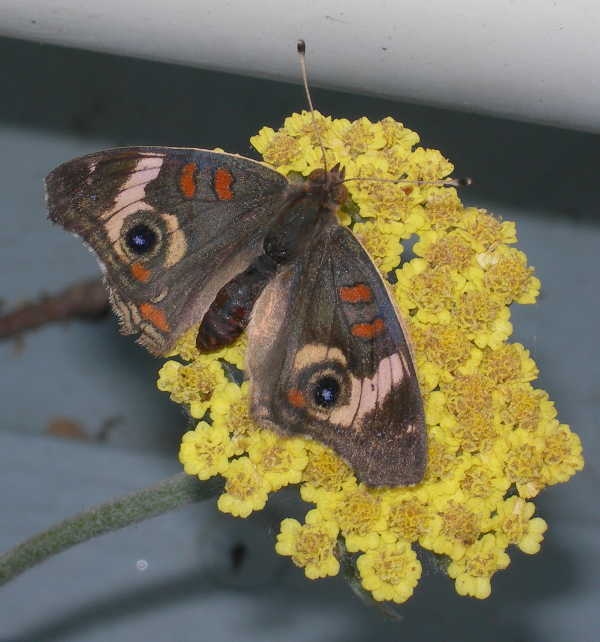
Another colorful pollinator. Photo by Kathleen Scavone.
While butterflies have a more simple-looking antennae structure, a moth's antennae are feathery in looks. Both creatures have scales all over their wings and bodies. Another distinguishing fact is that moths usually fly at night.
Mother Nature has many creative means of attracting pollinators. Pollinators are attracted to various color patterns in plants, their scents, and even a feature called a nectar guide which can be spotted via ultraviolet light.
Bees, among the most well-known of the pollinators, hold onto their cargo of pollen by their scopa, or the pollen-holders located on their hind legs.
Honey bees, as well as bumblebees have an enhanced version of the pollen-holder, known as its corbicula or pollen-basket.
These industrious creatures can also carry pollen because of a built-in electrostatic charge!
Kathleen Scavone, M.A., is a retired educator, potter, writer and author of “Anderson Marsh State Historic Park: A Walking History, Prehistory, Flora, and Fauna Tour of a California State Park” and “Native Americans of Lake County.” She also formerly wrote for NASA and JPL as one of their “Solar System Ambassadors.” She was selected “Lake County Teacher of the Year, 1998-99” by the Lake County Office of Education, and chosen as one of 10 state finalists the same year by the California Department of Education.
Another colorful pollinator. Photo by Kathleen Scavone.
NASA's Cassini spacecraft will enter new territory in its final mission phase, the Grand Finale, as it prepares to embark on a set of ultra-close passes through Saturn’s upper atmosphere with its final five orbits around the planet.
Cassini will make the first of these five passes over Saturn at 12:22 a.m. EDT Monday, Aug. 14 (9:22 p.m. Pacific Time Sunday, Aug. 13).
The spacecraft's point of closest approach to Saturn during these passes will be between about 1,010 and 1,060 miles above Saturn's cloud tops.
The spacecraft is expected to encounter atmosphere dense enough to require the use of its small rocket thrusters to maintain stability – conditions similar to those encountered during many of Cassini's close flybys of Saturn's moon Titan, which has its own dense atmosphere.
"Cassini's Titan flybys prepared us for these rapid passes through Saturn's upper atmosphere," said Earl Maize, Cassini project manager at NASA's Jet Propulsion Laboratory (JPL) in California. "Thanks to our past experience, the team is confident that we understand how the spacecraft will behave at the atmospheric densities our models predict."
Maize said the team will consider the Aug. 14 pass nominal if the thrusters operate between 10 and 60 percent of their capability. If the thrusters are forced to work harder – meaning the atmosphere is denser than models predict – engineers will increase the altitude of subsequent orbits. Referred to as a "pop-up maneuver,” thrusters will be used to raise the altitude of closest approach on the next passes, likely by about 120 miles.
If the pop-up maneuver is not needed, and the atmosphere is less dense than expected during the first three passes, engineers may alternately use the "pop-down" option to lower the closest approach altitude of the last two orbits, also likely by about 120 miles.
Doing so would enable Cassini's science instruments, especially the ion and neutral mass spectrometer (INMS), to obtain data on the atmosphere even closer to the planet's cloud tops.
"As it makes these five dips into Saturn, followed by its final plunge, Cassini will become the first Saturn atmospheric probe," said Linda Spilker, Cassini project scientist at JPL. "It's long been a goal in planetary exploration to send a dedicated probe into the atmosphere of Saturn, and we're laying the groundwork for future exploration with this first foray."
Other Cassini instruments will make detailed, high-resolution observations of Saturn's auroras, temperature, and the vortexes at the planet's poles. Its radar will peer deep into the atmosphere to reveal small-scale features as fine as 16 miles (25 kilometers) wide – nearly 100 times smaller than the spacecraft could observe prior to the Grand Finale.
On Sept. 11, a distant encounter with Titan will serve as a gravitational version of a large pop-down maneuver, slowing Cassini’s orbit around Saturn and bending its path slightly to send the spacecraft toward its Sept. 15 plunge into the planet.
During the half-orbit plunge, the plan is to have seven Cassini science instruments, including INMS, turned on and reporting measurements in near real time.
The spacecraft is expected to reach an altitude where atmospheric density is about twice what it encountered during its final five passes.
Once Cassini reaches that point, its thrusters will no longer be able to work against the push of Saturn’s atmosphere to keep the spacecraft's antenna pointed toward Earth, and contact will permanently be lost. The spacecraft will break up like a meteor moments later, ending its long and rewarding journey.
The Cassini-Huygens mission is a cooperative project of NASA, ESA and the Italian Space Agency. JPL manages the mission for NASA's Science Mission Directorate in Washington. JPL designed, developed and assembled the Cassini spacecraft.
LAKE COUNTY, Calif. – Lake County Animal Care and Control has a brand new group of dogs ready for new homes.
This week’s available dogs include mixes of Chihuahua, corgi, husky, shepherd and pit bull terrier.
Dogs that are adopted from Lake County Animal Care and Control are either neutered or spayed, microchipped and, if old enough, given a rabies shot and county license before being released to their new owner. License fees do not apply to residents of the cities of Lakeport or Clearlake.
If you're looking for a new companion, visit the shelter. There are many great pets hoping you'll choose them.
The following dogs at the Lake County Animal Care and Control shelter have been cleared for adoption (additional dogs on the animal control Web site not listed are still “on hold”).
This male Chihuahua is in kennel No. 2, ID No. 8233. Photo courtesy of Lake County Animal Care and Control. Male Chihuahua
This male Chihuahua has a short black and tan coat.
He’s in kennel No. 2, ID No. 8233.
This male shepherd-corgi mix is in kennel No. 7, ID No. 8198. Photo courtesy of Lake County Animal Care and Control. Shepherd-corgi mix
This male shepherd-corgi mix has a short black and tan coat.
He’s in kennel No. 7, ID No. 8198.
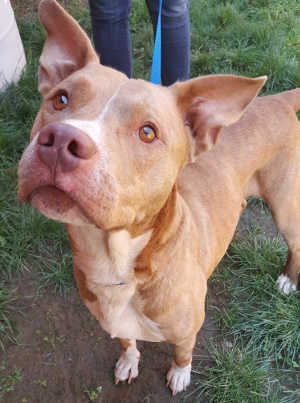
“Moose” is a male pit bull terrier mix in kennel No. 9, ID No. 8211. Photo courtesy of Lake County Animal Care and Control. ‘Moose’
“Moose” is a male pit bull terrier mix with a short red and white coat.
He’s in kennel No. 9, ID No. 8211.
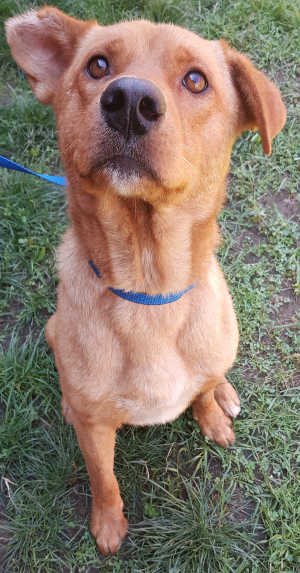
This male shepherd mix is in kennel No. 13, ID No. 8186. Photo courtesy of Lake County Animal Care and Control. Male shepherd mix
This male shepherd mix has a short red coat.
He’s in kennel No. 13, ID No. 8186.
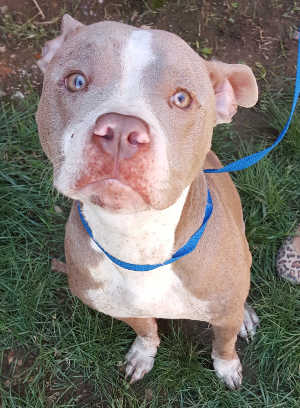
This young male pit bull terrier is in kennel No. 19, ID No. 8212. Photo courtesy of Lake County Animal Care and Control. Pit bull terrier
This young male pit bull terrier has a short blue and white coat.
He’s in kennel No. 19, ID No. 8212.
This female shepherd mix is in kennel No. 20, ID No. 8170. Photo courtesy of Lake County Animal Care and Control. Female shepherd mix
This female shepherd mix has a short black and tan coat.
She’s in kennel No. 20, ID No. 8170.
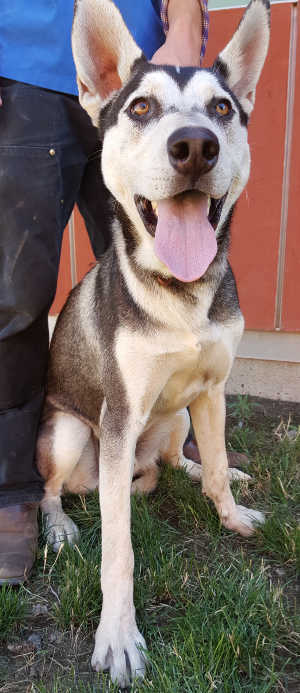
This male husky is in kennel No. 22, ID No. 8090. Photo courtesy of Lake County Animal Care and Control. Male husky
This male husky has a medium-length gray and white coat.
He’s in kennel No. 22, ID No. 8090.
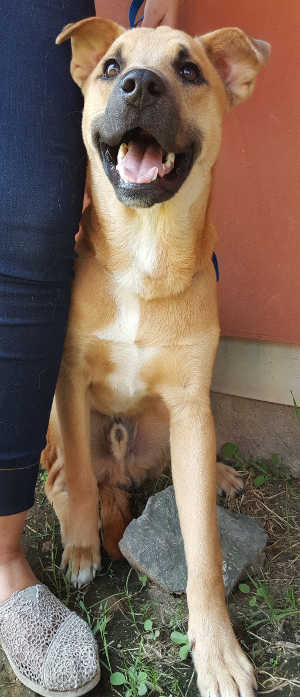
This young male shepherd mix is in kennel No. 29, ID No. 8229. Photo courtesy of Lake County Animal Care and Control. Shepherd mix
This young male shepherd mix has a short tan coat.
He’s in kennel No. 29, ID No. 8229.
Lake County Animal Care and Control is located at 4949 Helbush in Lakeport, next to the Hill Road Correctional Facility.
Office hours are Monday through Friday, 11 a.m. to 5 p.m., and 11 a.m. to 3 p.m., Saturday. The shelter is open from 11 a.m. to 4 p.m. Monday through Friday and on Saturday from 11 a.m. to 3 p.m.
For more information call Lake County Animal Care and Control at 707-263-0278.
Email Elizabeth Larson at This email address is being protected from spambots. You need JavaScript enabled to view it.. Follow her on Twitter, @ERLarson, or Lake County News, @LakeCoNews.
LAKE COUNTY, Calif. – A man who disappeared after falling into the lake on Friday afternoon has been found alive.
Sheriff Brian Martin said the man – whose name has so far not been released – was located in Lucerne early Saturday morning.
The search had begun on Friday afternoon after the man fell into the lake while riding a jet ski, Martin said.
Radio reports indicated that the REACH 6 helicopter participated in the search beginning shortly after 3:30 p.m.
The helicopter was asked to start around the middle of the lake and go toward the Clearlake Oaks area, according to radio traffic.
By Friday evening, the man hadn’t been located, with Martin explaining that the search area was very large.
The sheriff’s office was attempting to locate a forward looking infrared camera to use so the search could continue through the night. Otherwise, Martin said the search was to be suspended overnight and continue on Saturday morning.
Martin told Lake County News early on Saturday that the man was located at about 1 a.m. in Lucerne, where he swam to shore after going into the water.
The sheriff called the situation a “good case for wearing a life jacket.”
Email Elizabeth Larson at This email address is being protected from spambots. You need JavaScript enabled to view it.. Follow her on Twitter, @ERLarson, or Lake County News, @LakeCoNews.
 How to resolve AdBlock issue?