MIDDLETOWN, Calif. – On Friday Congressman Mike Thompson was in Middletown to meet with local students and hear their concerns about gun violence.
Thompson, who chairs the House Gun Violence Prevention Task Force, said he had received a letter from the south county students about their concerns and he had promised to stop in and visit with them the next time he was in town.
During his visit he fielded questions from students in different classes.
“The dominant question was school safety and gun violence prevention,” he said.
Thompson lauded the students for being articulate and intelligent.
In addition to answering their questions, he shared with them information about gun violence prevention measures in other communities and his experiences in meeting with the victims of last year’s deadly Las Vegas shooting.
Thompson’s visit came at the end of a busy week in which he was working to get background check bills through Congress.
Thompson’s visit with students can be seen in the video above.
Email Elizabeth Larson at This email address is being protected from spambots. You need JavaScript enabled to view it.. Follow her on Twitter, @ERLarson, or Lake County News, @LakeCoNews.
LAKEPORT, Calif. – The Board of Supervisors this week will take up new cannabis-related regulations and consider voting to move forward on a sales tax measure.
The board will meet beginning at 9 a.m. Tuesday, March 6, in the board chambers on the first floor of the Lake County Courthouse, 255 N. Forbes St., Lakeport.
The meeting can be watched live on Channel 8 and online at https://countyoflake.legistar.com/Calendar.aspx. Accompanying board documents, the agenda and archived board meeting videos also are available at that link.
At 10 a.m., the board will hold a public hearing to consider proposed amendments to Chapter 21, Article 27 of the Lake County Code to regulate the cultivation of cannabis.
At 10:30 a.m., the board will consider a resolution placing a 1.5-percent general transactions and use tax in the unincorporated area of the county on the June 5 ballot, as well as the accompanying ordinance to implement the tax if approved by voters and the tax measure document itself.
In other business, at 9:08 a.m. the board will present a proclamation designating the month of March 2018 as Meals on Wheels Month in Lake County and at 9:30 a.m. will give out the annual Employee Service Awards.
The full agenda follows.
CONSENT AGENDA
7.1: Adopt proclamation designating the month of March 2018 as Meals on Wheels Month in Lake County.
7.2: Approve letter of support for Lake Pillsbury Fire Protection District's request for grant funding from FEMA.
7.3: Approve letter of support for the Middletown Art Center's 2018 Local Impact Grant application and authorize the chair to sign.
7.4: Approve contract between the county of Lake and Sheila McCarthy, occupational therapist, registered for occupational therapy services in support of the California Children's Services Program and the Medical Therapy Unit.
7.5: Appoint Kim Tangermann, Lakeview Health Center director, to Serve on the Partnership HealthPlan Board of Commissioners and represent Lake County for a two-year period.
8.2, 9:08 a.m.: Presentation of proclamation designating the month of March 2018 as Meals on Wheels Month in Lake County.
8.3, 9:15 a.m.: Erratum, public hearing, consideration of a resolution imposing the county’s first, best, and final offer to Lake County Safety Employees Association. The correct title is: consideration of a resolution imposing the county’s last, best, and final offer to Lake County Employees Association. This matter will be continued to March 20 at 9:15 a.m. to allow for appropriate noticing.
8.4, 9:15 a.m.: Presentation of the annual syringe exchange program report by Denise Pomeroy, Health Services director.
8.5, 9:30 a.m.: Presentation of Employee Service Awards.
8.6, 10 a.m.: Public hearing, consideration of proposed amendments to Chapter 21, Article 27 of the Lake County Code to regulate the cultivation of cannabis.
8.7, 10:30 a.m.: Continued from Feb. 27, (a) consideration of an ordinance adding Article VII to Chapter 18 of the Lake County Code imposing a general transactions and use tax establishing a general tax of one and one-half percent in the unincorporated area of the county of Lake; (b) consideration of a tax measure, a transactions and use local revenue measure, for the June 5, 2018 General Election; and (c) consideration of a resolution placing the tax ordinance and the ballot measure statement on the June 5, 2018 election.
UNTIMED ITEMS
9.2: Sitting as Kelseyville County Waterworks District No. 3 Board of Directors, consideration of a resolution approving solar equipment finance agreement with TCF Equipment Finance in the amount of $951,800 and authorize Special Districts administrator to sign.
CLOSED SESSION
10.1: Public employee evaluations title: Registrar of Voters Diane Fridley, Water Resources Director Phil Moy.
10.2: Conference with legal counsel: Decision whether to Initiate Litigation Pursuant to Gov. Code sec. 54956.9(d)(4): One potential case.
Email Elizabeth Larson at This email address is being protected from spambots. You need JavaScript enabled to view it.. Follow her on Twitter, @ERLarson, or Lake County News, @LakeCoNews.
LAKEPORT, Calif. – The Lakeport City Council this week will pay tribute to community members who serve the city through participation in various bodies.
The council will meet at 5:30 p.m. Tuesday, March 6, in the council chambers at Lakeport City Hall, 225 Park St., for a reception with members of city committees and commissions before the regular meeting begins at 6 p.m.
During the meeting, Mayor Mireya Turner will read a proclamation honoring the city’s committee and commission members, and will present certificates of appreciation to outgoing committee and commission members.
In other business, the council will consider authorizing Police Chief Brad Rasmussen and Public Works Director Doug Grider to close portions of N. High Street, Lakeshore Boulevard, Giselman Street, Sayre Street and Lange Street, and also conduct traffic controls at other intersections along the route between the 1800 block of N. High Street and the Lakeport Unified campuses on Lange Street on the morning of May 9 during a walk and bike to school event.
Items on the consent agenda – items considered noncontroversial and usually accepted as a slate on one vote – are ordinances; minutes of the council’s regular meeting on Feb. 20 and the special meeting on Feb. 28; the Feb. 26 warrant register; adoption of the resolution approving a memorandum of understanding with the Lakeport Employees’ Association for the period of Jan. 1, 2018, through Dec. 31, 2020; adoption of a resolution approving the Compensation and Benefits Program for the City of Lakeport Confidential Employees for the period of March 1, 2018 through December 31, 2020; adoption of a resolution approving the Compensation and Benefits Program for the City of Lakeport Unrepresented Management Employees for the period of March 1, 2018 through June 30, 2020; approval Amendment No. 2 to agreement for services between the city of Lakeport and Margaret Silveira.
Email Elizabeth Larson at This email address is being protected from spambots. You need JavaScript enabled to view it.. Follow her on Twitter, @ERLarson, or Lake County News, @LakeCoNews.
CLEARLAKE, Calif. – Clearlake Animal Control has four dogs that need homes soon, as they’ve been waiting for weeks to find their new families.
The available dogs are Hutch, Jessie, Magnolia and Robbie.
To meet the animals, call Clearlake Animal Control at 707-994-8201 and speak to Marcia at Extension 103 or call Extension 118, 9 a.m. to 3 p.m. Monday through Thursday, or leave a message at any other time.
Below are this week's available pets.
“Hutch.” Courtesy photo. ‘Hutch’
Hutch is a calm shepherd mix estimated to be between 1 and 2 years old, with a short brown coat and weighing 55 pounds.
Shelter staff said he appears to be good with other dogs, and is attentive.
He walks great on leash but also likes to just chill on his bed.
“Jessie.” Courtesy photo. ‘Jessie’
“Jessie” is a small female shepherd mix, weighing about 20 pounds and estimated to be 4 months old.
She has a short tan coat with black and white markings.
Shelter staff said she is good with other dogs and with children.
Jessie is very spunky and on the go, and loves to play chase and zoom around. Staff said she is quickly learning to walk nicely on leash.
“Magnolia.” Courtesy photo. ‘Magnolia’
“Magnolia” has a short brown and white coat.
Shelter staff said she loves walks and commands you rub her belly. She wiggles over then flops over for the rubs.
She came in as a stray and is already spayed. Staff estimated she is around 2 years old and weighs about 60 pounds.
Magnolia is very social and friendly. She is fine with other dogs, and walks well on leash.
“Robbie.” Courtesy photo.
‘Robbie’
“Robbie” is a young and happy-go-lucky mix – possibly Labrador Retriever and Rottweiler.
Shelter staff said is he around a year and a half old and weighs 50 pounds.
He walks well on a leash, makes friends with other dogs, and is playful but not super active.
Robbie is vaccinated and will be neutered prior to adoption.
Email Elizabeth Larson at This email address is being protected from spambots. You need JavaScript enabled to view it.. Follow her on Twitter, @ERLarson, or Lake County News, @LakeCoNews.
CLEARLAKE, Calif. – The Clearlake Planning Commission will meet on Tuesday to discuss a sign permit and a commercial cannabis project.
The meeting will take place beginning at 6 p.m. Tuesday, March 6, in the council chambers at Clearlake City Hall, 14050 Olympic Drive.
On the agenda is a public hearing to approve a use permit to allow a change in the height of the existing pylon sign located at 15910 Dam Road from 30 feet to 35 feet to allow additional signage for potential businesses.
The project is proposed by the Carrington Co., the firm that owns the former Ray’s Food Place store, where Big 5 Sporting Goods and Tractor Supply stores are set to open later this year. The property where the sign is located is owned by Robert Rodde, according to the staff report.
Also on the agenda is a public hearing to approve use permits for a commercial cannabis business that will include manufacturing and distribution.
The operation, to be located in a 2,825-square-foot portion of a warehouse at 2395 Ogulin Canyon Road, is proposed by Clearlake Growth Fund I LLC, Growth Fund II Inc. and Clearlake Growth Fund III Inc.
Email Elizabeth Larson at This email address is being protected from spambots. You need JavaScript enabled to view it.. Follow her on Twitter, @ERLarson, or Lake County News, @LakeCoNews.
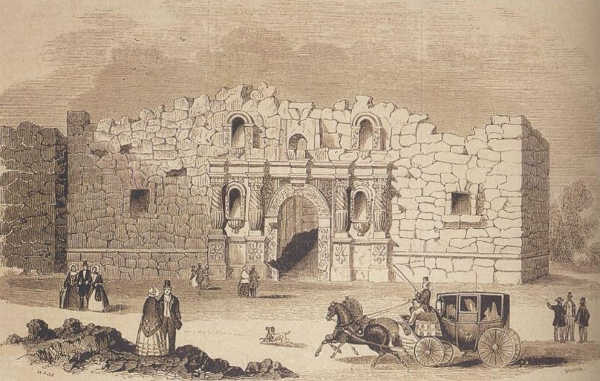
The ruins of the Alamo, less than 20 years after the battle. Public domain image. In the stillness of the night, the lonely outcropping of adobe walls and wood palisades huddled together, the white plaster of what remained of the old mission buildings reflecting the light of the moon.
The scene would almost look peaceful, if it weren’t for the lumps of crumpled bodies lying under the sage and coyote brush outside the walls.
For nearly two weeks, hundreds of men had expended their last reserve of strength, exhaled their final breath and now lay where they had fallen, too close to the enemy fortifications to be retrieved by their comrades.
Now, arranged in four columns of attack, the over 2,000 soldados of General Santa Anna prepared themselves for another assault. For the final assault, it was hoped, against the Alamo.
* * * * *
Ever since winning its own freedom from Spain in 1821, Mexico had grappled with the difficulty of managing its extensive northernmost territories.
During Spanish control, the lands that would become California, Nevada, Arizona, New Mexico and Texas had primarily served as an unoccupied bulwark against competing French, British and then American expansion.
By 1820, only the Apache and Comanche tribes populated the northeastern section of this land, because so few Mexicans wanted to risk life among the wild country.
In time, the new government of the Republic of Mexico faced a problem, a similar one America was then grappling with: land only becomes a national asset when it is settled and therefore taxable.
Before then, land is just a liability and a drain on the coffers – a place to maintain at all costs lest another country snatch it from you, but one rampant with dangerous natives and impassible to all but an armed group of soldiers.
Previously, Spain had solved this problem by encouraging Anglo-Americans to settle in upper Louisiana (St. Louis, Missouri today) and become Spanish citizens.
When she won her independence, Mexico copied her former oppressor and opened vast stretches of its northern territories to those Americans who wished to settle and integrate into Mexican society.
The government facilitated settlement by offering contracts to specific men, who were then charged with bringing in American families for settlement in designated colonies.
These selected men were called empresarios. The most influential of these would be Moses Austin and his son Stephen Fuller Austin, after whom the city in today’s Texas is named.
For their part, Americans immigrated to Mexican Texas for several reasons, not the least being that America and Mexico didn’t have an extradition treaty for debtors.
A good number of these intrepid American settlers were actually Mississippi valley farmers who had defaulted on their loans and sought greener (and prison-free) pastures in a new land. Other immigrants settled in Texas as a gamble that America would soon buy eastern Texas from Mexico. By 1830, empresarios like the Austins had settled over 1,000 American families in designated colonies.
To encourage American immigration, Mexico exempted these new settlers from certain tariffs and allowed slaveholding settlers to keep their slaves, even though the Mexican government had banned slavery in 1829. These incentives proved wildly popular.
Too popular, actually.
By the early 1830s, so many Americans had taken advantage of the incentives that the Mexican government became concerned of being overwhelmed in foreigners.
A failed rebellion of American settlers in 1830, known as the Fredonian Rebellion, excited further fears among Mexican officials. Many American settlers actually rode alongside the Mexican army to assist in putting down this rebellion, something they wished to forget a few years later in the middle of their own fight for independence.
Over the next few years, the system began to break down as speculators won contracts for new settlements and began selling shares to businessmen in Boston and New York.
This was not only illegal, but contrary to the whole spirit of the law. The Republic’s fears gave birth to the April 6, 1830, law that prohibited the immigration of Americans unless they held a passport for one of two state-approved colonies, including the Austin colony.
The colonists that already lived in Mexican Texas, some 6,000 or more, looked askance at this attempt to stem the tide of – as far as they were concerned – good American families.
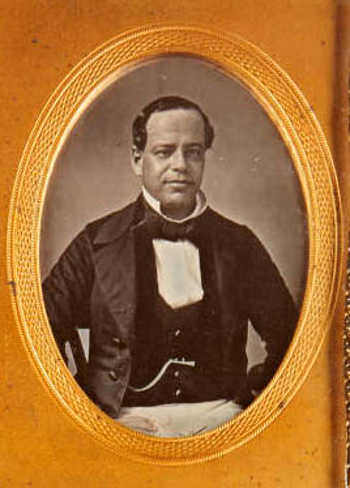
General Antonio Lopez de Santa Anna. Public domain image. They were downright afraid of another matter: all of those tax exemption incentives they were given when they first arrived were approaching their end date.
The settlers held conventions to draft and send demands for reform to the central Mexican government in 1832 and 1833.
They primarily wanted two things: an extension on the tariff exemptions granted to them in the 1820s, and the right to create their own state.
Having been given land, the American settlers now wanted a home and the autonomy to make it. Unfortunately, the timing couldn’t have been worse.
As the Texans worked to negotiate with the government, the newly elected president began a power grab. His name was Antonio Lopez de Santa Anna.
As a rule, dictators don’t relinquish power, least of all to newcomers. The Texans’ entreaties fell on deaf ears, and the situation deteriorated. It turned into open war in October of 1835.
So it was that in the new year of 1836, the Texans armed themselves for war.
Their defense rested on a triangle of cities. On the west was San Antonio, on the south was San Patricio, and on the northeast was La Bahía (Goliad).
Militarily speaking, San Antonio shouldn’t have been Santa Anna’s target, since the door to eastern Texas, home to most of the American settlements, was through Goliad.
But it was to San Antonio, and its 180 Texan defenders, that Santa Anna marched his army of some 2,000.
On Feb. 23, his advanced companies reached the front gate of the town’s fort, the old Mission of San Antonio de Valero, known locally as the Alamo.
* * * * *
Almost two weeks would drag on, bogging down Santa Anna’s army and wasting resources and men.
The final assault took several hours. In reality, though, all but an hour and a half of that was spent inching quietly toward the unsuspecting defenders. The actual fighting lasted less than two hours.
At sunbreak on March 6, all the Texan defenders lay dead, there to keep company the 600 soldados who also lost their lives. All of this in a needless assault on an inconsequential fort.
Antone Pierucci is curator of history at the Riverside County Park and Open Space District and a freelance writer whose work has been featured in such magazines as Archaeology and Wild West as well as regional California newspapers.
 How to resolve AdBlock issue?