Members of the Habematolel Pomo of Upper Lake, Calif., presented a check for $80,000 to Northshore Fire Protection District Chief Jay Beristianos (left) on Wednesday, January 17, 2018, at the tribe’s Running Creek Casino. Courtesy photo.
UPPER LAKE, Calif. – As part of an ongoing commitment to assist community organizations, the Habematolel Pomo of Upper Lake has made an $80,000 contribution to benefit the Northshore Fire Protection District.
Tribal officials said they presented the check to fire officials on Jan. 17.
“The unwavering partnership between Habematolel Pomo of Upper Lake and first responders showcases the power of community in a tangible way. Habematolel Pomo of Upper Lake is honored to contribute the needed funds for emergency personnel and the greater Upper Lake region,” the tribe said in a written statement.
Northshore Fire Chief Jay Beristianos said the tribe makes a similar contribution to the district annually.
“It’s going into the general fund,” he said.
Beristianos said the funds are typically earmarked for equipment maintenance and keeping the district’s fleet of 38 pieces of firefighting equipment rolling.
The equipment is allocated across seven stations, three of them staffed by volunteers, that serve the 357-square-mile fire district, one of the largest in the state based on land area, Beristianos said.
The tribe has also stepped forward to assist with other important community causes, including the Lights of Love stadium lighting project at Upper Lake High School. In 2017 the Habematolel tribe donated $130,000 to complete the project, as Lake County News has reported.
Email Elizabeth Larson at This email address is being protected from spambots. You need JavaScript enabled to view it.. Follow her on Twitter, @ERLarson, or Lake County News, @LakeCoNews.
After several more years of a depressed economy, another armed revolt threatened the new country. That time it took more than savvy political theater to extinguish it. It became known as Shays’ Rebellion. Public domain image.
America was born into debt.
Noble sentiments and lofty ideals might be enough to rally the troops for rebellion, but you can’t eat those inalienable rights, armies don’t march on liberty alone and no one has yet discovered a way to militarize the pursuit of happiness.
The harsh reality of their poverty hit the founding fathers almost immediately. They may have been willing to risk life and limb, but most Revolutionary leaders clung tightly to their personal wealth. It’s true that this wasn’t always the case.
The most extraordinary example of patriotic philanthropy being Robert Morris, a wealthy businessman who on several occasions personally funded the Continental Army in supplies and troop salaries.
Having said that, even Morris was guilty of financially benefiting from his positions as the bankroller of the Revolution. When he organized the smuggling of arms and goods from Europe and the Caribbean, it was his company who was contracted to ship them.
Since the budding country couldn’t rely on its own sources of money, it had to look elsewhere for capital. Most of the diplomats sent overseas during the war weren’t looking for allies to help fight England, but lenders willing to take a risk on funding a rebellion.
Between these loans, and printing out its own currency, America was able to win its independence from England. By the end of the war, America owed a modern day equivalent of $2.5 billion to the French and Spanish monarchies and Dutch bankers.
But like a new college graduate finally waking up to his mountain of student loan debt, our new government was not prepared to pay the piper. Today’s college graduates eventually tighten their belts, reduce their living expenses and begin the lifelong process of paying back their loans.
Post-revolutionary America took the alternative approach and pretended their loans didn’t exist. But no matter how many fingers they stuck in their ears, no matter how loudly they hummed to themselves, the roar of the creditors irritatingly insinuated itself into the hallowed halls of Congress.
To be fair, it wasn’t entirely Congress’ fault. You have to remember that the country was still operating under the Articles of Confederation, a document that established each colony as a separate, sovereign entity.
As far as the colonies (now states) were concerned, they existed only in a loose confederation with the others. So when it came time to collect money owed to it, Congress found itself utterly impotent. Every state was reluctant to pay back debt for a war that was already won.
To make matters worse, Congress had no other way to make money, since under the Articles, it was unable to collect tariffs from imported and exported goods and had no taxing power to speak of. They owed billions, but had no way to adequately get money to pay back the debt (again, much like student loan borrowers).
To make matters worse, Congress owed not only foreign investors, but the very men who had fought and died to make its existence a reality. In January of 1783, two years after Yorktown but still nine months before the official end of the war, a delegation of high-ranking army officers arrived in Congress with a petition for back pay.
Delegates included such esteemed men as generals Knox and McDougall as well as a litany of colonels from well-connected families. They demanded back pay not just for themselves, but the men they commanded. The army petition was clear, eloquent and left no room for misunderstanding.
The final sentences read, “Our private resources are at an end. The uneasiness of the soldiers, for want of pay, is dangerous. Any further experiments on their patience may have fata effects.”
For the next few months, Congress hemmed and hawed, tried unsuccessfully to get its due from the states and finally succeeded in only passing a motion that a permanent fund to pay the soldiers should be established. In response to which, the soldiers essentially told Congress where it could stuff its motion.
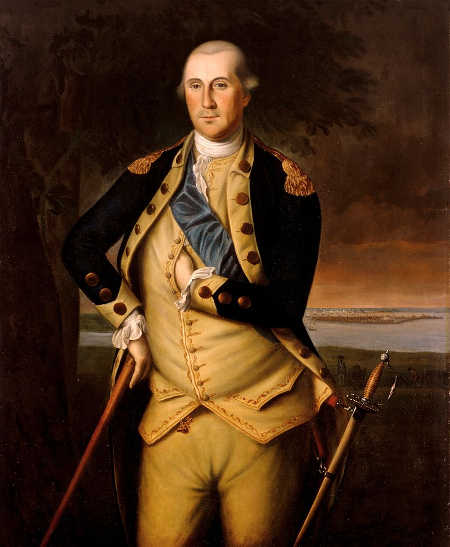
The situation finally boiled over and officers stationed at Newburgh, New York, circulated a memo among themselves setting up a secret meeting for March 12. George Washington, who had been staying clear of politics at the time, got wind of this meeting, and had it postponed until March 15.
Marching to the new officer’s barracks on the appointed day and time, Washington took to the lectern and gazed out at the faces of men he had known now for years. He paused, and his men shuffled uneasily. He then produced a letter from his breast pocket, which explained the difficulties the nation faced.
He started to read from the letter, stumbled and stopped. He then pulled from his pocket something none of his men had ever seen their commander and chief use before – spectacles.
“Gentleman, you must pardon me,” Washington said softly, “I have grown gray in the service of my country, and now I find myself growing blind.”
The hardened soldiers struggled to stifle tears, as they remembered Washington’s own sacrifices made throughout the past eight years. His men were nothing if not completely devoted to him.
The so-called Newburgh Conspiracy collapsed before it had begun.
Over the next two centuries, America would take on a burden of debt of some $300 billion, mostly to fight the wars it took to maintain us as a country.
According to John Steel Gordon, author of “Hamilton’s Blessing: The Extraordinary Life and Times of Our National Debt,” our nation has taken on 36-times as much new debt in just the last 50 years.
More than ever, we desperately search for a George Washington and his spectacles, knowing all the while, I suspect, that like our nation’s solvency, his is a character irretrievable from the past.
Antone Pierucci is curator of history at the Riverside County Park and Open Space District and a freelance writer whose work has been featured in such magazines as Archaeology and Wild West as well as regional California newspapers.
George Washington, as painted by Charles Willson Peale in 1776. Public domain image.
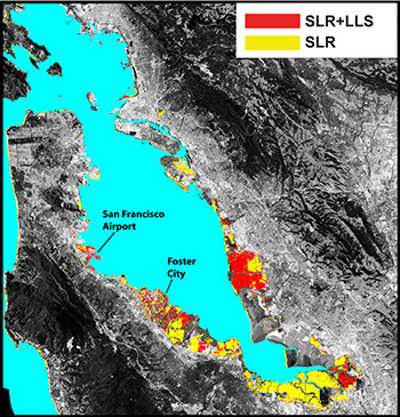
Yellow areas are parts of the San Francisco Bay shoreline at risk of flooding by 2100 because of sea level rise (SLR) alone, while red indicates those areas at risk because of both sea level rise and local land subsidence (LLS), based on a new study by UC Berkeley and Arizona State geologists. Image by ASU/Manoochehr Shirzaei.
BERKELEY, Calif. – Rising sea levels are predicted to submerge many coastal areas around San Francisco Bay by 2100, but a new study warns that sinking land – primarily the compaction of landfill in places such as Treasure Island and Foster City – will make flooding even worse.
Using precise measurements of subsidence around the Bay Area between 2007 and 2011 from state-of-the-art satellite-based synthetic aperture radar (InSAR), scientists from the University of California, Berkeley, and Arizona State University mapped out the waterfront areas that will be impacted by various estimates of sea level rise by the end of the century.
They found that, depending on how fast seas rise, the areas at risk of inundation could be twice what had been estimated from sea level rise only.
Previous studies, which did not take subsidence into account, estimated that between 20 and 160 square miles (51 to 413 square kilometers) of San Francisco Bay shoreline face a risk of flooding by the year 2100, depending on how quickly sea levels rise.
Adding the effects of sinking ground along the shoreline, the scientists found that the area threatened by rising seawater rose to between 48 and 166 square miles (125 to 429 square kilometers).
“We are only looking at a scenario where we raise the bathtub water a little bit higher and look where the water level would stand,” said senior author Roland Bürgmann, a UC Berkeley professor of earth and planetary science. “But what if we have a 100-year storm, or king tides or other scenarios of peak water-level change? We are providing an average; the actual area that would be flooded by peak rainfall and runoff and storm surges is much larger.”
The data will help state and local agencies plan for the future and provide improved hazard maps for cities and emergency response agencies.
"Accurately measuring vertical land motion is an essential component for developing robust projections of flooding exposure for coastal communities worldwide,” said Patrick Barnard, a research geologist with the U.S. Geological Survey in Menlo Park. “This work is an important step forward in providing coastal managers with increasingly more detailed information on the impacts of climate change, and therefore directly supports informed decision-making that can mitigate future impacts."
The low-end estimates of flooding reflect conservative predictions of sea level rise by 2100: about one and a half feet. Those are now being questioned, however, since ice sheets in Greenland and West Antarctica are melting faster than many scientists expected. Today, some extreme estimates are as high as five and a half feet.
That said, the subsidence – which the geologists found to be as high as 10 millimeters per year in some areas – makes less of a difference in extreme cases, Bürgmann noted. Most of the Bay Area is subsiding at less than 2 millimeters per year.
“The ground goes down, sea level comes up and flood waters go much farther inland than either change would produce by itself," said first author Manoochehr Shirzaei, a former UC Berkeley postdoctoral fellow who is now an assistant professor in ASU's School of Earth and Space Exploration and a member of NASA's Sea Level Change planning team.
Shirzaei and Bürgmann will publish their findings today in the online journal Science Advances.
Combining InSAR and GPS
InSAR, which stands for interferometric synthetic aperture radar, has literally changed our view of Earth’s landscape with its ability to measure elevations to within one millimeter, or four-hundredths of an inch, from Earth orbit.
While it has been used to map landscapes worldwide – Bürgmann has used InSAR data to map landslides in Berkeley and land subsidence in Santa Clara County – this may be the first time someone has combined such data with future sea level estimates, he said. The team used continuous GPS monitoring of the Bay Area to link the InSAR data to sea level estimates.
“Flooding from sea level rise is clearly an issue in many coastal urban areas,” Bürgmann said. “This kind of analysis is probably going to be relevant around the world, and could be expanded to a much, much larger scale.”
In the Bay Area, one threatened area is Treasure Island, which is located in the Bay midway between San Francisco and Oakland and was created by landfill for the 1939 Golden Gate International Exposition. It is sinking at a rate of one-half to three-quarters of an inch (12 to 20 millimeters) per year.
Projections for San Francisco International Airport show that when land subsidence is combined with projected rising sea levels, water will cover approximately half the airport's runways and taxiways by the year 2100. Parts of Foster City were built in the 1960s on engineered landfill that is now subsiding, presenting a risk of flooding by 2100.
Not all endangered areas are landfill, however. Areas where streams and rivers have deposited mud as they flow into the Bay are also subsiding, partly because of compaction and partly because they are drying out.
Other areas are subsiding because of groundwater pumping, which depletes the aquifer and allows the land to sink. In the early 20th century, the Santa Clara Valley at the south end of San Francisco Bay subsided as much as nine feet (three meters) due to groundwater depletion, though that has stabilized with restrictions on pumping.
Shirzaei noted that flooding is not the only problem with rising seas and sinking land. When formerly dry land becomes flooded, it causes saltwater contamination of surface and underground water and accelerates coastal erosion and wetland losses.
The work was supported by the National Science Foundation, National Aeronautics and Space Administration and Point Reyes Bird Observatory Conservation Science.
Robert Sanders writes for the UC Berkeley News Center.
LAKE COUNTY, Calif. – Lake County Animal Care and Control has a group of adults dogs who are waiting to meet their new families this week.
The dogs offered adoption this week include mixes of greyhound, Labrador Retriever, pit bull, Rottweiler, shepherd and terrier.
Dogs that are adopted from Lake County Animal Care and Control are either neutered or spayed, microchipped and, if old enough, given a rabies shot and county license before being released to their new owner. License fees do not apply to residents of the cities of Lakeport or Clearlake.
If you're looking for a new companion, visit the shelter. There are many great pets hoping you'll choose them.
The following dogs at the Lake County Animal Care and Control shelter have been cleared for adoption (additional dogs on the animal control Web site not listed are still “on hold”).
“Zeva” is a female Labrador Retriever-terrier mix is in kennel No. 4, ID No. 9553. Photo courtesy of Lake County Animal Care and Control. ‘Zeva’
“Zeva” is a female Labrador Retriever-terrier mix.
She has a medium-length black coat and already has been spayed.
She’s in kennel No. 4, ID No. 9553.
“Rowdy” is a female greyhound-Labrador Retriever mix in kennel No. 8, ID No. 9523. Photo courtesy of Lake County Animal Care and Control. ‘Rowdy’
“Rowdy” is a female greyhound-Labrador Retriever mix.
She has a short black coat with white markings, and already has been spayed.
She’s in kennel No. 8, ID No. 9523.
This male Labrador Retriever is in kennel No. 9, ID No. 9546. Photo courtesy of Lake County Animal Care and Control. Male Labrador Retriever
This male Labrador Retriever has a short black coat.
He’s in kennel No. 9, ID No. 9546.
“Onyx” is a female shepherd mix in kennel No. 22, ID No. 4174. Photo courtesy of Lake County Animal Care and Control. ‘Onyx’
“Onyx” is a female shepherd mix.
She has a medium-length black coat with white markings, and already has been spayed.
She’s in kennel No. 22, ID No. 4174.
“Baby” is a female pit bull terrier in kennel No. 23, ID No. 9501. Photo courtesy of Lake County Animal Care and Control. ‘Baby’
“Baby” is a female pit bull terrier with a short fawn coat.
She already has been spayed.
She’s in kennel No. 23, ID No. 9501.
This young female pit bull is in kennel No. 26, ID No. 9465. Photo courtesy of Lake County Animal Care and Control. Female pit bull
This young female pit bull has a short blue and fawn coat.
She is in kennel No. 26, ID No. 9465.
This male pit bull is in kennel No. 27, ID No. 9480. Photo courtesy of Lake County Animal Care and Control. Male pit bull
This male pit bull has a short blue and white coat.
Shelter staff said he is super sweet and bubbly.
He’s in kennel No. 27, ID No. 9480.
“BamBam” is a male Rottweiler mix in kennel No. 33, ID No. 9517. Photo courtesy of Lake County Animal Care and Control. ‘BamBam’
“BamBam” is a male Rottweiler mix.
He has a short tricolor coat.
He’s in kennel No. 33, ID No. 9517.
Lake County Animal Care and Control is located at 4949 Helbush in Lakeport, next to the Hill Road Correctional Facility.
Office hours are Monday through Friday, 11 a.m. to 5 p.m., and 11 a.m. to 3 p.m., Saturday. The shelter is open from 11 a.m. to 4 p.m. Monday through Friday and on Saturday from 11 a.m. to 3 p.m.
For more information call Lake County Animal Care and Control at 707-263-0278.
Email Elizabeth Larson at This email address is being protected from spambots. You need JavaScript enabled to view it.. Follow her on Twitter, @ERLarson, or Lake County News, @LakeCoNews.
Arp 256 is a stunning system of two spiral galaxies, about 350 million light-years away, in an early stage of merging. The image, taken with the NASA/ESA Hubble Space Telescope, displays two galaxies with strongly distorted shapes and an astonishing number of blue knots of star formation that look like exploding fireworks. The star formation was triggered by the close interaction between the two galaxies. This image was taken by Hubble’s Advanced Camera for Surveys (ACS) and the Wide Field Camera 3 (WFC3). It is a new version of an image already released in 2008 that was part a large collection of 59 images of merging galaxies taken for Hubble’s 18th anniversary. Credit: ESA/Hubble, NASA.
Galaxies are not static islands of stars – they are dynamic and ever-changing, constantly on the move through the darkness of the Universe.
Sometimes, as seen in this spectacular Hubble image of Arp 256, galaxies can collide in a crash of cosmic proportions.
Three hundred and 50 million light-years away in the constellation of Cetus (the sea monster), a pair of barred spiral galaxies have just begun a magnificent merger. This image suspends them in a single moment, freezing the chaotic spray of gas, dust and stars kicked up by the gravitational forces pulling the two galaxies together.
Though their nuclei are still separated by a large distance, the shapes of the galaxies in Arp 256 are impressively distorted. The galaxy in the upper part of the image contains very pronounced tidal tails – long, extended ribbons of gas, dust and stars.
The galaxies are ablaze with dazzling regions of star formation: the bright blue fireworks are stellar nurseries, churning out hot infant stars. These vigorous bursts of new life are triggered by the massive gravitational interactions, which stir up interstellar gas and dust out of which stars are born.
Arp 256 was first catalogued by Halton Arp in 1966, as one of 338 galaxies presented in the aptly-named Atlas of Peculiar Galaxies. The goal of the catalogue was to image examples of the weird and wonderful structures found among nearby galaxies, to provide snapshots of different stages of galactic evolution.
These peculiar galaxies are like a natural experiment played out on a cosmic scale and by cataloguing them, astronomers can better understand the physical processes that warp spiral and elliptical galaxies into new shapes.
Many galaxies in this catalogue are dwarf galaxies with indistinct structures, or active galaxies generating powerful jets – but a large number of the galaxies are interacting, such as Messier 51, the Antennae Galaxies, and Arp 256. Such interactions often form streamer-like tidal tails as seen in Arp 256, as well as bridges of gas, dust and stars between the galaxies.
Long ago, when our expanding Universe was much smaller, interactions and mergers were more common; in fact, they are thought to drive galactic evolution to this day.
The galaxies in the Arp 256 system will continue their gravitational dance over the next millions of years, at first flirtatious, and then intimate, before finally morphing into a single galaxy.
This spectacular image was taken by Hubble’s Advanced Camera for Surveys (ACS) and the Wide Field Camera 3 (WFC3). It is a new version of an image already released in 2008 that was part a large collection of 59 images of merging galaxies taken for Hubble’s 18th anniversary.
LAKEPORT, Calif. – Several local races featured in the June 5 primary closed on Friday, with one supervisor choosing not to seek reelection and a new candidate joining the race this week for Lake County superintendent of schools.
The key election-related developments revealed this week are that District 3 Supervisor Jim Steele won’t run for another term and Patrick Iaccino, the retired Upper Lake Unified School District superintendent, is challenging incumbent Brock Falkenberg for the Lake County superintendent of schools seat.
The deadline for all races in which an incumbent is seeking reelection was 5 p.m. on Friday, according to the Lake County Registrar of Voters Office.
As of that deadline, Assessor-Recorder Richard Ford, County Clerk-Auditor Cathy Saderlund, Sheriff-Coroner Brian Martin and Treasurer-Tax Collector Barbara Ringen all had filed for reelection and were unopposed, according to Chief Deputy Registrar of Voters Maria Valadez.
Also unopposed in seeking new terms are Lake County Superior Court Judge Andrew Blum and Judge Michael Lunas, Valadez said. Because they are unopposed, their names will not appear on the ballot and they will be considered reelected in November; that procedure is unique to judicial races.
In the race to succeed Judge Stephen Hedstrom, who is not seeking reelection, the deadline for filings also was 5 p.m. Friday, Valadez said.
Valadez said the three candidates in that race are District Attorney Don Anderson, Deputy County Counsel Shanda Harry and attorney Andre Ross.
In the race for Lake County superintendent of schools, Falkenberg, now in his first term, is seeking reelection, which he formally announced this week. Valadez confirmed all of his paperwork was filed by the Friday deadline.
But Falkenberg won’t run unopposed. Iaccino, who retired in June as the superintendent for the Upper Lake Unified School District, has joined the race, which he confirmed to Lake County News this week. Valadez said Iaccino’s name also is confirmed on the June ballot.
While those races are now closed, the filings for district attorney, and supervisorial districts 2 and 3 remain open until 5 p.m. Wednesday, March 14, because the incumbents haven’t filed to run for reelection, the Registrar of Voters Office reported.
In the district attorney’s race, attorney Steven Brown and Senior Deputy District Attorney Susan Krones have filed their papers and are confirmed candidates, Valadez said.
In the District 2 supervisorial race, Supervisor Jeff Smith has long made known his intention to not run for another term.
Clearlake Mayor Bruno Sabatier is seeking to succeed Smith and has filed all of the necessary paperwork to appear on the ballot, Valadez said.
As of Friday, Valadez said another Clearlake City Council member, Joyce Overton, had pulled nomination papers but still has to finalize the rest of her paperwork.
Perhaps the biggest surprise of the week was that, according to Valadez, District 3 Supervisor Jim Steele – who had earlier pulled initial paperwork to seek reelection – did not finish the process of filing to seek a second term by the Friday deadline.
“I will confirm I did not file by 5 p.m.,” Steele told Lake County News on Friday evening.
“I waited to the last minute to think about it,” he said.
He said he would issue an upcoming statement explaining his reasons for not seeking reelection.
The race for the District 3 seat now includes Eddie J. Crandell Sr., the Robinson Rancheria tribal chair, and Denise Loustalot, a businesswoman who previously served as the city of Clearlake’s mayor.
Both Crandell and Loustalot were appointed by Steele to fill local governing roles – Crandell as the District 3 representative on the Lake County Planning Commission and Loustalot as chair of the East Region Town Hall.
“It’s going to be interesting,” Steele said of the race to succeed him.
Email Elizabeth Larson at This email address is being protected from spambots. You need JavaScript enabled to view it.. Follow her on Twitter, @ERLarson, or Lake County News, @LakeCoNews.
 How to resolve AdBlock issue?