LAKEPORT, Calif. – The Board of Supervisors this week will consider receiving a donation to the county’s libraries and the conveyances to two local agencies of surplus county property.
The board will meet beginning at 9 a.m. Tuesday, June 5, in the board chambers on the first floor of the Lake County Courthouse, 255 N. Forbes St., Lakeport.
The meeting can be watched live on Channel 8 and online at https://countyoflake.legistar.com/Calendar.aspx. Accompanying board documents, the agenda and archived board meeting videos also are available at that link.
In an item time for 9:10 a.m., the board will consider County Librarian Christopher Veach’s request to accept a donation of $8,590 from the Friends of the Lake County Library to buy new children's books and new large type books for adults for all branches of the Lake County Library system.
The staff report said the Friends of the Lake County Library “have raised funds for this express purpose.”
In untimed items, the board also will look at requests from Sheriff Brian Martin to convey three Crown Victoria pursuit vehicles, two 2009 model year and a 2010 to the Clearlake Police Department and a 24-foot 2001 Godfrey Sweetwater Pontoon boat and trailer to the Northshore Fire Protection District. Martin’s reports said that both the vehicle and the boat have been declared surplus.
Regarding the patrol cars, Martin’s report stated, “These vehicles have been replaced in our vehicle fleet. The Clearlake Police Department’s vehicle fleet has recently been diminished due to unforeseen accidents and circumstances. The acting Clearlake Police Chief Tim Celli requested to purchase three patrol vehicles.”
In order to assist the Clearlake Police Department with maintaining the ability to carry on with their law enforcement patrols and operations, Martin said the county will sell the vehicles to the city for a total of $750.
Regarding the boat and trailer, Martin said the boat was originally donated to the county in May 2015 with a value of $8,970. A trailer was purchased at that time for $1,500 from McAtee’s Marine. “Due to the high cost of refurbishing this boat, it has been determined it is not cost effective for us to keep,” he said.
He added, “It is the intent of the Northshore Fire Protection District to refurbish the pontoon boat so that it can be used as a diving platform during diving operations.”
The full agenda follows.
CONSENT AGENDA
7.1: Approve minutes of the Board of Supervisors meeting held March 6, 2018.
7.2: Approve salary/grade step report attached to the memorandum of understanding between the county and the Lake County Correctional Officers Association.
7.3: (a) Appoint Senior HR Analyst Jesse Puett to Interim Deputy HR Director effective May 29, 2018, and; (b) Appoint HR Analyst II Diana Rico to Interim Senior HR Analyst effective May 29, 2018.
7.4: Approve Amendment 1 to the agreement between the county of Lake and Lake County Office of Education for School-Based Medi-Cal Specialty Mental Health Services for Fiscal Year 2017-18 for a decrease of $45,000 for a new contract maximum of $205,000 and authorize the chair to sign the amendment.
7.5: Approve Amendment 3 to the Agreement between county and Charis Youth Center for Fiscal Year 2017-18 for a new contract maximum of $20,000 and to authorize the board chair to sign the amendment.
7.6: Authorize Advanced Step 5 Hiring of Extra Help Office Assistant Myriam Herrera.
7.7: Approve resolution of the City Council of Lakeport calling for and providing for and giving notice of the General Municipal Election to be held in the City of Lakeport, County of Lake, State of California, on the sixth day of November, 2018, for the purpose of electing two City Council members, each to hold office for a term of four years, or until their successors are elected and qualified, requesting consolidation of that election with the State General Election and requesting approval of the Lake County Board of Supervisors for election services to be provided by the Lake County Registrar of Voters.
7.9: Approve budget transfer for purchase of a color plotter, copier, scanner for the Environmental Health Division's Certified Unified Program Agency (CUPA) Program and appropriate $7,000 from 170-410-740-38.00 Inventory to 170-410-740-62.71 Office Equipment.
7.10: (a) Waive the normal bidding requirements because to do so would produce no economic benefit for the county due to the unique nature of services, and (b) approve purchase of consulting services from Superion in the amount of $13,930 plus travel expenses and authorize IT director to issue purchase order.
7.11: Sitting as the Lake County Watershed Protection District, Board of Directors, approve joint funding agreement between the U.S. Geological Survey, U.S. Department of the Interior and Lake County Watershed Protection District for annual maintenance of the Kelsey Creek flow gauge station in the amount of $15,300 for the period Nov. 1, 2017, to Oct. 31, 2018; and authorize the chair to sign.
7.12: Approve agreement between the county of Lake and MGE Engineering Inc. for construction management services for replacement of Robinson Creek Bridge at Mockingbird Lane (14C-0086), Lake County, CA for an amount not to exceed $240,986.90; and authorize the chair to sign.
7.13: Approve a travel claim reimbursement for hotel bill incorrectly charged on personal credit card in the amount of $276.76; and authorize the chair to sign.
7.14: Approve extension of lease agreement between county of Lake and Pauline Usher Revocable Trust for the facility located at 9245 Hwy 53 # 14, Lower Lake, CA , and an annual amount of $6,002.52, through June 30, 2021; and authorize the chair to sign.
7.15: Approve long distance travel for Jan Coppinger to speak at the National Association of Clean Water Agencies 2018 Utility Leadership Conference in Boston, Mass., from July 23, through July 26.
7.16: Approve the creation of an extra help construction inspector in county service for use in Anderson Springs Sewer Project.
TIMED ITEMS
8.2, 9:10 a.m.: Consideration of Acceptance of $8,590 donation from the Friends of the Lake County Library.
8.3, 9:15 a.m.: Consideration of continuing a proclamation of a local emergency due to the Sulphur fire incident.
8.4, 9:16 a.m.: Consideration of continuing a proclamation of a local emergency due to wildfire conditions, pertaining to the Rocky, Jerusalem and Valley fires.
8.5, 9:17 a.m.: Consideration of continuing a proclamation of a local emergency due to Clayton fire.
8.6, 9:18 a.m.: Consideration of continuing a proclamation of a local emergency due to the atmospheric river storm.
UNTIMED ITEMS
9.2: Discussion and consideration of the possible creation of a joint powers authority dedicated to risk reduction.
9.3: Adopt resolution conveying personal property from the county of Lake to the city of Clearlake for use by the Clearlake Police Department.
9.4: Adopt resolution conveying personal property from the county of Lake to the Northshore Fire Protection District.
CLOSED SESSION
10.1: Conference with legal counsel: Decision whether to initiate litigation pursuant to Gov. Code sec. 54956.9(d)(4): One potential case.
10.2: Conference with legal counsel: Decision whether to initiate litigation pursuant to Gov. Code sec. 54956.9(d)(4): PG&E.
Email Elizabeth Larson at This email address is being protected from spambots. You need JavaScript enabled to view it.. Follow her on Twitter, @ERLarson, or Lake County News, @LakeCoNews.
MENDOCINO NATIONAL FOREST, Calif. – Work is continuing on a wildland fire burning since Friday on the Mendocino National Forest.
Fire crews have reached 75 percent containment on the 127-acre Open fire on the Grindstone District of the Mendocino National Forest, according to forest spokeswoman Punky Moore.
The fire, first reported at 2 p.m. Friday, is located 25 miles west of Willows on Open Ridge in grass, oak and mixed timber, Moore said.
Moore said approximately 100 resources remain assigned to the incident including crews, engines and water tenders. The fire is smoldering with some isolated hot spots.
The forecast called for gusty winds up to 20 miles per hour Sunday night.
Crews will be staying on the fireline to ensure burning embers do not spread outside the established lines. Moore said there are no structures immediately threatened.
The cause of the fire remains under investigation, Moore said.
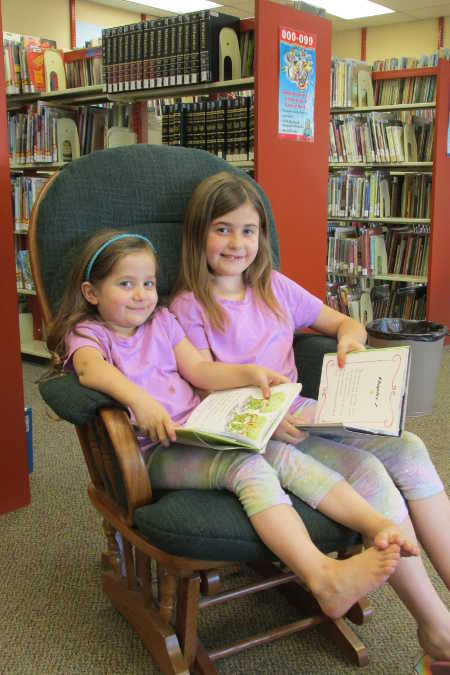
Library Kids Rylee and Payton enjoy reading and sharing some laughs at the library, in Lake County, Calif. The Lake County Library’s Summer Reading Program is in full swing and readers of all ages can still sign up. Courtesy photo.
LAKEPORT, Calif. – The Lake County Library invites residents to go on a journey with the 2018 Summer Reading Program, “Reading Takes You Everywhere.” The program is open to all ages, so everyone can join in the fun.
So far more than 250 people have signed up, and some of these intrepid readers have already logged more than 1000 points.
There is still plenty of time to sign up any time all four Lake County Library branches during the program which ends July 28.
Once you sign up you can keep track of your reading progress when you return your books to the library. There are three programs, each targeting a different age group from kids to adults.
The Lake County Library kids program is recommended for children ages from newborn to 14.
When you sign up at your local library you can pick up a reading log and start reading library books. When you return library books to the front desk, the library staff will log your page count.
For every page you read you get a reading point. For every 50 points you get a sticker for your reading log. At end of the program in August, there will be a party for the children who participate.
Tweens and teens ages 11 to 18 can sign up for the Teen program. Visit the library desk when you return books to get reading credit. For every 200 pages you read, you will be entered in a grand prize drawing. There will also be a variety of events for teens over the summer at the library.
The Lake County Library has a summer reading program for adults. It’s a fun way to challenge yourself to read more this summer.Just like the Teen program, for every 200 pages you read, you will be entered in a grand prize drawing.
For each of these programs, if you read at least 1,000 pages the Friends of the Library will donate a book to the library with your name inside to commemorate your reading achievement.
The Lake County Library Summer Reading Program is supported in part by the Friends of the Lake County Library and Friends of Middletown Library.
If you’re wondering who the heck the last man is, just know that he definitely deserves to be up there with the other great innovators of the technological revolution. In fact, he was the granddaddy of them all, preceding Jobs and Gates by a century.
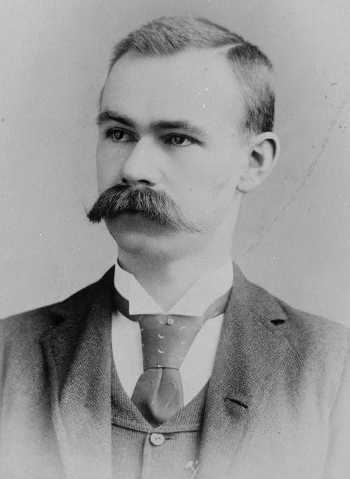
Herman Hollerith was an unknown engineer when he applied for the patent on his world-changing invention on June 8, 1887. His invention was the product of his work with the Census Bureau early in his career.
After graduating with his engineering degree at 19 years old, he eventually got a job on the 1880 census team that was responsible for adding up the demographic information collected across the country. This was a laborious and error-prone process that took eight years to fully complete – just two years before it had to start all over again with the next census!
After working with the census for two years, Hollerith became a professor at MIT and later went on to develop electro-pneumatic and vacuum-operated breaks for railroad engines.
Finally, he turned back to the frustrating problem of data compilation and, on June 8, 1887 he filed a patent for “a novel sorting device,” that he had devised as part of an “apparatus for compiling statistics.” What Hollerith had invented was a tabulating machine that used punch cards to quickly sort and compile statistical information. It worked like this:
A census worker would take one person’s information and punch that person’s details onto the appropriate places on the card. Another employee would then place the card on a press attached to the tabulating machine and lock the cover into place. This action would push a panel of pins down onto the card.
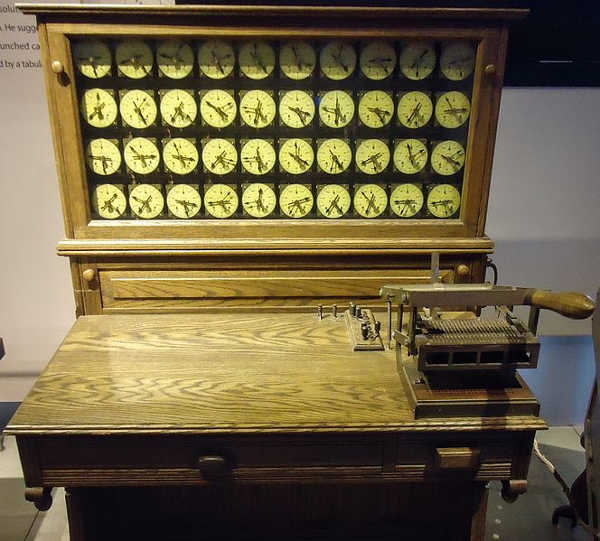
The pins that made their way through the holes contacted small cups of mercury, which completed an electrical circuit. The electrical impulses this created were transmitted to the counters on the machine and the results were registered on the counter board.
Hollerith’s design won a competition the Census Bureau had organized to find a more efficient means of calculating their data. When it was utilized in the 1890 census, Hollerith’s Tabulating Machine completed the entire 8-year process in just two years and saved the government $5 million.
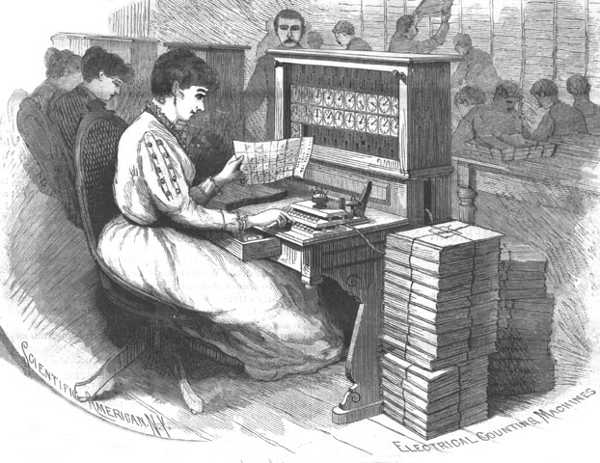
Hollerith’s census counting machines used in 1890. Public domain image.
Taking his machine, Hollerith created a business – the Hollerith Tabulating Machine Co. By 1911, his machine had counted the populations of Austria, Canada, Denmark, England, Russia and many more. But his invention was utilized for more things than simply counting people.
It was beginning to look like Hollerith would hold a monopoly on this age-defining invention. Then, in a move that smacks of betrayal today, the Census Bureau – barely skirting patent restrictions – invented their own tabulating machine, one that was even more efficient in adding data than Hollerith’s.
When another census employee patented this knock-off and started his own company, it didn’t take long for Hollerith’s company to feel the loss in their sales. Thanks to the hiring of an able executive in 1918, however, the company rebounded and returned to the top once more.
In time, people found even more uses for the tabulating machine. Businesses soon realized that the information on the cards didn’t just have to stand for a person. The data could be about a product, an insurance customer or a freight car line.
Not only did his machine allow people to add up numbers at an astounding rate, but it also allowed them to understand information in new ways.
By rearranging the wires on the tabulating machine, the tabulator could sort through thousands – millions of cards.
It was with a Hollerith Tabulating Machine that England was able to break the Nazi Enigma machine ciphers during World War 2. So well designed and versatile was Hollerith’s machine that it remained the primary form of data processing from 1890 until the 1950s.
Even after it was eclipsed by what would eventually become the computer, Hollerith’s legacy lived on. Because his Tabulating Machine Company eventually merged with two other companies to form the corporation known today as the International Business Machines – IBM.
So, you can see now why Hollerith deserves a place of honor among the great tech innovators of our day. You might even say that his contribution to data processing was … incalculable.
Antone Pierucci is curator of history at the Riverside County Park and Open Space District and a freelance writer whose work has been featured in such magazines as Archaeology and Wild West as well as regional California newspapers.
A Hollerith census counting machine. Public domain image.
LAKE COUNTY, Calif. – Lake County Animal Care and Control has more new dogs ready for new homes this week.
Dogs available for adoption this week include mixes of boxer, Chihuahua, German Shepherd, Labrador Retriever, Pekingese and pit bull.
Dogs that are adopted from Lake County Animal Care and Control are either neutered or spayed, microchipped and, if old enough, given a rabies shot and county license before being released to their new owner. License fees do not apply to residents of the cities of Lakeport or Clearlake.
If you're looking for a new companion, visit the shelter. There are many great pets hoping you'll choose them.
The following dogs at the Lake County Animal Care and Control shelter have been cleared for adoption (additional dogs on the animal control Web site not listed are still “on hold”).
This male Chihuahua is in kennel No. 5, ID No. 10112. Photo courtesy of Lake County Animal Care and Control.
Male Chihuahua
This male Chihuahua has a short black coat.
He is in kennel No. 5, ID No. 10112.
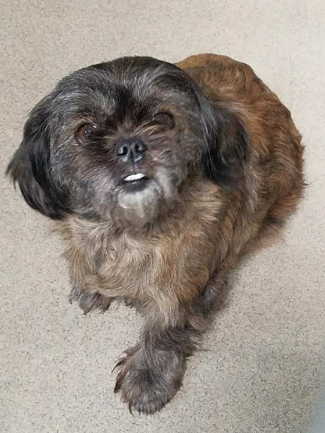
“Trixie” is a female Pekingese in kennel No. 6, ID No. 10139. Photo courtesy of Lake County Animal Care and Control.
‘Trixie’
“Trixie” is a female Pekingese with a shaved brindle coat.
She’s in kennel No. 6, ID No. 10139.
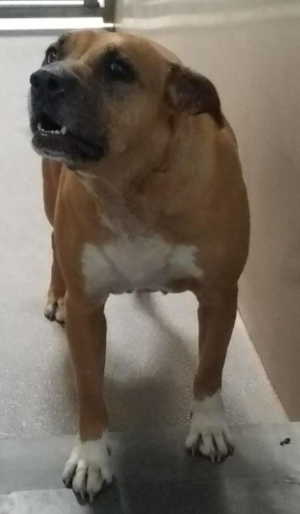
“Daisey May” is a female boxer-pit bull mix in kennel No. 12, ID No. 10114. Photo courtesy of Lake County Animal Care and Control.
‘Daisey May’
“Daisey May” is a female boxer-pit bull mix with a short tan and white coat.
She already has been spayed.
She’s in kennel No. 12, ID No. 10114.
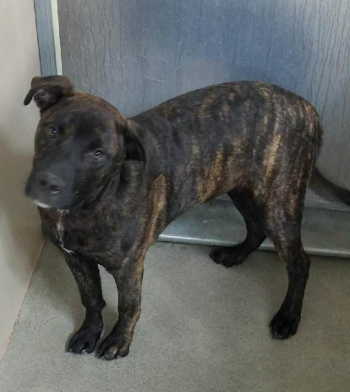
This male pit bull is in kennel No. 13, ID No. 10120. Photo courtesy of Lake County Animal Care and Control.
Male pit bull
This male pit bull has a short brindle coat.
He’s in kennel No. 13, ID No. 10120.
“Buddy” is a male Chihuahua in kennel No. 15a, ID No. 10141. Photo courtesy of Lake County Animal Care and Control.
‘Buddy’
“Buddy” is a male Chihuahua with a short brown coat.
He’s in kennel No. 15a, ID No. 10141.
“Sparky” is a male Chihuahua is in kennel No. 15b, ID No. 10142. Photo courtesy of Lake County Animal Care and Control.
‘Sparky’
“Sparky” is a male Chihuahua with a short brown coat.
He’s in kennel No. 15b, ID No. 10142.
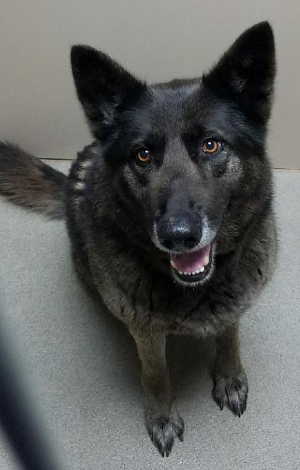
“Beauty” is a female German Shepherd in kennel No. 17, ID No. 9748. Photo courtesy of Lake County Animal Care and Control.
‘Beauty’
“Beauty” is a female German Shepherd with a medium-length black and tan coat.
She already has been spayed.
She’s in kennel No. 17, ID No. 9748.
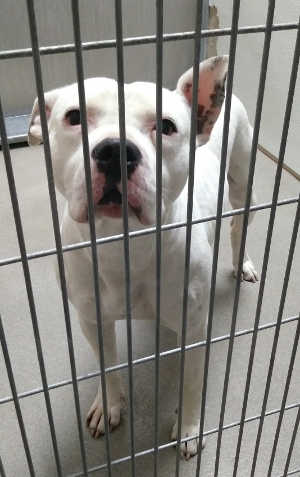
“Baxter” is a male pit bull in kennel No. 21, ID No. 10079. Photo courtesy of Lake County Animal Care and Control.
‘Baxter’
“Baxter” is a male pit bull with a short white coat.
He’s in kennel No. 21, ID No. 10079.
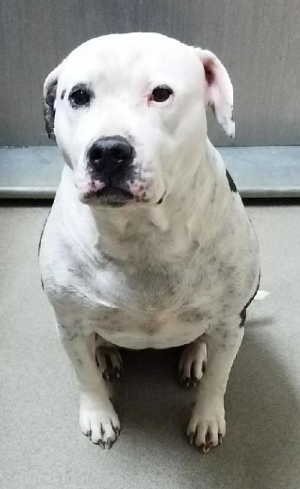
“Leah” is a female pit bull terrier in kennel No. 24, ID No. 10124. Photo courtesy of Lake County Animal Care and Control.
‘Leah’
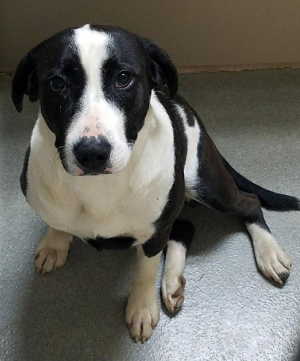
“Leah” is a female pit bull terrier with a short black and white coat.
She already has been spayed.
She’s in kennel No. 24, ID No. 10124.
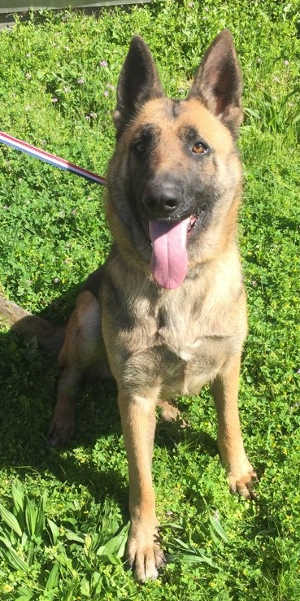
“Kuma” is a female German Shepherd in kennel No. 25, ID No. 10038. Photo courtesy of Lake County Animal Care and Control.
‘Kuma’
“Kuma” is a female German Shepherd with a long black and tan coat.
She already has been spayed.
She’s in kennel No. 25, ID No. 10038.
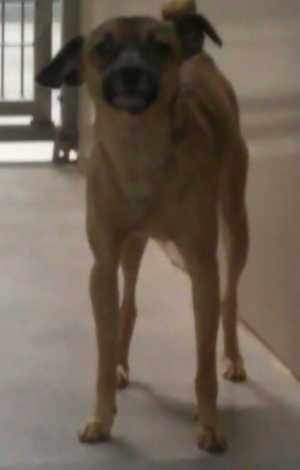
This female hound-Labrador Retriever mix is in kennel No. 32, ID No. 9933. Photo courtesy of Lake County Animal Care and Control.
Hound-Labrador Retriever mix
This female hound-Labrador Retriever mix has a short black and white coat.
She’s in kennel No. 32, ID No. 9933.
Lake County Animal Care and Control is located at 4949 Helbush in Lakeport, next to the Hill Road Correctional Facility.
Office hours are Monday through Friday, 11 a.m. to 5 p.m., and 11 a.m. to 3 p.m., Saturday. The shelter is open from 11 a.m. to 4 p.m. Monday through Friday and on Saturday from 11 a.m. to 3 p.m.
For more information call Lake County Animal Care and Control at 707-263-0278.
Email Elizabeth Larson at This email address is being protected from spambots. You need JavaScript enabled to view it.. Follow her on Twitter, @ERLarson, or Lake County News, @LakeCoNews.
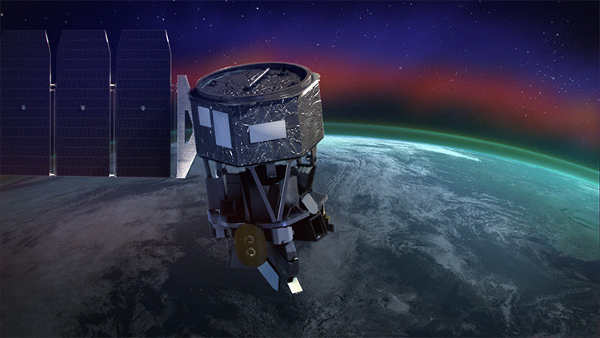
ICON will study the ionosphere from a height of about 350 miles to understand how the combined effects of terrestrial weather and space weather influence this ionized layer of particles. NASA Goddard's Conceptual Image Lab/B. Monroe image. BERKELEY, Calif. – If scientists hope to predict the magnetic storms around Earth that endanger satellites and interfere with radio communications on the ground, they must understand how tropical storms on Earth affect these magnetic storms 60 miles above our heads.
A new mission, NASA’s Ionospheric Connection Explorer, or ICON, is charged with that very task: to measure the winds of ionized atoms at the edge of space and determine how they are impacted by atmospheric weather, in particular seasonal monsoons in the tropics.
Designed and built at the Space Sciences Laboratory of the University of California, Berkeley, ICON is scheduled for a June 14 launch from an airplane over the Pacific Ocean, and should start probing the upper atmosphere and ionosphere by August.
“We are built to catch everything that is coming up into space at the boundary of space,” said Thomas Immel, principal investigator for the mission and a physicist at the Space Sciences Laboratory. “Anything that comes past there, we are going to see.”
ICON will orbit at about 350 miles above Earth’s surface, but will look downward at the region above 60 miles, where the thin upper atmosphere transitions to space and, at 200 Kelvin (100 degrees below zero Fahrenheit), the coldest environment on Earth. The sun is constantly shining on this region, heating it up and, because of the sun’s ultraviolet radiation, knocking electrons off oxygen atoms to produce an ionized gas, or plasma.
This plasma interacts with Earth’s magnetic field, migrating along field lines and generating electric fields that, in turn, shove the ionized plasma perpendicular to the magnetic fields.
The net result of all this moving, ionized gas is to produce waves of plasma that encircle the globe, visible because of airglow in green, red and ultraviolet.
The goal of ICON’s two MIGHTI telescopes – short for Michelson Interferometer for Global High-resolution Thermospheric Imaging – is to measure the speed of these plasma waves between 60 to 200 miles above the ground by means of their Doppler shift.
“It’s like watching runners and measuring how fast they are running by the change in the color of their shirts,” Immel said. Designed and built by the Naval Research Lab in Washington, D.C., MIGHTI is sensitive enough to measure the change in color or wavelength to within one part in 100 million, equal to a speed of about 10 miles per hour, and also to take the plasma’s temperature.
Two other instruments built at SSL measure far ultraviolet (FUV) and extreme ultraviolet (EUV) wavelengths to clock the winds at higher elevations in the ionosphere, revealing how far the plasma extends and where pockets of denser plasma form.
“Shortwave radio waves bounce off the ionosphere, and signals from GPS satellites have to pass through,” said Immel. “The changes in density directly affect communications and navigation.”
While ICON’s three airglow instruments measure the temperature, velocity and composition of gases miles away from the spacecraft, two identical instruments – Ion Velocity Meters, or IVMs, developed at the University of Texas in Dallas – measure the movement of the charged gas around the spacecraft.
One puzzle Immel hopes to investigate involves two belts of plasma girdling Earth just north and south of the equator. For unknown reasons, these belts sometimes rise upward and migrate toward each pole and at other times stall and merge into one belt.
Tropical rains around the world, in South America, Africa and Southeast Asia, seem to change these plasma belts with a daily regularity that matches the early afternoon downpours typical of monsoons. One goal of ICON is to find out what connection, if any, exists between tropical storms and tides in the plasma waves in the ionosphere.
ICON will also be able to measure how the ionospheric plasma waves change when hit by magnetic storms from the sun.
Eventually, what ICON discovers will be combined with observations from other Earth-orbiting satellites to make predictions about space weather tomorrow based on observations today.
“At some point we will hand off to an agency in charge of space weather and the space environment, and we have to give them a hint of what to measure to make predictions,” Immel said. “ICON will inform the next set of measurements and identify key parameters that need to be measured to support better predictions in the future.”
ICON is a $180 million Explorer-class mission managed by NASA Goddard Spaceflight Center in Maryland.
Robert Sanders writes for the UC Berkeley News Center.
 How to resolve AdBlock issue?