 How to resolve AdBlock issue?
News
NORTHERN CALIFORNIA – In a budget deal reached Friday by the Legislature and the governor, California will make significant investments to enhance mutual aid firefighting resources and to protect communities from the rising threats of wildfires.
The deal was announced by State Sen. Mike McGuire, who represents Lake County and other parts of the North Coast.
For months, Sen. McGuire and the entire North Bay Legislative Delegation have been working with the California Fire Chiefs, the California Professional Firefighters Association, Cal Fire firefighters, California Fire Districts Association, California State Firefighters Association and many other public safety organizations to secure millions in new funding for enhanced mutual aid.
McGuire, a member of the Senate Budget Committee, said that $50 million will be dedicated to enhanced mutual aid response, which will better equip and prepare our state’s firefighting agencies to battle the “New Normal” of California’s wildfire season.
“California is facing a new normal – the size and scope of wildland fires are getting worse. Today’s budget deal reinforces the Legislature and governor’s commitment to taking swift action and ensuring a more proactive and effective mutual aid response system is implemented across our state,” McGuire said Friday. “The safety of our communities depends on it.”
While California’s Mutual Aid System is world-renowned, 2017 confirmed the severe strain that the system currently faces. More than 35,600 mutual aid requests were made last year, of which 11,000 (31 percent) went unfilled. McGuire said that is a record number in California’s history.
In addition to the $50 million mutual aid budget allocation, the state also has responded with critical investments including $95 million for the purchase of new helicopters to replace Cal Fire’s current Vietnam-era helicopters; $4 million to fully staff and operate the McClellan Air Force Base, which provides a centralized location for rapid deployment of large firefighting air tankers, very large air tankers, and the California National Guard Modular Airborne FireFighting Systems; and $16 million for Cal Fire equipment replacement, including fire engines.
In addition, in the next month, up to $195 million will also be awarded to communities through CalFire’s Forest Health and Fire Prevention Programs. Together, these programs improve resiliency of forested and forest-adjacent communities and upper watershed forests while achieving climate goals.
The North Bay Legislative Delegation hosted a meeting with CalfFire’s and representatives from the North Bay’s fire impacted counties of Mendocino, Sonoma, Lake and Napa – along with the cities of Santa Rosa and Clearlake – to identify opportunities to secure these funds.
Millions will be requested by many of the counties that were devastated by the October firestorm, McGuire’s office reported.
Numerous grant opportunities are available for projects like removal of dead and dying trees, community fire prevention program funding, vegetation clearance and other activities that reduce the risk of wildfires.
“The October 2017 North Bay Firestorm will go down as the most destructive and deadly in modern American history and it was absolutely critical that the State of California invested in programs to improve resiliency, address the risk of wildfire and reduce wildfire potential in our communities,” McGuire said. “We still have work ahead of us, but these funds will help protect our communities fight California’s new normal.”
The budget deal was set to be voted on Friday afternoon by the joint Legislative conference committee, before going to both the full Senate and Assembly.
The deal was announced by State Sen. Mike McGuire, who represents Lake County and other parts of the North Coast.
For months, Sen. McGuire and the entire North Bay Legislative Delegation have been working with the California Fire Chiefs, the California Professional Firefighters Association, Cal Fire firefighters, California Fire Districts Association, California State Firefighters Association and many other public safety organizations to secure millions in new funding for enhanced mutual aid.
McGuire, a member of the Senate Budget Committee, said that $50 million will be dedicated to enhanced mutual aid response, which will better equip and prepare our state’s firefighting agencies to battle the “New Normal” of California’s wildfire season.
“California is facing a new normal – the size and scope of wildland fires are getting worse. Today’s budget deal reinforces the Legislature and governor’s commitment to taking swift action and ensuring a more proactive and effective mutual aid response system is implemented across our state,” McGuire said Friday. “The safety of our communities depends on it.”
While California’s Mutual Aid System is world-renowned, 2017 confirmed the severe strain that the system currently faces. More than 35,600 mutual aid requests were made last year, of which 11,000 (31 percent) went unfilled. McGuire said that is a record number in California’s history.
In addition to the $50 million mutual aid budget allocation, the state also has responded with critical investments including $95 million for the purchase of new helicopters to replace Cal Fire’s current Vietnam-era helicopters; $4 million to fully staff and operate the McClellan Air Force Base, which provides a centralized location for rapid deployment of large firefighting air tankers, very large air tankers, and the California National Guard Modular Airborne FireFighting Systems; and $16 million for Cal Fire equipment replacement, including fire engines.
In addition, in the next month, up to $195 million will also be awarded to communities through CalFire’s Forest Health and Fire Prevention Programs. Together, these programs improve resiliency of forested and forest-adjacent communities and upper watershed forests while achieving climate goals.
The North Bay Legislative Delegation hosted a meeting with CalfFire’s and representatives from the North Bay’s fire impacted counties of Mendocino, Sonoma, Lake and Napa – along with the cities of Santa Rosa and Clearlake – to identify opportunities to secure these funds.
Millions will be requested by many of the counties that were devastated by the October firestorm, McGuire’s office reported.
Numerous grant opportunities are available for projects like removal of dead and dying trees, community fire prevention program funding, vegetation clearance and other activities that reduce the risk of wildfires.
“The October 2017 North Bay Firestorm will go down as the most destructive and deadly in modern American history and it was absolutely critical that the State of California invested in programs to improve resiliency, address the risk of wildfire and reduce wildfire potential in our communities,” McGuire said. “We still have work ahead of us, but these funds will help protect our communities fight California’s new normal.”
The budget deal was set to be voted on Friday afternoon by the joint Legislative conference committee, before going to both the full Senate and Assembly.

In deep space, accessing water is a top priority for human survival. NASA is exploring ways to provide water using existing resources on multiple planetary surfaces and engaging universities in this mission through the RASC-AL (Revolutionary Aerospace Systems Concepts – Academic Linkages) Special Edition: Mars Ice Challenge.
The Mars Ice Challenge is one of several RASC-AL collegiate design competitions sponsored by NASA and administered by the National Institute of Aerospace in Hampton, Virginia, that exercise innovation in support of NASA’s vision for expanding human space exploration – in this case, a technology demonstration for critical in-situ resource utilization (ISRU) capabilities.
In its second year, Mars Ice Challenge judges 10 competitively selected teams to travel to NASA’s Langley Research Center from June 5 to 7 to demonstrate unique methods for harvesting water from simulated Martian subsurface ice. The goal? Extract as much water as possible over a two-day period.
“The students are using a combination of autonomous operation and remote control to operate their water extraction systems just like we would in space,” said Melvin Ferebee, program sponsor and director of the Systems Analysis and Concepts Directorate at Langley in Hampton. “They are taking on the role of astronauts on Mars, controlling drilling operations and having to strategize and adapt to challenges.”
The selected teams include two from West Virginia University and one each from Alfred University, Colorado School of Mines, Carnegie Mellon University, University of Tennessee, Knoxville, Massachusetts Institute of Technology, Northeastern University, Rowan University and Virginia Tech.
Teams mounted their prototype drills at individual test stations using 4-foot tall commercial fishing coolers filled with 600-pound ice blocks and a half-meter of pitcher’s mound clay and gravel to replicate a slice of the Martian surface as closely as possible.
Mimicking other Martian conditions on Earth, however, is nearly impossible. Differences in temperature, atmospheric pressure, power limitations and gravity all affect the way machinery and water operate on different planets.
“We know there is an abundance of frozen water on Mars,” said Richard Davis, assistant director of science and exploration for NASA’s Science Mission Directorate Planetary Science Division. “Before the water can be used to support sustained human presence, it must be extracted from the Mars ice deposits and isolated to prevent evaporation from the low atmospheric pressures found on Mars.”
Participating in the Mars Ice Challenge is no easy undertaking. Teams poured their blood, sweat, and tears into tackling this hard-to-solve problem, designing and building complicated prototypes to be tested and submitting robust technical papers outlining how they would adapt their concept to operate effectively on Mars.
This year, the team from Northeastern University placed first overall and collected the most water with its concept titled Planetary Articulating Water Extraction System.
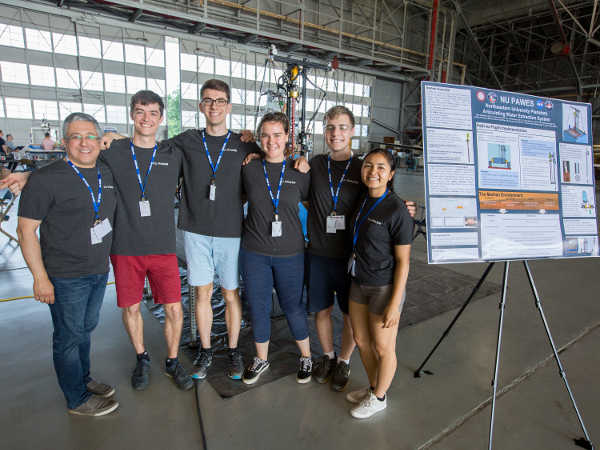
"The team is very excited, they all worked very hard," said Dr. Taskin Padir, the team's advisor. "One of the great things about this competition is that we were able to build on what we learned from the past year's teams."
Northeastern mechanical engineering student Emmy Kelly added the team is already thinking about what's next.
"We were glad we performed so well but as soon as we got back to the hotel we started talking about next year," she said. "We want to improve and make modifications so we can run more autonomously. We're looking to be more Mars ready."
The Northeastern University team isn’t the only the winner in this competition. NASA and industry experts also recorded lessons learned from the challenge that will help inform and improve the collective success of future work in this area.
“The idea behind this challenge is exciting,” Langley Deputy Director Clayton Turner said. “For a very small investment, we are reaping big rewards, getting to preview 10 completely unique methods for harvesting water on Mars so we can see what works and what doesn’t so we can narrow our focus and move forward with a few proven technologies.”
Other awards:
Second Place Winner and Clearest Water: West Virginia University – Second Generation Mountaineer Ice Drilling Automated System.
Best Technical Paper: Massachusetts Institute of Technology – High Yield Dihydrogen-monoxide Retrieval Assembly and Virginia Tech – Virginia Tech Ice Extractor.
View a photo gallery of the competition here.
To learn more about RASC-AL Special Edition: Mars Ice Challenge visit http://specialedition.rascal.nianet.org.
NORTHERN CALIFORNIA – On Friday, Cal Fire announced that, after “extensive and thorough investigations,” its investigators have determined that 12 Northern California wildfires in the October 2017 Fire Siege were caused by electric power and distribution lines, conductors and the failure of power poles.
Those incidents include the October 2017 Sulphur fire, which burned 2,207 acres and more than 160 structures in Clearlake and Clearlake Oaks.
The October 2017 Fire Siege involved more than 170 fires and burned at least 245,000 acres in Northern California. About 11,000 firefighters from 17 states and Australia helped battle the blazes.
Cal Fire investigators were dispatched to the fires last year and immediately began working to determine their origin and cause.
The agency said they continued to investigate the remaining 2017 fires, both in October and December, and will release additional reports as they are completed.
Cal Fire’s investigations have been referred to the appropriate county district attorney’s offices for review in eight of the 12 fires – Sulphur, Blue, Norrbom, Partrick, Pythian, Adobe, Pocket and Atlas – due to evidence of alleged violations of state law.
The cause of four other Northern California fires were released on May 25: The La Porte and Honey fires in Butte County, and the McCourtney and Lobo fires in Nevada County. Cal Fire also attributed those four fires to issues with PG&E power equipment.
In response to Friday’s Cal Fire announcement, Pacific Gas and Electric spokeswoman Deanna Contreras said the company is looking forward to the opportunity to carefully review the Cal Fire reports to understand the agency’s perspectives. “Based on the information we have so far, we continue to believe our overall programs met our state’s high standards.”
Lake County News is following up on the findings and will be reporting more specifically on the Sulphur fire’s cause.
Below is a summary of the findings from the 12 completed investigations Cal Fire announced Friday.
Sulphur fire – Lake County
The Sulphur Fire started the evening of Oct. 8 and burned a total of 2,207 acres, destroying 162 structures. There were no injuries. Cal Fire investigators determined the fire was caused by the failure of a PG&E owned power pole, resulting in the power lines and equipment coming in contact with the ground.
Redwood fire – Mendocino County
The Redwood fire started the evening of Oct. 8 and burned a total of 36,523 acres, destroying 543 structures. There were nine civilian fatalities and no injuries to firefighters. Cal Fire has determined the fire started in two locations and was caused by tree or parts of trees falling onto PG&E power lines.
Cherokee fire – Butte County
The Cherokee fire started the evening of Oct. 8 and burned a total of 8,417 acres, destroying six structures. There were no injuries. Cal Fire investigators have determined the cause of the fire was a result of tree limbs coming into contact with PG&E power lines.
37 fire – Sonoma County
The 37 fire started the evening of Oct. 9 and burned a total of 1,660 acres, destroying three structures. There were no injuries. CAL FIRE investigators have determined the cause of the fire was electrical and was associated with the PG&E distribution lines in the area.
Blue fire – Humboldt County
The Blue fire started the afternoon of Oct. 8 and burned a total of 20 acres. There were no injuries. Cal Fire investigators have determined a PG&E power line conductor separated from a connector, causing the conductor to fall to the ground, starting the fire.
Norrbom, Adobe, Partrick, Pythian and Nuns fires – Napa and Sonoma counties
The Norrbom, Adobe, Partrick, Pythian and Nuns fires were part of a series of fires that merged in Sonoma and Napa counties. These fires started in the late-night hours of Oct. 8 and burned a combined total of 56,556 acres, destroying 1,355 structures. There were three civilian fatalities.
Cal Fire investigators determined the following:
– The Norrbom fire was caused by a tree falling and coming in contact with PG&E power lines.
– The Adobe fire was caused by a eucalyptus tree falling into a PG&E powerline.
– The Partrick fire was caused by an oak tree falling into PG&E powerlines.
– The Pythian fire was caused by a downed powerline after PG&E attempted to re-energize the line.
– The Nuns fire was caused by a broken top of a tree coming in contact with a power line.
Pocket fire – Sonoma County
The Pocket fire started the early morning hours of Oct. 9 and burned a total of 17,357 acres, destroying six structures. There were no injuries. Cal Fire said it was caused by the top of an oak tree breaking and coming into contact with PG&E power lines.
Atlas fire – Napa County
The Atlas fire started the evening of Oct. 8 and burned a total of 51,624 acres, destroying 783 structures. There were six civilian fatalities. Cal fire said the fire started in two locations. At one location, it was determined a large limb broke from a tree and came into contact with a PG&E power line. At the second location, investigators determined a tree fell into the same line.
Those incidents include the October 2017 Sulphur fire, which burned 2,207 acres and more than 160 structures in Clearlake and Clearlake Oaks.
The October 2017 Fire Siege involved more than 170 fires and burned at least 245,000 acres in Northern California. About 11,000 firefighters from 17 states and Australia helped battle the blazes.
Cal Fire investigators were dispatched to the fires last year and immediately began working to determine their origin and cause.
The agency said they continued to investigate the remaining 2017 fires, both in October and December, and will release additional reports as they are completed.
Cal Fire’s investigations have been referred to the appropriate county district attorney’s offices for review in eight of the 12 fires – Sulphur, Blue, Norrbom, Partrick, Pythian, Adobe, Pocket and Atlas – due to evidence of alleged violations of state law.
The cause of four other Northern California fires were released on May 25: The La Porte and Honey fires in Butte County, and the McCourtney and Lobo fires in Nevada County. Cal Fire also attributed those four fires to issues with PG&E power equipment.
In response to Friday’s Cal Fire announcement, Pacific Gas and Electric spokeswoman Deanna Contreras said the company is looking forward to the opportunity to carefully review the Cal Fire reports to understand the agency’s perspectives. “Based on the information we have so far, we continue to believe our overall programs met our state’s high standards.”
Lake County News is following up on the findings and will be reporting more specifically on the Sulphur fire’s cause.
Below is a summary of the findings from the 12 completed investigations Cal Fire announced Friday.
Sulphur fire – Lake County
The Sulphur Fire started the evening of Oct. 8 and burned a total of 2,207 acres, destroying 162 structures. There were no injuries. Cal Fire investigators determined the fire was caused by the failure of a PG&E owned power pole, resulting in the power lines and equipment coming in contact with the ground.
Redwood fire – Mendocino County
The Redwood fire started the evening of Oct. 8 and burned a total of 36,523 acres, destroying 543 structures. There were nine civilian fatalities and no injuries to firefighters. Cal Fire has determined the fire started in two locations and was caused by tree or parts of trees falling onto PG&E power lines.
Cherokee fire – Butte County
The Cherokee fire started the evening of Oct. 8 and burned a total of 8,417 acres, destroying six structures. There were no injuries. Cal Fire investigators have determined the cause of the fire was a result of tree limbs coming into contact with PG&E power lines.
37 fire – Sonoma County
The 37 fire started the evening of Oct. 9 and burned a total of 1,660 acres, destroying three structures. There were no injuries. CAL FIRE investigators have determined the cause of the fire was electrical and was associated with the PG&E distribution lines in the area.
Blue fire – Humboldt County
The Blue fire started the afternoon of Oct. 8 and burned a total of 20 acres. There were no injuries. Cal Fire investigators have determined a PG&E power line conductor separated from a connector, causing the conductor to fall to the ground, starting the fire.
Norrbom, Adobe, Partrick, Pythian and Nuns fires – Napa and Sonoma counties
The Norrbom, Adobe, Partrick, Pythian and Nuns fires were part of a series of fires that merged in Sonoma and Napa counties. These fires started in the late-night hours of Oct. 8 and burned a combined total of 56,556 acres, destroying 1,355 structures. There were three civilian fatalities.
Cal Fire investigators determined the following:
– The Norrbom fire was caused by a tree falling and coming in contact with PG&E power lines.
– The Adobe fire was caused by a eucalyptus tree falling into a PG&E powerline.
– The Partrick fire was caused by an oak tree falling into PG&E powerlines.
– The Pythian fire was caused by a downed powerline after PG&E attempted to re-energize the line.
– The Nuns fire was caused by a broken top of a tree coming in contact with a power line.
Pocket fire – Sonoma County
The Pocket fire started the early morning hours of Oct. 9 and burned a total of 17,357 acres, destroying six structures. There were no injuries. Cal Fire said it was caused by the top of an oak tree breaking and coming into contact with PG&E power lines.
Atlas fire – Napa County
The Atlas fire started the evening of Oct. 8 and burned a total of 51,624 acres, destroying 783 structures. There were six civilian fatalities. Cal fire said the fire started in two locations. At one location, it was determined a large limb broke from a tree and came into contact with a PG&E power line. At the second location, investigators determined a tree fell into the same line.
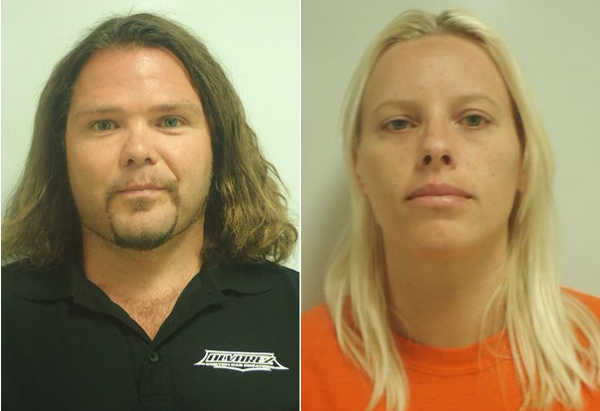
LAKEPORT, Calif. – A married couple charged with human trafficking for selling a young woman into prostitution in the Bay Area last fall made their first court appearance on Thursday.
Sam Lindsey Massette, 37, and Krystina Marie Pickersgill, 27, of Lakeport were arraigned Thursday afternoon before Lake County Superior Court Judge Michael Lunas.
Massette and Pickersgill were arrested on Tuesday following a search warrant service at their Lakeport home, according to the Lake County District Attorney’s Office.
At that time the District Attorney’s Office also seized assets including two new Jaguars, two Mitsubishi automobiles and a large sum of cash.
While Massette is reported to work in information technology and Pickersgill’s occupation is “webcam model,” according to their booking sheets, the District Attorney’s Office maintains that neither are involved in, or have, either a legitimate business or income.
District Attorney Don Anderson said the pair recruited girls at an early age while they were still in high school and then sold them into prostitution in the Bay Area.
Anderson’s criminal complaint filed on Thursday against the couple said that from Sept. 21 to 30, 2017, the two took a young woman identified as “T.P.” from Lake County to San Francisco. There they rented a hotel room and over the course of two weekends sold her services as a prostitute, posting Internet ads to solicit customers and obtaining a phone for the young woman so she could take calls in response to the ad.
“This is done under force and fear and threats,” Anderson told Lake County News after the arraignment. “They’re really good at manipulating.”
The young woman would leave the situation on her own at the end of September, Anderson said.
However, it wasn’t until she saw an April production of “Jane Doe in Wonderland” – a play about young women being lured into human trafficking – at the Soper Reese Theatre in Lakeport that she came forward to law enforcement.
At that time, she approached Anderson – who was speaking at the event – and told him her story. He subsequently launched a a nearly two-month-long investigation that led to the arrests of Massette and Pickersgill this week.
Massette and Pickersgill were in the same courtroom on Thursday, seated several feet away from each other in the jury box and wearing black and white striped jumpsuits.
In a hearing that lasted less than 10 minutes, Judge Lunas asked them a few questions, apprised them of their rights and then went over the points of the complaint the District Attorney’s Office filed against them earlier in the day.
Massette and Pickersgill are charged with four felonies: human trafficking, pimping and pandering, procuring for prostitution, and conspiring with other individuals whose identities are not yet known for the purposes of human trafficking, pimping and prostitution.
It’s also alleged that Massette has a prior serious felony conviction.
In March 2005 Massette was convicted in San Francisco of vehicular manslaughter in a case in which he originally was arrested for homicide, Anderson said.
A media report about the incident said that Massette ran over 16-year-old Nicholas Artola in a Safeway parking lot in San Francisco in February 2002 during a gang fight.
The combatants had used fists and baseball bats until Massette showed up in a vehicle and drove toward them, hitting and killing Artola. Massette fled the scene but later was arrested after being identified by witnesses, according to the media report.
During Thursday’s arraignment, Judge Lunas found the pair were eligible for public defenders and assigned Tom Quinn to represent Massette and Ed Savin to act as counsel to Pickersgill.
Lunas ordered the bail for each to remain at $1 million.
He scheduled them to return to court at 8:15 a.m. Tuesday, June 12, for appearance of counsel and entry of plea.
Lunas also referred the case to the Probation Department for a bail review recommendation, with the bail review to take place at the time of the next hearing.
Asked if more victims are anticipated to be identified in the case, Anderson said, “Definitely.”
Since the news about the couple’s arrest broke on Wednesday, Anderson said his agency has been getting contacted by potential victims.
“We’re getting several calls,” he said. “We’re looking into all of them right now.”
Email Elizabeth Larson at
LAKEPORT, Calif. – The Lake County Registrar of Voters Office reported that thousands of ballots remain to be counted before this week’s primary election results can become final.
Registrar Diane Fridley on Thursday issued her first post-election breakdown of the ballots that remain to be counted.
She and her staff are now in the 30-day official canvass period, which requires them to finish counting several thousand absentee and provisional ballots in order to certify the June 5 election results.
The tally on Thursday was as follows:
– Vote-by-mail, or VBM, ballots received by mail by Election Day: 2,324.
– VBM ballots postmarked on or before June 5 and received June 6: 739.
– Vote-by-mail ballots dropped off at the polls on Election Day: 2,190.
– Provisional ballots from the polls: 524.
– Conditional voter registration provisional ballots: 62.
– Vote-by-mail ballots that require further review for various reasons (including damage, such as tearing or bending): 199.
Those categories total 6,038 ballots, she said.
However, there was a change in election code that went into effect in January 2016 that impacted the deadline for elections officials to receive vote-by-mail ballots returned by mail, Fridley said.
As a result, Fridley said vote-by-mail ballots that are postmarked by the US Postal Service on or before Election Day shall be considered “timely cast” if the voter’s ballot is received by the voter’s elections official no later than three days after Election Day. In this case, that’s on Friday.
Fridley said more ballots are expected to come in on Friday, which will change that final tally.
Another delay in the process is that for any vote-by-mail ballots that were not signed when they were returned, Fridley’s office has to send them a notice. The voter then gets eight days from the election – until June 13 – to sign the ballot.
Fridley said her office will issue another update on the total number of ballots to be counted as well as a breakdown of ballots to be counted by unincorporated county and supervisorial Districts 2 and 3 when the information is available.
Email Elizabeth Larson atThis email address is being protected from spambots. You need JavaScript enabled to view it. . Follow her on Twitter, @ERLarson, or Lake County News, @LakeCoNews.
Registrar Diane Fridley on Thursday issued her first post-election breakdown of the ballots that remain to be counted.
She and her staff are now in the 30-day official canvass period, which requires them to finish counting several thousand absentee and provisional ballots in order to certify the June 5 election results.
The tally on Thursday was as follows:
– Vote-by-mail, or VBM, ballots received by mail by Election Day: 2,324.
– VBM ballots postmarked on or before June 5 and received June 6: 739.
– Vote-by-mail ballots dropped off at the polls on Election Day: 2,190.
– Provisional ballots from the polls: 524.
– Conditional voter registration provisional ballots: 62.
– Vote-by-mail ballots that require further review for various reasons (including damage, such as tearing or bending): 199.
Those categories total 6,038 ballots, she said.
However, there was a change in election code that went into effect in January 2016 that impacted the deadline for elections officials to receive vote-by-mail ballots returned by mail, Fridley said.
As a result, Fridley said vote-by-mail ballots that are postmarked by the US Postal Service on or before Election Day shall be considered “timely cast” if the voter’s ballot is received by the voter’s elections official no later than three days after Election Day. In this case, that’s on Friday.
Fridley said more ballots are expected to come in on Friday, which will change that final tally.
Another delay in the process is that for any vote-by-mail ballots that were not signed when they were returned, Fridley’s office has to send them a notice. The voter then gets eight days from the election – until June 13 – to sign the ballot.
Fridley said her office will issue another update on the total number of ballots to be counted as well as a breakdown of ballots to be counted by unincorporated county and supervisorial Districts 2 and 3 when the information is available.
Email Elizabeth Larson at

LAKE COUNTY, Calif. – Two Clearlake Oaks residents and a Lucerne couple have been arrested for their involvement in a Kelseyville burglary earlier this week.
Misty Rose Scott, 39, and Ian Skyler Sanders, 25, both of Clearlake Oaks, and Jessica Mae Sanders, 24, and her husband James Michael Shane Jackson, 30, both of Lucerne have been taken into custody in the case according to Lt. Corey Paulich of the Lake County Sheriff’s Office.
On Tuesday Lake County Sheriff’s Deputies responded to the 2000 block on Westlake Drive in Kelseyville for a report of a burglary that had occurred. Paulich said the victims reported more than 30 items stolen from the residence that were worth more than $5,000.
The victims’ surveillance system captured three subjects who Paulich said the deputies recognized from previous contacts – Scott, Ian Sanders and Jessica Sanders – removing items from the residence.
Paulich said Scott was on California Department of Corrections and Rehabilitation parole and Jessica Sanders was on felony probation.
He said the victims were familiar with Scott because one of her family members occasionally stayed at the victim’s residence and she had picked up the family member from the residence.
Deputies went to Jessica Sanders’ residence in Lucerne where they contacted the three suspects as well as Jackson, who also was on felony probation, Paulich said.
Paulich said one of the deputies noticed a vehicle leave Sanders’ residence just prior to making contact with the suspects.
The deputy contacted the occupants of the vehicle and learned they had just purchased a laptop computer and cell phone from Scott. Paulich said the items were identified as stolen and were recovered.
Deputies interviewed the suspects regarding the burglary. The suspects provided conflicting statements along with some admissions. Paulich said Ian Sanders told deputies he and Jackson hid an iPad that they had taken in a creek bed because they were worried it could be tracked. Deputies were able to locate and recover the iPad.
Deputies were able to locate and recover the remaining stolen property at the Lucerne residence, Paulich said.
All four suspects were arrested and booked at the Lake County Jail on charges of burglary, possession of stolen property, and conspiracy to commit a crime, according to Paulich.
Paulich said Scott also was charged with a violation of her parole, while Jackson and Jessica Sanders were charged with a violation of their felony probation.
Scott, Jackson, and Jessica Sanders remained in custody on Thursday on no bail parole and probation violation holds, while Ian Sanders remained in custody with bail set at $50,000, Paulich said.
All of them were arraigned in Lake County Superior Court before Judge Michael Lunas on Thursday afternoon.