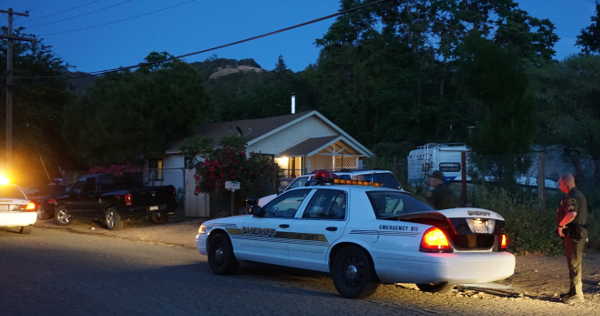
Lake County Sheriff’s deputies were processing the scene of a shooting in Lucerne, Calif., on the night of Saturday, June 2, 2018. Photo by Elizabeth Larson/Lake County News. LUCERNE, Calif. – Authorities have arrested a man who they say shot another man in the chest during a Saturday night argument.
The incident occurred at a residence at the corner of 15th Avenue and Highway 20 in Lucerne, according to Lake County Sheriff’s Sgt. Mike Davis.
Davis said deputies were dispatched to a report of some kind of an argument going on at the residence shortly after 8 p.m. Saturday.
He said it was reported that a shot had been fired inside of the house.
When the deputies arrived, Davis said they separated four subjects, including the man who they took into custody for the shooting.
There was just one victim, a man who was shot in the chest, Davis said.
“I don’t know how serious the injury is,” said Davis, who at that point said he hadn’t been able to speak with Northshore Fire personnel regarding the extent of the victim’s injuries.
A CalStar air ambulance responded to a landing zone at Lucerne Harbor Park shortly after 8:45 p.m. to transport the victim to an out-of-county trauma center, according to radio traffic.
Four sheriff’s units were at the shooting location on Saturday night, where Davis said the deputies were processing the scene.
In a nearby patrol SUV the deputies had the man who they believed to be responsible for the shooting in custody, Davis said.
“We are making an arrest on one subject,” he confirmed.
The house was cleared and remained under the sheriff’s office’s control while the investigation continued, Davis said.
One of the deputies emerged from the residence carrying two rifles and placed them in the trunk of one of the patrol vehicles.
Davis said the rifles were being taken for safe-keeping.
At that point, Davis could not say if either one of the weapons had been used in the shooting.
“We’ll know more by Monday,” he said.
Email Elizabeth Larson at This email address is being protected from spambots. You need JavaScript enabled to view it.. Follow her on Twitter, @ERLarson, or Lake County News, @LakeCoNews.
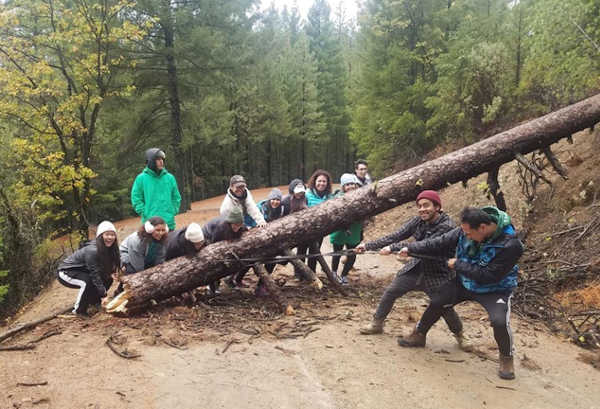
It takes teamwork to clear the trail. Photo by Janeth Alaborre, used with permission.
NORTHERN CALIFORNIA – As we near the 112th anniversary of the Antiquities Act on June 8, I want to share one of my most memorable experiences on our public lands.
Last November, with the political climate as hostile as it currently is, I was deeply saddened and searching to make sense of my role in all the mess. I was looking for peace and most crucially I was looking for strength to face the struggles ahead.
My prayers were answered, and I was invited to a weekend campout led by the Sierra Club Mother Lode Chapter and Tuleyome. It was a weekend getaway to bring awareness to the Monuments for All movement, with youth from underrepresented backgrounds.
Getting to our site was quite the adventure. Our first detour occurred when we entered the wrong campsite and discovered we had no wood for fire. It was late, the forest was filled with mist, and there was only an hour of daylight left. We needed to find our campsite.
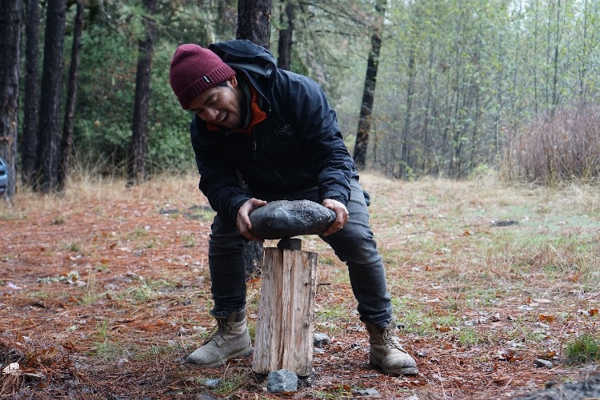
At the entrance of the campground we found some chopped tree trunks. We didn't have an ax or any tool that would allow us to chop wood for the fire but being the ingenious folks that we are, we figured out a way to get our logs: we used two rocks to chop our wood. One rock sat on the tree trunk and we used another to pound it so the impact would split the trunk. It worked!! And we had wood to burn.
After splitting enough wood, we continued to look for the correct camp site where our guide was waiting. We took a few detours, but we were soon on our way.
Our adventure didn’t end then. There had been a storm a few days prior and it had left puddles, fallen trees, and portions of the road had been transformed to mud. When we found a fallen tree across the road, we thought it impossible to continue. The tree had fallen from a hill and the roots were still in the ground.
We could have given up. We could have turned around and been done for the day. After all the earlier detours we had taken, we were tired. But, we pushed forward. We chose to find a way through.
How did we move the tree? Ee grabbed hammock straps, attached them to our vehicle, and reversed until the vehicle dragged the tree to the side opening enough space to drive through (thank you 200-pound strap capacity)!
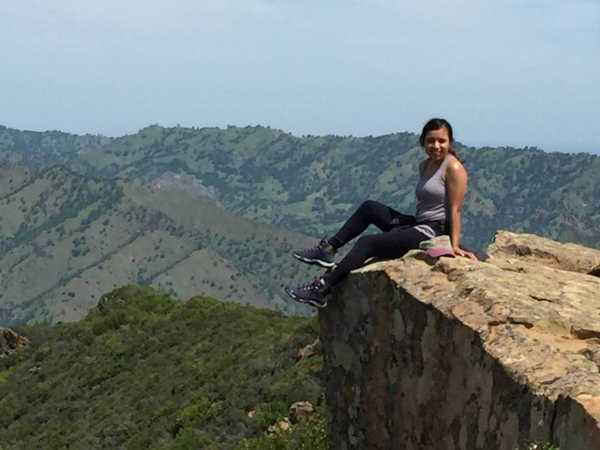
Mayra Pelagio at Annie’s Rock in the Stebbins Cold Canyon area. She is a recent graduate from UC Davis with a BS in environmental science. She is currently working on contract with Tuleyome assisting with their Hispanic/Latinx outreach and commitment to diversity, equity and inclusion. Photo by Bob Schneider, used with permission. We drove on and reached our campsite with just enough daylight to set up our tents. Alas, we found our stoves did not work. But, no worries, as we simply cooked over the fire.
We had a fantastic dinner, enjoyed each other’s company, and the beautiful starry sky. The next morning, we hiked up Berryessa Snow Mountain into Wilderness. The views were breathtakingly beautiful. There was a strong sense of community in our group that made me felt centered and peaceful.
It was an incredible trip, and if I learned anything is that we must never give up. Though it may be difficult, we have to keep trying and we have to do what we can with the pieces we are given.
The Monuments for All movement is a movement for all. I would like to encourage all people from underrepresented communities to share all the resources available to them for outdoor activities with their communities.
After our trip I felt refreshed with a renewed joy of life. I am ready to tackle the challenges to come; the racism, the threats to our environment and attacks on our public lands. I know I am not alone and I stand with our community beside me on the battlefield.
Everyone deserves to enjoy the beauty and healing powers of nature and it is important that the users of our public lands reflect the demographics of California. Diversity, youth, families, people of faith all must have this opportunity. It is all of us who will work to protect our public lands into the future.
Our public lands are a national treasure that must be preserved for future generations. We will do everything in our power to protect them.
Mayra Pelagio is a recent graduate from UC Davis with a BS in environmental science. She is currently working on contract with Tuleyome assisting with their Hispanic/Latinx outreach and commitment to diversity, equity and inclusion. Tuleyome is a501(c)(3) nonprofit conservation organization based in Woodland, Calif. For more information, visit www.tuleyome.org.
It sometime takes ingenuity and strength to split wood in the wilderness. Photo by Mayra Pelagio.
MENDOCINO NATIONAL FOREST, Calif. – State and federal firefighters have increased containment on a fire in the Mendocino National Forest.
The Open fire began Friday afternoon on Open Ridge, located 25 miles west of Willows on the forest’s Grindstone Ranger District, as Lake County News has reported.
Forest spokesman Punky Moore said that the fire had burned about 60 acres in grass, oak and mixed timber by Friday night. No structures are reported to be immediately threatened.
On Friday night Moore reported that the 100 firefighters on the scene had increased containment to 40 percent before the aircraft – including two helicopters and two wingle engine airtankers – were released for the evening.
Other resources at the scene included three engines, three water tenders and four crews, Moore said.
Moore said the fire’s cause is under investigation.
Email Elizabeth Larson at This email address is being protected from spambots. You need JavaScript enabled to view it.. Follow her on Twitter, @ERLarson, or Lake County News, @LakeCoNews.
The fifth annual California Invasive Species Action Week is scheduled Saturday, June 2, through Sunday, June 10.
Action Week is a statewide event that promotes public participation in the fight against invasive species that harm our environment, agriculture and native species.
Numerous state agencies, non-profit organizations and other organizations across the state are teaming up to host events this year.
Opportunities include educational booths in Humboldt County, online webinars, invasive species removals in the Delta and the San Francisco Bay, and trapping crayfish in the Santa Monica Mountains. To view the schedule of events and a map compiled by the California Department of Fish and Wildlife, please visit www.wildlife.ca.gov/CISAW.
Citizens can also stop the spread of invasive species year-round. People can contribute to a healthy environment by taking small, everyday actions that include cleaning, draining and drying boating gear after use, selecting native plants for landscaping, not releasing unwanted pets into the wild and reporting invasive species findings.
Members of the public are encouraged to help CDFW biologists monitor and prevent the spread of existing invasive species populations.
For example, please visit the CDFW Nutria Discovery webpage to learn how you can help CDFW eradicate this destructive South American rodent from California's wetlands.
For more information about Action Week, please contact This email address is being protected from spambots. You need JavaScript enabled to view it..
How are debts and other claims against a decedent’s estate handled in California?
Often a properly completed creditor’s claim form needs to be timely filed in a probate court proceeding. (Note: An equivalent court proceeding is sometimes opened by the trustee of the decedent’s trust estate provided no probate exists, but this is uncommon.) Other claims do not require filing a creditor claim. Let us discuss each.
Foreclosure actions by a secured creditor (e.g., a bank), claims against an Insurance Policy, and claiming a property ownership in property either possessed by or titled to the decedent’s estate do not require the filing of creditor claims.
A secured creditor or a judgment creditor with a lien against real property can simply foreclosure on the security interest and recover from the sale proceeds. A secured creditor may still have an unsatisfied portion and may file a creditor’s claim form for that amount.
A person with an insurance claim can proceed against the insurance company to the extent of the policy limits. Again, any claim above the policy limits would require filing a creditor’s claim form in a probate or trust administration proceeding.
A person claiming ownership in real or personal property possessed by or titled to the decedent’s estate can petition to recover the property without filing a creditor’s claim form.
Anyone seeking payment from the decedent’s estate must timely file a creditor’s claim form in the probate court proceedings.
Claims must be filed within one year of a decedent’s death. If no probate, or equivalent trust administration court proceeding has been opened, a creditor may open a probate proceedings in order to file their own creditor’s claim.
When a decedent dies owing large debts the surviving beneficiaries of the estate may delay administration of the decedent’s estate until past the one year anniversary of the decedent’s death to time bar creditor claims.
Generally speaking, most creditor claims become unenforceable unless filed within the first year in the decedent’s probate proceedings.
During the first four months of commencing probate, the decedent’s personal representative notifies all reasonably ascertainable creditors and provides them each with a creditor’s claim form.
A creditor then has until the end of the four months, but at least sixty days, to file a timely claim with the court and with the personal representative.
Untimely claims past the four months creditor claim period are discretionary with the court and depend on facts and circumstances. On occasion, when equity (fairness) demands, a claim may even be allowed after the one year mark.
Once filed, the personal representative has ninety days to either accept, deny or partially accept and partially deny the claim. A creditor with a rejected claim has ninety days from rejection to proceed with a lawsuit against the personal representative.
Usually a personal representative waits until the four month period is over, and perhaps later if there further creditor claims are expected, to pay the accepted claims.
If the decedent’s estate does not have sufficient assets to fully pay all accepted creditor claims the personal representative seeks court guidance on how much not to pay each creditor based on a California’s priority of debts. Expenses of administration – including the court costs and the fees owed to the personal representative and her attorney – are paid before creditor claims.
Secured debts, however, take priority even over expenses of administration to the extent of the security interest. For example, a bank mortgage must be fully satisfied before any remaining proceeds from the sale of a residence are available to the decedent’s estate to pay expenses of administration and to pay creditor claims.
Given the complexity and the grey areas in this broad area of law, persons seeking to recover against a decedent’s estate should consult a qualified attorney in order to proceed properly.
Dennis A. Fordham, attorney, is a State Bar-Certified Specialist in estate planning, probate and trust law. His office is at 870 S. Main St., Lakeport, Calif. He can be reached at This email address is being protected from spambots. You need JavaScript enabled to view it. and 707-263-3235. His Web site is www.DennisFordhamLaw.com.
Off the coast of Hawaii’s Big Island and more than 3,000 feet beneath the ocean surface lie the warm, bubbling springs of a volcano — a deep-sea location that may hold lessons for the search for extraterrestrial life.
Here, NASA and its partners are blending ocean and space exploration, with a project called SUBSEA, short for Systematic Underwater Biogeochemical Science and Exploration Analog.
Lessons learned in both fields will be mutually beneficial and could help design future science-focused missions across the solar system.
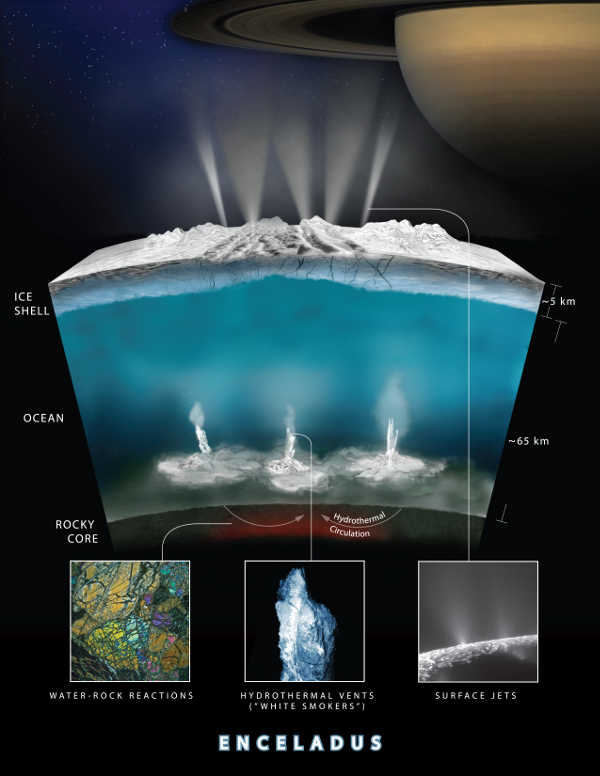
Saturn’s moon Enceladus and Jupiter’s moon Europa are thought to have liquid oceans and hydrothermal activity under icy crusts.
Locations on Earth with key similarities to future deep-space destinations are called analog environments. SUBSEA’s target, the springs emerging from a volcano forming the next Hawaiian island, called the Lō`ihi seamount, is an analog for these ocean worlds.
When NASA’s Cassini mission to Saturn discovered a plume of water erupting from beneath the icy surface of Enceladus, the characteristics of the plume told scientists what conditions might be like on the sea floor.
This included the temperature, pressure and composition, and suggested the presence of hydrothermal activity. Scientists think these moons are good places to look for potential life, because water interacting with rock on their sea floors could yield chemical reactions that would make microbial metabolism possible.
Lō`ihi is an especially good place to test predictions about seafloor hydrothermal systems and their ability to support life.
Previous research focused more on locations where tectonic plates come together, but the Lō`ihi seamount involves molten magma erupting from the middle of one of these plates.
This is the type of volcanic activity scientists think could be similar to seafloor volcanoes that may exist on Europa and Enceladus. The zones where plates meet may actually be too hot to provide a realistic representation of hydrothermal activity on the moons of Jupiter and Saturn.
Throughout the 2018 SUBSEA expedition aboard the vessel Nautilus, the team’s scientists from NASA, the National Oceanic and Atmospheric Administration and various academic institutions will study the conditions around Lō`ihi’s seafloor springs across a range of pressures and temperatures.
What they learn here will increase our understanding of the potential for conditions that could support life forms on other ocean worlds.
Abby Tabor works for NASA's Ames Research Center in Silicon Valley, Calif.
Artist rendering showing an interior cross-section of the crust of Enceladus, which shows how hydrothermal activity may be causing the plumes of water at the moon’s surface. Credits: NASA-GSFC/SVS, NASA/JPL-Caltech/Southwest Research Institute.
 How to resolve AdBlock issue?