 How to resolve AdBlock issue?
News
This is a story more than 4.5 billion years in the making. We’ve always referred to Mars as the red planet because of its surface color. But what’s below that dusty crust? We don’t know.
A new NASA mission is determined to find out. On May 5, 2018, an Atlas V rocket launched the InSight Lander to Mars. InSight is a 19 foot (6 meter), 794 pound (360 kg) solar powered data gathering machine, armed with a nearly 8 foot (2.4 meter) robotic arm and an array of specialized sensors.
Over the two years of its primary mission, or a little over one Martian year, InSight will help scientists determine the structure of the Martian interior, including the size of the planet’s core, and the thickness of its crust and mantle.
It will also help scientists determine the elements found in the core and the composition of the crust and mantle.
Bruce Banerdt is InSight’s principal investigator at NASA's Jet Propulsion Laboratory in Pasadena, California. “Information gleaned from the mission,” he explained, “will help scientists compare what’s found in Mars to what we believe is deep inside our own planet. It will also help improve the computer models of early planet formation of our neighbors in the inner solar system, and even what may be inside rocky exoplanets. In essence, it could help us better understand how planets are born.”
Shortly after landing, InSight’s robotic arm will lift a seismometer and heat probe from its deck and place them on the surface. A camera on the arm will show a color 3D view of the landing site. Sensors will measure weather and magnetic field variations. And then the real work begins.
The heat probe will burrow itself into the crust, millimeters at a time, until it reaches a depth of about 16 feet (5 meters) and then measure how warm the interior is and how much heat is flowing through the planet.
The seismometer, on the other hand, will measure the tectonic activity on the planet. Just how many – not earthquakes but Marsquakes – are produced over time? How powerful are they? Do they have a pattern or are they randomly located?
When a quake occurs on a planet, it releases waves of energy that bounce throughout the interior of that planet.
The waves travel at different velocities depending on the geologic material they travel through, and if the waves travel along the surface or deep into the planet. Insight’s seismometers will measure the size, frequency and speed of these waves, giving scientists a snapshot of the material they pass through.
Banerdt said, "It's a bit like taking a CT scan of a planet."
And InSight will not only look below, but above, measuring how often meteorites impact the surface.
Combined, InSight’s many experiments may help scientists explain why some rocky planets turn into an "Earth" rather than a "Mars" or "Venus". And that’s a factor that’s essential to our understanding of where life can appear in the universe.
To get even more InSight into this first-of-its-kind mission, visit http://science.nasa.gov.

THIS STORY IS BEING UPDATED ON A ROLLING BASIS.
CLEARLAKE OAKS, Calif. – Firefighters from around Lake County and beyond are responding to a wildland fire in the Spring Valley Lakes subdivision east of Clearlake Oaks that has resulted in a call for mandatory evacuations in all of Spring Valley.
The Pawnee fire was first reported shortly before 5:30 p.m. in the 2500 block of Pawnee Trail near New Long Valley Road in Spring Valley. However, firefighters later put the fire’s location elsewhere, accessing it from Spring Valley and Wolf Creek roads, and off of Quail Trail, according to radio reports.
Cal Fire and Northshore Fire were among the first units to respond, with additional fire agencies from around Lake County – and Cal Fire units from Mendocino County – being requested to send equipment and firefighters.
The Cal Fire battalion chief at scene reported that the fire is “well-established” on the top of a ridge, with issues accessing it. Some firefighters were attempting to access it from the Double Eagle subdivision nearby.
As of 5:45 p.m. three copters, five dozers, four water tenders and numerous engines – as many as 20, based on radio reports – were responding.
Initial size estimates on the fire had been as high as 100 acres, which was dialed back to less than 50 acres just before 6 p.m., according to reports from the scene.
At about 6 p.m. incident command requested that Spring Valley Road at Highway 20 be closed to incoming traffic.
Although as of 6 p.m. it was reported that there was no immediate structure threat, incident command asked for the sheriff’s office to respond to help with evacuations.
At the same time, Cal Fire put the fire at 75 acres in size.
Just before 6:30 p.m., incident command followed up by calling for mandatory evacuations off of Quail Trail and advisory evacuations in the area of Quail Trail at Chalk Mountain Road. Minutes later, evacuations were called for all of Wolf Creek Road and then for Chalk Mountain Road.
Then, at 6:46 p.m., a call was put out to evacuate all of Spring Valley.
Radio traffic indicated evacuees are being directed to the Clearlake Oaks Moose Lodge.
More engines were staging for a short time at the Spring Valley fire house while dozers worked to gain access. Resources were then directed through to the scene.
Cal Fire air attack reported that the fire had reached about 400 acres by 9 p.m., with the fire continuing on a moderate rate of spread, pushed by north winds that are expected to continue through the night and into Sunday morning.
Additional updates based on radio reports and Nixle alerts are being posted below.
INCIDENT UPDATES
6:05 p.m.: Cal Fire puts the fire’s size at 75 acres with no containment.
7:09 p.m.: The Lake County Sheriff’s Office issued the following Nixle alert: “This is a Mandatory Evacuation Notice for ALL of Spring Valley. A temporary staging area for evacuees has been set up at the Moose Lodge, Hwy 20 & 53. Please leave immediately and watch for emergency vehicles.”
7:13 p.m.: Fire has progressed to the south beyond Salt Lick Canyon.
7:46 p.m.: The Lake County Sheriff’s Office issued the following Nixle alert: “A shelter is in the process of being established for evacuees from Spring Valley at Lower Lake High School, 9430 Lake Street. Drive carefully and watch for emergency vehicles.”
7:51 p.m.: Incident command reports that 25 homes are immediately threatened by the fire.
7:57 p.m.: Air Attack 110 assuming Pawnee air attack.
8:51 p.m.: Requesting two additional dozers, agency or private, within an hour's response time of the incident.
8:57 p.m.: Fire is cresting a ridge but is not reported to be an immediate threat to Doe Trail. Dozers are working on the fire’s western side.
9:03 p.m.: Pawnee air attack reports the fire is at 400 acres, with a moderate rate of spread, making a run in chaparral and brush. It’s being pushed by a north wind.
9:12 p.m.: Cal Fire Dispatch’s report on conditions said gusty north winds are expected to continue through the night with gusts of up to 25 miles per hour, very dry conditions, north wind gusts of up to 22 miles per hour Sunday morning.
Email Elizabeth Larson at
The First 5 Lake Children’s Champions for the second quarter of 2018 are: Ana Santana, Healthy Start director at Lake County Office of Education; Mary Prather, grants coordinator for Easter Seals Bay Area; Brandy Perry, resource and referral manager for North Coast Opportunities’ Rural Communities Child Care Program; Barbara Green, children’s service coordinator for Lake County Libraries; and David and Denice Solgat, foster and adoptive parents.
The first five years of a child’s life, starting in the prenatal period, provide the greatest window of opportunity to build a strong foundation for lifelong health and wellbeing.
What happens to and for each child in those first five years is critically important for our society. Responsive and nurturing care, provided in safe, engaging environments fosters healthy brain development.
A lack of these things, or the presence of chronic stressors (poverty and discrimination) and adverse childhood experiences (abuse and neglect, parental mental illness and substance abuse, or family violence) can disrupt healthy brain development in children, creating lifelong negative impacts on learning, behavior and health.
Because not every child begins life with the same strong foundation and because risk factors for adverse childhood experiences and chronic stress are high in Lake County, First 5 Lake wants to shine a light on those in our community who are making a positive difference in the lives of our youngest citizens and inspire others to do the same.
Each quarter in 2018, the First 5 Lake Commissioners are recognizing “Children’s Champions” in our community – people who are going above and beyond to make sure that our youngest citizens are protected, nurtured, and prioritized.
Ana Santana
Ana Santana oversees critical services for children and families around the Lake including an oral health program that brings free dental screenings and transportation to dental care appointments for children from preschool through high school; the Nurturing Families program providing free parenting classes throughout the county (via drop-in appointments or group classes, which include dinner and child care), foster youth services in schools, the FamilyPRO program for families who have come to the attention of child welfare as needing extra support, the McKinney-Vento Homeless Student Services program, the Tobacco-Use Prevention Education program, and all basic needs services provided on school sites through Healthy Start.
In addition to this work, Santana serves as the head of both the Lake County Children’s Council and Building Resilient Lake County (a trauma-informed guide team) and is a foster parent.
Her dedication to children and families in Lake County is unparalleled and she leads, equips and advocates for a team of Healthy Start professionals who are equally as committed to the health and wellbeing of our County’s children.
Mary Prather
Mary Prather is the friendly face parents, caregivers and children see when they walk through the doors of the First 5 Early Learning Centers in Clearlake and Lakeport.
Prather truly goes above and beyond as she welcomes families into the Centers each day. As a trainer of trainers in the Ages & Stages Questionnaire (a developmental milestone screening tool), she helps parents understand what skills can be expected at each stage of their children’s development and gives them ideas for helping their children explore and grow. She has created welcoming, non-threatening, child-centered environments for families to enjoy together and has enrolled in LCOE’s Quality Rating & Improvement System (QRIS) program so that the Centers and her practices can benefit from outside coaching and ongoing evaluation.
Prather can regularly be seen at community events offering face-painting, teaching infant massage, or presenting to a variety of groups about early screening and intervention. She also oversees grants providing transportation stipends for families who need to travel out of county due to high risk pregnancy or ongoing health needs of a child.
Brandy Perry
Brandy Perry is no stranger to the First 5 Commission in her role as resource and referral Specialist at NCO. She tirelessly advocates for the needs of child care and preschool providers who serve Lake County’s children in family child care home businesses.
Perry equips, supports, and provides training for these early educators and care providers and connects families in search of high quality care with a provider that can meet their needs. She also serves as a vital member of the Local Child Care Planning Council and the QRIS Consortium.
Since the legalization of adult-use marijuana, Perry has been called upon to verify that applicants for commercial cannabis cultivation/distribution are not located within the required 1,000-foot radius of licensed child care facilities, and has been lauded by the Lake County Planning Department for her quick responses to these requests.
Barbara Green
Barbara Green has been on staff at Lake County Libraries since 2007 and has been conducting story time at the Lakeport branch since 2008.
Since 2011, Green and a team of volunteers have hosted 815 story times, class visits to schools, and class field trips to the library with an attendance of more than 32,000.
Her true love is helping children discover a love of reading and she is always ready and willing to represent the library at community events.
Families who frequent storytimes describe Green as fun and cheerful and have noted that she finds a way to make each child feel special.
One parent who nominated Green for this honor said, “It just means the world to my children to be treated that special by an adult other than their family members.”
David and Denice Solgat
Finally, David and Denice Solgat have been state-licensed foster parents in Lake County for 25 years, during which time they have fostered 500 children for varying lengths of time. In previous years they have taken in numerous children for emergency, short-term placements, but for the last seven years they have focused their energy on fostering medically fragile children with complex needs.
The Solgats’ goal is to give vulnerable children a soft place to land within their home and to advocate and partner with social workers and the children’s families for the best possible outcome – whether that is reunification with their families, adoption into another family or remaining in the Solgats’ home and becoming part of their family.
The Solgats have adopted nine children to date and are in the process of adopting two more. Family members, community members, and county health workers are a big part of the team that works together to help the Solgats create opportunities for children to maximize their potential.
The First 5 Lake Commissioners are honored to bring these Children’s Champions and their efforts to the attention of our Lake County friends and neighbors.
Members of the community are encouraged to nominate worthy Champions for Children in Lake County, by filling out a nomination form at: www.firstfivelake.org/childrens-champions.php . New Champions will be selected and honored each quarter.
Those previously honored as Children’s Champions for the first quarter of 2018 are: Christopher Veach, director of Lake County Libraries; Jeff Smith, District 2 Supervisor; Kari Donley, LVN at Adventist Health Clearlake; and the IMPACT/QRIS Team at Lake County Office of Education (Angela Cuellar-Marroquin, Angel Coppa and April Strait).
Using funds derived from CA Proposition 10’s voter-mandated tax on tobacco products, the First 5 Lake County Commission funds programs and services that benefit the health and development of young children and educate parents, grandparents, caregivers and teachers about the critical role they play during a child’s first five years.
Since its inception in 2000, First 5 Lake has supported thousands of families with programs and services designed to help Lake County children grow up healthy and ready to succeed in school and life. Current First 5 Lake Commissioners are: Pam Klier, Denise Pomeroy, Brock Falkenberg, Tina Scott, Crystal Markytan, Susan Jen, Laurie Daly, Carly Swatosh and Allison Panella.
Rachael Taylor of the firm Civitas Advisors and Deputy County Administrative Officer Michelle Scully appeared before the board to discuss the district’s formation.
The county staff report explained that the Lake County Tourism Improvement District is a benefit assessment district meant to help fund marketing and sales promotion efforts for lodging businesses in Lake County, including the cities of Lakeport, and Clearlake.
A presentation was given to the Lakeport City Council earlier this month, as Lake County News has reported.
The district will collect a 3-percent assessment from accommodations businesses throughout the county, which will be a pass-through to customers. That’s in addition to the 10-percent transient occupancy tax paid by the same businesses.
It’s estimated that the 3-percent assessment will bring in $340,000 countywide.
The funds don’t belong to the government and instead will be held and managed by a nonprofit destination management organization that is now being formed.
Scully said county staff had asked the board in November to approve moving forward with Civitas Advisors. The firm is helping the county through an interesting and collaborative legal process with many steps.
“Today is one of the key steps in this process,” said Taylor, explaining that the board was considering the resolution of intention to form the district.
She said they were there to show evidence of support. In order to hold the hearing, they had gathered petitions signed by hoteliers and lodging owners from throughout the county in favor of the district’s formation. Those petitions were weighted on what the lodging owners would pay.
Taylor said they had 58.6 percent of hoteliers in support; they needed 50 percent plus one. “We know that there are a few others out there.”
She said that after the hearing, a notice would be mailed out from the county to every lodging owner that they have information for that would pay the assessment. Those businesses would then have 45 days to protest or support it.
There will then be a public meeting in July during which the board will hear support or opposition from business owners; Taylor said the board will take no action at that meeting.
The proposal will be taken to the two cities, which will have to grant consent. Taylor said the cities will consider their resolutions in July, and then, if approved, the final resolution of formation will go before the supervisors on Aug. 7.
Lisa Wilson, general manager of the Clear Lake Campground in Clearlake, said she signed a petition in support, adding that her campers will support the increase.
City Manager Greg Folsom also gave his support. He said he’s worked in other jurisdictions with tourism improvement districts. “They’re very important.”
He said Lake County is competing against other jurisdictions that have such districts. Folsom said the county needs to do a better job of attracting tourists.
Taylor said the district will create a stable funding source for marketing the county, and sets in place an organization that will represent the county for tourism at an “all-encompassing level.”
She said that during this process they have noticed a lack of connectivity and communication between businesses and the government jurisdictions. “This will kind of solve that problem as well.”
Supervisor Moke Simon, who also is chair of the Middletown Rancheria – which owns Twin Pine Casino – thanked everyone for bringing the proposal this far, noting he was excited about it.
The board unanimously adopted a resolution declaring intent to establish the Lake County Tourism Improvement District, and approved a second resolution requesting consent of the city councils of Lakeport and Clearlake to establish the district. Supervisor Rob Brown was absent for the vote.
“This is momentous as far as we’re concerned,” said Board Chair Jim Steele.
Also on Tuesday, Supervisor Brown presented a proclamation to Richard Schmidt appointing Schmidt as Lake County Poet Laureate for the years 2018-2020.
Simon also presented a proclamation recognizing the 50th anniversary of Hidden Valley Lake.
In other business, the board held a nuisance abatement hearing request regarding Toby Coleman’s property at 3905 Gaddy Lane in Kelseyville, with a request to bring it back at a future meeting.
The board also received a presentation from Lake County Environmental Health and Eric Rapport of the State Water Quality Control Board regarding the Lake County Local Agency Management Programs for onsite wastewater treatment systems, and considered Eastlake Sanitary Landfill solid waste disposal fees and amendment one to the franchise solid waste hauler contracts.
Email Elizabeth Larson at

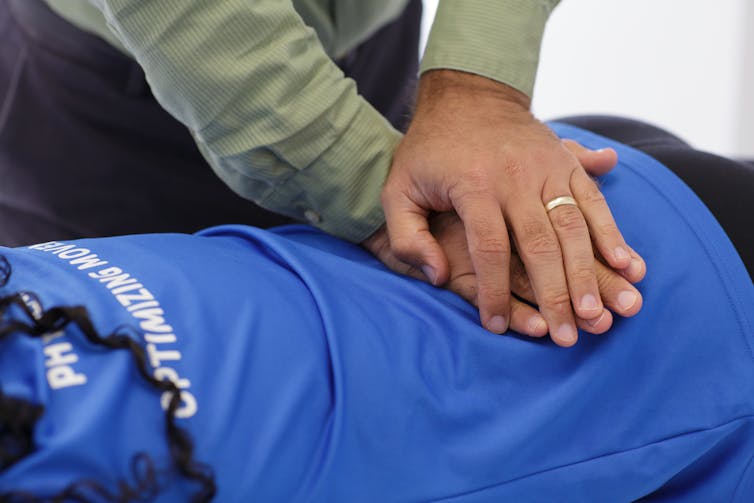
Physical therapists Steven Hunter and Laura Hayes teach an unidentified patient lumbar stabilization exercises at the Equal Access Clinic in Gainesville, Florida. Maria Belen Farias, UF Health Photography, CC BY-SA
Physical therapists help people walk again after a stroke and recover after injury or surgery, but did you know they also prevent exposure to opioids? This is timely, given we are in a public health emergency related to an opioid crisis.
Many people addicted to opioids are first exposed through a medical prescription for pain. Opiate-based drugs provide relief for acute conditions, such as post-surgical pain.
Unfortunately, the effectiveness of opioids decreases after time, requiring higher doses of the drug for the same effects and, perhaps counter-intuitively, worsening pain in some people. Many people progress from this prescription to other opiate derivatives, including heroin and fentanyl. As a result, a growing emphasis has been placed on nonpharmacological alternatives to opioids.
I am a physical therapist and I have studied non-pharmacological methods of preventing the transition from acute to chronic pain. It’s an exciting time for the field, because practice and research are showing that physical therapy could diminish the need for opioids, and thus lower the risk of addiction.
Reducing initial exposures to opioids
Part of the proposed solution to the opioid crisis is to limit new opioid exposures. Physical therapists are an important part of this process. And it is not just physical therapists who are saying this.
A letter to the president from the Commission on Combating Drug Addiction and the Opioid Crisis stated, “individuals with acute or chronic pain must have access to non-opioid pain management options. Everything from physical therapy, to non-opioid medications, should be easily accessible as an alternative to opioids.” U.S. Surgeon General Jerome Adams echoed this call for alternative treatments, including physical therapists.
The Centers for Disease Control and Prevention also issued prescribing guidelines in 2016 that recommend physical therapists be considered a first-line treatment for people with chronic pain conditions.
Research supports these positions, including research papers studying opioid use for common musculoskeletal pain conditions like back, knee and neck pain.
These studies show quite convincingly that the probability of receiving a prescription for opioids is 89 percent lower for people seeing a physical therapist for pain. Seeing the physical therapist sooner, rather than later, makes this protective effect even greater.
Why don’t more people see a physical therapist?
People in pain can go directly to a physical therapist in every state. So why don’t more people to do this? The simple answer: time and money.
Steven George, the director of musculoskeletal research for the Duke Clinical Research Institute, recently wrote, “Our existing health care system is designed to treat pain through easily delivered products, like opioids, injections and surgery,” suggesting that alternatives are not as easily delivered.
Only about 10 percent of people who see a physician for back pain get referred to a physical therapist. Only 37 percent of those people actually go. The process to make an appointment can be lengthy and time-consuming, and insurance companies often slow down the process. Some HMO insurance plans require that physical therapy treatment be certified as medically necessary, or they will not pay. And, there’s another step: pre-authorization. This, too, delays the access to covered care even more. For a person in pain and in need of help, this is a deterrent. It’s much easier to ask for a pill.
Then there is the cost. Physical therapists are often classified as specialists, so co-payments may be as high as US$75 a visit. The average patient with back pain sees a physical therapist for seven visits. Even with insurance coverage, this episode of care still will cost the person over US$500 out of pocket compared to the cost of a single primary care visit and prescription. Several states, including Kentucky, have enacted laws limiting co-payment for many services. One of the recommendations from the President’s Commission was that alternatives to opioids, including physical therapy, should be adequately covered by payers. These recommendations have yet to be acted upon.
 So what does all of this mean for people in pain? First, seeing a physical therapist is effective for many pain conditions. Second, getting to a physical therapist sooner rather than later decreases the use of opioid medication. The current health care system must change in order for people in pain to access this safe and effective non-opioid alternative for pain management.
Mark Bishop is Associate Professor of Physical Therapy, University of Florida
This article was originally published on The Conversation. Read the original article.
The Digital Refuge Web site, unveiled Wednesday on World Refugee Day, tracks in vivid words and imagery the odyssey of refugees who have stayed in camps in Greece en route to other parts of Europe.
Its launch is timely as debates rage over tough immigration policies that include family separation at the U.S.-Mexico border, and a travel ban on nationals from several majority Muslim countries, which the Supreme Court is expected to rule on next week.
"Heartless immigration policies, including separating families at the U.S. southern border, underscore the importance of understanding the living conditions and needs of migrants and refugees worldwide," said project co-leader Katerina Linos, a UC Berkeley law professor and co-director of the Miller Institute for Global Challenges and the Law.
Analyzing social media data, ethnography and non-governmental organization databases, Linos and fellow faculty, staff and graduate students created the multimedia project to allow users to explore camp conditions and compare on-the-ground experiences to government reports. Their data is based on more than 6,000 interviews and 10,000 Facebook posts.
"Our hope is that Digital Refuge will help governments, aid organizations, policymakers, and the public to better understand and address refugees’ everyday issues and concerns," Linos said.
For example, Linos notes, while refugees are in need of food, clothing and shelter, they also rely heavily on mobile technology such as smartphones, WhatsApp and Facebook to stay in touch with family and other support networks. That means they need access to Wi-Fi.
Also of great concern are sudden changes in immigration policy, such as the proposed ban on travelers from Syria, Iran, Yemen, Libya and Somalia.
"Our research shows that while governments often change policies quickly to deal with emergencies, this sows confusion and deep distrust among migrants and refugees, and turns them away from government and aid organizations, and towards smugglers and other informal information brokers," Linos said.
According to international law, refugees are people who have fled their homelands fearing persecution, and are entitled to basic protections under international law, such as the right not to be turned back to danger. Migrants include many more groups, including people who are fleeing poverty and other adverse conditions in search of a better life.
As wars, droughts, famines and other humanitarian crises break out around the world, the line between refugees and migrants is becoming blurred, though the legal definition of a refugee remains enshrined in the 1951 Refugee Convention.
That said, Linos predicts immigrants and refugees alike will be paying close attention to the Supreme Court decision regarding the travel ban, which is expected to be handed down Monday.
"Whichever way the decision goes, it will have a huge impact not only on people who want to visit, work, and study in the U.S., but also on Americans’ long-term trust in U.S. institutions, and on our global standing," she said.
The Digital Refuge project is funded by a Carnegie Fellowship awarded to Linos, and by seed funding from the Center for Information Technology in the Interest of Society and the Banatao Institute (CITRIS) awarded to Linos and to UC Davis law professor Anupam Chander.
In addition to Linos and Chander, leaders of the Digital Refuge project include UC Berkeley Ph.D. students Laura Jakli and Melissa Carlson, and Patty Frontiera from the UC Berkeley’s D-Lab and Stavros Spyrellis from the Centre national de la recherche scientifique.