How to resolve AdBlock issue?
News
CLEARLAKE OAKS, Calif. – A one-stop local assistance center to help Pawnee fire survivors is set to open on Thursday, according to county officials.
The Lake County Department of Social Services is working with local nonprofit agencies, county and state organizations to provide the center for those impacted by the fire, which began on Saturday.
On Wednesday the mandatory evacuation for Spring Valley Lakes was lifted, as Lake County News has reported.
The local assistance center, or LAC, will be open from 9 a.m. to 7 p.m. Thursday and Friday, and 10 a.m. to 3 p.m. Saturday at the Spring Valley Community Center, located at 3000 Wolf Creek Road.
A wide-ranging array of services and expertise will be available.
Some of the organizations that will be present include American Red Cross, North Coast Opportunities, United Methodist Church, Lake County Animal Care and Control, Behavioral Health, Social Security Administration, Social Services, Habitat for Humanity and Hope Animal Response, to name a few.
If you need food, assistance accessing medical care, come to the LAC. If you have concerns about your animals, debris removal or even insurance matters, there will be people on site at the LAC to help. If you need replacement copies of vital records, or a new driver’s license, come to the LAC.
All of these organizations will be there to help make profoundly complicated situations a little bit easier, and offer some of the first building blocks of successful long-term recovery.
For more information, contact the Department of Social Services at 707- 995-3260.
The Lake County Department of Social Services is working with local nonprofit agencies, county and state organizations to provide the center for those impacted by the fire, which began on Saturday.
On Wednesday the mandatory evacuation for Spring Valley Lakes was lifted, as Lake County News has reported.
The local assistance center, or LAC, will be open from 9 a.m. to 7 p.m. Thursday and Friday, and 10 a.m. to 3 p.m. Saturday at the Spring Valley Community Center, located at 3000 Wolf Creek Road.
A wide-ranging array of services and expertise will be available.
Some of the organizations that will be present include American Red Cross, North Coast Opportunities, United Methodist Church, Lake County Animal Care and Control, Behavioral Health, Social Security Administration, Social Services, Habitat for Humanity and Hope Animal Response, to name a few.
If you need food, assistance accessing medical care, come to the LAC. If you have concerns about your animals, debris removal or even insurance matters, there will be people on site at the LAC to help. If you need replacement copies of vital records, or a new driver’s license, come to the LAC.
All of these organizations will be there to help make profoundly complicated situations a little bit easier, and offer some of the first building blocks of successful long-term recovery.
For more information, contact the Department of Social Services at 707- 995-3260.
One of Lake County’s members of Congress said Wednesday that he and several of his colleagues went to see for themselves a facility housing minors separated from their families after crossing the US border.
Representatives Mike Thompson (CA-05), Doris Matsui (CA-06), Jimmy Panetta (CA-20) and Brad Sherman (CA-30) visited a private nonprofit facility in Virginia that houses children separated from their parents at the border as a result of the administration’s “zero tolerance” policy.
The group condemned the family separation policy and called for children to be reunited immediately.
They issued the following joint statement:
“The children we met today have faced unimaginable horrors coming to the United States, and the trauma of that journey is only perpetuated the longer they are separated from their families. Today’s visit only underscored the extreme urgency with which we must work to reunite families and the lasting trauma the Trump Administration’s inhumane policy has caused on thousands of children. While we appreciate that this experienced facility is providing necessary care, no standard of care can meet the needs of children desperate to see their families again and the Administration must present its policy for a swift reunification infrastructure immediately.”
Thompson also released the video above in which he discusses his visit to the facility.
“We need to figure out how to do this right. We can secure our borders. We can improve our immigration system and we can do it in a humane way, in a moral way,” he said. “The way the kids are being treated isn’t about immigration, it’s about morals. We need to get this right.”
He concluded by calling for comprehensive immigration reform and reuniting the children with their parents “as soon as we can.”
Thompson represents California’s Fifth Congressional District, which includes all or part of Contra Costa, Lake, Napa, Solano and Sonoma counties.
On Wednesday, seven and a half years after taking office and inheriting a $27 billion budget deficit, California Gov. Edmund G. Brown Jr. signed his final state budget, which his office said fills the Rainy Day Fund to the brim and sends record funding to California’s classrooms.
“When I took office back in 2011 with the state facing a $27 billion deficit, I pledged to work with the Legislature to fix California’s financial mess,” said Governor Brown. “Today, the final budget I sign delivers on that pledge and prepares us for the future.”
The governor was joined by Senate President pro Tempore Toni Atkins, Assembly Speaker Anthony Rendon and budget chairs Senator Holly J. Mitchell and Assemblymember Phil Ting.
“This budget is the product of all of us working together to craft a fiscally responsible plan that serves the people of California while at the same time saves for the future,” said Senate President pro Tempore Atkins. “I especially want to thank Governor Brown’s leadership – in this, his last budget – for helping to bring back California from a historic recession and onto a solid economic footing.”
“Devastating budget cuts first compelled me to run for the Assembly. I thought we needed to do better, and this budget does better,” said Assembly Speaker Rendon. “There is more to do, but by investing in our people and saving for the future, this budget gives us the tools we need to keep doing better.”
“Gov. Brown has done an admirable job in leading our state out of budget deficits to financial stability. This is a spending plan we can be proud of because it makes the right investments and reflects many of California’s values,” said Assemblymember and Assembly Budget Committee Chair Ting. “I’m especially glad we were able to partner with cities and counties to help them address the homeless crisis with unprecedented funding for more shelters and services.”
“This budget strikes an appropriate balance that strengthens our state’s fiscal stability with an unprecedented level of reserves, while prioritizing investments that will address the pressing needs of this state,” said Senator and Senate Budget and Fiscal Review Committee Chair Mitchell. “We continue to work toward restoring programs that still have yet to be made whole from devastating cuts during the great recession and prioritize funding to confront the challenges associated with homelessness and disaster response.”
The Governor’s Office outlined the following details of the 2018-19 State Budget:
Saving for uncertain times
The state’s Rainy Day Fund, established by a vote of the people in 2014, saves money when the economy is strong for uncertain times ahead. By the end of 2018-19, the current economic expansion will have matched the longest in post-war history. The budget fully fills the fund, growing the balance to an unprecedented $13.8 billion.
Supporting our schools
The budget increases funding by more than $4,600 per student over 2011-12 levels and directs $78.4 billion in funding to K-14 schools – a 66 percent increase in annual funding from seven years ago. Additionally, the state will fully implement the Local Control Funding Formula, correcting historical inequities in school district funding.
Counteracting the effects of poverty and combatting homelessness
The budget invests $5 billion to help address challenges with affordable housing and homelessness, including providing $500 million to assist local governments in their immediate efforts to help homeless Californians. The state also continues to provide billions of dollars to: raise the state’s minimum wage; grow the state’s Earned Income Tax Credit program; expand health care coverage to millions more Californians; restore low-income health benefits eliminated during the recession; boost CalWORKs grants; and increase child care and early education provider rates and the number of children served.
Strengthening infrastructure
This budget delivers the first full year of funding under Senate Bill 1 – the state’s Road Repair and Accountability Act – with $4.6 billion in new transportation funding in 2018-19. The funding will repair neighborhood roads, state highways and bridges, fill potholes, ease congestion in busy trade and commute corridors and improve and modernize passenger rail and public transit.
Investing in higher education
The budget continues to increase funding for the state’s university and community colleges systems with no tuition or fees hikes and establishes the state’s first-ever online community college. Since 2012, the University of California has received $1.2 billion in new funding, with $1.7 billion for the California State University and $2.4 billion for community colleges over the same period.
Combating climate change
The budget includes a $1.4 billion Cap and Trade Expenditure Plan to invest in programs that further reduce carbon pollution and support climate resiliency efforts, including $210 million for forest improvement and fire prevention projects that protect the state’s forests from wildfires and $334.5 million for the California Energy Commission and the California Air Resources Board to begin the implementation of a multi-year initiative to accelerate sales of zero-emission vehicles through vehicle rebates and infrastructure investments.
Protecting hardworking immigrants
The budget provides $79 million to support hardworking immigrants through a number of legal services programs, including deportation defense, naturalization services and DACA assistance.
The budget and related acts signed by the governor today include the following.
AB 1808 by the Committee on Budget – Education finance: education omnibus trailer bill.
AB 1809 by the Committee on Budget – Higher education trailer bill.
AB 1810 by the Committee on Budget – Health.
AB 1811 by the Committee on Budget – Human services omnibus.
AB 1812 by the Committee on Budget – Public safety omnibus.
AB 1817 by the Committee on Budget – State government.
AB 1824 by the Committee on Budget – State government.
AB 1825 by the Committee on Budget – Education finance: constitutional minimum funding obligation: local control funding formula.
AB 1826 by the Committee on Budget – State Capitol Building Annex: state office building.
AB 1827 by the Committee on Budget – No Place Like Home Act of 2018.
AB 1830 by the Committee on Budget – Budget Deficit Savings Account: Safety Net Reserve Fund.
AB 1831 by the Committee on Budget – State government: appointments: infrastructure.
AB 1834 by the Committee on Budget – Corrections: omnibus.
SB 840 by Senator Holly J. Mitchell (D-Los Angeles) – Budget Act of 2018.
SB 841 by the Committee on Budget and Fiscal Review – Budget Act of 2017: augmentation.
SB 847 by the Committee on Budget and Fiscal Review – Courts: omnibus.
SB 848 by the Committee on Budget and Fiscal Review – Transportation.
SB 849 by the Committee on Budget and Fiscal Review – Medi-Cal.
SB 850 by the Committee on Budget and Fiscal Review – Housing.
SB 852 by the Committee on Budget and Fiscal Review – State public employment: memorandum of understanding: State Bargaining Unit 6: approval.
SB 853 by the Committee on Budget and Fiscal Review – Developmental services.
SB 854 by the Committee on Budget and Fiscal Review – Public resources.
SB 855 by the Committee on Budget and Fiscal Review – Taxation.
SB 856 by the Committee on Budget and Fiscal Review – Budget Act of 2018.
SB 866 by the Committee on Budget and Fiscal Review – Employment.
SB 871 by the Committee on Budget and Fiscal Review – Income taxes: credits: motion pictures.
For full text of the Budget Act and associated legislation, visit: www.leginfo.legislature.ca.gov. Additional details on the 2018-19 State Budget can be found at www.ebudget.ca.gov.
“When I took office back in 2011 with the state facing a $27 billion deficit, I pledged to work with the Legislature to fix California’s financial mess,” said Governor Brown. “Today, the final budget I sign delivers on that pledge and prepares us for the future.”
The governor was joined by Senate President pro Tempore Toni Atkins, Assembly Speaker Anthony Rendon and budget chairs Senator Holly J. Mitchell and Assemblymember Phil Ting.
“This budget is the product of all of us working together to craft a fiscally responsible plan that serves the people of California while at the same time saves for the future,” said Senate President pro Tempore Atkins. “I especially want to thank Governor Brown’s leadership – in this, his last budget – for helping to bring back California from a historic recession and onto a solid economic footing.”
“Devastating budget cuts first compelled me to run for the Assembly. I thought we needed to do better, and this budget does better,” said Assembly Speaker Rendon. “There is more to do, but by investing in our people and saving for the future, this budget gives us the tools we need to keep doing better.”
“Gov. Brown has done an admirable job in leading our state out of budget deficits to financial stability. This is a spending plan we can be proud of because it makes the right investments and reflects many of California’s values,” said Assemblymember and Assembly Budget Committee Chair Ting. “I’m especially glad we were able to partner with cities and counties to help them address the homeless crisis with unprecedented funding for more shelters and services.”
“This budget strikes an appropriate balance that strengthens our state’s fiscal stability with an unprecedented level of reserves, while prioritizing investments that will address the pressing needs of this state,” said Senator and Senate Budget and Fiscal Review Committee Chair Mitchell. “We continue to work toward restoring programs that still have yet to be made whole from devastating cuts during the great recession and prioritize funding to confront the challenges associated with homelessness and disaster response.”
The Governor’s Office outlined the following details of the 2018-19 State Budget:
Saving for uncertain times
The state’s Rainy Day Fund, established by a vote of the people in 2014, saves money when the economy is strong for uncertain times ahead. By the end of 2018-19, the current economic expansion will have matched the longest in post-war history. The budget fully fills the fund, growing the balance to an unprecedented $13.8 billion.
Supporting our schools
The budget increases funding by more than $4,600 per student over 2011-12 levels and directs $78.4 billion in funding to K-14 schools – a 66 percent increase in annual funding from seven years ago. Additionally, the state will fully implement the Local Control Funding Formula, correcting historical inequities in school district funding.
Counteracting the effects of poverty and combatting homelessness
The budget invests $5 billion to help address challenges with affordable housing and homelessness, including providing $500 million to assist local governments in their immediate efforts to help homeless Californians. The state also continues to provide billions of dollars to: raise the state’s minimum wage; grow the state’s Earned Income Tax Credit program; expand health care coverage to millions more Californians; restore low-income health benefits eliminated during the recession; boost CalWORKs grants; and increase child care and early education provider rates and the number of children served.
Strengthening infrastructure
This budget delivers the first full year of funding under Senate Bill 1 – the state’s Road Repair and Accountability Act – with $4.6 billion in new transportation funding in 2018-19. The funding will repair neighborhood roads, state highways and bridges, fill potholes, ease congestion in busy trade and commute corridors and improve and modernize passenger rail and public transit.
Investing in higher education
The budget continues to increase funding for the state’s university and community colleges systems with no tuition or fees hikes and establishes the state’s first-ever online community college. Since 2012, the University of California has received $1.2 billion in new funding, with $1.7 billion for the California State University and $2.4 billion for community colleges over the same period.
Combating climate change
The budget includes a $1.4 billion Cap and Trade Expenditure Plan to invest in programs that further reduce carbon pollution and support climate resiliency efforts, including $210 million for forest improvement and fire prevention projects that protect the state’s forests from wildfires and $334.5 million for the California Energy Commission and the California Air Resources Board to begin the implementation of a multi-year initiative to accelerate sales of zero-emission vehicles through vehicle rebates and infrastructure investments.
Protecting hardworking immigrants
The budget provides $79 million to support hardworking immigrants through a number of legal services programs, including deportation defense, naturalization services and DACA assistance.
The budget and related acts signed by the governor today include the following.
AB 1808 by the Committee on Budget – Education finance: education omnibus trailer bill.
AB 1809 by the Committee on Budget – Higher education trailer bill.
AB 1810 by the Committee on Budget – Health.
AB 1811 by the Committee on Budget – Human services omnibus.
AB 1812 by the Committee on Budget – Public safety omnibus.
AB 1817 by the Committee on Budget – State government.
AB 1824 by the Committee on Budget – State government.
AB 1825 by the Committee on Budget – Education finance: constitutional minimum funding obligation: local control funding formula.
AB 1826 by the Committee on Budget – State Capitol Building Annex: state office building.
AB 1827 by the Committee on Budget – No Place Like Home Act of 2018.
AB 1830 by the Committee on Budget – Budget Deficit Savings Account: Safety Net Reserve Fund.
AB 1831 by the Committee on Budget – State government: appointments: infrastructure.
AB 1834 by the Committee on Budget – Corrections: omnibus.
SB 840 by Senator Holly J. Mitchell (D-Los Angeles) – Budget Act of 2018.
SB 841 by the Committee on Budget and Fiscal Review – Budget Act of 2017: augmentation.
SB 847 by the Committee on Budget and Fiscal Review – Courts: omnibus.
SB 848 by the Committee on Budget and Fiscal Review – Transportation.
SB 849 by the Committee on Budget and Fiscal Review – Medi-Cal.
SB 850 by the Committee on Budget and Fiscal Review – Housing.
SB 852 by the Committee on Budget and Fiscal Review – State public employment: memorandum of understanding: State Bargaining Unit 6: approval.
SB 853 by the Committee on Budget and Fiscal Review – Developmental services.
SB 854 by the Committee on Budget and Fiscal Review – Public resources.
SB 855 by the Committee on Budget and Fiscal Review – Taxation.
SB 856 by the Committee on Budget and Fiscal Review – Budget Act of 2018.
SB 866 by the Committee on Budget and Fiscal Review – Employment.
SB 871 by the Committee on Budget and Fiscal Review – Income taxes: credits: motion pictures.
For full text of the Budget Act and associated legislation, visit: www.leginfo.legislature.ca.gov. Additional details on the 2018-19 State Budget can be found at www.ebudget.ca.gov.
CLEARLAKE OAKS, Calif. – Hundreds more firefighters joined the effort to fully contain the Pawnee fire on Wednesday, with acreage growing modestly and containment rising.
Cal Fire’s Wednesday evening report put the fire’s acreage at 13,700, up by 200 acres from the morning estimate, with 30 percent containment, a 5-percent gain during the day.
Approximately 3,066 firefighters were committed to the incident on Wednesday, along with 234 engines, 33 water tenders, 15 helicopters, 79 hand crews and 71 dozers.
A Cal Fire damage assessment released Wednesday put the total structures impacted at 27. Of those, 22 were destroyed, including 12 homes and 10 outbuildings, and five – three homes and two outbuildings – had minor damage.
Cal Fire said firefighters took advantage of favorable weather conditions to build direct control lines, but heat still continued to be a challenge on the incident.
Experts are developing a plan to repair damage to natural resources caused by fire suppression activities, Cal Fire said.
The improved conditions led to the lifting on Wednesday of the mandatory evacuation of the Spring Valley Lakes subdivision, but officials said evacuations remain in place for Double Eagle Ranch and the area of Walker Ridge.
The evacuation center at Lower Lake High School remains open, and those with animal-related needs can call Lake County Animal Care and Control at 707-263-0278.
Road closures still in effect are New Long Valley Road at Highway 20, Old Long Valley Road at Highway 20, Walker Ridge at Highway 20 and Mule Skinner Road at Highway 20.
Email Elizabeth Larson at
LAKEPORT, Calif. – Cal Fire officials are using a new tool in the battle to contain the Pawnee fire east of Clearlake Oaks.
On Wednesday, at the command center located at the Lake County Fairgrounds in Lakeport, Cal Fire hosted a small gathering to unveil the new firefighting technology.
The modeling program is called Simtable, produced by a company based in Santa Fe.
John Heggie, a fire behavior analyst with Cal Fire’s Incident Management Team 3 who led the demonstration, said that to his knowledge this is the first wildfire incident on which the program has been utilized.
Among those on hand for the demonstration were Sheriff Brian Martin, Northshore Fire Chief Jay Beristianos and Lakeport Fire Chief Doug Hutchison.
“This is a marriage of the science and fire service,” Heggie said, adding it’s a great opportunity to use private sector technology to fight fires.
In the video above, Heggie and Cal Fire staff use Simtable to do a 3-D illustration of the Pawnee fire’s progression in its first burning period.
Video and article by John Jensen. Reach him via email at

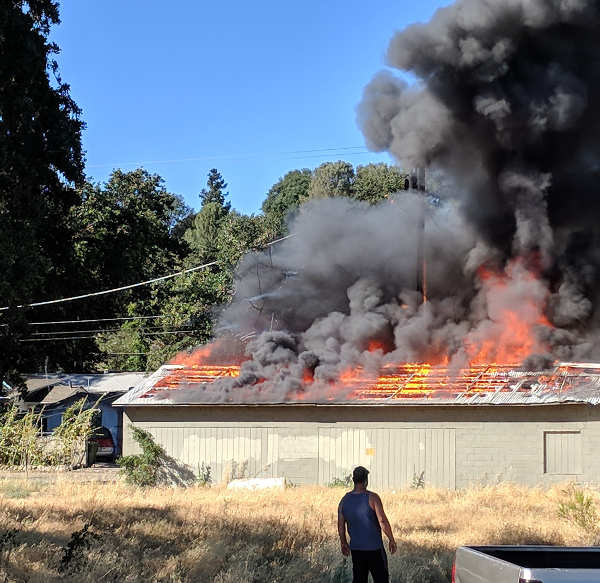
CLEARLAKE, Calif. – A Clearlake man has been arrested for setting fire to a red-tagged building on Monday.
Jason William Olson Jr., 19, was arrested on Tuesday morning, according to a report from Clearlake Police Sgt. Tim Hobbs.
Hobbs said that just after 5 p.m. Monday the Clearlake Police Department responded to a report of a structure fire near Emory Avenue and Lakeshore Drive.
Officers arrived on scene within one minute and found the abandoned red-tagged building at 14668 Lakeshore Drive was on fire, Hobbs said.
A few minutes later personnel from the Lake County Fire Protection District arrived and began to work on extinguishing the fire and preventing the spread of a small grass fire to other properties, he reported.
Hobbs said Officer Daniel Eagle spoke with witnesses and obtained a description of a person seen leaving the building shortly before they fire.
Based on the description, Hobbs said Officer Eagle believed the person was Olson.
Eagle prepared a photographic lineup which was shown to a witness who identified Olson as the person seen leaving the building, Hobbs said.
Hobbs said that at 8:40 a.m. Tuesday, Olson was contacted walking behind Safeway in Clearlake.
During an interview, Olson admitted to being in the building and accidentally starting the fire while smoking methamphetamine, Hobbs said.
Olson was arrested for unlawfully causing a fire and later transported to the Lake County Jail, according to Hobbs.
Jail records showed that Olson, whose job is listed as “landscaping,” remained in custody on Wednesday with bail set at $15,000. He is scheduled to be arraigned on Thursday.