 How to resolve AdBlock issue?
News
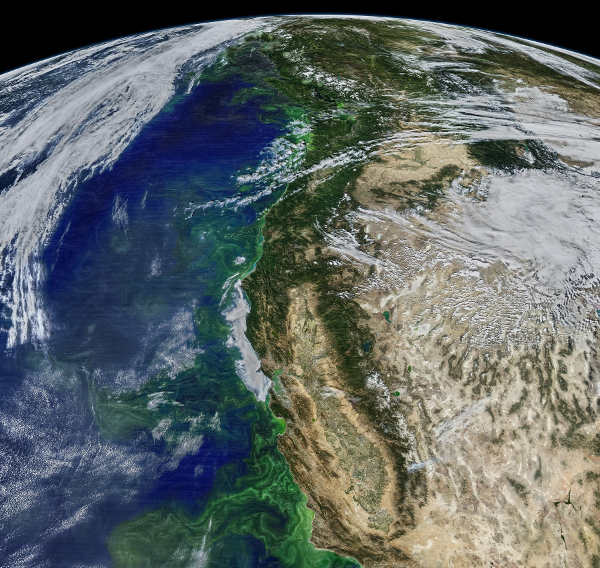
A large multidisciplinary team of scientists, equipped with advanced underwater robotics and an array of analytical instrumentation, will set sail for the northeastern Pacific Ocean this August.
The team’s mission for NASA and the National Science Foundation, or NSF, is to study the life and death of the small organisms that play a critical role in removing carbon dioxide from the atmosphere and in the ocean’s carbon cycle.
More than 100 scientists and crew from more than 20 research institutions will embark from Seattle for NASA’s Export Processes in the Ocean from Remote Sensing, or EXPORTS, oceanographic campaign.
EXPORTS is the first coordinated multidisciplinary science campaign of its kind to study the fates and carbon cycle impacts of microscopic plankton using two research vessels and several underwater robotic platforms.
The research vessels, the R/V Revelle and R/V Sally Ride, operated by the Scripps Institution of Oceanography, University of California San Diego, will sail west 200 miles into the open ocean.
From these seaborne laboratories, researchers will explore the plankton, as well as the chemical and physical properties of the ocean from the surface to half a mile below into the twilight zone, a region with little or no sunlight where the carbon from the plankton can be sequestered, or kept out of the atmosphere, for periods ranging from decades to thousands of years.
“By employing two ships we’ll be able to observe complex oceanographic processes that vary both in space and time that we wouldn’t be able to capture with a single ship,” said Paula Bontempi, program manager for Ocean Biology and Biogeochemistry at NASA Headquarters.
Phytoplankton are tiny, plant-like organisms that live in the sunlit upper ocean. They use sunlight and dissolved carbon dioxide that enters the upper ocean from the atmosphere to grow through photosynthesis, which is one way that ocean organisms cycle carbon.
As primary producers, phytoplankton play an important role in removing atmospheric carbon dioxide and producing oxygen. When phytoplankton are consumed by plankton or die, their remains sink and some fraction of their carbon is exported to depth.
While the major export pathways of how carbon moves through the ocean are known, the magnitude of the carbon flows in the different oceanic pathways and their dependence on ecosystem characteristics are poorly known.
Scientists on the EXPORTS team are investigating how much carbon moves through the ocean within the upper sunlit layer and into the twilight zone and how ocean ecological processes affect carbon fate and sequestration.
This information is needed to predict how much carbon will cycle back into the atmosphere over what time scales, or how much carbon is exported to ocean depths.
“The carbon humans are putting into the atmosphere is warming Earth,” said Mike Sieracki, program director in the National Science Foundation’s Division of Ocean Sciences. “Much of that carbon eventually finds its way into the ocean and is transported to the deep ocean, where it is sequestered and will not return to the atmosphere for a long time. This project will help us understand the biological and chemical processes that remove the carbon, and establish a foundation for monitoring these processes as the climate changes.”
Seven years in the making, the 2018 campaign has been a huge undertaking, said David Siegel, EXPORTS science lead from the University of California, Santa Barbara.
“The impact the EXPORTS data will have for understanding how our planet is changing will be significant,” Siegel said. “NASA's ocean color satellite record shows us these ecosystems are highly sensitive to climate variability. Changes in phytoplankton populations affect the marine food web since phytoplankton are eaten by many animal species big and small. The stakes are high.”
The long-term removal of organic carbon from the atmosphere to the ocean depths is known as the biological pump, which operates through three main processes.
First, carbon-laden particles from the ocean’s surface sink through gravity, as happens with dead phytoplankton or feces produced by small animals called zooplankton.
Second, zooplankton migrate daily close to the ocean’s surface to feed on phytoplankton and return to the twilight zone during nighttime.
Third, physical processes in the ocean, such as the large global overturning circulation of the oceans and smaller-scale turbulent eddies, transport suspended and dissolved carbon to great depths.
NASA’s satellites provide a variety of measurements of the ocean’s uppermost layer, such as temperature, salinity and the concentration of a pigment found in all plants called chlorophyll.
EXPORTS will provide data on the role of phytoplankton and plankton in the biological pump and the export of carbon, information important to planning observations and technologies needed for future Earth-observing satellite missions.
“We’ve designed EXPORTS to observe simultaneously the three basic mechanisms by which carbon is exported from the upper ocean to depth,” Siegel said. “We’re trying to better understand the biology and ecology of phytoplankton in the surface water, how those characteristics drive the transport of carbon to the twilight zone, and then what happens to the carbon in the deeper water.”
Among the many technologies being used is an autonomous platform called a “Wirewalker” that uses wave energy to move instruments along a taut wire from the surface to 1,600 feet (500 meters) in depth while measuring temperature, salinity, oxygen, carbon, and chlorophyll concentration.
A 6.5 foot-long (2 meter-long) remote-controlled underwater vehicle called the Seaglider will gather similar measurements, but at depths as much as 3,200 feet (1,000 meters.)
On board the ship, samples will be collected for genomic sequencers to assess the composition of the phytoplankton, zooplankton, bacterial and archaeal communities.
New microscopic imaging tools also will be used by EXPORTS scientists, including a high throughput microscope called the Imaging FlowCytobot that will provide real-time, high-resolution images of billions of individual phytoplankton. The Underwater Vision Profiler will measure the sizes of sinking aggregate particles and collect images of zooplankton organisms.
Mounted on the ship’s superstructure will be optical instruments that will measure the ocean’s color at very high spectral resolution, from the ultraviolet wavelengths to the shortwave infrared bands of the electromagnetic spectrum.
Phytoplankton have distinct spectral “signatures” – colors of light they absorb and scatter. By identifying those signatures scientists will be able to develop algorithms for future satellite ocean color missions such as NASA’s Plankton, Aerosol, Cloud, ocean Ecosystem (PACE) mission. From space, PACE will use similar optical instruments to distinguish the type and amount of phytoplankton present in the ocean.
“What we will learn from EXPORTS will give us a deeper understanding of how plankton species and other microorganisms such as bacteria interact with their environment,” said Bontempi. “Not only will we be able to use this information to develop new approaches to identifying and quantifying plankton species from space, we’ll be able to predict how much carbon will cycle back into the atmosphere and how much will be transported to the ocean depths for the long term.”
For more information about EXPORTS, visit http://oceanexports.org/.
CLEARLAKE, Calif. – The city of Clearlake is in the final stages of hiring a new police chief, with the top candidate – who has not been announced publicly – now being vetted.
At the end of December, the city announced that Chief Craig Clausen – who had been off work due to an injury for two years at that time – had retired, as Lake County News has reported.
At the same time, the Clearlake City Council appointed Lt. Tim Celli, who already had been doing double-duty as acting police chief since December 2015, as interim chief.
In February, the city began the process of choosing a new police chief, selecting Ralph Andersen & Associates to lead the executive search process.
The firm hosted a Feb. 26 public meeting to take input on what the community wanted in a new police chief.
The council held a special closed session meeting on June 8 to discuss the police chief selection, but city officials said no action was announced out of that meeting.
City Manager Greg Folsom confirmed to Lake County News this week that the city has a final chief’s candidate.
Folsom explained that part of the process of hiring a police chief is a pre-employment background investigation that is completed per the State of California Commission on Peace Officer Standards and Training, or POST.
“Completing those requirements typically takes three to four weeks,” Folsom said. “During that time we are working through the contract negotiation process as well.”
He added, “Assuming there are no background issues and we are able to come to a contract agreement, I anticipate an announcement and contract approval in July and a start date in August, but it is all subject to completing the background and agreeing to contract terms.”
While the city isn’t announcing the individual who is its top pick, Lake County News was able to confirm that Celli, who had earned significant community support for his bid to be the chief, is not the final candidate.
Although he originally told Lake County News he didn’t intend to seek the chief’s job on a permanent basis, Celli later did put his name forward.
When contacted for comment, Celli confirmed to Lake County News that it was true that he was not selected as the final candidate, but that he’s continuing his work for the agency.
“I’ve been really proud of the work we’ve all done here at the Clearlake Police Department,” he said.
He said they’ve been able to reduce homicides by 85 percent and overall crime by 6 percent, and made internal changes.
Celli has been credited with getting the department the equipment it needs – from more patrol vehicles to a new dispatch console. He’s also kept staffing rates up for both officers and nonsworn employees such as dispatchers.
A longtime member of the department himself, Celli said, “I am looking forward to working with a new chief with some fresh ideas.”
Lake County News has so far not been able to confirm if Russell Perdock, the city councilman who stepped down in February in order to pursue the police chief’s job, is the top pick or is out of the running altogether.
Folsom said he could not discuss the matter, because the hiring process is a confidential one ”and I cannot comment on who may or may not have applied or what their status is.”
Perdock did not respond to requests for comment from Lake County News.
Email Elizabeth Larson atThis email address is being protected from spambots. You need JavaScript enabled to view it. . Follow her on Twitter, @ERLarson, or Lake County News, @LakeCoNews.
At the end of December, the city announced that Chief Craig Clausen – who had been off work due to an injury for two years at that time – had retired, as Lake County News has reported.
At the same time, the Clearlake City Council appointed Lt. Tim Celli, who already had been doing double-duty as acting police chief since December 2015, as interim chief.
In February, the city began the process of choosing a new police chief, selecting Ralph Andersen & Associates to lead the executive search process.
The firm hosted a Feb. 26 public meeting to take input on what the community wanted in a new police chief.
The council held a special closed session meeting on June 8 to discuss the police chief selection, but city officials said no action was announced out of that meeting.
City Manager Greg Folsom confirmed to Lake County News this week that the city has a final chief’s candidate.
Folsom explained that part of the process of hiring a police chief is a pre-employment background investigation that is completed per the State of California Commission on Peace Officer Standards and Training, or POST.
“Completing those requirements typically takes three to four weeks,” Folsom said. “During that time we are working through the contract negotiation process as well.”
He added, “Assuming there are no background issues and we are able to come to a contract agreement, I anticipate an announcement and contract approval in July and a start date in August, but it is all subject to completing the background and agreeing to contract terms.”
While the city isn’t announcing the individual who is its top pick, Lake County News was able to confirm that Celli, who had earned significant community support for his bid to be the chief, is not the final candidate.
Although he originally told Lake County News he didn’t intend to seek the chief’s job on a permanent basis, Celli later did put his name forward.
When contacted for comment, Celli confirmed to Lake County News that it was true that he was not selected as the final candidate, but that he’s continuing his work for the agency.
“I’ve been really proud of the work we’ve all done here at the Clearlake Police Department,” he said.
He said they’ve been able to reduce homicides by 85 percent and overall crime by 6 percent, and made internal changes.
Celli has been credited with getting the department the equipment it needs – from more patrol vehicles to a new dispatch console. He’s also kept staffing rates up for both officers and nonsworn employees such as dispatchers.
A longtime member of the department himself, Celli said, “I am looking forward to working with a new chief with some fresh ideas.”
Lake County News has so far not been able to confirm if Russell Perdock, the city councilman who stepped down in February in order to pursue the police chief’s job, is the top pick or is out of the running altogether.
Folsom said he could not discuss the matter, because the hiring process is a confidential one ”and I cannot comment on who may or may not have applied or what their status is.”
Perdock did not respond to requests for comment from Lake County News.
Email Elizabeth Larson at
LAKE COUNTY, Calif. – In May Lake County experienced its lowest jobless rate in nearly 30 years, according to the latest unemployment figures released by the state.
The Employment Development Department’s report for May showed that Lake County’s unemployment rate was 4.5 percent, the lowest rate recorded since 1990.
Lake County’s April unemployment rate was a revised 5 percent, and its May 2017 rate was 5.2 percent, the Employment Development Department reported.
The county’s second-lowest rate for that 28-year period, 4.8 percent, was reported in September, as Lake County News has reported.
The Employment Development Department said California’s overall unemployment rate held steady at 4.2 percent in May, tying the record low set during April in a series dating back to the beginning of 1976. The May 2017 state unemployment rate was 4.9 percent.
The US Bureau of Labor Statistics said May’s nationwide unemployment number was 3.8 percent, down from 3.9 percent in April and 4.3 percent in May 2017.
State data showed that agriculture helped fuel Lake County’s low May unemployment numbers, with a 20.6-percent growth in the “total farm” employment category, followed by nondurable goods, 9.1 percent; federal government, 7.7 percent; and financial activities, 2.7 percent. Declines were reported in retail trade, -11.1 percent; durable goods, -7.7 percent; transportation, warehousing and utilities, -3.6 percent; and mining, logging and construction, -2.7 percent.
Rankings for Lake’s neighboring counties are as follows: Colusa, 11.6 percent, No. 57; Glenn, 6 percent, No. 46; Mendocino, 3.2 percent, No. 16; Napa, 2.5 percent, No. 6; Sonoma, 2.4 percent, No. 5; and Yolo, 3.6 percent, No. 25.
Email Elizabeth Larson atThis email address is being protected from spambots. You need JavaScript enabled to view it. . Follow her on Twitter, @ERLarson, or Lake County News, @LakeCoNews.
The Employment Development Department’s report for May showed that Lake County’s unemployment rate was 4.5 percent, the lowest rate recorded since 1990.
Lake County’s April unemployment rate was a revised 5 percent, and its May 2017 rate was 5.2 percent, the Employment Development Department reported.
The county’s second-lowest rate for that 28-year period, 4.8 percent, was reported in September, as Lake County News has reported.
The Employment Development Department said California’s overall unemployment rate held steady at 4.2 percent in May, tying the record low set during April in a series dating back to the beginning of 1976. The May 2017 state unemployment rate was 4.9 percent.
The US Bureau of Labor Statistics said May’s nationwide unemployment number was 3.8 percent, down from 3.9 percent in April and 4.3 percent in May 2017.
State data showed that agriculture helped fuel Lake County’s low May unemployment numbers, with a 20.6-percent growth in the “total farm” employment category, followed by nondurable goods, 9.1 percent; federal government, 7.7 percent; and financial activities, 2.7 percent. Declines were reported in retail trade, -11.1 percent; durable goods, -7.7 percent; transportation, warehousing and utilities, -3.6 percent; and mining, logging and construction, -2.7 percent.
Rankings for Lake’s neighboring counties are as follows: Colusa, 11.6 percent, No. 57; Glenn, 6 percent, No. 46; Mendocino, 3.2 percent, No. 16; Napa, 2.5 percent, No. 6; Sonoma, 2.4 percent, No. 5; and Yolo, 3.6 percent, No. 25.
Email Elizabeth Larson at
CLEARLAKE, Calif. – With the June primary now past, city officials in Clearlake are gearing up for the municipal election set to take place this fall.
City Clerk Melissa Swanson said three city seats will be on the ballot in the Nov. 6 general municipal election.
Two seats will be up for election on the Clearlake City Council; both are four-year terms. Another four-year term office is the city treasurer, Swanson said.
The council seats up for election currently are held by Bruno Sabatier and Russell Cremer. The treasurer job has had no candidate for many years and is filled by a city employee.
Swanson said the candidate filing period begins on Monday, July 16, at 8 a.m.
Candidate packets will be available in the City Clerk’s Office, 14050 Olympic Drive in Clearlake.
Swanson asks candidates to contact her at 707-994-8201, Extension 106, or via email atThis email address is being protected from spambots. You need JavaScript enabled to view it. to schedule an appointment time convenient to the candidate’s schedule as the packet disbursal process will take approximately one hour.
The filing period continues to Friday, Aug. 10, at 5 p.m. Should one or more of the incumbent council members not file for reelection, the filing period is extended to 5 p.m., Wednesday, Aug. 18, for non-incumbents, Swanson said.
Email Elizabeth Larson atThis email address is being protected from spambots. You need JavaScript enabled to view it. . Follow her on Twitter, @ERLarson, or Lake County News, @LakeCoNews.
City Clerk Melissa Swanson said three city seats will be on the ballot in the Nov. 6 general municipal election.
Two seats will be up for election on the Clearlake City Council; both are four-year terms. Another four-year term office is the city treasurer, Swanson said.
The council seats up for election currently are held by Bruno Sabatier and Russell Cremer. The treasurer job has had no candidate for many years and is filled by a city employee.
Swanson said the candidate filing period begins on Monday, July 16, at 8 a.m.
Candidate packets will be available in the City Clerk’s Office, 14050 Olympic Drive in Clearlake.
Swanson asks candidates to contact her at 707-994-8201, Extension 106, or via email at
The filing period continues to Friday, Aug. 10, at 5 p.m. Should one or more of the incumbent council members not file for reelection, the filing period is extended to 5 p.m., Wednesday, Aug. 18, for non-incumbents, Swanson said.
Email Elizabeth Larson at
NORTHERN CALIFORNIA – Women who were pregnant during or right after the October 2017 wildfires in Northern California are invited to participate in a new UC Davis study to determine if those fires affected their health and the health of their babies.
Public health researchers leading the study, called the Bio-Specimen Assessment of Fire Effects Study (B-SAFE), will test blood, hair and breast milk from women and, if possible, placenta, umbilical cord, saliva and blood samples from their babies for toxic exposures related to smoke and ash from the fires.
“Very little is known about how wildfires impact the health of women and their babies who were exposed during pregnancy,” said principal investigator Rebecca J. Schmidt, assistant professor of public health sciences and the MIND Institute at UC Davis. “Our goal is to gather mothers with fire-affected pregnancies who want to help us understand what they were exposed to and the biological effects of those exposures on them and their children.”
B-SAFE researchers will visit participants up to three times to collect samples and information. All women who enroll are eligible for compensation and will be the first to know overall study outcomes.
They also will help close gaps in what is known about the health effects of fires that involve manmade structures as well as landscape.
This is especially important in Northern California, where the incidence and intensity of wildland fires have increased in recent years.
Study participants must have been living or working in Butte, Lake, Mendocino, Napa, Nevada, Solano, Sonoma or Yuba County in October 2017.
They also must be:
– at least 18 years of age;
– able to understand and respond to written questions in English (the researchers plan to expand the study to include Spanish-language speakers);
– currently pregnant with an expected due date no later than Oct. 31, or a new mom who was pregnant at the time of the fires.
Women who participate may be able to enroll their children in ongoing health assessments related to the fires.
To find out more, emailThis email address is being protected from spambots. You need JavaScript enabled to view it. or call 916-703-0228.
B-SAFE is one of a series of Northern California fire studies funded by the National Institute of Environmental Health Sciences through the UC Davis Environmental Health Sciences Center.
Established in 2015, the center links experts in multiple UC Davis schools – medicine, veterinary medicine, engineering, biological sciences, letters and science, and agricultural and environmental sciences – for studies on the effects of environmental events, chemicals, pollutants, and disasters on disease and disability.
The ultimate goal is to foster new approaches and policies that protect communities from harmful exposures.
More information is available on the center’s Web site, https://ehscc.ucdavis.edu/.
Public health researchers leading the study, called the Bio-Specimen Assessment of Fire Effects Study (B-SAFE), will test blood, hair and breast milk from women and, if possible, placenta, umbilical cord, saliva and blood samples from their babies for toxic exposures related to smoke and ash from the fires.
“Very little is known about how wildfires impact the health of women and their babies who were exposed during pregnancy,” said principal investigator Rebecca J. Schmidt, assistant professor of public health sciences and the MIND Institute at UC Davis. “Our goal is to gather mothers with fire-affected pregnancies who want to help us understand what they were exposed to and the biological effects of those exposures on them and their children.”
B-SAFE researchers will visit participants up to three times to collect samples and information. All women who enroll are eligible for compensation and will be the first to know overall study outcomes.
They also will help close gaps in what is known about the health effects of fires that involve manmade structures as well as landscape.
This is especially important in Northern California, where the incidence and intensity of wildland fires have increased in recent years.
Study participants must have been living or working in Butte, Lake, Mendocino, Napa, Nevada, Solano, Sonoma or Yuba County in October 2017.
They also must be:
– at least 18 years of age;
– able to understand and respond to written questions in English (the researchers plan to expand the study to include Spanish-language speakers);
– currently pregnant with an expected due date no later than Oct. 31, or a new mom who was pregnant at the time of the fires.
Women who participate may be able to enroll their children in ongoing health assessments related to the fires.
To find out more, email
B-SAFE is one of a series of Northern California fire studies funded by the National Institute of Environmental Health Sciences through the UC Davis Environmental Health Sciences Center.
Established in 2015, the center links experts in multiple UC Davis schools – medicine, veterinary medicine, engineering, biological sciences, letters and science, and agricultural and environmental sciences – for studies on the effects of environmental events, chemicals, pollutants, and disasters on disease and disability.
The ultimate goal is to foster new approaches and policies that protect communities from harmful exposures.
More information is available on the center’s Web site, https://ehscc.ucdavis.edu/.

NORTH COAST, Calif. – A Trinidad woman whose young son died after being left in a vehicle for several hours has been arrested.
The Mendocino County Sheriff’s Office said Alexandrea Raven Scott, 23, was arrested following the death of her 18-month-old son, Chergery Teywoh Lew Mays.
Det. Sgt. Andrew Porter said that shortly after 1:30 p.m. Wednesday Mendocino County Sheriff's Deputies were dispatched to a reported coroners case involving an small child at Howard Memorial Hospital in Willits.
Deputies arrived and learned the child, identified as Chergery Mays, had been brought to the hospital by his mother, Alexandrea Scott, Porter said.
Porter said initial investigations indicated the child had been accidentally left inside a vehicle for several hours while Scott was at a residence in the 2600 block of Mitomkai Way in Willits.
Deputies requested the assistance of Mendocino County Sheriff's detectives and further investigations were conducted, Porter said.
Investigators learned the involved vehicle had been used by Scott's friend to transport her and the child to the hospital but had returned to the Mitomkai Way residence while Scott remained at the hospital, according to Porter.
Porter said investigators responded to the Mitomkai Way residence, locating the vehicle and witnesses to the incident.
After investigating this incident, Porter said detectives determined Scott arrived at the Mitomkai Way residence around 3 a.m. Wednesday.
Once there, Scott socialized with people while leaving her child in the back seat of her car which was parked in front of the residence with the windows rolled up. Porter said it is believed the child was left unattended in the back seat of the vehicle with the windows rolled up for about 10 hours.
Scott was subsequently arrested and booked into the Mendocino County Jail for willfully causing or permitting a child to suffer great bodily injury or death, Porter said.
Porter said a Mendocino County Superior Court judge was contacted about Scott's bail and Scott is now being held without bail.
Any persons with information about Scott and her activities between June 19 and 20 are encouraged to contact the Mendocino County Sheriff's Office tip-line at 707-234-2100.