How to resolve AdBlock issue?
News
California agencies combating the spread of invasive quagga and zebra mussels remind boaters to remain cautious over Labor Day weekend.
Quagga and zebra mussels are invasive freshwater mussels native to Europe and Asia. They multiply quickly, encrust watercraft and infrastructure, alter water quality and the aquatic food web and ultimately impact native and sport fish communities.
These mussels spread from one waterbody to another by attaching to watercraft, equipment and nearly anything that has been in an infested waterbody.
Invisible to the naked eye, microscopic juveniles are spread from infested water bodies by water that is entrapped in boat engines, bilges, live-wells and buckets.
Quagga mussels have infested 33 waterways in Southern California and zebra mussels have infested two waterways in San Benito County.
To prevent the spread of these mussels and other aquatic invasive species, people launching vessels at any waterbody are subject to watercraft inspections and are strongly encouraged to clean, drain and dry their motorized and non-motorized boats, including personal watercraft, and any equipment that contacts the water before and after use.
“As the summer boating season comes to an end, boaters are reminded to clean, drain, and dry their watercraft and equipment after every use to limit the spread of invasive species and help conserve California’s irreplaceable plant, fish and wildlife resources,” California Department of Fish and Wildlife Habitat Conservation Planning Branch Chief Rick Macedo said.
Take the following steps both before traveling to and before leaving a waterbody to prevent spreading invasive mussels, improve the efficiency of your inspection experience and safeguard California waterways:
CLEAN — inspect exposed surfaces and remove all plants and organisms;
DRAIN — all water, including water contained in lower outboard units, livewells and bait buckets; and
DRY — allow the watercraft to thoroughly dry between launches. Watercraft should be kept dry for at least five days in warm weather and up to 30 days in cool weather.
CDFW has developed a brief video (which can be seen above) demonstrating the ease of implementing the clean, drain and dry prevention method. In addition, a detailed guide to cleaning vessels of invasive mussels is available on the CDFW’s Web page. Additional information is available on the Division of Boating and Waterways Web site.
Travelers are also advised to be prepared for inspections at California Department of Food and Agriculture Border Protection Stations.
Over the past 10 years, more than 1.45 million watercraft entering California have been inspected at the Border Protection Stations.
Inspections, which can also be conducted by CDFW and California State Parks, include a check of boats and personal watercraft, as well as trailers and all onboard items. Contaminated vessels and equipment are subject to decontamination, rejection, quarantine or impoundment.
Quagga and zebra mussels can attach to and damage virtually any submerged surface. They can:
– Ruin a boat engine by blocking the cooling system and causing it to overheat.
– Jam a boat’s steering equipment, putting occupants and others at risk.
– Require frequent scraping and repainting of boat hulls.
– Colonize all underwater substrates such as boat ramps, docks, lines and other underwater surfaces, causing them to require constant cleaning.
– Impose large expenses to owners.
A multi-agency effort that includes CDFW, DBW, CDFA and the California Department of Water Resources has been leading an outreach campaign to alert the public to the quagga and zebra mussel threats.
A toll-free hotline, 866-440-9530, is available for those seeking information on quagga or zebra mussels.
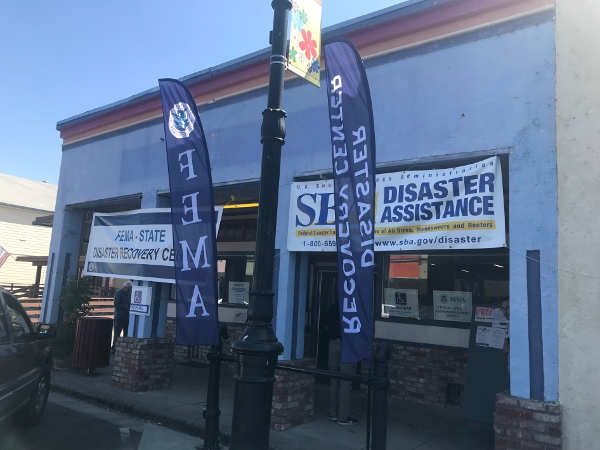
UPPER LAKE, Calif. – Lake County residents affected by the Mendocino Complex fires can now access recovery and relief services and resources at the newly established Federal Emergency Management Agency Disaster Recovery Center, located at the Habematolel Pomo of Upper Lake Community Center in Upper Lake.
The Disaster Recovery Center at Habematolel of Upper Lake Community Center is the only recovery center servicing the county residents and employees and helps between approximately 80 households affected by the fires each day.
FEMA partnered with the Habematolel Pomo of Upper Lake tribal government to establish a Disaster Recovery Center in order to serve individuals devastated by the Mendocino Complex Fires.
“These services are vital for the people of Lake County who lost everything or were evacuated as a result of the Mendocino Complex fires,” said Sherry Treppa, chairwoman of the Habematolel Pomo of Upper Lake Indian tribe. “These services are only the beginning to the recovery and rebuilding efforts, and we are proud to partner with the state and federal government to help ensure resources are readily available to our local community.”
The Disaster Recovery Center is a one-stop shop for those impacted by the fires, providing an array of services including food assistance programs, clean-up assistance, grants and loans for rental assistance, home repairs and rebuilding, personal disaster-related expenses, and temporary emergency housing, as well as important document recovery.
The agencies offering services include the California Department of Human Resources, the Department of Insurance, the Contractors State License Board, the Department of Public Health, the Department of Tax and Fee Administration, the Department of Motor Vehicles, Employment Development Department, Franchise Tax Board, Department of Social Services, Lake County Behavioral Health, the American Red Cross, FEMA, the Small Business Administration and the US Department of Agriculture.
Mendocino Complex survivors who visit the center are encouraged to bring a social security number (one per household), address of the damaged home or apartment, description of the damage, information about insurance coverage, telephone number, mailing address, bank account and routing numbers for direct deposit of funds.
The Disaster Recovery Center is open from 9 a.m. to 6 p.m. Monday through Saturday, with the exception of Labor Day when the center will be closed.

This award is granted to people across the country who make lasting differences in promoting adoption, permanency, and child welfare.
“Supervisor Scott makes a difference in the lives of children in our community each and every day and I am so pleased to honor her with this exciting award. She has served children in our community as supervisor, as school district board member, and as an incredible foster and adopted parent,” said Thompson. “Her work is constantly focused on making our community an even better place for children and we are so proud of her hard work. I look forward to honoring her at an upcoming ceremony in Washington, D.C. for dedicated advocates like her from across the nation.”
“Serving children, as both an elected official and as a parent, is one of my greatest passions in life. Each day, I am proud to care for children through my work in our community and as a parent,” said Supervisor Scott. “Receiving the Angel in Adoption award is a deep honor for me and I look forward to continuing to serve children across our community.”
Scott currently serves as a Lake County supervisor and previously served as a Lakeport Unified School District Board member.
Supervisor Scott moved to Lakeport from Santa Rosa. In her 16 years in Lake County, she and her husband have fostered more than 60 youth and adopted five of those children.
Among her many passions, Supervisor Scott has always been passionate about making her community a better place for children.
She served as a Juvenile Justice Commissioner; a Court Appointment Child Advocate with CASA, and tutors weekly at Lakeport Elementary School with Schools of Hope.
During her time on the school board, Supervisor Scott was instrumental in passing Measure T, gaining the school district $17 million to rebuild the community pool and equip classrooms with 21st century learning capabilities.
The Angels in Adoption Program is run by the Congressional Coalition on Adoption Institute and honors people and organizations that promote strong adoption, permanency, and child welfare programs across the county. Each year they recognize individuals who are dedicated to these issues and make a deep national impact.
The following list covers races including special districts, school boards, councils and the Superior Court.
As noted below, some of the races won’t appear on the ballot because there are not more candidates than the number of seats.
The full list follows.
CLEARLAKE CITY COUNCIL
Two vacancies: Terms expiring December 2022
Russell Cremer, appointed incumbent, Clearlake
Russell Perdock, insurance agent, Clearlake Park
Dirk C. Slooten, retired business owner, Clearlake
KONOCTI UNIFIED SCHOOL DISTRICT
Three vacancies: Four-year terms expiring December 2022
Pamela Bening-Hale, retired teacher, Lower Lake
Bill Diener, incumbent, Lower Lake
Herb Gura, incumbent, Clearlake
Joan S. Mingori, college career advisor, Clearlake
LAKE COUNTY BOARD OF EDUCATION
Trustee Area No. 3: One vacancy, four-year term expiring December 2022
Joanne Breton, business owner, Upper Lake
Denise Lee Loustalot, small business owner, Clearlake
Trustee Area No. 5: One vacancy, four-year term expiring December 2022
Madelene M. Lyon, incumbent, Kelseyville
Anna Rose Ravenwoode, public school educator, Kelseyville
LAKE COUNTY SUPERIOR COURT, DEPARTMENT 4
Runoff from June 5 Statewide Direct Primary Election; term expires January 2025
Don Anderson, district attorney for the county of Lake, Lakeport
Shanda Harry, deputy county counsel for the county of Lake, Lakeport
LAKEPORT UNIFIED SCHOOL DISTRICT
Two vacancies, four-year terms expiring December 2022
Carly Alvord, parent, Lakeport
Jennifer Hanson, professor of economics, Lakeport
Thomas W. Powers, incumbent, Lakeport
One vacancy, two-year term expiring December 2020
Dan Buffalo, finance director for city of Ukiah, Lakeport
Dennis Darling, business owner, Lakeport
MENDOCINO-LAKE COMMUNITY COLLEGE DISTRICT
Trustee Area No. 5: One vacancy, four-year term expiring December 2022, voted on in both Lake and Mendocino counties
Philip “Ed” Nickerman, retired administrator/farmer, Potter Valley
Camille Schraeder, CEO of local nonprofit, Potter Valley
Trustee Area No. 6: One vacancy, four-year term expiring December 2022, voted on in Lake County
Andy Anderson, retired business owner, Upper Lake
John H. Tomkins, incumbent, Lucerne
MIDDLETOWN UNIFIED SCHOOL DISTRICT
Three vacancies: Four-year terms expiring December 2022
Larry Allen, retired teacher, Cobb
Christina Braden, business owner, Hidden Valley Lake
Thad R. Owens, principal/parent, Hidden Valley Lake
Latrease Walker, parent/business owner, Middletown
REDBUD HEALTH CARE DISTRICT
Zone 2: One vacancy, four-year term expiring December 2022
Mark Burkdoll, clinical laboratory scientist, Clearlake
Sandra M. Richards, registered nurse, Clearlake
Brice Trask, appointed incumbent, Clearlake
UPPER LAKE UNIFIED SCHOOL DISTRICT
Five vacancies: Terms will be determined by Education Code Section 35105
Franklin Gudmundson correctional sergeant, county of Lake, Upper Lake
Don Meri, appointed incumbent, Upper Lake
Claudine M. Pedroncelli, appointed incumbent, Upper Lake
Diane Tomkins Plante, appointed incumbent, Upper Lake
Ronald L. Raetz, retired educator, Upper Lake
Ana Santana, service program director, Upper Lake
RACES THAT WON’T APPEAR ON THE BALLOT
The following candidates will not appear on the ballot because there are not more candidates than vacancies.
CLEARLAKE CITY TREASURER
One vacancy: Term expiring December 2022
No candidates filed for the Nov. 6 election.
HIDDEN VALLEY LAKE COMMUNITY SERVICES DISTRICT
Two vacancies, four-year terms expiring December 2022
Linda Herndon, incumbent, Hidden Valley Lake
Judy Mirbegian, incumbent, Hidden Valley Lake
KELSEYVILLE UNIFIED SCHOOL DISTRICT
Two vacancies, four-year terms expiring December 2022
Allison Panella, business owner/parent, Lakeport
Rick Winer, incumbent, Kelseyville
LAKE PILLSBURY FIRE PROTECTION DISTRICT
Five vacancies
Titina Hardwick Hall, retired business owner, Potter Valley
Gordon R. Hasler, appointed incumbent, Potter Valley
Lee Ann McKay, retired legislative aide, Potter Valley
Paul Rooney, retired master mechanic, Potter Valley
David J. Smith, retired truck drive, Potter Valley
LAKE COUNTY BOARD OF EDUCATION
Trustee Area No. 4: One vacancy, four-year term expiring December 2022
David Browning, incumbent, Lakeport
LAKEPORT CITY COUNCIL
Two vacancies: Four-year terms expiring December 2022
Stacey Mattina, councilmember/business owner, Lakeport
Mireya Gehring Turner, councilmember/associate planner, Lakeport
The Lakeport City Council voted to appoint Mattina and Turner to new four-year terms at its meeting on Tuesday, Aug. 21, pursuant to Elections Code section 1022, as Lake County News has reported.
LUCERNE ELEMENTARY SCHOOL DISTRICT
Two vacancies: Four-year terms expiring December 2022
Bruce Higgins, incumbent, Lucerne
Dawn Renee McAuley, incumbent, Lucerne
NORTHSHORE FIRE PROTECTION DISTRICT
At-Large: One vacancy, four-year term expiring December 2022
James O. Burton, incumbent, Clearlake Oaks
Lucerne Zone: One vacancy, four-year term expiring December 2022
Gerald Shepherd, incumbent, Lucerne
Nice Zone: One vacancy, four-year term expiring December 2022
John T. Barnette, incumbent, Nice
REDBUD HEALTH CARE DISTRICT
Zone 3: One vacancy, two-year unexpired term expiring December 2020
James E. Scholz, appointed incumbent, Clearlake
Zone 4: One vacancy, four-year term expiring December 2022
Bill Diener, appointed incumbent, Lower Lake
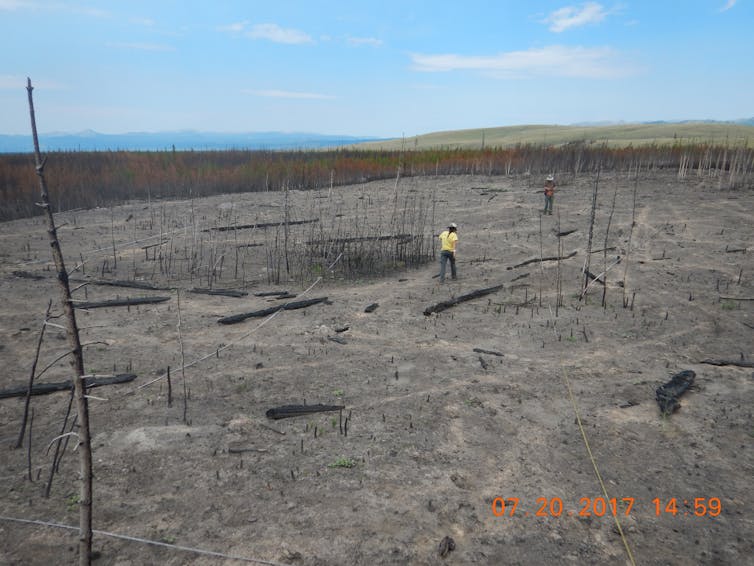 The 2016 Maple fire (photographed in July 2017) reburned young forests that had regenerated after the 1988 Yellowstone fires. More frequent high-severity fires are expected in the future as climate warms, which may change patterns of forest recovery. Monica Turner, CC BY-ND
Monica G. Turner, University of Wisconsin-Madison
This summer marks the 30th anniversary of the 1988 Yellowstone fires – massive blazes that affected about 1.2 million acres in and around Yellowstone National Park. Their size and severity surprised scientists, managers and the public and received heavy media coverage. Many news reports proclaimed that Yellowstone was destroyed, but nothing was further from the truth.
I was there during the fires and returned that fall to view the aftermath. Burned forests extended for miles, with blackened tree trunks creating a stark and seemingly desolate landscape. But peering down from a helicopter, we were surprised to see that the fires had actually produced a mosaic of burned and unburned patches of forest.

I have studied the recovery of Yellowstone’s forests since 1989, watching landscapes of charred trees transition into lush young forests. Fires play an important ecological role in many ecosystems, and Yellowstone’s native plants and animals are well-adapted to historical cycles of disturbance and recovery. Today the burned landscape is dominated by thriving young lodgepole pine trees.
We learned much about how ecosystems respond to such fires because they burned mostly in national parks and wilderness areas. Post-fire management was minimal, and nature took its course through most of the burned area.
Because Yellowstone’s forests were remarkably resilient, the 1988 fires were not an ecological catastrophe. Today, however, climate and fire trends may be pushing forests beyond their limits. The rules of the game are changing fast.

Heat, drought and wind
Extreme weather conditions drove the 1988 fires, as they have fostered many recent fires across the West. Summers in Yellowstone are usually too cool and moist for such large fires, but the summer of 1988 was and remains the driest on record there.
Amounts of fuel (dead logs and pine needles on the ground and live trees) were not unusual, and there is no evidence that suppression of prior fires had much, if any, influence on the 1988 fires. Hot temperatures, severe drought and high winds set the stage.
Gusts over 60 miles per hour prevented me from flying over the fires in early July, well before the blazes made their biggest runs. Roads, rivers and even wide canyons spanning the Yellowstone and Lewis rivers did not stop flames from spreading on windy days. Strong winds carried burning branches ahead of the main fire front, advancing fire spread. The fires also continued to burn at night.

How burned forests recover
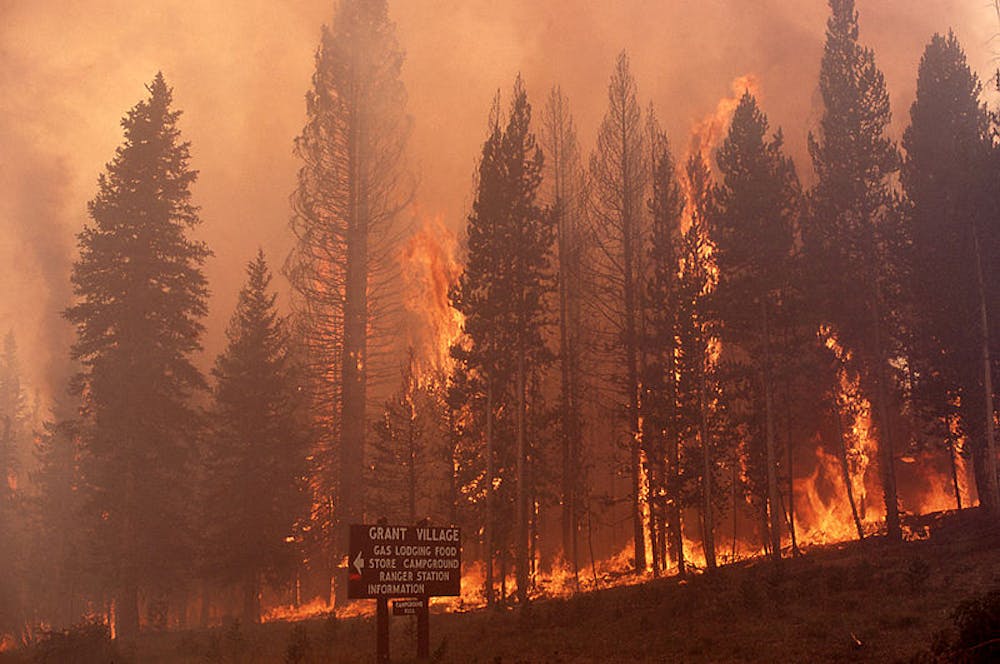
Severe fires have burned in Yellowstone at 100- to 300-year intervals for the past 10,000 years. “Crown fires” burn through the forest canopy, killing the trees while triggering a flush of new growth. Such fires are business as usual in Yellowstone and many other forests at high elevations and far north latitudes.
Lodgepole pines have thin bark and are readily killed, but often bear fire-adapted cones that allow them to regenerate right after fires. When heated, the cones release vast quantities of seeds that produce a new generation of trees. Fires also create ideal growing conditions, with plenty of mineral soil and sunlight.
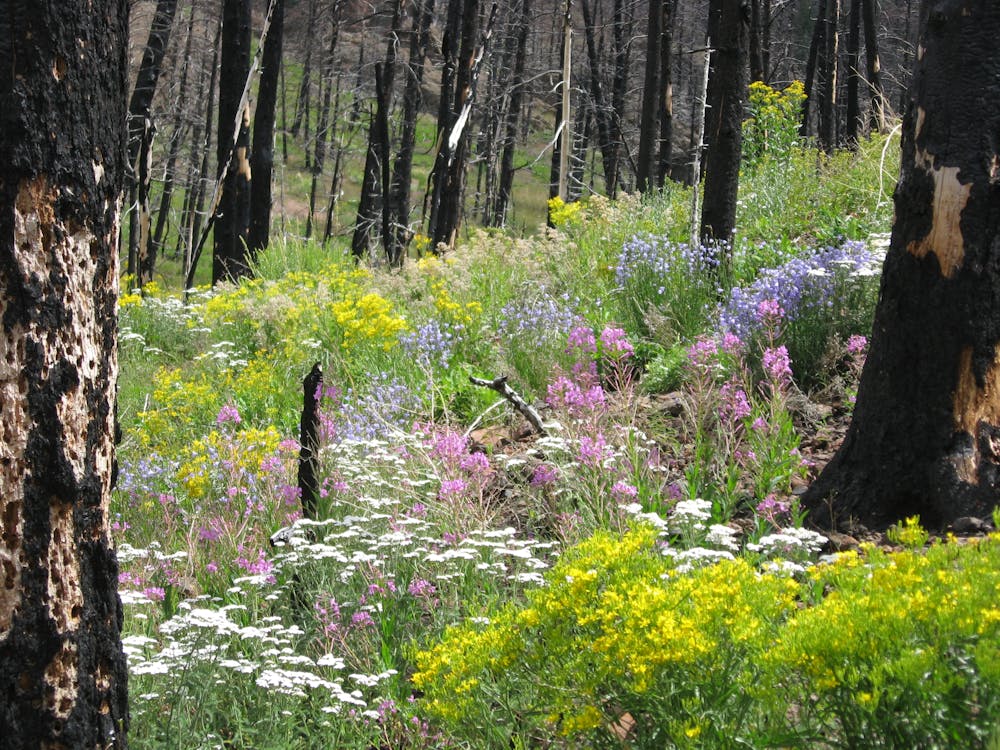
In Yellowstone, wildflowers and grasses sprouted from surviving roots because soils did not burn deeply and retained key nutrients needed for plant growth. Native species steadily filled in the bare spots. Aspens – long a species of concern in the northern Rockies – established from seed throughout the burned pine forests, many miles from the nearest mature aspen trees. Many are doing well at higher elevations than their pre-fire distribution.
Yellowstone’s ecosystems recovered rapidly on their own. I suspect that many visitors no longer “see” evidence of the 1988 fires as they admire scenery and wildlife amidst a sea of green. Similar patterns of natural recovery following 20th-century fires have also been observed in Rocky Mountain, Glacier and Grand Teton National Parks, which also have evolved with fire for millennia. Historically, high-severity fires kill trees but do not destroy the forest.

Warming climate, more fire
The 1988 fires ushered in a new era of major wildfires that are burning more western forests each year. Summers and winters are getting warmer, and the hot, dry weather associated with large fires is no longer so rare. Snow melts earlier each year, fuels dry out sooner, temperature records are broken and fire season gets longer. Recent fires have burned in many national parks and monuments, including Bandelier, Rocky Mountain, Glacier and Yosemite.
A warmer, drier climate means that drought is getting worse in places that are already hot and dry. In the western United States, human-caused climate change has dried fuels and nearly doubled the area burned by forest fires from 1984 to 2015.
And while lightning ignites most fires in the northern Rockies, human ignitions are lengthening fire seasons in populated areas. Even in the moist mixed forests of the southern Appalachians, severe drought allowed a human-caused fire that started in Great Smoky Mountains National Park to rage into Gatlinburg, Tennessee.
What lies ahead?
Even forests that are well-adapted to large, severe fires are at risk in a warming world. By the late 21st century, hot, dry weather like the summer of 1988 could be the rule rather than the exception in Yellowstone.
Large fires are expected to occur more often, and are already starting to reburn forests long before they have had enough time to recover. In Yellowstone and Grand Teton National Parks, fires in 2016 burned young forests that regenerated from fires in 1988 and 2000. Our studies of these recent fires have documented greater burn severity and fewer post-fire tree seedlings. Survival of these young trees is not guaranteed, as they are starting out in a much warmer world.
National parks anchor many of the country’s last intact landscapes, and are among our best living laboratories for understanding environmental change. Research on the 1988 fires now provides a reference for assessing effects of more recent fires. Yellowstone will still maintain its beauty, native species and power to inspire us. However, only time will tell whether Yellowstone’s forests can maintain their ability to recover from fire in the decades ahead.
Monica G. Turner, Professor of Ecology, University of Wisconsin-Madison
This article was originally published on The Conversation. Read the original article.
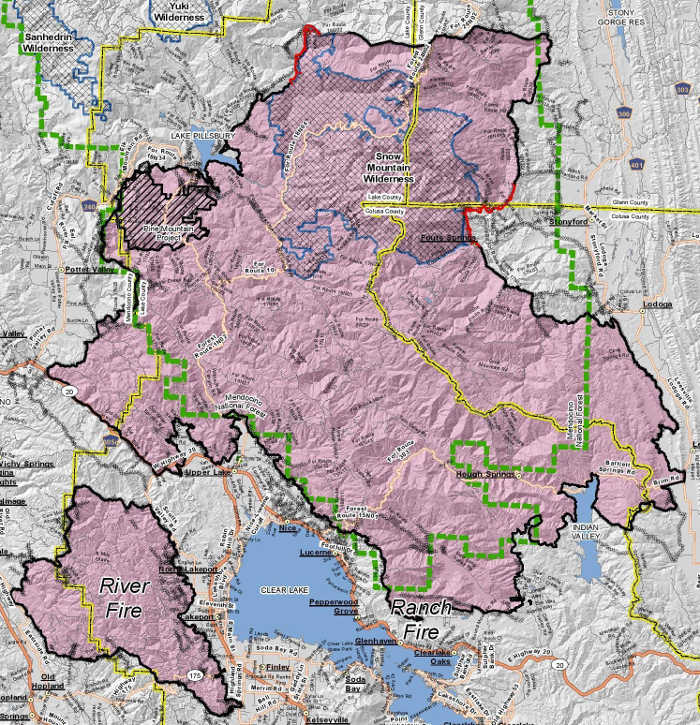
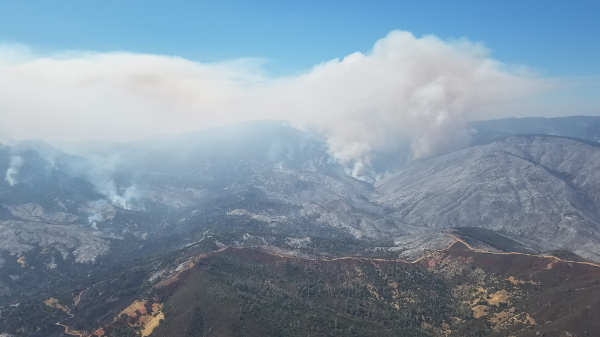
LAKE COUNTY, Calif. – Over the past day firefighters have stopped the growth of the Mendocino Complex as they close in on fully containing the largest wildland fire in California history.
On Wednesday the Mendocino Complex remained at 459,102 acres with containment up to 93 percent, according to the U.S. Forest Service.
The report showed no new growth on the fire in the previous 24 hours.
That overall size total breaks down as 410,182 acres and 93 percent containment for the Ranch fire, which is the active portion of the complex, officials said. The River fire was contained earlier this month at 48,920 acres.
Progress appears to be on track for having the complex – burning since July 27 – fully contained by Sept. 1, officials said.
Officials said resources assigned include 2,116 personnel, 90 engines, 49 hand crews, three helicopters and 28 dozers.
The U.S. Forest Service, which is now taking the lead on issuing updates on the Mendocino complex, said Wednesday that the complex is being managed by the United States Department of Agriculture Forest Service and California Interagency Incident Management Team 3 under Incident Commander Mark von Tillow.
The Mendocino National Forest thanked Incident Commander Sean Kavanaugh and Cal Fire Incident Management Team 2 who had held unified command on the fire for their monthlong service to the forest and the people of Mendocino, Lake, Colusa and Glenn counties.
Forest officials said that on the Ranch fire several interior islands of vegetation burned off Tuesday producing columns of smoke visible over a large area. Interior burning is expected to continue.
On Wednesday, while firefighters continue to monitor the interior fires, they will also work on suppression repair efforts and mop up, the Forest Service reported.
Suppression repairs include constructing water bars and breaking down berms in an effort to prevent erosion, while felling teams continue to take down hazardous trees for the safety of crews working on mop up, officials said.
Additionally, non-forest system roads that were opened for access and fireline will be closed and repaired. This work will continue throughout the week.
Officials said Forest Order No. 08-18-14 remains in effect until further notice. All roads and areas described within it are closed to the general public.
The northern half of the Mendocino National Forest remains open and can be accessed via Forest Highway 7. The forest areas around Plaskett Meadows and Hammerhorn Lake are open for recreation activities. The Yolla Bolly-Middle Eel Wilderness is also open for recreation.
As for smoke impacts, light southerly winds will drift smoke and haze from the Ranch fire to the north Wednesday. Local communities downwind, including Covelo and Laytonville, are expected to have an increase in smoke midday. Communities on the east side, such as Elk Creek and Stonyford, which were in heavy smoke Wednesday morning are expected to have cleaner air move in midday.
Ukiah and areas to the south, such as those around Clear Lake, should have hazy skies and moderate to light smoke impacts. Smoke impacts are expected to be on an improving trend this week, officials said.
A smoke impacts report can be found at https://wildlandfiresmoke.net/outlooks/MendocinoNationalForest-SacramentoValleyArea.
The Burned Area Emergency Response team, or BAER, will hold a one-hour community meeting on Thursday, Aug. 30, at 6 p.m. at the North Shore Event Center, 2817 E. Highway 20 in NIce.
The BAER team is hosting a presentation of its findings after the initial assessment of the southern portion of the fire area.
There will be a question and answer session with BAER team specialists following the presentation.
For more BAER information please visit: https://inciweb.nwcg.gov/incident/6156.