 How to resolve AdBlock issue?
News
LAKEPORT, Calif. – The Lakeport Police Department is introducing a new technology – “DNA for Property” – to residents that will help deter theft and increase returning recovered property.
It’s part of the kick off a national crime prevention campaign, “Connecting the Dots to Reduce Crime,” that’s assisting law enforcement in efforts to lessen property theft.
The focus on this national campaign is to connect law enforcement and their communities around the country, providing every resident with new technology – “DNA for Property” – to deter theft and increase the chance of returning recovered property to the rightful owners.
“DNA for Property” is a special forensic adhesive that can be applied to all types of valuables.
The adhesive is swabbed on an item and will permanently dry clear and invisible to the naked eye.
Suspended in the adhesive are thousands of “microscopic dots” that are .05 mm in size, that is smaller than the size of a grain of sand.
Chemically etched into the microdot is a unique alphanumeric personal identification number, or PIN.
With a commitment from the insurance industry, law enforcement agencies around the country will have the ability to provide a free – except for a $5 fee for shipping – DNA for Property kit, which is a $40 retail value to all the residents and businesses in their community.
The DNA for Property kits will provide each user with up to 100 applications and a free online account in the “International Asset Registry for Law Enforcement,” or IARLE.
Each user must register online to set up their free account, their DNA for Property kit will be linked to that secure account, and provide protected storage to include a full description for each item they apply with their DNA adhesive.
The IARLE database is accessible to every law enforcement agency around the country and will help increase the return rate of property that is recovered.
Lakeport Police Department is one of the first agencies in Northern California to introduce the program to residents.
The local program will kick off Sept. 17 at Lakeport's National Night Out event being held at Library Park. For further details see our event page on Facebook at: https://www.facebook.com/events/1809377609370805/.
Residents who attend will receive details and information on registering for their DNA for Property kit. To get involved in this program contact Lakeport Police Detective Dale Stoebe at the police booth at the National Night Out Event.
ProtechDNA, the company that provides the technology stated, “We are excited to introduce this program to the residents of Northern California in cooperation with Lakeport Police Department. Lakeport Police Department is very active in their community, with neighborhood watch and other ongoing outreach programs and the DNA for Property technology will help enhance those efforts.”
With the recent fires across the state of California this presents a more urgent application. Evacuations of communities unfortunately provides opportunities to criminals that will take advantage of this situation and prey on this disaster to steal property from evacuated homes.
Lakeport Police Department will have resources that will help them detect if the DNA adhesive has been applied to the property and special readers to view the PIN and determine ownership. This is extremely valuable in combating property theft, giving law enforcement a clear advantage in identifying ownership to contact the victim and arrest the criminals.
“I am excited to partner with ProtechDNA and the insurance industry to provide another crime prevention program to our residents,” said Lakeport Police Chief Brad Rasmussen. “Property crime continues to be an issue in our community and I am hopeful that this technology will discourage criminals and reduce theft in our community.”
The commitment from the national insurance cooperative provides the funding for the DNA for Property kits that will be distributed to all the residents/businesses of Lakeport that will help provide resources to Lakeport Police to ensure all residents are able to take advantage of this crime prevention program.
For residents to get their free DNA kits they need to go to www.protechDNA.com and set up their free account, of go the Lakeport Police Department for additional details. There will be a $5.00 fee for shipping.
It’s part of the kick off a national crime prevention campaign, “Connecting the Dots to Reduce Crime,” that’s assisting law enforcement in efforts to lessen property theft.
The focus on this national campaign is to connect law enforcement and their communities around the country, providing every resident with new technology – “DNA for Property” – to deter theft and increase the chance of returning recovered property to the rightful owners.
“DNA for Property” is a special forensic adhesive that can be applied to all types of valuables.
The adhesive is swabbed on an item and will permanently dry clear and invisible to the naked eye.
Suspended in the adhesive are thousands of “microscopic dots” that are .05 mm in size, that is smaller than the size of a grain of sand.
Chemically etched into the microdot is a unique alphanumeric personal identification number, or PIN.
With a commitment from the insurance industry, law enforcement agencies around the country will have the ability to provide a free – except for a $5 fee for shipping – DNA for Property kit, which is a $40 retail value to all the residents and businesses in their community.
The DNA for Property kits will provide each user with up to 100 applications and a free online account in the “International Asset Registry for Law Enforcement,” or IARLE.
Each user must register online to set up their free account, their DNA for Property kit will be linked to that secure account, and provide protected storage to include a full description for each item they apply with their DNA adhesive.
The IARLE database is accessible to every law enforcement agency around the country and will help increase the return rate of property that is recovered.
Lakeport Police Department is one of the first agencies in Northern California to introduce the program to residents.
The local program will kick off Sept. 17 at Lakeport's National Night Out event being held at Library Park. For further details see our event page on Facebook at: https://www.facebook.com/events/1809377609370805/.
Residents who attend will receive details and information on registering for their DNA for Property kit. To get involved in this program contact Lakeport Police Detective Dale Stoebe at the police booth at the National Night Out Event.
ProtechDNA, the company that provides the technology stated, “We are excited to introduce this program to the residents of Northern California in cooperation with Lakeport Police Department. Lakeport Police Department is very active in their community, with neighborhood watch and other ongoing outreach programs and the DNA for Property technology will help enhance those efforts.”
With the recent fires across the state of California this presents a more urgent application. Evacuations of communities unfortunately provides opportunities to criminals that will take advantage of this situation and prey on this disaster to steal property from evacuated homes.
Lakeport Police Department will have resources that will help them detect if the DNA adhesive has been applied to the property and special readers to view the PIN and determine ownership. This is extremely valuable in combating property theft, giving law enforcement a clear advantage in identifying ownership to contact the victim and arrest the criminals.
“I am excited to partner with ProtechDNA and the insurance industry to provide another crime prevention program to our residents,” said Lakeport Police Chief Brad Rasmussen. “Property crime continues to be an issue in our community and I am hopeful that this technology will discourage criminals and reduce theft in our community.”
The commitment from the national insurance cooperative provides the funding for the DNA for Property kits that will be distributed to all the residents/businesses of Lakeport that will help provide resources to Lakeport Police to ensure all residents are able to take advantage of this crime prevention program.
For residents to get their free DNA kits they need to go to www.protechDNA.com and set up their free account, of go the Lakeport Police Department for additional details. There will be a $5.00 fee for shipping.
When a marriage ends in dissolution, assets are divided by court order between the spouses.
In California, which is a community property state, the character of each asset determines the division – separate property (goes to one spouse), community property (is divided 50-50 between spouses), and mixed property (where an asset has both separate and community property interests is allocated accordingly between spouses).
Assets that are mixed – such as where the community property estate and one spouse’s separate property estate each have property rights – are apportioned based on proportionate interests.
For example, if an asset is forty percent the husband’s own separate property and sixty percent community property then seventy percent is allocated to the husband and thirty percent to the wife, as she is entitled to one-half of any community property asset.
Disability Insurance that is purchased to safeguard preretirement earnings is usually treated the same as earnings. That is, while a couple is married each spouse’s earnings and disability income are community property.
After dissolution of marriage, any disability income that is received – just like any post marital earnings – is entirely that spouse’s own separate property. Two Important exceptions, however, may nonetheless apply.
First, if disability insurance is purchased while married using community property funds (such as employment earnings) with the intention of providing retirement income, then a portion of the disability insurance payments received after dissolution of marriage is community property; that portion is allocated equally between the spouses.
Whether the exception applies is a finding of fact for a court to make. In two landmark California cases the court found that the disability insurance was in fact replacing retirement income. The husband had elected to receive disability insurance income in lieu of fully vested and mature retirement pension.
Only the excess of the disability income over the retirement pension is treated as disability insurance and the balance is treated as retirement income in which the community property may have an interest.
If the court finds that the disability insurance is both to replace lost preretirement earnings (due to disability) and to augment retirement income the court may determine a retirement age for allocation purposes. All disability insurance received from that deemed retirement age forward is retirement income and is divided between the spouses based on community property law to the extent that the disability benefits were contributed while married.
The second exception is when community property funds are used during marriage to purchase a right of renewal – allowing the insured to pay reasonable premiums in the future – without which right the insured would not have been able to continue paying for the disability insurance after the marriage ended.
The extent of the community property’s ongoing interest after marriage is determined by the extent to which the right of renewal made the disability insurance premiums affordable.
This follows term insurance, where a right of renewal purchased with community assets allows a spouse to continue the term insurance at affordable premiums even after a significant decline in health would otherwise have either prohibited continued insurance or made it too costly.
The foregoing two exceptions to the general rule require the spouse invoking an exception to argue that the facts and circumstances require an exception.
The merits of the case must stand out from the general rule.
Dennis A. Fordham, attorney, is a State Bar-Certified Specialist in estate planning, probate and trust law. His office is at 870 S. Main St., Lakeport, Calif. He can be reached atThis email address is being protected from spambots. You need JavaScript enabled to view it. and 707-263-3235. His Web site is www.DennisFordhamLaw.com.
In California, which is a community property state, the character of each asset determines the division – separate property (goes to one spouse), community property (is divided 50-50 between spouses), and mixed property (where an asset has both separate and community property interests is allocated accordingly between spouses).
Assets that are mixed – such as where the community property estate and one spouse’s separate property estate each have property rights – are apportioned based on proportionate interests.
For example, if an asset is forty percent the husband’s own separate property and sixty percent community property then seventy percent is allocated to the husband and thirty percent to the wife, as she is entitled to one-half of any community property asset.
Disability Insurance that is purchased to safeguard preretirement earnings is usually treated the same as earnings. That is, while a couple is married each spouse’s earnings and disability income are community property.
After dissolution of marriage, any disability income that is received – just like any post marital earnings – is entirely that spouse’s own separate property. Two Important exceptions, however, may nonetheless apply.
First, if disability insurance is purchased while married using community property funds (such as employment earnings) with the intention of providing retirement income, then a portion of the disability insurance payments received after dissolution of marriage is community property; that portion is allocated equally between the spouses.
Whether the exception applies is a finding of fact for a court to make. In two landmark California cases the court found that the disability insurance was in fact replacing retirement income. The husband had elected to receive disability insurance income in lieu of fully vested and mature retirement pension.
Only the excess of the disability income over the retirement pension is treated as disability insurance and the balance is treated as retirement income in which the community property may have an interest.
If the court finds that the disability insurance is both to replace lost preretirement earnings (due to disability) and to augment retirement income the court may determine a retirement age for allocation purposes. All disability insurance received from that deemed retirement age forward is retirement income and is divided between the spouses based on community property law to the extent that the disability benefits were contributed while married.
The second exception is when community property funds are used during marriage to purchase a right of renewal – allowing the insured to pay reasonable premiums in the future – without which right the insured would not have been able to continue paying for the disability insurance after the marriage ended.
The extent of the community property’s ongoing interest after marriage is determined by the extent to which the right of renewal made the disability insurance premiums affordable.
This follows term insurance, where a right of renewal purchased with community assets allows a spouse to continue the term insurance at affordable premiums even after a significant decline in health would otherwise have either prohibited continued insurance or made it too costly.
The foregoing two exceptions to the general rule require the spouse invoking an exception to argue that the facts and circumstances require an exception.
The merits of the case must stand out from the general rule.
Dennis A. Fordham, attorney, is a State Bar-Certified Specialist in estate planning, probate and trust law. His office is at 870 S. Main St., Lakeport, Calif. He can be reached at

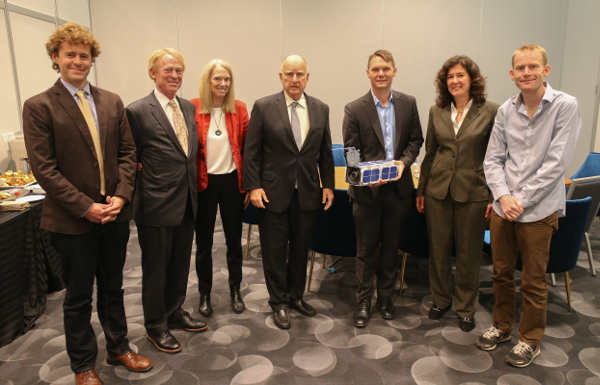
In closing remarks at the Global Climate Action Summit in San Francisco on Friday, California Gov. Edmund G. Brown Jr. announced that the state of California is teaming up with San Francisco-based Earth imaging company Planet Labs to develop and eventually launch a satellite that will track climate change-causing pollutants with unprecedented precision and help the world dramatically reduce these destructive emissions.
“With science still under attack and the climate threat growing, we’re launching our own damn satellite,” said Gov. Brown. “This groundbreaking initiative will help governments, businesses and landowners pinpoint – and stop – destructive emissions with unprecedented precision, on a scale that’s never been done before.”
Planet, which was founded by ex-NASA scientists in 2010, operates the world’s largest constellation of satellites in history.
In the last two years, Planet has launched over 150 Earth-imaging satellites, manufactured in San Francisco, helping customers in agriculture, government, mapping, NGOs and in other markets to make better decisions. Its robust aerospace and data processing infrastructure, innovative technology and engineering and scientific expertise will be utilized to develop and operate the new satellite, with the possibility of launching additional satellites in the future as part of this initiative.
“Planet is honored to work closely with the state of California to understand how advanced satellite technology can enhance our ability to measure, monitor, and ultimately mitigate the impacts of climate change,” said Robbie Schingler, co-founder and chief strategy officer of Planet. “As a mission-driven commercial company, one of the greatest impacts Planet can make is turning technological breakthroughs and data into tools that benefit the planet while encouraging the growth of business.”
The state of California, through the California Air Resources Board, is developing and refining the technology needed to make this initiative possible with Planet and other stakeholders.
Planet will manage the mission operations and collaborate with the State of California and others on funding this groundbreaking effort.
This satellite will be capable of detecting the “point source” of climate pollutants, including super pollutants which have more potent heat-trapping effects, but remain in the atmosphere for a shorter time than carbon dioxide. Reducing these pollutants can have an immediate and beneficial impact.
The state of California and Planet are committed to making environmentally-related satellite data available to the public and will work in partnership with the Environmental Defense Fund or EDF — and others with complementary projects — to establish a new Climate Data Partnership.
EDF is uniquely positioned as a partner having announced its own distinct and complementary project, MethaneSAT, in April.
The Climate Data Partnership will serve as a common platform for reporting data from these, and other, satellite systems studying climate variables and the earth’s atmosphere. This data sharing will enable governments, businesses, landowners and others to pursue more targeted mitigation measures worldwide.
These efforts are part of a strategy that has the potential to deliver global emission reductions equivalent to 1,000 million metric tons of carbon dioxide annually – or removing 200 million vehicles from roads every year.
“This new initiative is a critical part of Gove. Brown’s bold commitment to harness leading edge technology in the fight against climate change,” said EDF President Fred Krupp. “These satellite technologies are part of a new era of environmental innovation that is supercharging our ability to solve problems. They won’t cut emissions by themselves, but they will make invisible pollution visible and generate the transparent, actionable, data we need to protect our health, our environment and our economies.”
Initial funding of this project has been provided by Dee and Richard Lawrence and OIF, as well as The Jeremy and Hannelore Grantham Environmental Trust.
“If what gets measured, gets managed, part of the problem is that we cannot attribute specific climate pollutants to specific sources,” said Richard Lawrence of OIF and Jeremy Grantham, Trustee of The Jeremy and Hannelore Grantham Environmental Trust. “We are proud to have played a role to use philanthropy as a tool to partner with government and the private sector to give the world real time greenhouse gas emissions at the very low cost that only satellites can provide.”
Additional scientific, business and philanthropic partners are expected to join this initiative in the months ahead and the State of California and Planet will serve as the conveners of all parties.
This announcement comes nearly two years after Gov. Brown told thousands of scientists gathered at the Moscone Center – the same venue hosting the Global Climate Action Summit – that “California will launch its own damn satellite” and will continue pursuing “honest, independent science,” following reports of potential cuts to federal satellite and climate monitoring programs.
“The time has never been more urgent or your work never more important,” said Gov. Brown in that 2016 speech at the American Geophysical Union’s annual fall meeting. “We’ve got the scientists, we’ve got the universities, we have the national labs and we have the political clout and sophistication for the battle – and we will persevere. Have no doubt about that.”
Gov. Brown’s announcement came on the heels of a call to global climate action presented at the plenary, urging national governments to increase climate ambition, develop mid-century emissions plans and support climate leadership at the local and regional level.
On Thursday, Gov. Brown signed a raft of measures to promote zero-emission vehicles and reduce carbon emissions; released a new report quantifying non-federal climate action in the U.S. with fellow Summit co-chair and America’s Pledge co-founder Michael Bloomberg; joined fellow U.S. Climate Alliance governors to announce a range of new commitments; met with Canada’s Minister of Environment and Climate Change Catherine McKenna, Mexico’s Deputy Minister for International Affairs Enrique Lendo Fuentes and U.S. Climate Alliance governors to advance a framework for ambitious climate action across North America; and participated in a ministerial dialogue with heads of state and international climate leaders, including European Commissioner for Climate Action and Energy Miguel Arias Cañete. Governor Brown and Commissioner Cañete also reiterated their commitment to greater alignment of California and EU carbon markets.
On Wednesday, Gov. Brown welcomed China’s delegation to the Summit, signing an agreement to enhance climate and clean energy cooperation, meeting with the Vice Governor of Jiangsu Province and joining leaders, including former Vice President Al Gore and China’s Special Representative for Climate Change Minister Xie Zhenhua, for a U.S.-China subnational climate dialogue. Governor Brown also addressed the Under2 Coalition General Assembly and joined a signing ceremony for 16 new members; participated in an event to support the Talanoa Dialogue, led by the Prime Minister of Fiji Frank Bainimarama; and met with C40 Steering Committee members at San Francisco City Hall. On Tuesday, the Governor highlighted the importance of California’s landmark cap-and-trade program at an event co-hosted by the by the European Commission, Canada and California, during which he blasted the Trump Administration’s proposal to roll back methane regulation; held discussions with Governors’ Climate and Forests Task Force members and indigenous community leaders; and delivered remarks at the National Governors Association’s Water Policy Institute conference.
Earlier this week, Gov. Brown signed legislation setting a 100 percent clean electricity goal for the state, and issued an executive order establishing a new target to achieve carbon neutrality – both by 2045.
Late last week, Gov. Brown also signed legislation to block new federal offshore oil drilling along California’s coast and announced the state’s opposition to the federal government’s plan to expand oil drilling on public lands in California.

BERKELEY, Calif. – Artificial intelligence is invading many fields, most recently astronomy and the search for intelligent life in the universe, or SETI.
Researchers at Breakthrough Listen, a SETI project led by the University of California, Berkeley, have now used machine learning to discover 72 new fast radio bursts from a mysterious source some 3 billion light years from Earth.
Fast radio bursts are bright pulses of radio emission mere milliseconds in duration, thought to originate from distant galaxies. The source of these emissions is still unclear, however. Theories range from highly magnetized neutron stars blasted by gas streams from a nearby supermassive black hole, to suggestions that the burst properties are consistent with signatures of technology developed by an advanced civilization.
"This work is exciting not just because it helps us understand the dynamic behavior of fast radio bursts in more detail, but also because of the promise it shows for using machine learning to detect signals missed by classical algorithms," said Andrew Siemion, director of the Berkeley SETI Research Center and principal investigator for Breakthrough Listen, the initiative to find signs of intelligent life in the universe.
Breakthrough Listen is also applying the successful machine-learning algorithm to find new kinds of signals that could be coming from extraterrestrial civilizations.
While most fast radio bursts are one-offs, the source here, FRB 121102, is unique in emitting repeated bursts. This behavior has drawn the attention of many astronomers hoping to pin down the cause and the extreme physics involved in fast radio bursts.
The AI algorithms dredged up the radio signals from data were recorded over a five-hour period on Aug. 26, 2017, by the Green Bank Telescope in West Virginia. An earlier analysis of the 400 terabytes of data employed standard computer algorithms to identify 21 bursts during that period. All were seen within one hour, suggesting that the source alternates between periods of quiescence and frenzied activity, said Berkeley SETI postdoctoral researcher Vishal Gajjar.
UC Berkeley Ph.D. student Gerry Zhang and collaborators subsequently developed a new, powerful machine-learning algorithm and reanalyzed the 2017 data, finding an additional 72 bursts not detected originally. This brings the total number of detected bursts from FRB 121102 to around 300 since it was discovered in 2012.
"This work is only the beginning of using these powerful methods to find radio transients,” said Zhang. “We hope our success may inspire other serious endeavors in applying machine learning to radio astronomy."
Zhang's team used some of the same techniques that internet technology companies use to optimize search results and classify images. They trained an algorithm known as a convolutional neural network to recognize bursts found by the classical search method used by Gajjar and collaborators, and then set it loose on the dataset to find bursts that the classical approach missed.
The results have helped put new constraints on the periodicity of the pulses from FRB 121102, suggesting that the pulses are not received with a regular pattern, at least if the period of that pattern is longer than about 10 milliseconds. Just as the patterns of pulses from pulsars have helped astronomers constrain computer models of the extreme physical conditions in such objects, the new measurements of FRBs will help figure out what powers these enigmatic sources, Siemion said.
“Whether or not FRBs themselves eventually turn out to be signatures of extraterrestrial technology, Breakthrough Listen is helping to push the frontiers of a new and rapidly growing area of our understanding of the Universe around us,” he added.
The new results are described in an article accepted for publication in The Astrophysical Journal and is available for download from the Breakthrough Listen Web site.
Robert Sanders writes for the UC Berkeley News Center.
CLEARLAKE, Calif. – The Lake County Library and StoryCenter invite Lake County residents to sign up to share their 30-minute reflections and stories about their experiences of the fires last year, or in years before, on Wednesday, Sept. 26.
The StoryCenter will be available from 2 to 7 p.m. at the Redbud Library 14785 Burns Valley Rd in Clearlake.
The 2017-18 fires wrote a new chapter in the lives of millions of California residents.
The scope, spread and fierceness of these numerous fires for the residents of Lake County have sharpened our attention to the need to be and stay aware of ways to prepare for, and respond to, the threat of wildfires and other disasters that will surely come in the future.
To apply for interview participation, visit https://www.storycenter.org/lake-county-wildfire-stories.
You can come to be interviewed or bring a friend, family member or colleague to have a conversation about your experiences and the lessons learned from those events.
The interviews will be conducted using the Listening Station recording kit developed by StoryCenter organization based in Berkeley. Library staff and StoryCenter representatives will assist with the interviews.
Your recording will be stored as part of the California State Library collections.
The Lake County Library is on the internet at http://library.lakecountyca.gov and Facebook at www.facebook.com/LakeCountyLibrary.
Jan Cook is a library technician at the Lakeport Library.
The StoryCenter will be available from 2 to 7 p.m. at the Redbud Library 14785 Burns Valley Rd in Clearlake.
The 2017-18 fires wrote a new chapter in the lives of millions of California residents.
The scope, spread and fierceness of these numerous fires for the residents of Lake County have sharpened our attention to the need to be and stay aware of ways to prepare for, and respond to, the threat of wildfires and other disasters that will surely come in the future.
To apply for interview participation, visit https://www.storycenter.org/lake-county-wildfire-stories.
You can come to be interviewed or bring a friend, family member or colleague to have a conversation about your experiences and the lessons learned from those events.
The interviews will be conducted using the Listening Station recording kit developed by StoryCenter organization based in Berkeley. Library staff and StoryCenter representatives will assist with the interviews.
Your recording will be stored as part of the California State Library collections.
The Lake County Library is on the internet at http://library.lakecountyca.gov and Facebook at www.facebook.com/LakeCountyLibrary.
Jan Cook is a library technician at the Lakeport Library.
UPPER LAKE, Calif. – Assemblymember Cecilia Aguiar-Curry (D-Winters) has passed AB 1966 to ratify a tribal compact between the Habematolel Pomo of Upper Lake Tribe and the state of California.
This agreement allows the tribe to continue operating the Running Creek Casino in Upper Lake, generating revenue for essential government programs for tribal members.
It also ensures the tribe can operate an effective system to protect employees who are injured or become sick while performing work-related duties by conforming the provisions of its 2011 compact regarding workers’ compensation and labor relations to those of more recent compacts.
“The Habematolel Pomo of Upper Lake Tribe is an integral part of the Lake County community. They are committed to using their land and natural resources to preserve Pomo culture, provide for the future for their children, support the stability and security of the tribe and its families, and promote social and economic well-being inside and outside of the tribal community. I am proud to represent the tribe and fight for their sovereignty in the Legislature,” said Aguiar-Curry.
“Our tribe understands and embraces the fact that the health of our members, businesses and homelands are intrinsically intertwined with the health of our local community,” said Habematolel Tribal Chair Sherry Treppa. “By developing gaming and other businesses, tribes like the Habematolel become an economic driver for rural economies – when tribes succeed, they contribute to the entire local economy.”
From before recorded history, ancestral Pomo people occupied parts of central and Northern California, known as “Pomo Country.”
The Pomos were made up of numerous small bands spread throughout the area North of the Sacramento River Delta and between the Russian River and the California River Valleys and along the Pacific Coast.
Today the Habematolel Pomo of Upper Lake Tribe is located roughly a mile from their aboriginal land and engage in a variety of economic development strategies, which not only benefit tribal families, but also the larger community.
“I’d like to thank Gov. Brown and Assemblywoman Aguiar-Curry for recognizing the rights of California tribes and respecting our sovereignty,” said Treppa. “AB 1966 not only supports our tribe’s economic development efforts and the self-sufficiency of our members, but also protects the interests of our surrounding communities and the California public. The Habematolel Pomo of Upper Lake Tribe believes in, and proactively supports, strong partnerships between tribal, state and local governments, and we look forward to continuing to work with California’s elected leaders in the future.”
Aguiar-Curry represents the Fourth Assembly District, which includes all of Lake and Napa counties, all of Yolo County except West Sacramento, and parts of Colusa County, Solano County, and Sonoma County.
This agreement allows the tribe to continue operating the Running Creek Casino in Upper Lake, generating revenue for essential government programs for tribal members.
It also ensures the tribe can operate an effective system to protect employees who are injured or become sick while performing work-related duties by conforming the provisions of its 2011 compact regarding workers’ compensation and labor relations to those of more recent compacts.
“The Habematolel Pomo of Upper Lake Tribe is an integral part of the Lake County community. They are committed to using their land and natural resources to preserve Pomo culture, provide for the future for their children, support the stability and security of the tribe and its families, and promote social and economic well-being inside and outside of the tribal community. I am proud to represent the tribe and fight for their sovereignty in the Legislature,” said Aguiar-Curry.
“Our tribe understands and embraces the fact that the health of our members, businesses and homelands are intrinsically intertwined with the health of our local community,” said Habematolel Tribal Chair Sherry Treppa. “By developing gaming and other businesses, tribes like the Habematolel become an economic driver for rural economies – when tribes succeed, they contribute to the entire local economy.”
From before recorded history, ancestral Pomo people occupied parts of central and Northern California, known as “Pomo Country.”
The Pomos were made up of numerous small bands spread throughout the area North of the Sacramento River Delta and between the Russian River and the California River Valleys and along the Pacific Coast.
Today the Habematolel Pomo of Upper Lake Tribe is located roughly a mile from their aboriginal land and engage in a variety of economic development strategies, which not only benefit tribal families, but also the larger community.
“I’d like to thank Gov. Brown and Assemblywoman Aguiar-Curry for recognizing the rights of California tribes and respecting our sovereignty,” said Treppa. “AB 1966 not only supports our tribe’s economic development efforts and the self-sufficiency of our members, but also protects the interests of our surrounding communities and the California public. The Habematolel Pomo of Upper Lake Tribe believes in, and proactively supports, strong partnerships between tribal, state and local governments, and we look forward to continuing to work with California’s elected leaders in the future.”
Aguiar-Curry represents the Fourth Assembly District, which includes all of Lake and Napa counties, all of Yolo County except West Sacramento, and parts of Colusa County, Solano County, and Sonoma County.