CLEARLAKE, Calif. – The Clearlake City Council this week will consider extending a moratorium applying to establishments including smoke shops and vapor lounges.
The council will convene in closed session at 5 p.m. Thursday, Sept. 27, to discuss a case of anticipated litigation and conference for labor negotiations with the Clearlake Municipal Employees Association before the public portion of the meeting begins at 6 p.m. in the council chambers at Clearlake City Hall, 14050 Olympic Drive.
The Thursday meeting will include several presentations, including one by the Park Study Club of a gift certificate for the council to use the clubhouse for an off-site retreat, a proclamation declaring the second week of October as Code Enforcement Officer Appreciation Week; a proclamation and plaque to former Planning Commissioner Carl Webb; and a proclamation declaring Sept. 28 as Native American Day.
Under business, council members also will consider extending a moratorium on the establishment of tobacco retailing businesses, smoke shops, or hookah or vapor lounges within the city.
The city has been approached by a company wanting to get a business license for a smoke shop on Lakeshore Drive. Staff is asking for the action to give them additional time to research what regulations are necessary for that industry.
The council will discuss a proposed agreement between the city and the Local Agency Formation Commission for city finance services.
Additionally, the council will look at designating the police department as a 911 primary public safety answering point.
Also on the agenda is discussion about the number of council members appointed to ad hoc committees.
On the consent agenda – items considered noncontroversial and usually accepted as a slate on one vote – are warrant registers; the Lake County Vector Control District Board minutes; minutes of the council’s Aug. 2, 9, 15 and 23 meetings; consideration of Resolution No. 2018-37, approving a temporary street closure for the annual Christmas parade and tree lighting; consideration of accepting for filing the 2018 local agency biennial notice regarding amendments to the conflict of interest code; receipt of the 2018 mayor appointments list; consideration of appointment of a marketing committee member; and consideration of declaring surplus property.
Email Elizabeth Larson at This email address is being protected from spambots. You need JavaScript enabled to view it.. Follow her on Twitter, @ERLarson, or Lake County News, @LakeCoNews.
LAKE COUNTY, Calif. – Residents of Lake County who suffered damage or losses from the recent wildfires have one week left to register for disaster assistance with FEMA.
The deadline is Wednesday, Oct. 3.
A presidential disaster declaration made federal assistance available to eligible individuals and business owners in Lake County impacted by the Mendocino Complex.
Survivors who primarily reside in Lake County can apply online at www.DisasterAssistance.gov or by phone at 800-621-3362 or (TTY) 800-462-7585. Applicants who use 711 or Video Relay Service may call 800-621-3362. The toll-free numbers are open 7 a.m. to 10 p.m. seven days a week.
Applicants will be asked for the following information:
– Social Security number; – Address of the damaged primary residence; – Description of the damage; – Information about insurance coverage; – A current contact telephone number; – An address where they can receive mail; – Bank account and routing numbers for direct deposit of funds.
Disaster assistance for homeowners and renters may include grants to help pay for:
– Rental assistance; – Essential home repairs; – Uninsured and underinsured personal property losses; – Other serious disaster-related needs not covered by insurance.
Low-interest disaster loans from the U.S. Small Business Administration (SBA) are available for businesses of all sizes (including landlords), private non-profit organizations, homeowners and renters.
Disaster loans cover losses not fully compensated by insurance or other recoveries; however, an SBA applicant does not need to wait for insurance settlement.
FEMA grants do not have to be repaid. FEMA assistance is nontaxable and will not affect eligibility for Social Security, Medicaid or other federal benefits.
Registering with FEMA is required for federal aid, even if a survivor has registered with another disaster-relief organization, such as the American Red Cross.
The SBA offers federal disaster loans for businesses of all sizes, private non-profit organizations, homeowners and renters. The SBA is the federal government’s primary source of money for the long-term rebuilding of disaster-damaged property.
Survivors should register even if they have insurance. FEMA cannot duplicate insurance payments, but underinsured applicants may receive help after their claims have been settled.
When registering for assistance, individuals self-certify their citizenship status. A parent or guardian of a minor child who is a U.S. citizen, non-citizen national, or a qualified alien is able to apply for assistance on behalf of the child, as long as they live in the same household. The parent or legal guardian must register as a co-applicant.
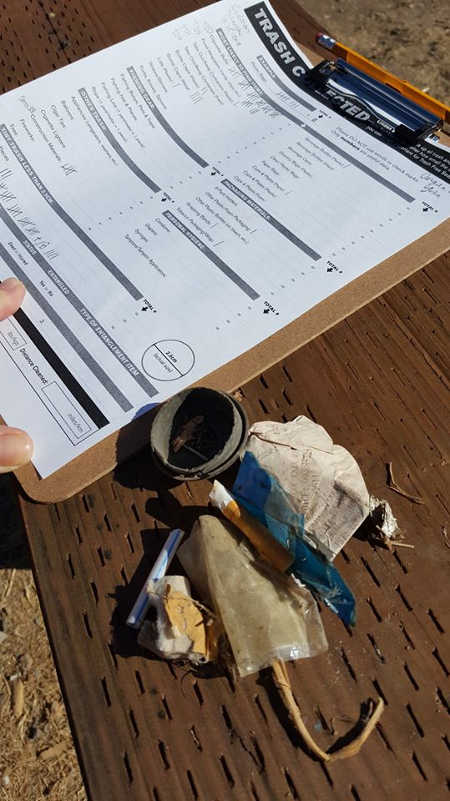
Items of trash picked up in Lake County during the 34th annual California Coastal Cleanup on Saturday, September 15, 2018. Photo courtesy of the Lake County Water Resources Department. LAKE COUNTY, Calif. – Dozens of Lake County residents were among the tens of thousands of volunteers who took part statewide in the California Coastal Cleanup on Saturday, Sept. 15.
The California Coastal Commission, which organizes the statewide event, said the 34th annual event – part of the International Coastal Cleanup organized by Ocean Conservancy – had the largest cleanup of sites in its history.
More than 53,000 volunteers collected an estimated 698,931 pounds of trash and an additional 35,674 pounds of recyclable materials, for a total of 734,606 pounds or 367 tons, the commission reported.
One thousand sites statewide – from beaches to shorelines and inland waterways in 55 of 58 counties – were included. The commission reported that cleanups took place up and down the coast, from the Oregon to Mexico border and as far inland as Lake Tahoe.
Lake County Department of Water Resources staff were out at cleanup sites in Lake County on Sept. 15 to meet with volunteers, collect the trash and document what was picked up.
The five local sites were Keeling County Park in Nice and Rodman Slough County Park near north Lakeport, and in Clearlake, the Clear Lake Campground, the Clear Lake Chamber of Commerce and Pomo Elementary School.
In Clearlake, the group Citizens Caring for Clearlake played a big part in the event, both in terms of promotion and turnout, officials said.
Angela DePalma-Dow of Lake County Water Resources said there were 31 volunteers at the Clearlake sites who removed 400 pounds of trash.
At the two Northshore sites, eight volunteers removed 100 pounds of trash, she said.
DePalma-Dow said some of the trash items included tires, clothes, pallets, lots of plastic bottles and food cans. The No. 1 item: cigarette butts.
“We had a fantastic day along our coast and inland waterways that flow to the ocean from every corner of the state,” said Jack Ainsworth, executive director of the California Coastal Commission. “In only three hours, tens of thousands of Californians removed hundreds of tons of trash from our environment. It’s truly amazing what we can accomplish when we work together to protect our coast and ocean.”
The Coastal Commission continues to highlight to damage that trash, especially single-use disposable plastics, can cause to California’s wildlife, economy, and even human health.
According to past cleanup data, 75 percent of the debris that volunteers removed today was composed of plastic, a material that never completely biodegrades and has numerous harmful consequences in the environment.
The commission said volunteers picked up a number of “unusual” items during this year’s cleanup.
The winners of the 2018 Most Unusual Item contest are, in Northern California, a volunteer in Marin County found a painting of a marsh, in a marsh and, in Southern California, a volunteer in Los Angeles County found a Coca-Cola can from 1963.
Email Elizabeth Larson at This email address is being protected from spambots. You need JavaScript enabled to view it.. Follow her on Twitter, @ERLarson, or Lake County News, @LakeCoNews.
The California Department of Public Health reported that California’s adolescent birth rate continues to decline.
A new state report indicates a record low of 15.7 births per 1,000 females between the ages of 15 and 19. Those numbers reflect an 11 percent decline between 2015 and 2016.
Lake County’s adolescent birth rate was 30.3 births per 1,000 females, the eighth-highest rate in the state.
While its rate remains high, Lake’s rate has been working its way down over the past two decades. It was reported at 31.1 from the last report issued last year, 34.7 in 2014 and 36.1 in 2013. In 2000 it had been reported at a rate of 52.
In this latest report, Sierra County had the highest rate, at 38.6, while San Francisco and Marin counties tied for the lowest adolescent birth rate at 7.4. Alpine County was not ranked.
Declining rates can be attributed to a number of factors, including improved access to reproductive health services and increased use of contraception; delayed first sexual intercourse; and public health prevention, education and support programs.
“While we have more work to do, the decline in adolescent births is a sign that our efforts in California are working,” said Dr. Karen Smith, CDPH director and state public health officer.
The adolescent birth rate decreased among all racial and ethnic groups between 2015 and 2016.
Despite these declining birth rates, racial disparities persist in adolescent childbearing in California. African-American and Hispanic adolescents are three to four times as likely to give birth as White youth.
Hispanic females account for 75 percent of adolescent births and have the highest adolescent birth rate at 23.7.
Rates also vary dramatically across counties: the county with the highest adolescent birth rate has a rate 5.2 times greater than the county with the lowest adolescent birth rate.
For more birth rate data, visit CDPH’s Adolescent Health Data and Statistics Web page.
LAKE COUNTY, Calif. – U.S. Forest Service officials said work is continuing in the vast area burned by the Mendocino Complex.
The Mendocino Complex is the largest wildland fire in California at 459,123 acres, which includes the 410,203-acre Ranch fire and the River fire, which burned 48,920 acres.
The complex was fully contained on Sept. 19, as Lake County News has reported.
The Northern California Team 1 has been managing the suppression repair activities of the Mendocino Complex since Sept. 17.
The management of the complex transitioned back to the Mendocino National Forest on Monday, with Jason Kraling serving as the incident commander, officials said.
The Forest Service said the fireline has been secured to prevent further growth. The remaining resources will continue to extinguish any smoldering vegetation near containment lines and fall trees that pose a hazard to firefighters working in the area.
Officials said the Mendocino National Forest is doing everything possible to reasonably reduce risks to the public and reopen areas. The goal is to reduce erosion and other impacts from suppression activities and there is still a lot of restoration work to do.
As of Monday, there were 6.5 miles of fireline still to be repaired, the Forest Service reported.
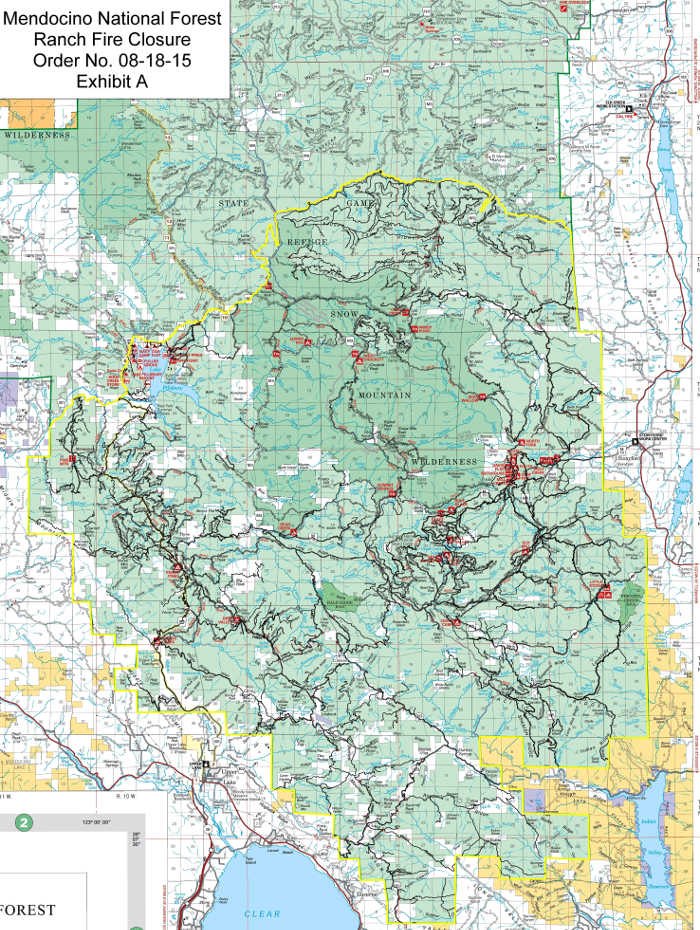
The Ranch fire area is closed as described in Forest Order 08-18-15. The purpose of the closure is to provide for public safety and for the firefighters who are engaged in repair efforts within the Ranch Fire closure area. The closure area applies to all public use, including hunting, the use of firearms and off-highway vehicles.
The northern half of the forest is open for outdoor activities.
The B-Zone deer hunting season continues until Sunday, Oct. 21. Forest visitors need to exercise extreme caution near the fire closure since heavy equipment and firefighting vehicles are utilizing area roads. Visitors can contact the ranger station nearest their destination for current information.
The Ranch fire closure area, the boundary of which is marked in yellow. Map courtesy of the U.S. Forest Service.
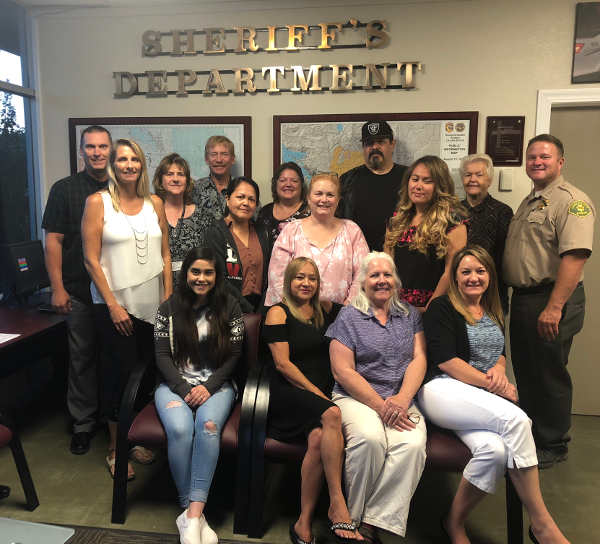
The 20th session of the Lake County Sheriff’s Office Citizens’ Academy ended on Thursday, September 27, 2018. Courtesy photo. LAKEPORT, Calif. – On Sept. 20, 18 Lake County residents completed the 20th session of the Lake County Sheriff’s Office Citizens’ Academy.
The academy consisted of 15 three-hour classes offering classroom and hands-on instruction by deputy sheriffs, custody staff, supervisors, civilian employees and command staff members whose assignments were specific to the subjects of training.
The next academy is set to begin in the summer of 2019. Anyone interested in learning about the services provided by the sheriff’s office and becoming a more informed member of the community is encouraged to participate in this worthwhile program.
Those wishing to enroll can do so by visiting the Lake County Sheriff’s Office Web site at www.lakesheriff.com.
Applications will be accepted starting in the spring of 2019.
There is no cost to those attending the academy. However, applicants must meet the following minimum qualifications:
• Resident or employment in Lake County; • At least 18 years of age; • No felony convictions; • No misdemeanor convictions within three years; • Able to attend all fourteen sessions.
 How to resolve AdBlock issue?