How to resolve AdBlock issue?
Refresh this page
How to resolve AdBlock issue?
Refresh this page
Lake County News,California
  • Home
    • Registration Form
  • News
    • Education
    • Veterans
    • Community
      • Obituaries
      • Letters
      • Commentary
    • Police Logs
    • Business
    • Recreation
    • Health
    • Religion
    • Legals
    • Arts & Life
    • Regional
  • Calendar
  • Contact us
    • FAQs
    • Phones, E-Mail
    • Subscribe
  • Advertise Here
  • Login

News

May 28 town hall to discuss Lake Pillsbury, Potter Valley Project dams

LAKE COUNTY, Calif. — A town hall set for next week will bring together leaders from around the North Coast to discuss the potential decommissioning of the dams in the Potter Valley Project and the impact on Lake Pillsbury.

The Lake County Chamber of Commerce will host the town hall from 5:30 to 7:30 p.m. Wednesday, May 28, at the Soper Reese Theater, 275 S. Main St., Lakeport.

Everyone concerned about the future of Lake Pillsbury and the decommissioning of the dams — from residents to business owners — is encouraged to attend.

Panelists will include Lake County supervisors E.J. Crandell and Bruno Sabatier; Carol Cinquini and Frank Lynch of the Lake Pillsbury Alliance; Lake Pillsbury Fire Chief Larry Thompson; Frost Pauli of the Mendocino County Farm Bureau; and Cloverdale Mayor Todd Lands.

The Potter Valley Project includes the Potter Valley powerhouse, Cape Horn Dam and Van Arsdale Reservoir, Scott Dam and Lake Pillsbury.

Pacific Gas and Electric Co., which operates the project, abandoned its license for the facility in 2019 after determining it was “uneconomic” for its customers to maintain.

In January, PGE released its final draft surrender application and decommissioning plan for the project, which it was ordered to complete after no other party filed an application to take over the project’s operation.

The company said it’s moving forward with its plans to decommission and eventually remove the dams, which in turn will require the building of another water diversion facility, which PG&E said it will not be responsible for building or operating.

The issue has been highly divisive, with Lake County’s interests largely sidelined in the process that created a “two basin solution” that emphasizes the removal of the ams.

In February, the Board of Supervisors voted unanimously to send letters to PG&E, Gov. Gavin Newsom and the Trump Administration over its concerns about the decommissioning plans.

In a letter addressed to several federal cabinet secretaries, the board said the destruction of Lake Pillsbury “would constitute an expensive and irresponsible gamble with regional water supply in an area that has repeatedly been threatened by catastrophic wildfire events” and asked for the Trump Administration’s “collective support in ensuring the Federal Energy Regulatory Commission and your Federal Agencies take seriously the potential for profound human consequences.”

In its announcement about the town hall, the chamber said the decision about the project “stands to profoundly affect not only Mendocino, Sonoma and Marin counties’ water supply but also Lake County’s economy, wildlife, wildfire readiness and recreational access.”

Email Elizabeth Larson at This email address is being protected from spambots. You need JavaScript enabled to view it.. Follow her on Twitter, @ERLarson, and on Bluesky, @erlarson.bsky.social. Find Lake County News on the following platforms: Facebook, @LakeCoNews; X, @LakeCoNews; Threads, @lakeconews, and on Bluesky, @lakeconews.bsky.social.

US safety net helps protect children from abuse and neglect, and some of those programs are threatened by proposed budget cuts


Safety net programs protect children in many ways. Energy/E+ via Getty Images

President Donald Trump and Republicans in the House of Representatives have put forward budget proposals that would slash spending by hundreds of millions of dollars over the next decade on several programs that support low-income U.S. families with children.

If those cuts are in the version of the 2026 budget that clears Congress, and Trump signs it into law, funding for early childhood education, support for grocery purchases and an array of programs that help keep children fed, housed and cared for would decline sharply.

As professors who conduct research about child welfare, we are alarmed by these proposed cuts and concerned about their potential impact on children and families. We are particularly concerned that steps taken to reduce costs will make children less safe and more susceptible to the consequences of abuse and neglect.

Help for low-income families

Our research has shown that increasing access to programs that support low-income families decreases child abuse and neglect while improving parents’ well-being. Examples of these programs include subsidies for child care and the earned-income tax credit, which supplements the earnings of many low- and moderate-income Americans.

Other researchers have found further evidence that policies that help low-income families put food on the table, keep a roof over their heads and obtain health care also provide for children’s basic needs, such as food and education, and keep children safe.

The proposed budget cuts could cost all taxpayers down the line because child abuse and neglect is costly for not only the people who are mistreated as kids but also for society.

What’s more, a series of cost-benefit studies have found that providing a safety net for families not only helps the families who receive assistance but also society as a whole.

Child abuse and neglect

In 2023, child protection agencies received 4.4 million reports for suspected abuse and neglect, and 546,159 cases were confirmed. As high as these numbers are, they drastically underestimate the number of abused and neglected children in the U.S. because many acts of abuse and neglect are never reported.

Research documenting the consequences and costs of child abuse and neglect has led many experts, including us, to recommend programs and policies that can reduce risks.

Without attempts to reduce these risks, more children would suffer or die. The U.S Department of Health and Human Services found that 2,000 children died from abuse and neglect in 2023. Nearly half of these fatalities were among children under the age of 1.

Kids crying, standing between two screaming adults.
Parents experiencing high levels of stress can be more prone to abusing their kids. salim hanzaz/iStock via Getty Images Plus

Risks tied to poverty

Some of the most helpful programs to prevent child abuse and neglect focus on reducing poverty.

Poverty can place children at risk of abuse and neglect. When families can’t afford the bare necessities, it can add to the stress that makes parenting more difficult.

Poverty isn’t the only cause of child abuse and neglect, but it is high on the list of risk factors. And its harms can be hard to reverse.

A recent campaign by Prevent Child Abuse America, a nonprofit, posits that child abuse and neglect are not a “bad parent problem” but rather “a lack of resource problem.” Researchers have found that child abuse and neglect often come from the social and economic issues that lead families into crises.

For example, parenting stress rises and children’s basic needs can go unmet when parents don’t have jobs, lack high-quality child care and generally struggle to make ends meet.

Young woman and a child blow bubbles together in a park.
When families’ basic needs are met, children are safer. Jackyenjoyphotography/Moment via Getty Images

Government programs that help everyone

The Centers for Disease Control and Prevention has found that improving public health requires government programs that can reduce harm to children and promote childhood development and well-being.

These programs include efforts to improve parenting skills, expand access to high-quality child care and early education, and strengthen the financial resilience of families.

And yet the Trump administration initially sought to eliminate Head Start, a successful federally funded preschool program for low-income children, and dismantle many essential services. Evidence indicates that children who participate in Head Start are more likely to finish high school and college, which is important for employment and financial security.

The CDC and our own review of the research point to big improvements in children’s health and fewer cases of child abuse and neglect with economic policies such as the earned-income tax credit, Temporary Assistance for Needy Families and the Supplemental Nutrition Assistance Program.

We believe these programs are worth investing in because children’s lives are at stake. Especially when the economy appears to be in trouble, the consequences of weakening the safety net are dire.The Conversation

Todd Herrenkohl, Professor of Social Work, University of Michigan; Kathryn Maguire-Jack, Associate Professor of Social Work, University of Michigan, and Rebeccah Sokol, Assistant Professor of Social Work, University of Michigan

This article is republished from The Conversation under a Creative Commons license. Read the original article.

Support sought for ‘Harlem Voices’ in wake of federal funding cuts

Clovice Lewis. Photo by Nathan DeHart.

MIDDLETOWN, Calif. — Producers of an upcoming series of performances are seeking the community’s support in the wake of federal action that has canceled a grant that was to provide critical funding for the production.

On April 2, the National Endowment for the Humanities, or NEH, was abruptly instructed to cancel hundreds of grants, including a $25,000 “Humanities for All” award from California Humanities.

This was the primary funding source for the “Harlem Voices Project,” Clovice Lewis Jr.’s opus work exploring Black cultural history and modern justice through storytelling and song.

The project is a partnership between Lewis and the Middletown Art Center, or MAC.

President Trump and DOGE cut NEH funding by 80 to 85%, laying off staff, cancelling grants and ongoing public programs across the United States, while diverting funds to other “fiscal priorities.”

Humanities agencies and projects funded prior to the present Trump administration across the U.S. were impacted.

Composed by Lewis, the Harlem Voices Project consists of selections from “Harlem Voices” and “Harlem Voices: Revisited.”

Two preview performances were held in Upper Lake at the Tallman Hotel and at the Middletown Art Center.

Loss of financial support from California Humanities leaves Lewis and the MAC urgently seeking financial support for the remaining three concert performances at the Soper-Reese Theatre in Lakeport.

The concerts feature a standout cast of vocalists and 13-piece orchestra from across the tri-county and Bay Areas.

The vocalists are:

• April M. Wright – gospel singer and star of “Chicken, Chitlins, and Caviar.”
• Reginald V. Finley – gospel singer and pastor.
• Ben Meyers – Unitarian Universalist minister and vocalist.
• Blue Ryon – local singer-songwriter and activist.
• My Divas – Lake County’s beloved a cappella group.

“This is more than a show — it’s a cultural lifeline,” said Bay Area theater veteran Sabrina Klein Clement.

Take local action to support Harlem Voices, the arts and humanities by buying a ticket to one of three shows at the Soper Reese Theatre in Lakeport on May 30 and 31 at 7 p.m. and June 1 at 2 p.m.

Visit the Middletown Art Center webpage at https://middletownartcenter.org/harlem-voices.html to learn more about Harlem Voices, purchase tickets, sponsor the project or contribute to the Harlem Voices GoFundMe campaign at https://gofund.me/4f7b8b3c.

Helping Paws: New puppies and dogs

LAKE COUNTY, Calif. — Lake County Animal Care and Control has new puppies and adult dogs wanting new homes.

The dogs available for adoption this week include mixes of Australian shepherd, Catahoula leopard dog, German shepherd, husky, Labrador Retriever, pit bull terrier and terrier.

Dogs that are adopted from Lake County Animal Care and Control are either neutered or spayed, microchipped and, if old enough, given a rabies shot and county license before being released to their new owner. License fees do not apply to residents of the cities of Lakeport or Clearlake.

Those dogs and the others shown on this page at the Lake County Animal Care and Control shelter have been cleared for adoption.

Call Lake County Animal Care and Control at 707-263-0278 or visit the shelter online for information on visiting or adopting.

The shelter is located at 4949 Helbush in Lakeport.

Email Elizabeth Larson at This email address is being protected from spambots. You need JavaScript enabled to view it.. Follow her on Twitter, @ERLarson, and on Bluesky, @erlarson.bsky.social. Find Lake County News on the following platforms: Facebook, @LakeCoNews; X, @LakeCoNews; Threads, @lakeconews, and on Bluesky, @lakeconews.bsky.social.


Shadow's preview photo
Shadow

Tank's preview photo
Tank

Gabby's preview photo
Gabby

Maggie's preview photo
Maggie

Winnie's preview photo
Winnie

Millie's preview photo
Millie

Bertha's preview photo
Bertha

Gunther's preview photo
Gunther

Bruno's preview photo
Bruno

Priscilla's preview photo
Priscilla

Ruger's preview photo
Ruger

Sally's preview photo
Sally

Jack's preview photo
Jack

Rome's preview photo
Rome

Bruce's preview photo
Bruce

Duece's preview photo
Duece

Raisin's preview photo
Raisin

Leo's preview photo
Leo

Phoebe's preview photo
Phoebe

Roxy's preview photo
Roxy

Chuck's preview photo
Chuck

Frank's preview photo
Frank

Kennel#7's preview photo
Kennel#7

Kennel#9's preview photo
Kennel#9

Kennel#11's preview photo
Kennel#11

Kennel#15a's preview photo
Kennel#15a

Kennel#15b's preview photo
Kennel#15b


Gratitude comes with benefits − a social psychologist explains how to practice it when times are stressful


If the concept of journaling feels daunting, perhaps just call it a gratitude list. Karl Tapales/Moment via Getty Images

A lot has been written about gratitude over the past two decades and how we ought to be feeling it. There is advice for journaling and a plethora of purchasing options for gratitude notebooks and diaries. And research has consistently pointed to the health and relationship benefits of the fairly simple and cost-effective practice of cultivating gratitude.

Yet, Americans are living in a very stressful time, worried about their financial situation and the current political upheaval.

How then do we practice gratitude during such times?

I am a social psychologist who runs the Positive Emotion and Social Behavior Lab at Gonzaga University. I teach courses focused on resilience and human flourishing. I have researched and taught about gratitude for 18 years.

At the best of times, awareness of the positive may require more effort than noticing the negative, let alone in times of heightened distress. There are, however, two simple ways to work on this.

A team of soccer players lift their coach into the air, as she smiles and high fives the air.
Expressions of gratitude can take many different forms. Lighthouse Films/DigitalVision via Getty Images

Gratitude doesn’t always come easily

Generally, negative information captures attention more readily than the positive. This disparity is so potent that it’s called the negativity bias. Researchers argue that this is an evolutionary adaptation: Being vigilant for life’s harms was essential for survival.

Yet, this means that noticing the kindnesses of others or the beauty the world has to offer may go unnoticed or forgotten by the end of the day. That is to our detriment.

Gratitude is experienced as a positive emotion. It results from noticing that others − including friends and family certainly, but also strangers, a higher power or the planet − have provided assistance or given something of value such as friendship or financial support. By definition, gratitude is focused on others’ care or on entities outside of oneself. It is not about one’s own accomplishments or luck.

When we feel gratitude toward something or someone, it can increase well-being and happiness and relationship satisfaction, as well as lower depression.

Thus, it may assist in counteracting the negativity bias by helping us find and remember the good that others are doing for us every day − the good that we may lose sight of in the best of times, let alone in times when Americans are deeply stressed.

A middle-aged woman sits at a kitchen table between two older women, all of whom are laughing joyously.
We feel gratitude more easily when we notice the good that others have brought into our lives. Catherine Falls Commercial/Moment via Getty Images

How to practice gratitude

Research has shown that some people are naturally more grateful than others.

But it’s also clear that gratitude can be cultivated through practice. People can improve their ability to notice and feel this positive emotion.

One way to do this is to try a gratitude journal. Or, if the idea of journaling is daunting or annoying, perhaps call it a daily list instead. If you have given this a try and dislike it, skip to the second method below.

Gratitude lists are designed to create a habit in which you scan your day looking for the positive outcomes that others have brought into your life, no matter how small. Writing down several experiences each day that went well because of others may make these positive events more visible to you and more memorable by the end of the day − thus, boosting gratitude and its accompanying benefits.

While the negative news − “The stock market is down again!” “How are tariffs going to affect my financial security?” − is clearly drawing attention, a gratitude list is meant to help highlight the positive so that it doesn’t go overlooked.

The negative doesn’t need help gaining attention, but the positive might.

A second method for practicing gratitude is expressing that gratitude to others. This can look like writing a letter of gratitude and delivering it to someone who has made a positive impact in your life.

When my students do this exercise, it often results in touching interactions. For instance, my college students often write to high school mentors, and those adults are regularly moved to tears to learn of the positive impact they had. Expressing gratitude in work settings can boost employees’ sense of social worth.

In a world that may currently feel bleak, a letter of gratitude may not only help the writer recognize the good of others but also let others know that they are making a beautiful difference in the world.The Conversation

Monica Y. Bartlett, Professor of Psychology, Gonzaga University

This article is republished from The Conversation under a Creative Commons license. Read the original article.

Space News: Why collect asteroid samples? 4 essential reads on what these tiny bits of space rock can tell scientists


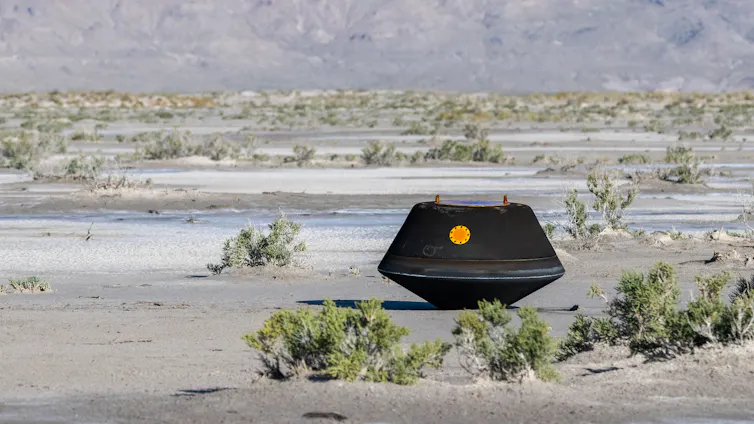
The OSIRIS-REx sample return capsule contained rock from the asteroid Bennu. NASA/Keegan Barber

China’s Tianwen-2 asteroid sample return mission is set to launch this month, May 2025, en route to the asteroid Kamoʻoalewa (2016 HO3). The country could join the United States and Japan, whose space agencies have both successfully retrieved a sample from an asteroid to study back on Earth.

Several space missions have flown by asteroids before and gotten a peek at their compositions, but bringing a sample back to Earth is even more helpful for scientists. The most informative analyses require having physical samples to poke and prod, shine light at, run through CT scanners and examine under electron microscopes.

These missions require detailed planning and specialized spacecraft, so to shed light on why agencies go through the trouble, we compiled four stories from The Conversation U.S.’s archive. These articles describe the ways asteroid sample return missions generate new scientific insights at every stage – from the collection process, to the container’s return to Earth, to laboratory analyses.

1. Ryugu’s colorful history

The asteroid Ryugu is made of carbon-rich rock. Japan targeted Ryugu for its sample return mission Hayabusa2 in 2020.

A small metal cylinder about the size of a human palm, with a person's hand holding it under a light.
A sealed container that holds a piece of the Ryugu sample from Japan’s Hayabusa2 mission. NASA/Robert Markowitz

As planetary scientist Paul K. Byrne from Washington University in St. Louis described in his article, the Hayabusa2 team shot the asteroid with a metal projectile and collected the dusty debris that floated into space. This process allowed the Hayabusa2 craft to gather a sample to bring home and also get a close-up look at the asteroid’s surface.

One thing the collection team noticed: The material that flew off the asteroid was redder than the surface they shot at, which had a bluer tinge.

Some parts of Ryugu appear almost striped – the middle latitudes are redder, while the poles look more blue. The sample collection process gave researchers some hints about why that is.

“At some point the asteroid must have been closer to the Sun that it is now,” Byrne wrote. “That would explain the amount of reddening of the surface.”

2. Return capsules make shock waves

Similar to how researchers gained valuable data just from the Hayabusa2 collection process, atmospheric scientists didn’t even need to open the OSIRIS-REx sample return capsule to learn something new.

NASA’s OSIRIS-REx mission traveled to the carbon-rich asteroid Bennu and sent home a small capsule containing a sample in September 2023.

Released from the OSIRIS-REx craft, the sample return capsule hurtled down to Earth in a heavy box about the size of a microwave. Aside from the fact that it had been released from a spacecraft about 63,000 miles (102,000 kilometers) away, the return looked strikingly similar to that of a meteorite hitting Earth.

Scientists don’t often have the advance notice needed to study how real meteoroids – the term given to meteorites before they hit the ground – behave when they enter the atmosphere, so they jumped on the opportunity to study the capsule as it returned to Earth.

As physicists Brian Elbing from Oklahoma State University and Elizabeth A. Silber from Sandia National Laboratories discussed in their article, OSIRIS-REx’s reentry was the perfect opportunity to study what happens in the atmosphere when meteoroid-size objects fly through.

The teams set up networks of sensitive microphones and other instruments – both on the ground and attached to balloons – to log the sound wave frequencies that the capsule generated in the atmosphere. Understanding how waves travel through the atmosphere can help scientists figure out how to detect hazards such as natural disasters.

3. Building blocks of life on Bennu

Once the OSIRIS-REx return capsule was safely back on Earth, researchers across the world – including geologist Timothy J. McCoy from the Smithsonian Institution and planetary scientist Sara Russell from the Natural History Museum in the U.K. – got to work running tests on its contents, while handling the sample carefully to avoid contaminating it.

As they described in their article, McCoy and Russell found the sample was mostly water-rich clay, which they expected from a carbon-rich asteroid. But they also found a surprising amount of salty and brine-related minerals. These minerals form when water evaporates off a rock’s surface.

Because these minerals – aptly called evaporites – dissolve when they come into contact with moisture, scientists had never seen them in the meteorites that fly through Earth’s atmosphere, even ones with similar compositions to Bennu. The spacecraft’s sample container kept the Bennu sample airtight, so these evaporites stayed intact.

These results suggest that the asteroid used to be wet and muddy. And a salty, water-rich environment like Bennu may have once been a great place for organic molecules to form. Some scientists predict that Earth got its ingredients for life from a collision with an asteroid like Bennu.

4. Looking ahead: Asteroid mining

Asteroid sample return missions generate lots of scientific insights. They can also help space agencies and companies understand what exactly is out there, available to bring home from asteroids. While carbon-rich asteroids like Bennu and Ryugu aren’t flush with precious metals, other asteroids have more valuable contents.

Launched in 2023 and currently traveling through space, NASA’s Psyche mission will explore a metallic asteroid. The Psyche asteroid likely contains platinum, nickel, iron and possibly gold – all materials of commercial interest.

Scientists can learn about the formation and composition of Earth’s core from metallic asteroids like Psyche, which is the mission’s main goal. But as planetary scientist Valerie Payré from the University of Iowa wrote in her article, “The Psyche mission is a huge step in figuring out what sort of metals are out there.”

For now, commercial asteroid mining operations are science fiction – not to mention legally fraught. But some companies have started considering early-stage plans for how they one day might do it. Asteroid sample missions can lay some early groundwork.

This story is a roundup of articles from The Conversation’s archives.The Conversation

Mary Magnuson, Associate Science Editor, The Conversation

This article is republished from The Conversation under a Creative Commons license. Read the original article.

  • 189
  • 190
  • 191
  • 192
  • 193
  • 194
  • 195
  • 196
  • 197
  • 198

Community

  • Lake County Wine Alliance offers sponsor update; beneficiary applications open 

  • Mendocino National Forest announces seasonal hiring for upcoming field season

Public Safety

  • Lakeport Police logs: Thursday, Jan. 15

  • Lakeport Police logs: Wednesday, Jan. 14

Education

  • Woodland Community College receives maximum eight-year reaffirmation of accreditation from ACCJC

  • SNHU announces Fall 2025 President's List

Health

  • California ranks 24th in America’s Health Rankings Annual Report from United Health Foundation

  • Healthy blood donors especially vital during active flu season

Business

  • Two Lake County Mediacom employees earn company’s top service awards

  • Redwood Credit Union launches holiday gift and porch-to-pantry food drives

Obituaries

  • Rufino ‘Ray’ Pato

  • Patty Lee Smith

Opinion & Letters

  • The benefits of music for students

  • How to ease the burden of high electric bills

Veterans

  • CalVet and CSU Long Beach team up to improve data collection related to veteran suicides

  • A ‘Big Step Forward’ for Gulf War Veterans

Recreation

  • Wet weather trail closure in effect on Upper Lake Ranger District

  • Mendocino National Forest seeking public input on OHV grant applications

  • State Parks announces 2026 Anderson Marsh nature walk schedule 

  • BLM lifts seasonal fire restrictions in central California

Religion

  • Kelseyville Presbyterian to host Ash Wednesday service and Lenten dinner Feb. 18

  • Kelseyville Presbyterian Church to hold ‘Longest Night’ service Dec. 21

Arts & Life

  • Auditions announced for original musical ‘Even In Shadow’ set for March 21 and 28

  • ‘The Rip’ action heist; ‘Steal’ grounded in a crime thriller

Government & Politics

  • Lake County Democrats issue endorsements in local races for the June California Primary

  • County negotiates money-saving power purchase agreement

Legals

  • March 3 hearing on ordinance amending code for commercial cannabis uses

  • Feb. 12 public hearing on resolution to establish standards for agricultural roads

How to resolve AdBlock issue?
Refresh this page