How to resolve AdBlock issue?
Refresh this page
How to resolve AdBlock issue?
Refresh this page
Lake County News,California
  • Home
    • Registration Form
  • News
    • Education
    • Veterans
    • Community
      • Obituaries
      • Letters
      • Commentary
    • Police Logs
    • Business
    • Recreation
    • Health
    • Religion
    • Legals
    • Arts & Life
    • Regional
  • Calendar
  • Contact us
    • FAQs
    • Phones, E-Mail
    • Subscribe
  • Advertise Here
  • Login

News

Space News: Devil is in details in selfie taken by NASA’s Mars Perseverance rover

marsroverselfie.jpg

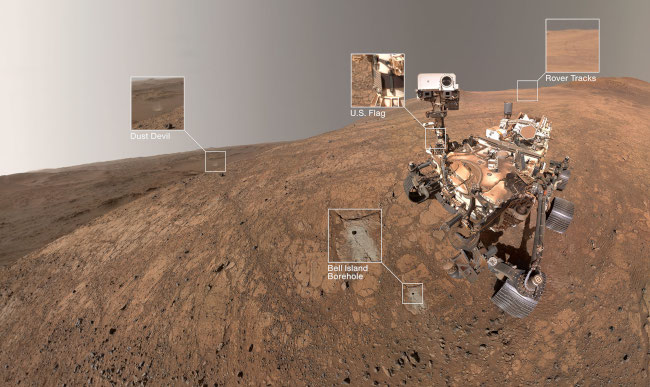
NASA’s Perseverance took this selfie on May 10, 2025. The small dark hole in the rock in front of the rover is the borehole made when Perseverance collected its latest sample. The small puff of dust left of center and below the horizon line is a dust devil. Photo credit: NASA/JPL-Caltech/MSSS.


A Martian dust devil photobombed NASA’s Perseverance Mars rover as it took a selfie on May 10 to mark its 1,500th sol (Martian day) exploring the Red Planet. At the time, the six-wheeled rover was parked in an area nicknamed “Witch Hazel Hill,” an area on Jezero Crater’s rim that the rover has been exploring over the past five months.

“The rover self-portrait at the Witch Hazel Hill area gives us a great view of the terrain and the rover hardware,” said Justin Maki, Perseverance imaging lead at NASA’s Jet Propulsion Laboratory in Southern California, which manages the mission. “The well-illuminated scene and relatively clear atmosphere allowed us to capture a dust devil located 3 miles to the north in Neretva Vallis.”

The selfie also gives the engineering teams a chance to view and assess the state of the rover, its instruments, and the overall dust accumulation as Perseverance reached the 1,500-sol milestone. (A day on Mars is 24.6 hours, so 1,500 sols equals 1,541 Earth days.)

The bright light illuminating the scene is courtesy of the high angle of the Sun at the time the images composing the selfie were taken, lighting up Perseverance’s deck and casting its shadow below and behind the chassis. Immediately in front of the rover is the “Bell Island” borehole, the latest sampling location in the Witch Hazel Hill area.

How Perseverance did it

This newest selfie, Perseverance’s fifth since the mission began, was stitched together on Earth from a series of 59 images collected by the WATSON (Wide Angle Topographic Sensor for Operations and eNgineering) camera at the end of the robotic arm. It shows the rover’s remote sensing mast looking into the camera. To generate the version of the selfie with the mast looking at the borehole, WATSON took three additional images, concentrating on the reoriented mast.

“To get that selfie look, each WATSON image has to have its own unique field of view,” said Megan Wu, a Perseverance imaging scientist from Malin Space Science Systems in San Diego. “That means we had to make 62 precision movements of the robotic arm. The whole process takes about an hour, but it’s worth it. Having the dust devil in the background makes it a classic. This is a great shot.”

The dust covering the rover is visual evidence of the rover’s journey on Mars: By the time the image was captured, Perseverance had abraded and analyzed a total of 37 rocks and boulders with its science instruments, collected 26 rock cores (25 sealed and 1 left unsealed), and traveled more than 22 miles (36 kilometers).

“After 1,500 sols, we may be a bit dusty, but our beauty is more than skin deep,” said Art Thompson, Perseverance project manager at JPL. “Our multi-mission radioisotope thermoelectric generator is giving us all the power we need. All our systems and subsystems are in the green and clicking along, and our amazing instruments continue to provide data that will feed scientific discoveries for years to come.”

The rover is currently exploring along the western rim of Jezero Crater, at a location the science team calls “Krokodillen.”

Ely Carriage House Hoedown to raise funds for Historical Society project

elybarn.jpg

A previous event at the Ely Stage Stop in Kelseyville, California. Courtesy photo.


KELSEYVILLE, Calif. — An upcoming event will raise funds for the Lake County Historical Society’s Ely Stage Stop Carriage House project.

The Ely Carriage House Hoedown will take place from 4 to 9 p.m. Saturday, June 7.

Step back into the 1880s for a big tri-tip dinner, an evening of music and dancing, yard games, hay rides, silent auction, raffle baskets, and a chance to see many of Lake County's historic carriages. 

Join a party for a good cause. Lake County's biggest collection of historic horse-drawn wagons and carriages need a home so the public can enjoy them. 

The Hoedown Party will raise funds for the construction of a new carriage house on the grounds of the Ely Stage Stop Museum located at 9921 Soda Bay Road, just north of Kitt's Corner off Highway 29.
 
The Ely Museum's Oak Grove will be the place for a tri-tip dinner by Smokin S BBQ (vegetarian option available), music by the Fargo Brothers, blacksmith demonstrations and much more.


elymailwagon.jpg

A mail carriage at the Ely Stage Stop. Courtesy photo.


Tickets are $80/person and can be purchased online at Carriage House Hoedown, or in person at the Ely Museum.  

To sponsor a table and receive eight tickets (depending on the level), fill out the form here.

The Ely Stage Stop is an all-volunteer, all-donation run public museum operated by the Lake County Historical Society since 2011.  

The grounds contain the 1860s Jamison and Ely Family ranch house and stage stop, two display barns, the restored 1890s Kelseyville jail, a 1906 San Francisco Cable Car, displays of historic Lake County farm machinery, tractors and much more.

For more information visit the Hoedown Fundraiser Dinner event page or call Event Committee Chair Bill Lane at 707-349-3453.


elybiggshotel.jpg

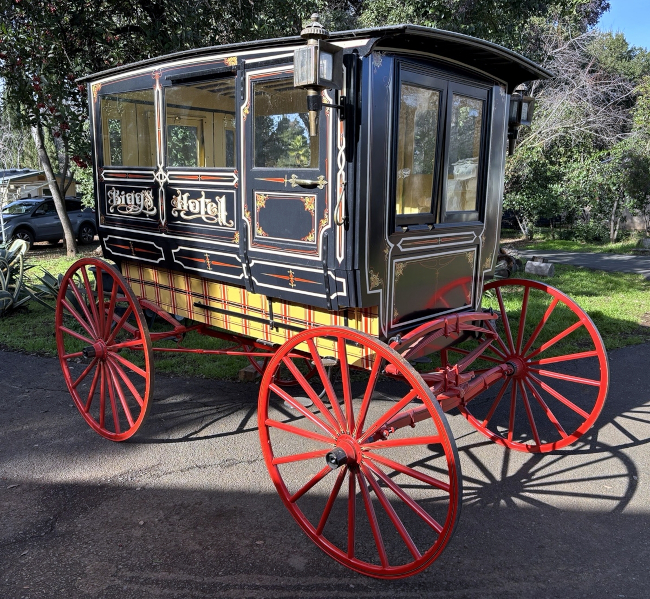
One of the historic carriages at the Ely Stage Stop. Courtesy photo.

Seat belts save lives: CHP ramps up holiday roadway patrols ahead of Memorial Day weekend

LAKE COUNTY, Calif. — As Memorial Day weekend marks the unofficial beginning of summer, the California Highway Patrol urges drivers and passengers to prioritize safety by buckling up before each trip.

The CHP began its annual statewide Memorial Day Holiday Enforcement Period, or HEP, on Friday, May 23, at 6:01 p.m. It will continue through Monday, May 26, at 11:59 p.m. 

To help maintain safety on California’s roadways, CHP officers will be vigilant for impaired and reckless drivers and motorists who fail to buckle up.

“Our top priority is keeping the public safe, not just during the holidays but daily,” said CHP Commissioner Sean Duryee. “Buckling up is one of the easiest and most effective ways to protect yourself and your passengers in a crash. Our officers will be out in force to help everyone arrive at their destination safely.”

In addition to CHP officers driving traditional black-and-white patrol vehicles, motorists are reminded that they may encounter the CHP’s new generation of low-profile specially marked patrol vehicles on the roadway. 

These fully marked patrol vehicles blend into traffic just enough to observe the most reckless and dangerous driving behaviors without immediate detection.

Last year, 42 people lost their lives in crashes across California during Memorial Day weekend. 

Tragically, nearly half of all vehicle occupants killed in a crash within CHP jurisdiction were not wearing seatbelts. 

CHP officers also made more than 1,100 arrests for driving under the influence of alcohol or drugs.

California law mandates that all drivers and passengers aged eight and older must wear seatbelts. Children under eight need to be properly secured in an appropriate child passenger safety seat or booster seat situated in the back seat of the vehicle. Children under two must also ride in a rear-facing car seat unless they weigh more than 40 pounds or are taller than 40 inches.

This year, the CHP’s holiday enforcement effort coincides with the National Highway Traffic Safety Administration’s designation of May 19 to June 1 as the national “Click it or Ticket” mobilization campaign. 

Throughout this awareness initiative, CHP personnel will concentrate their enforcement efforts on seat belt and child safety seat violations.

As always, the CHP urges everyone to make smart choices behind the wheel: Buckle up. Drive sober. Stay alert. If you plan to drink or use drugs, arrange for a safe ride home before heading out. Your safety and the safety of others depend on it.

“Let’s work together to make this Memorial Day weekend safe for all Californians,” the CHP said.

Clearlake Animal Control: ‘Caesar’ and the dogs

caccaesar.jpg
Caesar. Courtesy photo.


CLEARLAKE, Calif. — Clearlake Animal Control has a varied group of canines waiting for homes.   

The shelter has 54 adoptable dogs listed on its website.

This week’s dogs include “Caesar,” a big fluffy Great Pyrenees/Saint Bernard mix.

The shelter is located at 6820 Old Highway 53. It’s open from 9 a.m. to 6 p.m. Tuesday through Saturday. 

For more information, call the shelter at 707-762-6227, email This email address is being protected from spambots. You need JavaScript enabled to view it., visit Clearlake Animal Control on Facebook or on the city’s website.

This week’s adoptable dogs are featured below.

Email Elizabeth Larson at This email address is being protected from spambots. You need JavaScript enabled to view it.. Follow her on Twitter, @ERLarson, and on Bluesky, @erlarson.bsky.social. Find Lake County News on the following platforms: Facebook, @LakeCoNews; X, @LakeCoNews; Threads, @lakeconews, and on Bluesky, @lakeconews.bsky.social. 

Estate Planning: On being a representative payee


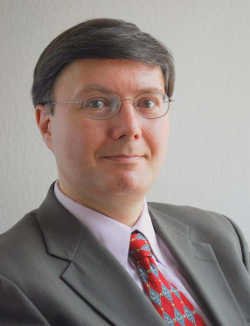
Dennis Fordham. Courtesy photo.

An incapacitated adult or minor person who is unable to manage their bill paying often has a representative payee appointed by the Social Security Administration to manage their receipt of Supplemental Security Income or Social Security Disability Income, as relevant.

Each year, the representative payee must report to and account to the Social Security Administration for the use of the Supplemental Security Income, or SSI, and Social Security Disability Income, or SSDI, monies. 

An SSI recipient may sometimes also be a beneficiary of a special needs trust established, with inheritance or settlement proceeds, to preserve their SSI and other needs-based government benefits, such as food stamps. 

It is important that the representative payee and the SNT trustee, if not the same person, coordinate their separate spending of monies for the beneficiary.

The representative payee of a SSI recipient must use SSI monies to pay for the recipient’s basic living expenses — food, shelter, utilities and medical expenses not covered by Medi-Cal. 

If any SSI money remains, which is unlikely, it must be kept for future expenses, less perhaps a possible discretionary spending allowance. 

Typically, the representative payee is a close family member or friend with close contact to the SSI beneficiary. One reason for this is that, except for certain approved organizations, a representative payee is not entitled to any compensation. 

Nevertheless, an uncompensated representative payee is still subject to duties and to liabilities imposed by the Social Security Administration, or SSA.

Specifically, the representative payee has a duty to report any changes in circumstances (such as changes in the recipient’s assets and in income) that would affect the SSI recipient’s eligibility to receive, or the amount of, their SSI benefits. 

If the SSA makes an overpayment in SSI benefits that should have been avoided had the personal representative reported relevant changes, then the SSA may proceed against the personal representative personally.

In addition, if the representative payee misuses the SSI recipient’s SSI money or, even worse yet embezzles the SSI money, then not only may the SSA go after the representative for reimbursement but any embezzlement is a felony that can result in incarceration. 

The trustee of a special needs trust, on the other hand, is typically compensated (by the trust) and may be a professional (such as a private fiduciary or a pooled special needs trust). Such trustees are much better equipped to deal with government regulations and oversight. 

Given that distributions from special needs trusts for the basic necessities of life count against the beneficiary’s right to receive SSI, it is important that the representative payee and the trustee work closely together and keep each other informed. 

Otherwise, the SSA may make SSI overpayments that have negative consequences to the recipient’s right to additional SSI benefits and to the representative payee in terms of his liability for SSI overpayments (which do accumulate).

Typically, the trustee of the special needs trust first makes distributions for the benefit of the beneficiary to improve the quality (comforts) of the SSI beneficiary by purchasing items that are not covered by SSI benefits. That is, the trust monies may be used to purchase travel, entertainment, and services excluding food, shelter, and utilities that are first paid with SSI monies. 

Nonetheless, given the high cost of basic living and the small amount of SSI checks, special needs trusts often authorize payments for such necessities. 

Such direct payments by anyone other than the SSI recipient from their SSI income is treated as “in kind, support and maintenance,” or ISM, and counts as unearned income to the SSI recipient. This negatively affects his or her right to receive SSI.  

Fortunately, ISM payments reduce but do not usually wholly eliminate a recipient’s right to receive SSI entirely. That is, ISM payments reduce the SSI check up to a presumed maximum value and no more (currently around $264). 

So long as at least $1 of SSI remains after subtracting for the ISM, the SSI beneficiary also remains categorically eligible to receive Medi-Cal health care benefits, sometimes more important than the SSI benefits.  

In sum, being a representative payee on behalf of an SSI or SSDI recipient is serious business. Know SSA’s rules, keep good book keeping, keep the money in a bank account in the recipient’s name, and, if the recipient receives other sources of income and assets make sure to notify SSA and know how such income and assets affects eligibility, as relevant.

The foregoing is not legal advice. Consult a qualified estate planning attorney for guidance. 

Dennis A. Fordham, attorney, is a State Bar-Certified Specialist in estate planning, probate and trust law. His office is at 870 S. Main St., Lakeport, Calif. He can be reached at This email address is being protected from spambots. You need JavaScript enabled to view it. and 707-263-3235.  

Space News: A decade after the release of ‘The Martian’ and a decade out from the world it envisions, a planetary scientist checks in on real-life Mars exploration


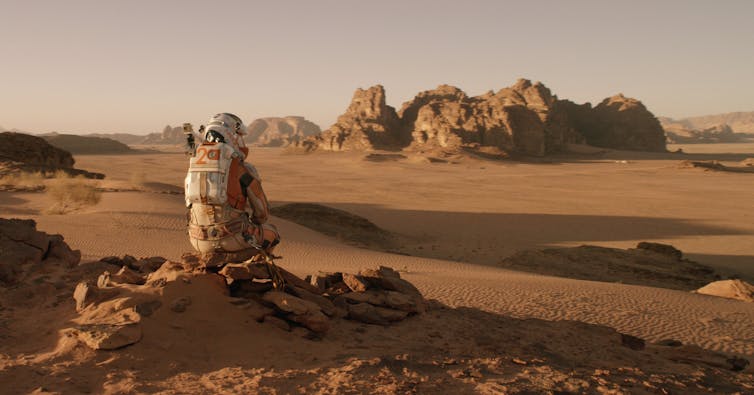
‘The Martian’ protagonist Mark Watney contemplates his ordeal. 20th Century Fox

Andy Weir’s bestselling story “The Martian” predicts that by 2035 NASA will have landed humans on Mars three times, perfected return-to-Earth flight systems and collaborated with the China National Space Administration. We are now 10 years past the Hollywood adaptation’s 2015 release and 10 years shy of its fictional timeline. At this midpoint, Mars exploration looks a bit different than how it was portrayed in “The Martian,” with both more discoveries and more controversy.

As a planetary geologist who works with NASA missions to study Mars, I follow exploration science and policy closely. In 2010, the U.S. National Space Policy set goals for human missions to Mars in the 2030s. But in 2017, the White House Space Policy Directive 1 shifted NASA’s focus toward returning first to the Moon under what would become the Artemis program.

Although concepts for crewed missions to Mars have gained popularity, NASA’s actual plans for landing humans on Mars remain fragile. Notably, over the last 10 years, it has been robotic, rather than crewed, missions that have propelled discovery and the human imagination forward.

A diagram showing the steps from lunar missions to Mars missions. The steps in the current scope are labeled 'Human presence on Moon,' 'Practice for Mars Exploration Demo' and 'Demo exploration framework on Mars.' The partial scope step is labeled 'Human presence on Mars.'
NASA’s 2023 Moon to Mars Strategy and Objectives Development document lays out the steps the agency was shooting for at the time, to go first to the Moon, and from there to Mars. NASA

Robotic discoveries

Since 2015, satellites and rovers have reshaped scientists’ understanding of Mars. They have revealed countless insights into how its climate has changed over time.

As Earth’s neighbor, climate shifts on Mars also reflect solar system processes affecting Earth at a time when life was first taking hold. Thus, Mars has become a focal point for investigating the age old questions of “where do we come from?” and “are we alone?”

The Opportunity, Curiosity and Perseverance rovers have driven dozens of miles studying layered rock formations that serve as a record of Mars’ past. By studying sedimentary layers – rock formations stacked like layers of a cake – planetary geologists have pieced together a vivid tale of environmental change that dwarfs what Earth is currently experiencing.

Mars was once a world of erupting volcanoes, glaciers, lakes and flowing rivers – an environment not unlike early Earth. Then its core cooled, its magnetic field faltered and its atmosphere drifted away. The planet’s exposed surface has retained signs of those processes ever since in the form of landscape patterns, sequences of layered sediment and mineral mixtures.

Rock shelves layered on top of each other, shown from above.
Layered sedimentary rocks exposed within the craters of Arabia Terra, Mars, recording ancient surface processes. Photo from the Mars Reconnaissance Orbiter High Resolution Imaging Science Experiment. NASA/JPL/University of Arizona

Arabia Terra

One focus of scientific investigation over the last 10 years is particularly relevant to the setting of “The Martian” but fails to receive mention in the story. To reach his best chance of survival, protagonist Mark Watney, played by Matt Damon, must cross a vast, dusty and crater-pocked region of Mars known as Arabia Terra.

In 2022 and 2023, I, along with colleagues at Northern Arizona University and Johns Hopkins University, published detailed analyses of the layered materials there using imagery from the Mars Reconnaissance Orbiter and Mars Odyssey satellites.

By using infrared imagery and measuring the dimensions of surface features, we linked multiple layered deposits to the same episodes of formation and learned more about the widespread crumbling nature of the terrain seen there today. Because water tends to cement rock tightly together, that loose material indicates that around 3.5 billion years ago, that area had a drying climate.

To make the discussions about this area easier, we even worked with the International Astronomical Union to name a few previously unnamed craters that were mentioned in the story. For example, one that Watney would have driven right by is now named Kozova Crater, after a town in Ukraine.

More to explore

Despite rapid advances in Mars science, many unknowns remain. Scientists still aren’t sure of the precise ages, atmospheric conditions and possible signatures of life associated with each of the different rock types observed on the surface.

For instance, the Perseverance rover recently drilled into and analyzed a unique set of rocks hosting organic – that is, carbon-based – compounds. Organic compounds serve as the building blocks of life, but more detailed analysis is required to determine whether these specific rocks once hosted microbial life.

The in-development Mars Sample Return mission aims to address these basic outstanding questions by delivering the first-ever unaltered fragments of another world to Earth. The Perseverance rover is already caching rock and soil samples, including ones hosting organic compounds, in sealed tubes. A future lander will then need to pick up and launch the caches back to Earth.

Sampling Mars rocks could tell scientists more about the red planet’s past, and whether it could have hosted life.

Once home, researchers can examine these materials with instruments orders of magnitude more sensitive than anything that could be flown on a spacecraft. Scientists stand to learn far more about the habitability, geologic history and presence of any signs of life on Mars through the sample return campaign than by sending humans to the surface.

This perspective is why NASA, the European Space Agency and others have invested some US$30 billion in robotic Mars exploration since the 1960s. The payoff has been staggering: That work has triggered rapid technological advances in robotics, telecommunications and materials science. For example, Mars mission technology has led to better sutures for heart surgery and cars that can drive themselves.

It has also bolstered the status of NASA and the U.S. as bastions of modern exploration and technology; and it has inspired millions of students to take an interest in scientific fields.
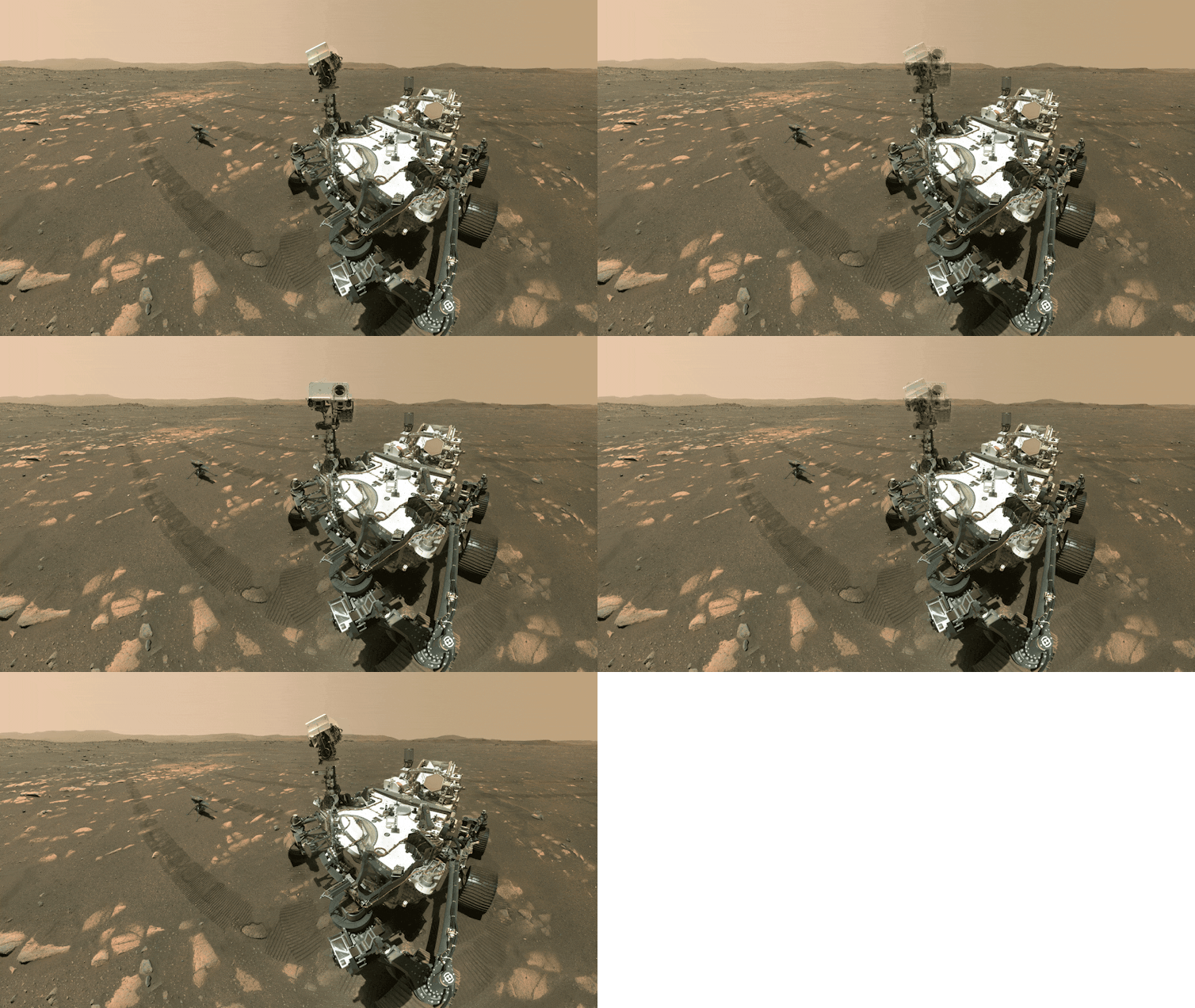
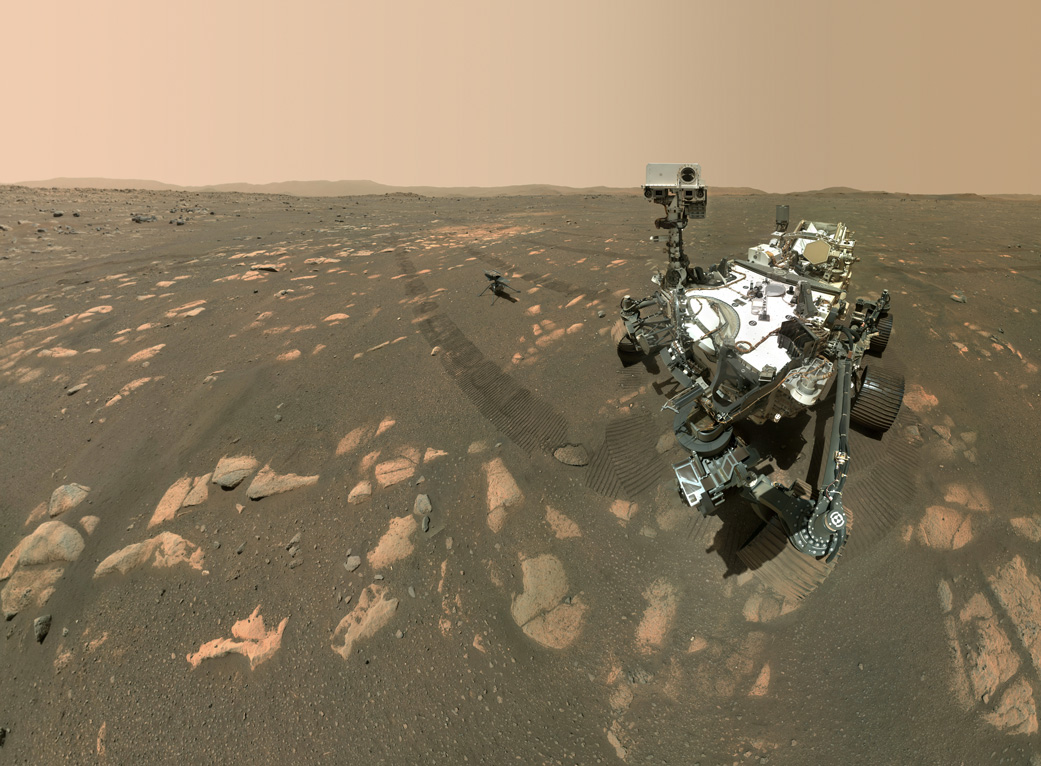
The Perseverance rover and the Ingenuity helicopter on the Martian surface, with the rover's camera moving to look down at Ingenuity.
A selfie from NASA’s Perseverance Mars rover with the Ingenuity helicopter, taken with the rover’s extendable arm on April 6, 2021. NASA/JPL-Caltech/MSSS

Calling the red planet home?

Colonizing Mars has a seductive appeal. It’s hard not to cheer for the indomitable human spirit while watching Watney battle dust storms, oxygen shortages and food scarcity over 140 million miles from rescue.

Much of the momentum toward colonizing Mars is now tied to SpaceX and its CEO Elon Musk, whose stated mission to make humanity a “multi-planetary species” has become a sort of rallying cry. But while Mars colonization is romantic on paper, it is extremely difficult to actually carry out, and many critics have questioned the viability of a Mars habitation as a refuge far from Earth.

Now, with NASA potentially facing a nearly 50% reduction to its science budget, the U.S. risks dissolving its planetary science and robotic operations portfolio altogether, including sample return.

Nonetheless, President Donald Trump and Musk have pushed for human space exploration to somehow continue to progress, despite those proposed cuts – effectively sidelining the robotic, science-driven programs that have underpinned all of Mars exploration to date.

Yet, it is these programs that have yielded humanity’s richest insights into the red planet and given both scientists and storytellers like Andy Weir the foundation to imagine what it must be like to stand on Mars’ surface at all.The Conversation

Ari Koeppel, Postdoctoral Scientist in Earth and Planetary Science, Dartmouth College

This article is republished from The Conversation under a Creative Commons license. Read the original article.

  • 185
  • 186
  • 187
  • 188
  • 189
  • 190
  • 191
  • 192
  • 193
  • 194

Community

  • Lake County Wine Alliance offers sponsor update; beneficiary applications open 

  • Mendocino National Forest announces seasonal hiring for upcoming field season

Public Safety

  • Lakeport Police logs: Thursday, Jan. 15

  • Lakeport Police logs: Wednesday, Jan. 14

Education

  • Woodland Community College receives maximum eight-year reaffirmation of accreditation from ACCJC

  • SNHU announces Fall 2025 President's List

Health

  • California ranks 24th in America’s Health Rankings Annual Report from United Health Foundation

  • Healthy blood donors especially vital during active flu season

Business

  • Two Lake County Mediacom employees earn company’s top service awards

  • Redwood Credit Union launches holiday gift and porch-to-pantry food drives

Obituaries

  • Rufino ‘Ray’ Pato

  • Patty Lee Smith

Opinion & Letters

  • The benefits of music for students

  • How to ease the burden of high electric bills

Veterans

  • CalVet and CSU Long Beach team up to improve data collection related to veteran suicides

  • A ‘Big Step Forward’ for Gulf War Veterans

Recreation

  • Wet weather trail closure in effect on Upper Lake Ranger District

  • Mendocino National Forest seeking public input on OHV grant applications

  • State Parks announces 2026 Anderson Marsh nature walk schedule 

  • BLM lifts seasonal fire restrictions in central California

Religion

  • Kelseyville Presbyterian to host Ash Wednesday service and Lenten dinner Feb. 18

  • Kelseyville Presbyterian Church to hold ‘Longest Night’ service Dec. 21

Arts & Life

  • Auditions announced for original musical ‘Even In Shadow’ set for March 21 and 28

  • ‘The Rip’ action heist; ‘Steal’ grounded in a crime thriller

Government & Politics

  • Lake County Democrats issue endorsements in local races for the June California Primary

  • County negotiates money-saving power purchase agreement

Legals

  • March 3 hearing on ordinance amending code for commercial cannabis uses

  • Feb. 12 public hearing on resolution to establish standards for agricultural roads

How to resolve AdBlock issue?
Refresh this page