How to resolve AdBlock issue?
Refresh this page
How to resolve AdBlock issue?
Refresh this page
Lake County News,California
  • Home
    • Registration Form
  • News
    • Education
    • Veterans
    • Community
      • Obituaries
      • Letters
      • Commentary
    • Police Logs
    • Business
    • Recreation
    • Health
    • Religion
    • Legals
    • Arts & Life
    • Regional
  • Calendar
  • Contact us
    • FAQs
    • Phones, E-Mail
    • Subscribe
  • Advertise Here
  • Login

News

Space News: Landing on the Moon is an incredibly difficult feat − 2025 has brought successes and shortfalls for companies and space agencies


Several missions have already attempted to land on the lunar surface in 2025, with more to come. AP Photo

Half a century after the Apollo astronauts left the last bootprints in lunar dust, the Moon has once again become a destination of fierce ambition and delicate engineering.

This time, it’s not just superpowers racing to plant flags, but also private companies, multinational partnerships and robotic scouts aiming to unlock the Moon’s secrets and lay the groundwork for future human return.

So far in 2025, lunar exploration has surged forward. Several notable missions have launched toward or landed on the Moon. Each has navigated the long journey through space and the even trickier descent to the Moon’s surface or into orbit with varying degrees of success. Together, these missions reflect both the promise and difficulty of returning to the Moon in this new space race defined by innovation, competition and collaboration.

As an aerospace engineer specializing in guidance, navigation and control technologies, I’m deeply interested in how each mission – whether successful or not – adds to scientists’ collective understanding. These missions can help engineers learn to navigate the complexities of space, operate in hostile lunar environments and steadily advance toward a sustainable human presence on the Moon.

Why is landing on the Moon so hard?

Lunar exploration remains one of the most technically demanding frontiers in modern spaceflight. Choosing a landing site involves complex trade-offs between scientific interest, terrain safety and Sun exposure.

The lunar south pole is an especially attractive area, as it could contain water in the form of ice in shadowed craters, a critical resource for future missions. Other sites may hold clues about volcanic activity on the Moon or the solar system’s early history.

Each mission trajectory must be calculated with precision to make sure the craft arrives and descends at the right time and place. Engineers must account for the Moon’s constantly changing position in its orbit around Earth, the timing of launch windows and the gravitational forces acting on the spacecraft throughout its journey.

They also need to carefully plan the spacecraft’s path so that it arrives at the right angle and speed for a safe approach. Even small miscalculations early on can lead to major errors in landing location – or a missed opportunity entirely.

Once on the surface, the landers need to survive extreme swings in temperature – from highs over 250 degrees Fahrenheit (121 degrees Celsius) in daylight down to lows of -208 F (-133 C) at night – as well as dust, radiation and delayed communication with Earth. The spacecraft’s power systems, heat control, landing legs and communication links must all function perfectly. Meanwhile, these landers must avoid hazardous terrain and rely on sunlight to power their instruments and recharge their batteries.

These challenges help explain why many landers have crashed or experienced partial failures, even though the technology has come a long way since the Apollo era.

Commercial companies face the same technical hurdles as government agencies but often with tighter budgets, smaller teams and less heritage hardware. Unlike government missions, which can draw on decades of institutional experience and infrastructure, many commercial lunar efforts are navigating these challenges for the first time.

Successful landings and hard lessons for CLPS

Several lunar missions launched this year belong to NASA’s Commercial Lunar Payload Services program. CLPS is an initiative that contracts private companies to deliver science and technology payloads to the Moon. Its aim is to accelerate exploration while lowering costs and encouraging commercial innovation.

An illustration of a lander, which looks like a mechanical box with small suport legs, on the lunar surface.
An artist’s rendering of Firefly Aerospace’s Blue Ghost lander, which navigated and avoided hazards during its final descent to the surface. NASA/GSFC/Rani Gran/Wikimedia Commons

The first Moon mission of 2025, Firefly Aerospace’s Blue Ghost Mission 1, launched in January and successfully landed in early March.

The lander survived the harsh lunar day and transmitted data for nearly two weeks before losing power during the freezing lunar night – a typical operational limit for most unheated lunar landers.

Blue Ghost demonstrated how commercial landers can shoulder critical parts of NASA’s Artemis program, which aims to return astronauts to the Moon later this decade.

The second CLPS launch of the year, Intuitive Machines’ IM-2 mission, launched in late February. It targeted a scientifically intriguing site near the Moon’s south pole region.
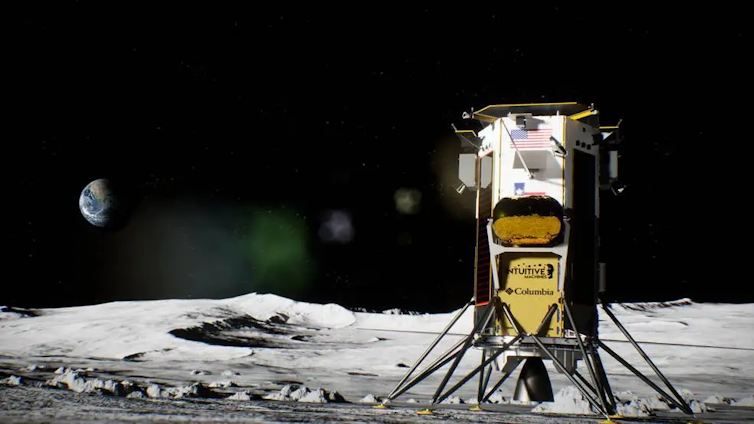
An illustration of a lander, a rectangular machine on triangular legs, on the lunar surface.
An artist’s rendering of Intuitive Machines’ IM-2 mission, which is scheduled to land near the lunar south pole for in-situ resource utilization demonstration on the Moon. NASA/Intuitive Machines

The Nova-C lander, named Athena, touched down on March 6 close to the south pole. However, during the landing process, Athena tipped over. Since it landed on its side in a crater with uneven terrain, it couldn’t deploy its solar panels to generate power, which ended the mission early.

While Athena’s tipped-over landing meant it couldn’t do all the scientific explorations it had planned, the data it returned is still valuable for understanding how future landers can avoid similar fates on the rugged polar terrain.

Not all lunar missions need to land. NASA’s Lunar Trailblazer, a small lunar orbiter launched in February alongside IM-2, was intended to orbit the Moon and map the form, abundance and distribution of water in the form of ice, especially in shadowed craters near the poles.

Shortly after launch, however, NASA lost contact with the spacecraft. Engineers suspect the spacecraft may have experienced a power issue, potentially leaving its batteries depleted.

NASA is continuing recovery efforts, hoping that the spacecraft’s solar panels may recharge in May and June.

An illustration of Lunar Trailblazer, which looks like a mechanical box with two solar panel wings.
An artist’s rendering of NASA’s Lunar Trailblazer spacecraft. If recovered, it will orbit the Moon to measure the form and distribution of water on the lunar surface. Lockheed Martin Space

Ongoing and future missions

Launched on the same day as the Blue Ghost mission in January, Japanese company ispace’s Hakuto-R Mission 2 (Resilience) is on its way to the Moon and has successfully entered lunar orbit.

The lander carried out a successful flyby of the Moon on Feb. 15, with an expected landing in early June. Although launched at the same time, Resilience took a longer trajectory than Blue Ghost to save energy. This maneuver also allowed the spacecraft to collect bonus science observations while looping around the Moon.

The mission, if successful, will advance Japan’s commercial space sector and prove an important comeback for ispace after its first lunar lander crashed during its final descent in 2023.

A lander – which looks like a large box with metal sides – on a platform in a white room.
The Resilience lunar lander days before its launch in the payload processing facility at the U.S. Space Force station. The Resilience lander has completed its Earth orbit and a lunar flyby. It is now completing a low-energy transfer orbit and entering an orbit around the Moon. Business Wire

The rest of 2025 promises a busy lunar calendar. Intuitive Machines plans to launch IM-3 in late 2025 to test more advanced instruments and potentially deliver NASA scientific experiments to the Moon.

The European Space Agency’s Lunar Pathfinder will establish a dedicated lunar communications satellite, making it easier for future missions, especially those operating on the far side or poles, to stay in touch with Earth.

Meanwhile, Astrobotic’s Griffin Mission-1 is scheduled to deliver NASA’s VIPER rover to the Moon’s south pole, where it will directly search for ice beneath the surface.

Together, these missions represent an increasingly international and commercial approach to lunar science and exploration.

As the world turns its attention to the Moon, every mission – whether triumph or setback – brings humanity closer to a permanent return to our closest celestial neighbor.The Conversation

Zhenbo Wang, Associate Professor of Mechanical and Aerospace Engineering, University of Tennessee

This article is republished from The Conversation under a Creative Commons license. Read the original article.


Thompson, Matsui, local experts sound the alarm on devastating impacts of congressional Republicans' budget bill

congresshearing

Rep. Thompson and Rep. Matsui listen to testimony from a local expert on Friday, May 30, 2025. Courtesy photo.


On Friday, Rep. Mike Thompson (CA-04) and Rep. Doris Matsui (CA-07) held a forum featuring testimony from local public safety experts, tax law experts, and health care providers to discuss how Congressional Republicans’ latest budget bill will impact Sacramento metro region residents.

Congressional Republicans’ bill, which passed the House of Representatives this month, will slash health care coverage for nearly 14 million people, cut nutrition benefits for nearly 11 million people, and raise energy costs for families by $110 per year in order to hand a tax break to the ultra-wealthy.

“Simply put, this bill is a bad deal for the American people,” said Thompson. “My Republican colleagues are paying for these huge tax breaks for the wealthy by stripping health care away from nearly 14 million Americans, taking food assistance from 11 million people, and cutting green energy investments responsible for our manufacturing boom. This will add $5 trillion to our national debt and will impact everyone in our community. Hospitals and clinics will be forced to reduce services or shut down altogether, local food banks will have fewer resources, and families will pay more for their energy bills. This is unacceptable.”

“Republicans’ Big Ugly Bill is a disaster — targeting the most vulnerable among us to give tax breaks to the richest Americans,” said Matsui. “This bill rips away health care and nutrition assistance from millions of Americans and will have devastating consequences here in our region. That’s why we gathered a panel of local experts to explain exactly what is at stake for our communities. Programs like Medicaid and SNAP are lifelines – they allow our loved ones, friends, and neighbors to live healthy and fulfilling lives with dignity and independence. With the health and future of our constituents at risk, we will not back down. This battle is far from over.”

Representatives Thompson and Matsui were joined by local experts testifying to the negative impacts of this bill. Panelists included Dr. Darien Shanske, Martin Luther King Jr. Professor of Law at UC Davis; Chief Chris Costamagna of the Sacramento Fire Department; Dr. Erika Roshanravan, Medical Director for CommuniCare+OLE; Kate Laddish, Medicaid beneficiary and Chair of Yolo County In-Home Supportive Services’ Advisory Committee; Diana Flores, Executive of Director Nutrition Services, Central Kitchen and Distribution Services for Sacramento City Unified School District; and Jessica Bartholow, Director of Government Relations for SEIU California.

H.R. 1 passed the House of Representatives 215-214 in May. Every Democrat and two Republicans voted "No." Now, it is under consideration in the Senate.

CHP expands ranks with 133 new officers

chpgrads

Graduating cadets at the California Highway Patrol graduation ceremony on Friday May 30, 2025. Courtesy photo.


On Friday, the California Highway Patrol welcomed 133 new officers who completed 26 weeks of intensive training at the CHP Academy in West Sacramento.

“This graduation marks the beginning of a commitment to protecting and serving others,” said CHP Commissioner Sean Duryee. “These officers have demonstrated their dedication to keeping California’s communities safe and upholding the CHP’s core values.”

The officers will now report to one of the CHP’s 102 Area offices across California to begin their law enforcement careers.

During academy training, cadets receive instruction in traffic enforcement, collision investigation, defensive tactics, firearms, emergency vehicle operations, and community policing.

The curriculum also focuses on legal responsibilities, communication, ethics and cultural awareness to prepare cadets to serve California’s diverse population.

The CHP has sworn in 364 officers in 2025 with this graduating class.

Nearly 300 cadets continue training at the West Sacramento facility, and another 160 are scheduled to begin instruction on June 9 as part of the department’s ongoing efforts to strengthen public safety statewide.

The CHP continues to seek motivated individuals who are ready to make a difference in communities throughout California. A career with the CHP offers comprehensive training, competitive benefits, and opportunities for professional growth and advancement.

To learn more about joining the CHP, please visit https://chpmadeformore.com/ to take the first step towards a rewarding career in law enforcement.

Clearlake Animal Control: ‘Sahara’ and the dogs

cacsahara

“Sahara.” Photo courtesy of Clearlake Animal Control.


CLEARLAKE, Calif. — Clearlake Animal Control has many unique dogs waiting to be adopted this week.

The shelter has 51 adoptable dogs listed on its website.

This week’s dogs include “Sahara,” a female Doberman pinscher mix with a black and tan coat.

Shelter staff said Sahara is a well-behaved dog who walks well on a leash. “She has a unique way of interacting — if you stop petting her, she will pet you back for attention.”

Staff said Sahara gets along well with other dogs, making her a good fit for multi-pet households.

“She also enjoys wearing sweaters, adding a touch of charm to her personality. Overall, Sahara is a friendly and affectionate companion,” they said.

The shelter is located at 6820 Old Highway 53. It’s open from 9 a.m. to 6 p.m. Tuesday through Saturday.

For more information, call the shelter at 707-762-6227, email This email address is being protected from spambots. You need JavaScript enabled to view it., visit Clearlake Animal Control on Facebook or on the city’s website.

This week’s adoptable dogs are featured below.

Email Elizabeth Larson at This email address is being protected from spambots. You need JavaScript enabled to view it.. Follow her on Twitter, @ERLarson, and on Bluesky, @erlarson.bsky.social. Find Lake County News on the following platforms: Facebook, @LakeCoNews; X, @LakeCoNews; Threads, @lakeconews, and on Bluesky, @lakeconews.bsky.social.


Three new wolf packs confirmed in California

collaredwolf

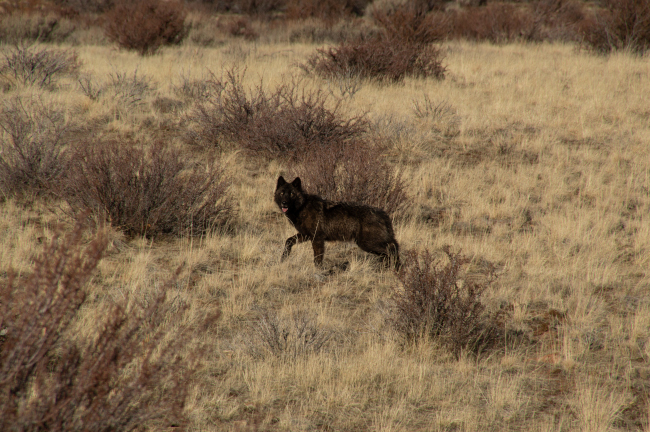
CDFW wolf collaring January 2025 photo by Malia Byrtus/California Wolf Project.


NORTHERN CALIFORNIA — The California Department of Fish and Wildlife reported Tuesday that three new wolf packs have been confirmed in the state.

These new wolf families are the Ishi pack in eastern Tehama County, the Tunnison pack in central Lassen County and the Ashpan pack in eastern Shasta County.

This brings California’s total current known number of packs to 10.

“How wonderful to witness another year of continued growth in California’s recovering wolf population,” said Amaroq Weiss, a senior wolf advocate at the Center for Biological Diversity. “It’s inspiring to watch this renaissance and we should do everything we can to ensure California’s wolves have every chance to thrive.”

Confirmation of these new packs shows the ongoing progress in wolf reestablishment and recovery across the West Coast.

The first packs were confirmed in 2008 in Washington and Oregon and in 2015 in California. By the end of 2024 there were 75 individual wolf pack territories across the three states.

A new time-lapsetime-lapse map prepared by the Center depicts the renaissance of wolves across the West Coast region from 2008 to 2024. The map also confirms that wolves here are still in the early stages of recovery since there’s abundant identified suitable wolf habitat that has not yet been occupied. Confirmation of the Ishi, Tunnison and Ashpan packs brings the tally to at least 78 wolf family territories on the West Coast.

California’s other seven packs consist of the Whaleback pack in Siskiyou County; the Lassen pack ranging across parts of Lassen and Plumas counties; the Diamond pack straddling portions of Plumas and Lassen counties; the Beyem Seyo pack which inhabits Sierra County; the Ice Cave pack whose territory touches portions of Lassen, Plumas, Shasta and Tehama counties; the Harvey pack ranging in parts of Lassen and Shasta counties; and the Yowlumni pack in Tulare County.

There are additionally two known small groups of two to three wolves each in northern California, one in southern Modoc County and the other in southern Plumas County, which do not yet qualify as packs. The latest wolf map posted by the department shows where each pack and each small group of wolves are ranging.

The department’s quarterly report provided information on California’s wolves from the start of 2025 up to the end of March. The report mentioned that a dispersing wolf was detected on a camera trap in central Kern County. It also reported that the deaths of two wolves from the Yowlumni pack in Tulare County were discovered this quarter and are under investigation.

“It’s been a bumpy road lately for California wolves as some northern counties have enacted emergency resolutions based on misunderstanding and misinformation,” said Weiss. “Decades of research shows that conflicts between livestock, wolves and people are rare and preventable. These magnificent animals have immense value because they help keep nature wild and healthy, and that ultimately benefits humans as well.”

Background

The first wolf in nearly a century to make California part of his range was OR-7, a radio-collared wolf from Oregon that entered California in late 2011. OR-7 traveled across seven northeastern counties in California before returning to southwestern Oregon, where he found a mate and settled down, forming the Rogue pack.

Several of OR-7’s offspring have since come to California and established packs. Those include the original breeding male of the Lassen pack and the breeding female of the Yowlumni pack residing in Tulare County. The Shasta pack, California’s first confirmed wolf pack in nearly 100 years, was discovered in 2015 but disappeared a few months later.

The gray wolf (Canis lupus) is native to California but was driven to extinction in the state by the mid-1920s. After OR-7 left Oregon for California, the Center and allies successfully petitioned the state to fully protect wolves under California’s endangered species act. Wolves are also federally protected in California under the federal Endangered Species Act. It is illegal to intentionally kill any wolves in the state except in defense of human life.

Space News: Eccentric ‘Star’ Defies Easy Explanation, NASA’s Chandra Finds

eccentricstar2

X-ray: NASA/CXC/ICRAR, Curtin Univ./Z. Wang et al.; Infrared: NASA/JPL/CalTech/IPAC; Radio: SARAO/MeerKAT; Image processing: NASA/CXC/SAO/N. Wolk.


Scientists have discovered a star behaving like no other seen before, giving fresh clues about the origin of a new class of mysterious objects.

As described in our press release, a team of astronomers combined data from NASA’s Chandra X-ray Observatory and the SKA [Square Kilometer Array] Pathfinder (ASKAP) radio telescope on Wajarri Country in Australia to study the antics of the discovered object, known as ASKAP J1832−0911 (ASKAP J1832 for short).

ASKAP J1832 belongs to a class of objects called “long period radio transients” discovered in 2022 that vary in radio wave intensity in a regular way over tens of minutes. This is thousands of times longer than the length of the repeated variations seen in pulsars, which are rapidly spinning neutron stars that have repeated variations multiple times a second. ASKAP J1832 cycles in radio wave intensity every 44 minutes, placing it into this category of long period radio transients.

Using Chandra, the team discovered that ASKAP J1832 is also regularly varying in X-rays every 44 minutes. This is the first time that such an X-ray signal has been found in a long period radio transient.

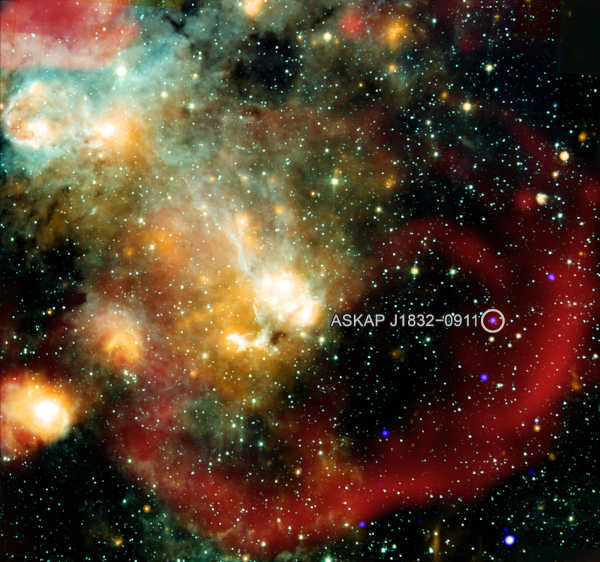
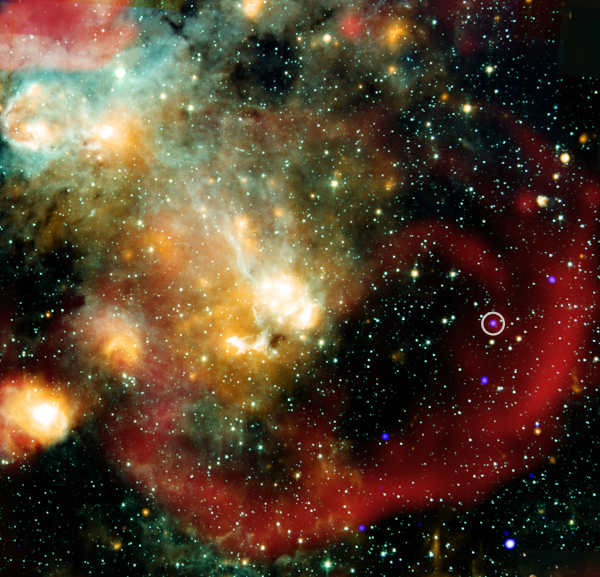
In this composite image, X-rays from Chandra (blue) have been combined with infrared data from NASA’s Spitzer Space Telescope (cyan, light blue, teal and orange), and radio from LOFAR (red). An inset shows a more detailed view of the immediate area around this unusual object in X-ray and radio light.

Using Chandra and the SKA Pathfinder, a team of astronomers found that ASKAP J1832 also dropped off in X-rays and radio waves dramatically over the course of six months. This combination of the 44-minute cycle in X-rays and radio waves in addition to the months-long changes is unlike anything astronomers have seen in the Milky Way galaxy.

The research team argues that ASKAP J1832 is unlikely to be a pulsar or a neutron star pulling material from a companion star because its properties do not match the typical intensities of radio and X-ray signals of those objects. Some of ASKAP J1832’s properties could be explained by a neutron star with an extremely strong magnetic field, called a magnetar, with an age of more than half a million years.

However, other features of ASKAP J1832 — such as its bright and variable radio emission — are difficult to explain for such a relatively old magnetar.

On the sky, ASKAP J1832 appears to lie within a supernova remnant, the remains of an exploded star, which often contain a neutron star formed by the supernova. However, the research team determined that the proximity is probably a coincidence and two are not associated with each other, encouraging them to consider the possibility that ASKAP J1832 does not contain a neutron star.

They concluded that an isolated white dwarf does not explain the data but that a white dwarf star with a companion star might. However, it would require the strongest magnetic field ever known for a white dwarf in our galaxy.

A paper by Ziteng Wang (Curtin University in Australia) and collaborators describing these results appears in the journal Nature. Another team led by Di Li from Tsinghua University in China independently discovered this source using the DAocheng Radio Telescope and submitted their paper to the arXiv on the same day as the team led by Dr Wang. They did not report the X-ray behavior described here.

NASA’s Marshall Space Flight Center in Huntsville, Alabama, manages the Chandra program. The Smithsonian Astrophysical Observatory’s Chandra X-ray Center controls science operations from Cambridge, Massachusetts, and flight operations from Burlington, Massachusetts.

Learn more about the Chandra X-ray Observatory and its mission here: https://www.nasa.gov/chandra and https://chandra.si.edu.


eccentricstar3

A close-up image of ASKAP J1832 in X-ray and radio light. X-ray: NASA/CXC/ICRAR, Curtin Univ./Z. Wang et al.; Radio: SARAO/MeerKAT; Image processing: NASA/CXC/SAO/N. Wolk.


Visual description

This release features two composite images of a mysterious object, possibly an unusual neutron star or white dwarf, residing near the edge of a supernova remnant. The object, known as ASKAP J1832, has been intriguing astronomers from the Chandra X-ray Observatory and Square Kilometre Array Pathfinder radio telescope with its antics and bizarre behavior.

Astronomers have discovered that ASKAP J1832 cycles in radio wave intensity every 44 minutes. This is thousands of times longer than pulsars, which are rapidly spinning neutron stars that have repeated variations multiple times a second. Using Chandra, the team discovered that the object is also regularly varying in X-rays every 44 minutes. This is the first time such an X-ray signal has been found in a long period radio transient like ASKAP J1832.

In the primary composite image of this release, the curious object is shown in the context of the supernova remnant and nearby gas clouds. Radio data is red and and X-ray sources seen with Chandra are in dark blue. The supernova remnant is the large, wispy, red oval ring occupying the lower right of the image. The curious object sits inside this ring, to our right of center; a tiny purple speck in a sea of colorful specks. The gas cloud shows infrared data from NASA’s Spitzer Space Telescope and resembles a mottled green, teal blue, and golden orange cloud occupying our upper left half of the square image.

The second, close-up image shows a view of the immediate area around ASKAP J1832. In this composite image, infrared data from Spitzer has been removed, eliminating the mottled cloud and most of the colorful background specks. Here, near the inside edge of the hazy red ring, the curious object resembles a bright white dot with a hot pink outer edge, set against the blackness of space. Upon close inspection, the hot pink outer edge is revealed to have three faint spikes emanating from the surface.

The primary and close-up images are presented both unadorned, and with labels, including fine white circles identifying ASKAP J1832.

eccentricstar1

A close-up image of ASKAP J1832 in X-ray and radio light. X-ray: NASA/CXC/ICRAR, Curtin Univ./Z. Wang et al.; Radio: SARAO/MeerKAT; Image processing: NASA/CXC/SAO/N. Wolk.

  • 180
  • 181
  • 182
  • 183
  • 184
  • 185
  • 186
  • 187
  • 188
  • 189

Community

  • Lake County Wine Alliance offers sponsor update; beneficiary applications open 

  • Mendocino National Forest announces seasonal hiring for upcoming field season

Public Safety

  • Lakeport Police logs: Thursday, Jan. 15

  • Lakeport Police logs: Wednesday, Jan. 14

Education

  • Woodland Community College receives maximum eight-year reaffirmation of accreditation from ACCJC

  • SNHU announces Fall 2025 President's List

Health

  • California ranks 24th in America’s Health Rankings Annual Report from United Health Foundation

  • Healthy blood donors especially vital during active flu season

Business

  • Two Lake County Mediacom employees earn company’s top service awards

  • Redwood Credit Union launches holiday gift and porch-to-pantry food drives

Obituaries

  • Rufino ‘Ray’ Pato

  • Patty Lee Smith

Opinion & Letters

  • The benefits of music for students

  • How to ease the burden of high electric bills

Veterans

  • CalVet and CSU Long Beach team up to improve data collection related to veteran suicides

  • A ‘Big Step Forward’ for Gulf War Veterans

Recreation

  • Wet weather trail closure in effect on Upper Lake Ranger District

  • Mendocino National Forest seeking public input on OHV grant applications

  • State Parks announces 2026 Anderson Marsh nature walk schedule 

  • BLM lifts seasonal fire restrictions in central California

Religion

  • Kelseyville Presbyterian to host Ash Wednesday service and Lenten dinner Feb. 18

  • Kelseyville Presbyterian Church to hold ‘Longest Night’ service Dec. 21

Arts & Life

  • Auditions announced for original musical ‘Even In Shadow’ set for March 21 and 28

  • ‘The Rip’ action heist; ‘Steal’ grounded in a crime thriller

Government & Politics

  • Lake County Democrats issue endorsements in local races for the June California Primary

  • County negotiates money-saving power purchase agreement

Legals

  • March 3 hearing on ordinance amending code for commercial cannabis uses

  • Feb. 12 public hearing on resolution to establish standards for agricultural roads

How to resolve AdBlock issue?
Refresh this page