How to resolve AdBlock issue?
Refresh this page
How to resolve AdBlock issue?
Refresh this page
Lake County News,California
  • Home
    • Registration Form
  • News
    • Education
    • Veterans
    • Community
      • Obituaries
      • Letters
      • Commentary
    • Police Logs
    • Business
    • Recreation
    • Health
    • Religion
    • Legals
    • Arts & Life
    • Regional
  • Calendar
  • Contact us
    • FAQs
    • Phones, E-Mail
    • Subscribe
  • Advertise Here
  • Login

News

California invests $32.4 million to help communities combat extreme heat

As part of a first of its kind grant program, Gov. Gavin Newsom is announcing $32.4 million in funding to help 47 California communities — including Middletown — protect people from the dangers of extreme heat.

Through the Extreme Heat and Community Resilience Program, or EHCRP, the state aims to support local, tribal, and regional efforts to reduce the impacts of extreme heat — by building long-lasting infrastructure solutions, while also strengthening the community resilience needed to withstand extreme heat events. EHCRP is the first government grant program in the U.S. to support communities building resilience to extreme heat in multiple ways.

“Extreme heat kills — and with the federal government cutting the very programs that help forecast it, California is taking aggressive action to protect residents from the impacts of extreme heat and build resilience in our most vulnerable communities,” said Gov. Newsom. “… we’re connecting more Californians — particularly those that are most vulnerable to dangerous heat – to life-saving information, resources, and programs across the state.”

In Lake County, North Coast Opportunities Inc. and the Middletown Rancheria of Pomo Indians have received $2.3 million for the “SolarCHHILL” program, which stands for “Cooling and Heating Homes with Innovative, Low-Impact Living.”

The project will include installing solar-powered mini-splits in homes of senior residents and those with chronic health conditions, with a focus on members of Middletown Rancheria of Pomo Indians. It also will provide workforce development programming to build community resilience and encourage construction of solar-powered mini-splits.

EHCRP is part of the governor’s Extreme Heat Action Plan, which guides the state’s response to extreme heat events. Developed in partnership with more than 20 state agencies and informed by more than 1000 individuals through listening sessions and public engagement, EHCRP responds directly to community needs and builds on existing state programs.

“California is taking aggressive action to protect residents from the impacts of extreme heat and build resilience in our most vulnerable communities,” said Samuel Assefa, Director of the Governor’s Office of Land Use and Climate Innovation (LCI), the agency overseeing the funding. “With lives on the line each summer, the Extreme Heat and Community Resilience Program will provide critical infrastructure investments in heat vulnerable communities.”

The EHCRP is a crucial component of the coordinated efforts between state agencies to build resilience to extreme heat across California, supporting infrastructure solutions that complement the state’s extreme heat planning approach, statewide initiatives like CalHeatScore, and grant programs including the California Strategic Growth Council’s Community Resilience Center Program, California Natural Resources Agency’s Urban Greening Grant Program, and Cal Fire’s Urban and Community Forestry Grant Program.

EHCRP Projects will build much needed cooling infrastructure in heat vulnerable communities across the state. In Imperial and Riverside counties, the Torres Martinez Desert Cahuilla Indians will be able to update a senior housing property with solar parking shades, clean energy for their gym/Cooling Center, and plant trees for more shade and green spaces.

"As stewards of our ancestral lands, we have witnessed firsthand the devastating impacts of extreme heat on our community, natural resources, and cultural heritage. It is imperative that we invest in sustainable solutions to protect our people, preserve our traditions, and ensure a resilient future for generations to come,” Torres Martinez Desert Cahuilla Indians.

In Redding, where it’s estimated that there may be 100 days over 100 degrees by the end of the century, city officials will construct a heat resilient playground and splashpad.

In San Bernardino County, the community college district will work directly with students to provide heat safe infrastructure including shaded spaces, cool water stations, and solar-powered study spots.

"We’re planning for the future, making sure that when the heat returns, our students have a campus that’s comfortable, safe, and designed with them in mind," said Gilbert J. Contreras, a grantee through San Bernardino Valley College. "These infrastructure upgrades came directly from our students’ voices. It’s all about building a campus where students feel supported and can focus on achieving their goals."

Extreme Heat solutions funded through EHCRP combine physical infrastructure with nature-based solutions and in-home technology to create a more resilient community. In Los Angeles, the county will work with local community-based organizations to provide heat safe spaces by planting tree canopies, installing water fountains, and hosting educational programming in parks across the county.

In Northern California, community-based organizations, North Coast Opportunities and the Middletown Rancheria of Pomo Indians of California, will partner to provide solar powered air conditioning in the homes of vulnerable community members.

EHCRP will also support projects in the northern part of the state, through projects like the Happy Camp Cool Community Resilience and Emergency Operations Center Project, and the far south, in Imperial Valley, where Comite Civico de Valle and the Imperial Valley Justice and Equity Coalition will lead partnership development and create a collaborative plan for extreme heat response and relief in one of the hottest parts of the state.

“Extreme heat exposure has severe consequences, and the impacts are felt at all levels in the Imperial Valley,” said Christian Torres, Director of Climate Equity and Resilience at Comite Civico del Valle, Inc. “Despite this, grassroots efforts and organizations are helping those most affected. The time to prepare for this challenge is now and we look forward to collaborating with local groups, agencies, and stakeholders to build a comprehensive extreme heat preparedness plan for the Imperial Valley."

Critical minerals don’t belong in landfills – microwave tech offers a cleaner way to reclaim them from e-waste


Broken electronics still contain valuable critical minerals. Beeldbewerking/iStock/Getty Images Plus

When the computer or phone you’re using right now blinks its last blink and you drop it off for recycling, do you know what happens?

At the recycling center, powerful magnets will pull out steel. Spinning drums will toss aluminum into bins. Copper wires will get neatly bundled up for resale. But as the conveyor belt keeps rolling, tiny specks of valuable, lesser-known materials such as gallium, indium and tantalum will be left behind.

Those tiny specks are critical materials. They’re essential for building new technology, and they’re in short supply in the U.S. They could be reused, but there’s a problem: Current recycling methods make recovering critical minerals from e-waste too costly or hazardous, so many recyclers simply skip them.

Sadly, most of these hard-to-recycle materials end up buried in landfills or get mixed into products like cement. But it doesn’t have to be this way. New technology is starting to make a difference.

Multiple printed circuit boards laid on top of one another.
A treasure trove of critical materials is often overlooked in e-waste, including gallium in LEDs, indium in LCDs, and tantalum in surface mount capacitors. Ansan Pokharel/West Virginia University, CC BY

As demand for these critical materials keeps growing, discarded electronics can become valuable resources. My colleagues and I at West Virginia University are developing a new technology to change how we recycle. Instead of using toxic chemicals, our approach uses electricity, making it safer, cleaner and more affordable to recover critical materials from electronics.

How much e-waste are we talking about?

Americans generated about 2.7 million tons of electronic waste in 2018, according to the latest federal data. Including uncounted electronics, a survey by the United Nations suggests that the U.S. recycles only about 15% of its total e-waste.

Even worse, nearly half the electronics that people in Northern America sent to recycling centers end up shipped overseas. They often land in scrapyards, where workers may use dangerous methods like burning or leaching using harsh chemicals to pull out valuable metals. These practices can harm both the environment and workers’ health. That’s why the Environmental Protection Agency restricts these methods in the U.S.

The tiny specks matter

Critical minerals are in most of the technology around you. Every phone screen has a super-thin layer of a material called indium tin oxide. LEDs glow because of a metal called gallium. Tantalum stores energy in tiny electronic parts called capacitors.

All of these materials are flagged as “high risk” on the U.S. Department of Energy’s critical materials list. That means the U.S. relies heavily on these materials for important technologies, but their supply could be easily disrupted by conflicts, trade disputes or shortages.

Right now, just a few countries, including China, control most of the mining, processing and recovery of these materials, making the U.S. vulnerable if those countries decide to limit exports or raise prices.


These materials aren’t cheap, either. For example, the U.S. Geological Survey reports that gallium was priced between US$220 to $500 per kilogram in 2024. That’s 50 times more expensive than common metals like copper, at $9.48 per kilogram in 2024.

Revolutionizing recycling with microwaves

At West Virginia University’s Department of Mechanical, Materials and Aerospace Engineering, I and materials scientist Edward Sabolsky asked a simple question: Could we find a way to heat only specific parts of electronic waste to recover these valuable materials?

If we could focus the heat on just the tiny specks of critical minerals, we might be able to recycle them easily and efficiently.

The solution we found: microwaves.

This equipment isn’t very different from the microwave ovens you use to heat food at home, just bigger and more powerful. The basic science is the same – electromagnetic waves cause electrons to oscillate, creating heat.

In our approach, though, we’re not heating water molecules like you do when cooking. Instead, we heat carbon, the black residue that collects around a candle flame or car tailpipe. Carbon heats up much faster in a microwave than water does. But don’t try this at home; your kitchen microwave wasn’t designed for such high temperatures.
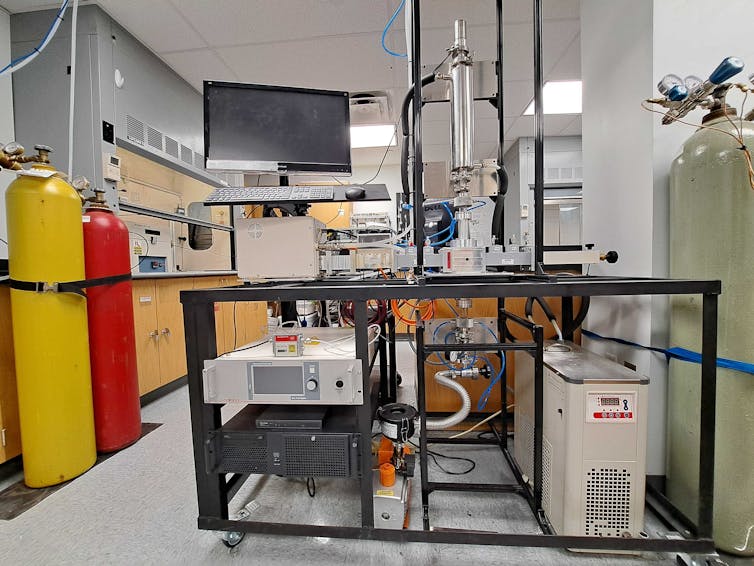
Photo of a chemistry lab space with colorful gas bottles. At the center of the image is a microwave reactor connected by a waveguide to a microwave source.
West Virginia University researchers are using this experimental microwave reactor to recycle critical materials from end-of-life electronics. Ansan Pokharel/West Virginia University, CC BY

In our recycling method, we first shred the electronic waste, mix it with materials called fluxes that trap impurities, and then heat the mixture with microwaves. The microwaves rapidly heat the carbon that comes from the plastics and adhesives in the e-waste. This causes the carbon to react with the tiny specks of critical materials. The result: a tiny piece of pure, sponge-like metal about the size of a grain of rice.

This metal can then be easily separated from leftover waste using filters.

So far, in our laboratory tests, we have successfully recovered about 80% of the gallium, indium and tantalum from e-waste, at purities between 95% and 97%. We have also demonstrated how it can be integrated with existing recycling processes.

Why the Department of Defense is interested

Our recycling technology got its start with help from a program funded by the Defense Department’s Advanced Research Projects Agency, or DARPA.

Many important technologies, from radar systems to nuclear reactors, depend on these special materials. While the Department of Defense uses less of them than the commercial market, they are a national security concern.

We’re planning to launch larger pilot projects next to test the method on smartphone circuit boards, LED lighting parts and server cards from data centers. These tests will help us fine-tune the design for a bigger system that can recycle tons of e-waste per hour instead of just a few pounds. That could mean producing up to 50 pounds of these critical minerals per hour from every ton of e-waste processed.

If the technology works as expected, we believe this approach could help meet the nation’s demand for critical materials.

How to make e-waste recycling common

One way e-waste recycling could become more common is if Congress held electronics companies responsible for recycling their products and recovering the critical materials inside. Closing loopholes that allow companies to ship e-waste overseas, instead of processing it safely in the U.S., could also help build a reserve of recovered critical minerals.

But the biggest change may come from simple economics. Once technology becomes available to recover these tiny but valuable specks of critical materials quickly and affordably, the U.S. can transform domestic recycling and take a big step toward solving its shortage of critical materials.The Conversation

Terence Musho, Associate Professor of Engineering, West Virginia University

This article is republished from The Conversation under a Creative Commons license. Read the original article.


Growing together: Lakeport Rotary’s ParkLife Tree Initiative brings shade and heart to the park

rotarytreeinitiative1

The Lakeport Rotary ParkLife Tree Initiative has helped bring new trees to Xabatin Park. Here the trees are located next to the Curfew Bell, another Rotary project. Photo courtesy of Pam Harpster.


LAKEPORT, Calif. — The Lakeport Rotary ParkLife Tree Initiative began with a simple and heartfelt mission: to add a little more to the original vision for Xabatin Park — a space designed to bring people together, shaded by trees, and filled with beauty and life.

When Xabatin Park was first developed, the city of Lakeport envisioned a thriving landscape filled with trees and natural features to create a welcoming and comfortable environment for all.

Many of these plans were thoughtfully designed, but due to budgetary setbacks, the city was unable to carry out every element.

In such a large park, the absence of trees was especially noticeable during hot summer days, when shade was needed most.

That’s when the Rotary Club of Lakeport stepped in.

Rotary members partnered closely with city officials and Public Works staff to help bring the park’s full vision closer to reality.

Rotarians were involved in selecting tree and grass species that would thrive in Lakeport’s climate and walked the park grounds alongside city staff to determine the best planting locations.

Every decision was made with care — balancing sustainability, ease of maintenance and the comfort of future parkgoers.

Now, with the additional trees in place, the park will offer much-needed shade — making it more inviting for families, seniors and children to relax, gather, and enjoy outdoor time, even on the hottest days.

The new trees will also contribute to cleaner air, reduced ground temperatures, and a more beautiful, tranquil space for the community to enjoy.

But the ParkLife Tree Initiative is about more than just planting trees. It’s about investing in the future of Lakeport.

Rotary members are sharing updates at City Council meetings and helping educate the public about the environmental and social benefits of urban trees.

It’s one more way Rotary demonstrates that small efforts — planted with purpose — can grow into lasting impact.

As the Rotary Club of Lakeport celebrates its 100th anniversary, this initiative marks the beginning of a renewed commitment to serving the community in meaningful ways.

The newly planted trees build on last year’s installation of the historic Curfew Bell, another Rotary-led project located in Xabatin Park.

These contributions reflect Rotary’s enduring values — honoring the past, enriching the present, and planting hope for the future.

Pam Harpster is president of Rotary Club of Lakeport.


rotarytreeinitiative2

An area in Xabatin Park slated for new trees as part of the Lakeport Rotary ParkLife Tree Initiative. Photo courtesy of Pam Harpster.


Helping Paws: New dogs and puppies

LAKE COUNTY, Calif. — Lake County Animal Care and Control has many dogs waiting for their new homes this week, including several puppies.

The dogs available for adoption this week include mixes of Australian shepherd, border collie, Catahoula leopard dog, Chihuahua, German shepherd, husky, Labrador Retriever, pit bull terrier, terrier, shepherd and spaniel.

Dogs that are adopted from Lake County Animal Care and Control are either neutered or spayed, microchipped and, if old enough, given a rabies shot and county license before being released to their new owner. License fees do not apply to residents of the cities of Lakeport or Clearlake.

Those dogs and the others shown on this page at the Lake County Animal Care and Control shelter have been cleared for adoption.

Call Lake County Animal Care and Control at 707-263-0278 or visit the shelter online for information on visiting or adopting.

The shelter is located at 4949 Helbush in Lakeport.

Email Elizabeth Larson at This email address is being protected from spambots. You need JavaScript enabled to view it.. Follow her on Twitter, @ERLarson, and on Bluesky, @erlarson.bsky.social. Find Lake County News on the following platforms: Facebook, @LakeCoNews; X, @LakeCoNews; Threads, @lakeconews, and on Bluesky, @lakeconews.bsky.social.


Tank's preview photo

Tank

Gabby's preview photo

Gabby

Maggie's preview photo

Maggie

Chevy's preview photo

Chevy

Lexus's preview photo

Lexus

Mercedes's preview photo

Mercedes

Bentley's preview photo

Bentley

Gunther's preview photo

Gunther

Priscilla's preview photo

Priscilla

Ruger's preview photo

Ruger

Rome's preview photo

Rome

Raisin's preview photo

Raisin

Roxy's preview photo

Roxy

Frank's preview photo

Frank

Carlo's preview photo

Carlo

Tucker's preview photo

Tucker

Bandit 's preview photo

Bandit

Louie's preview photo

Louie

Estrella's preview photo

Estrella

Chamel's preview photo

Chamel

Reesa's preview photo

Reesa

Cammie's preview photo

Cammie

Tilda's preview photo

Tilda

Joy's preview photo

Joy

Spencer's preview photo

Spencer

Desiree's preview photo

Desiree

Saint's preview photo

Saint

Elvis's preview photo

Elvis

 Kennel#6's preview photo

Kennel#6


Mama Dog's preview photo

Mama Dog

Ginny's preview photo

Ginny

Millions of US children have parents with substance use disorder, and the consequences are staggering − new research


Alcohol is the most common substance misused by parents. igorr1/iStock via Getty Images Plus

About 1 in 4 U.S. children – nearly 19 million – have at least one parent with substance use disorder. This includes parents who misuse alcohol, marijuana, prescription opioids or illegal drugs. Our estimate reflects an increase of over 2 million children since 2020 and an increase of 10 million from an earlier estimate using data from 2009 to 2014.

Those are the key findings from a new study my colleagues and I published in the journal JAMA Pediatrics.

To arrive at this estimate, our team used data from the National Survey on Drug Use and Health in 2023, the most recently released year of data. Nearly 57,000 people ages 12 and up responded.

Why it matters

As a researcher who studies substance use in adolescents and young adults, I know these children are at considerable risk for the disorder, and other mental health issues, such as behavioral problems and symptoms of anxiety and depression.

Substance use disorder is a psychiatric condition marked by frequent and heavy substance use. The disorder is characterized by numerous symptoms, including behaviors such as driving while intoxicated and fights with family and friends over substance use.

This disorder also affects a parent’s ability to be an attentive and loving caregiver. Children of these parents are more likely to be exposed to violence, initiate substance use at a younger age, be less prepared for school and enter the child welfare system. They are also more likely to have mental health problems both as children and as adults, and they have a much higher chance of developing a substance use disorder in adulthood.

Despite the new study’s findings, mental health programs for children at risk could be cut.

Of the 19 million children, our study found about 3.5 million live with a parent who has multiple substance use disorders. More than 6 million have a parent with both a substance use disorder and significant symptoms of depression, anxiety or both. Alcohol is by far the most common substance used, with 12.5 million children affected.

Our 19 million estimate is significantly larger than an earlier estimate based on older data. That study, which reviewed data from 2009 to 2014, indicated that 8.7 million U.S. children – or roughly 1 in 8 – lived with a parent, or parents, with substance use disorder. That’s a difference of about 10 million children.

This happened primarily because between the time of the two studies – from 2014 to 2023 – the criteria for diagnosing someone with substance use disorder became broader and more inclusive. That change alone accounted for more than an 80% jump in the estimate of children affected by parental substance use disorder. There was also a further increase of 2 million in the number of affected children since 2020, which reflects the rising number of parents with a substance use disorder.

What’s next

There is a critical need to better identify parents with substance use disorder and the children who are affected by it. In my experience, many pediatric clinicians screen children for substance use, but they are much less likely to screen accompanying parents. So the first step is to make such screenings common and expected for both children and their adult caregivers.

But that is not the case now. The U.S. Preventive Services Task Force, an expert panel that recommends screening and prevention best practices for clinicians, does not yet recommend such a screening for children, although that could help direct those in need to treatment and prevent the worst outcomes from substance use disorder.

Additional intervention, which requires funding, is needed from federal, state and local government. This may seem fanciful in an age of scrutinized government budgets. But the alternative is a bill that comes due later: millions of adults exposed to this disorder at an early age, only to struggle decades later with their own substance use and mental health problems.

The Research Brief is a short take on interesting academic work.The Conversation

Ty Schepis, Professor of Psychology, Texas State University

This article is republished from The Conversation under a Creative Commons license. Read the original article.

Over 300 firefighting and law enforcement graduates add to state’s public safety force

maycalfiregrads

New Cal Fire Academy graduates. Courtesy photo.


The California Department of Forestry and Fire Protection, or Cal Fire, the California Department of Corrections and Rehabilitation and the California Highway Patrol are celebrating the graduation of hundreds of new firefighters, correctional officers and highway patrol officers who join their colleagues in communities statewide to protect the state of California.

“Thank you for answering the call to serve our great state. As you go back to your communities, may you face any uncertainty with resolve, any challenges with integrity, and any hardships with determination,” said Gov. Gavin Newsom.

Enhancing the state’s firefighting fleet

Cal Fire celebrated 38 new Company Officer Academy graduates. These leaders will supervise and direct firefighters as Cal Fire Company Officers.

The academy offers extensive training in emergency and daily personnel management, physical conditioning, wildland and structural incident command, fire investigation, and the operation of fire vehicles, encompassing driving, pumping, and specialized wildland gear.

“Graduations are a time to come together with family, friends, and coworkers to celebrate the hard work our Company Officers have put in over the past six weeks. These women and men represent the next generation of leadership at Cal Fire. I am very proud of their accomplishment and wish them the best as they return home to their new roles,” said Cal Fire Chief/Director Joe Tyler.

This cohort brings the total number of Company Officer Academy graduates in 2025 to 272, highlighting CAL FIRE’s continued investment in leadership development and operational readiness.

In addition to this program, 42 students have successfully completed the Emergency Command Center Academy so far this year, further strengthening CAL FIRE’s ability to respond quickly and effectively to emergencies across California.

This graduating class brings the total number of Company Officers employed by CAL FIRE to over 4,150.


maycorrexgrads

Basic Correctional Officer Academy graduates. Courtesy photo.


Protecting our communities

Following an intensive 13-week program at the Basic Correctional Officer Academy 168 cadets graduated, embarking on their new careers as CDCR correctional officers.

“It takes a special kind of person to wear the badge, the sacrifices and dedication of our families cannot be overstated. Our future success is dependent upon your professionalism, respect, and commitment to excellence,” said CDCR Secretary Jeff Macomber.

Including these graduates, CDCR will have 601 graduates this year, marking a significant step forward in CDCR’s ongoing efforts and focus on recruitment, hiring, promotion, retention and culture through collaboration of diverse and qualified candidates. Following their graduation, officers serve in institutions throughout California.

With these graduates, there are a total of nearly 21,500 correctional officers at 31 adult institutions statewide.


maychpgrads

The latest class of California Highway Patrol graduates. Courtesy photo.


Patrolling our streets and highways

The CHP welcomed 133 new officers who completed 26 weeks of rigorous training at the CHP Academy in West Sacramento. The officers now report to one of the CHP’s 102 Area offices across California to begin their law enforcement careers.

Academy cadets receive training in areas such as traffic enforcement, collision investigation, defensive tactics, firearms, emergency vehicle operations, community policing, legal responsibilities, communication, ethics, and cultural awareness to prepare them for serving California's diverse population.

“This graduation marks the beginning of a commitment to protecting and serving others. These officers have demonstrated their dedication to keeping California’s communities safe and upholding the CHP’s core values,” said CHP Commissioner Sean Duryee.

Nearly 300 cadets continue training at the West Sacramento facility, and another 160 are scheduled to begin instruction on June 9 as part of the department’s ongoing efforts to strengthen public safety statewide.

So far, the CHP has sworn in 364 officers in 2025 with this graduating class. There are a total of nearly 7,000 CHP officers statewide protecting our roadways.

Join the state today

California offers diverse job opportunities with comprehensive benefits for those dedicated to providing essential services to millions of Californians. To learn more, please visit the California Department of Human Resources.

  • 179
  • 180
  • 181
  • 182
  • 183
  • 184
  • 185
  • 186
  • 187
  • 188

Community

  • Lake County Wine Alliance offers sponsor update; beneficiary applications open 

  • Mendocino National Forest announces seasonal hiring for upcoming field season

Public Safety

  • Lakeport Police logs: Thursday, Jan. 15

  • Lakeport Police logs: Wednesday, Jan. 14

Education

  • Woodland Community College receives maximum eight-year reaffirmation of accreditation from ACCJC

  • SNHU announces Fall 2025 President's List

Health

  • California ranks 24th in America’s Health Rankings Annual Report from United Health Foundation

  • Healthy blood donors especially vital during active flu season

Business

  • Two Lake County Mediacom employees earn company’s top service awards

  • Redwood Credit Union launches holiday gift and porch-to-pantry food drives

Obituaries

  • Rufino ‘Ray’ Pato

  • Patty Lee Smith

Opinion & Letters

  • The benefits of music for students

  • How to ease the burden of high electric bills

Veterans

  • CalVet and CSU Long Beach team up to improve data collection related to veteran suicides

  • A ‘Big Step Forward’ for Gulf War Veterans

Recreation

  • Wet weather trail closure in effect on Upper Lake Ranger District

  • Mendocino National Forest seeking public input on OHV grant applications

  • State Parks announces 2026 Anderson Marsh nature walk schedule 

  • BLM lifts seasonal fire restrictions in central California

Religion

  • Kelseyville Presbyterian to host Ash Wednesday service and Lenten dinner Feb. 18

  • Kelseyville Presbyterian Church to hold ‘Longest Night’ service Dec. 21

Arts & Life

  • Auditions announced for original musical ‘Even In Shadow’ set for March 21 and 28

  • ‘The Rip’ action heist; ‘Steal’ grounded in a crime thriller

Government & Politics

  • Lake County Democrats issue endorsements in local races for the June California Primary

  • County negotiates money-saving power purchase agreement

Legals

  • March 3 hearing on ordinance amending code for commercial cannabis uses

  • Feb. 12 public hearing on resolution to establish standards for agricultural roads

How to resolve AdBlock issue?
Refresh this page