How to resolve AdBlock issue?
Refresh this page
How to resolve AdBlock issue?
Refresh this page
Lake County News,California
  • Home
    • Registration Form
  • News
    • Education
    • Veterans
    • Community
      • Obituaries
      • Letters
      • Commentary
    • Police Logs
    • Business
    • Recreation
    • Health
    • Religion
    • Legals
    • Arts & Life
    • Regional
  • Calendar
  • Contact us
    • FAQs
    • Phones, E-Mail
    • Subscribe
  • Advertise Here
  • Login

News

AmeriCorps is on the chopping block – despite research showing that the national service agency is making a difference in local communities


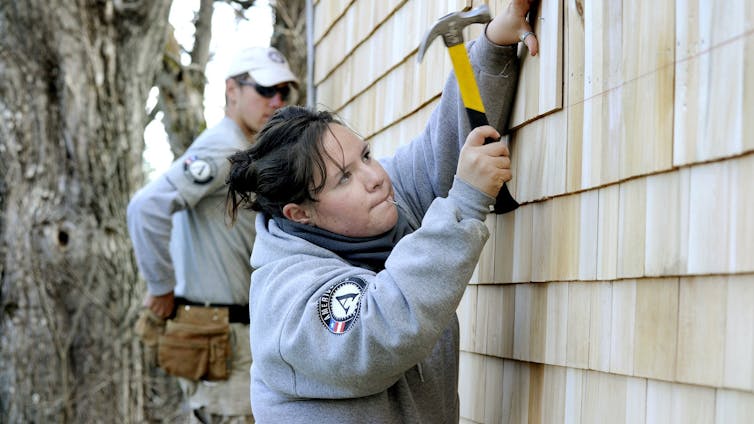
Many AmeriCorps crews, like this one seen at work in Maine in 2011, restore and renovate public parks. John Patriquin/Portland Press Herald via Getty Images

Hundreds of thousands of U.S. nonprofits provide vital services, such as running food banks and youth programs, supporting public health initiatives and helping unemployed people find new jobs. Although this work helps sustain local communities, obtaining the money and staff they require is a constant struggle for many of these groups.

That’s where AmeriCorps often comes in. The independent federal agency for national service and volunteerism has facilitated the work of approximately 200,000 people a year, placing them through partnerships with thousands of nonprofits that provide tutoring, disaster relief and many other important services.

But Americorps’ fate is now uncertain. In April 2025, the Trump administration canceled more than 1,000 grants, suddenly ending the stipends that were supporting more than 32,000 AmeriCorps volunteers. On June 5, a judge ordered that these grants be restored in Washington D.C. and 24 states in response to a lawsuit they had filed. The judge also ordered that all volunteers who had been deployed in those places be reinstated “if they are willing and able to return.”

The Trump administration has also put most of AmeriCorps administrative staff on leave and indicated that it wants to eliminate the independent agency, along with its US$1.2 billion annual budget. AmeriCorps doesn’t appear in a detailed 2026 budget request the administration released on May 30.

I’m a sociology and public affairs professor who has studied nonprofits and volunteering for decades. My research suggests that dismantling AmeriCorps would harm the organizations that rely on national service members and take a toll on the communities that benefit from their work.

AmeriCorps explains what the independent national service agency does.

What AmeriCorps does

AmeriCorps traces its roots to the mid-1960s, when Volunteers in Service to America, known as VISTA, was founded as a domestic counterpart to the Peace Corps. Several earlier service programs were consolidated when Congress passed the National and Community Service Trust Act in 1993. AmeriCorps was officially launched in 1994 – and VISTA became one of its programs.

Since then, AmeriCorps members have built housing and infrastructure, delivered disaster relief, tutored in low-income schools, provided health care and helped older adults age with dignity in both urban and rural communities across the nation.

AmeriCorps includes a variety of programs, each designed to address specific public needs. Some AmeriCorps volunteers provide direct services, such as tutoring, food delivery and in disaster response efforts. Others focus on building the long-term capacity of local nonprofits through volunteer recruitment, fundraising strategy and community outreach.

AmeriCorps volunteers, whom the agency calls “members,” are placed in thousands of nonprofits, schools and local agencies. Many of them are recent college graduates or early-career professionals. Some programs specifically ask people over 55 to serve. Those “senior” volunteers support children through the Foster Grandparents program, volunteer for organizations or assist other older people through the Senior Companions program.

Many AmeriCorps volunteers are paid a modest allowance for this work that runs about $500 per week. AmeriCorps senior volunteers receive smaller sums in hourly stipends to offset the costs of volunteering.

Fox40 News in Sacramento, Calif., covers the Trump administration’s reduction of AmeriCorps’ ranks in April 2025.

Helping nonprofits gain traction

AmeriCorps has long funded research that assesses its impact.

One such study found that every dollar invested in national service generates $11.80 in benefits for society, such as higher earnings, better mental and physical health, and economic growth. Additionally, every federal dollar spent on national service produces $17.30 in savings across other government programs through reductions in public assistance, health and criminal justice spending.

As part of AmeriCorps’ research grants program, I have received funding to study civic engagement and AmeriCorps programming.

In one of those studies, which I conducted with two former colleagues at the University of Texas at Austin in 2021, we found that VISTA volunteers were able to help nonprofits gain volunteers. After two years, an organization with that support had 71% more volunteers than those that didn’t participate in the VISTA program.

We also found that the longer a nonprofit had a staffer supported by the VISTA program, the more its overall pool of volunteers increased.

Nonprofits with VISTA volunteers also had three times as many donations two years later, compared with nonprofits without VISTA service members. But the total value of donations the nonprofit obtained didn’t always rise. That is, we found that VISTA builds people power, but not necessarily fundraising revenue.

Findings like these indicate that AmeriCorps hasn’t just helped the people it serves or the people who volunteer through the program. It also strengthens nonprofits and increases engagement within local communities, reinforcing the civic fabric that knits communities together.

As members of Congress and the White House decide whether to preserve AmeriCorps, I hope they consider the evidence that demonstrates this worthwhile program’s positive impact.The Conversation

Pamela Paxton, Professor of Sociology, The University of Texas at Austin

This article is republished from The Conversation under a Creative Commons license. Read the original article.
Space News: What’s up for June 2025

junewhatsupmars 

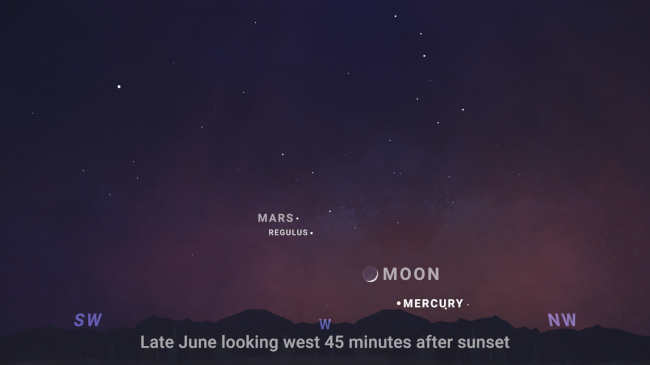
Sky chart showing Mercury with the crescent Moon following sunset in late June, 2025. NASA/JPL-Caltech.


What’s Up for June? Mars grazes the lion's heart, a connection to ancient times, and the galaxy in all its glory.

June planet observing

Starting with planet observing for this month, find Saturn and Venus in the eastern sky during the couple of hours before dawn each morning throughout the month. Saturn rapidly climbs higher in the sky each day as the month goes on. You'll find the third quarter moon next to Saturn on the 19th, and a crescent moon next to Venus on the 22nd. 

Mercury pops up toward the end of the month. Look for it quite low in the west, just as the glow of sunset is fading. It's highest and most visible on the 27th.

Mars is still visible in the couple of hours after sunset toward the west, though it's noticeably fainter than it was in early May. 

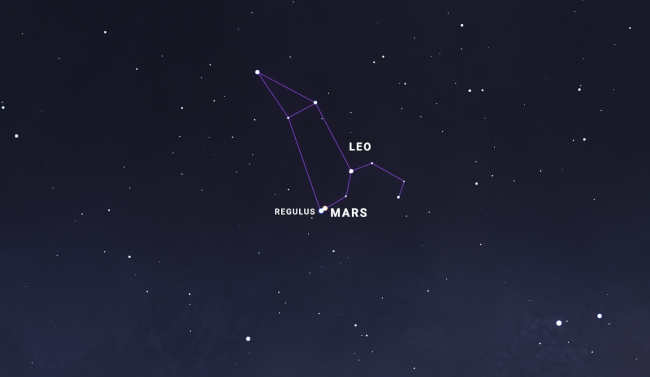
Over several days in mid-June, Mars passes quite close to Regulus, the bright star at the heart of the constellation Leo, the lion. Have a peek on the 16th and 17th with binoculars or a small telescope to see them as close as the width of the full moon.

Milky Way core season

June means that Milky Way "Core Season" is here. This is the time of year when the Milky Way is visible as a faint band of hazy light arching across the sky all night. You just need to be under dark skies away from bright city lights to see it. What you're looking at is the bright central core of our home galaxy, seen edge-on, from our position within the galaxy's disk. 

Long-exposure photos make the Milky Way's bright stars and dark dust clouds even clearer. And while our eyes see it in visible light, NASA telescopes observe the galaxy across the spectrum — peering through dust to help us better understand our origins.

However you observe it, getting out under the Milky Way in June is a truly remarkable way to connect with the cosmos.

junewhatsupregulus

Sky chart showing Mars close to Regulus in the evening sky on June 16, 2025. NASA/JPL-Caltech.


June Solstice

June brings the summer solstice for those north of the equator, which is the winter solstice for those south of the equator. In the Northern Hemisphere, this is when the Sun is above the horizon longer than any other day, making it the longest day of the year. The situation is reversed for the Southern Hemisphere, where it's the shortest day of the year. 

Earth's tilted rotation is the culprit. The tilt is always in the same direction, with the North Pole always pointing toward Polaris, the North Star. And since that tilt stays the same, year round, when we're on one side of the Sun in winter, the north part of the planet is tilted away from the Sun. 

But six months later, the planet moves halfway around its annual path, carrying us to the opposite side of Earth's orbit, and the northern part of the planet now finds itself tilted toward the Sun. The June solstice is when this tilt is at its maximum. This is summertime for the north, bringing long days, lots more sunlight, and warmer temperatures.

junewhatsuppolaris

Illustration from a NASA animation showing the tilt of Earth's axis in June (Northern Hemisphere summer) with respect to the Sun, the planet's orbit, and the North Star, Polaris. NASA's Goddard Space Flight Center.


The June solstice marks a precise moment in Earth's orbit — a consistent astronomical signpost that humans have observed for millennia. Ancient structures from Stonehenge to Chichén Itzá were built, in part, to align with the solstices, demonstrating how important these celestial events were to many cultures. 

So whether you're experiencing long summer days in the northern hemisphere or the brief daylight hours of winter in the south, find a quiet spot to watch the sunset on this special day and you'll be participating in one of humanity's oldest astronomical traditions, connecting you to observers across thousands of years of human history.

Preston Dyches works for NASA's Jet Propulsion Laboratory.


junewhatsupmoon

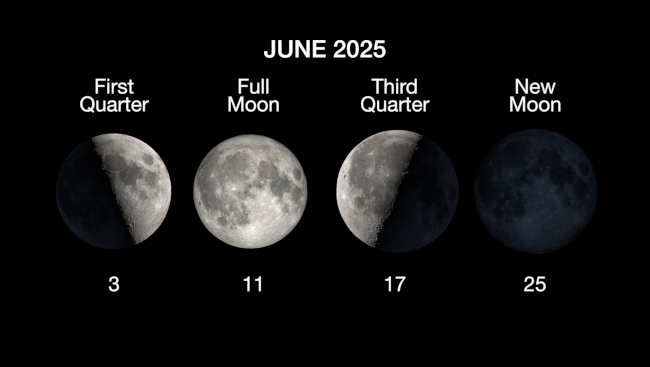
The phases of the moon for June 2025. NASA/JPL-Caltech.

Lake County Adult School celebrates nearly 100 graduates in 2025

lcoeadultschoolgrads

The Lake County Adult School Graduating Class of 2025 after receiving their high school diploma on Saturday May 31, 2025, at the Lower Lake High School Gym in Lower Lake, California. Photo courtesy of the Lake County Office of Education.


LAKEPORT, Calif. — The Lake County Office of Education said it was proud to announce that nearly 100 students have earned their high school diplomas through the Lake County Adult School during the 2024–25 academic year.

This significant achievement underscores the program’s commitment to providing accessible and flexible educational opportunities for adult learners across the county.

The graduation ceremony took place on Saturday, May 31, at the Lower Lake High School Gym.

“All students can learn and succeed, but not on the same day, and not in the same way,” said Lake County Superintendent of Schools Brock Falkenberg. “Nearly 100 students earning their high school diploma proves that when given the opportunity and support, everyone can reach their goals.”

The Lake County Adult School, established in September 2023, offers free, in-person high school diploma completion programs for adults aged 18 and older, with classes held at both the Lake County Campus of Woodland Community College and Mendocino College Lake Center.

“Our adult education programs are designed to meet the diverse needs of our students, providing them with the support and resources necessary to succeed,” said Matt Russell, director of Adult Education & College and Career Readiness. “These graduates have demonstrated incredible grit, resilience, and dedication. We are immensely proud of their accomplishments.”

The program’s success stories include individuals like Tom Willis, who earned his diploma at the age of 71.

Willis was the student speaker at the graduation ceremony and exemplifies that it is never too late to earn your diploma. Inspired by his daughter and granddaughter who are both previous graduates of the program, Willis’s achievement highlights the program’s impact on families and the broader community.

Willis plans to continue his education journey by taking classes at the Woodland Community College for culinary and baking.

With a 130-credit graduation requirement and Western Association of Schools and Colleges, or WASC, accreditation, the Lake County Adult School ensures a comprehensive educational experience.

The program’s flexibility allows students to balance their studies with personal and professional responsibilities, fostering an environment where lifelong learning thrives.

For more information about the Lake County Adult School and enrollment opportunities, please visit lakecoe.org/AdultSchool or contact Adult Education Instructor Jonah Wakefield at This email address is being protected from spambots. You need JavaScript enabled to view it. or 707-245-6366.

Clearlake Animal Control: ‘Coco’ and the dogs

caccoco 

“Coco.” Photo courtesy of Clearlake Animal Control.


CLEARLAKE, Calif. — Clearlake Animal Control has many dogs that are waiting to be part of new families.

The shelter has 50 adoptable dogs listed on its website.

This week’s dogs include “Coco,” a male Great Pyrenees mix with a white coat.

The shelter is located at 6820 Old Highway 53. It’s open from 9 a.m. to 6 p.m. Tuesday through Saturday.

For more information, call the shelter at 707-762-6227, email This email address is being protected from spambots. You need JavaScript enabled to view it., visit Clearlake Animal Control on Facebook or on the city’s website.

This week’s adoptable dogs are featured below.

Email Elizabeth Larson at This email address is being protected from spambots. You need JavaScript enabled to view it.. Follow her on Twitter, @ERLarson, and on Bluesky, @erlarson.bsky.social. Find Lake County News on the following platforms: Facebook, @LakeCoNews; X, @LakeCoNews; Threads, @lakeconews, and on Bluesky, @lakeconews.bsky.social.


Estate Planning: The possible return of the MediCal asset limits

dennisfordhamheadshot

Dennis Fordham. Courtesy photo.


California’s just revised proposed state budget shows that Gov. Newsom intends to reinstate the Asset test for Medi-Cal eligibility.

Previously, on Jan. 1, 2024, California had abolished the asset test. Currently, assets are not considered when a person applies for any type of Medi-Cal, whether it is community based (at home) or long term care Medi-Cal (at a skilled nursing facility).

However, the proposed budget shows that the $2,000/$3,000 (single/married couple) assets limits for countable non-exempt will return in 2026. Medi-Cal would revert to pre-2024.

Prior to Jan. 1, 2024, Medi-Cal had the following asset categories: (1) Exempt assets, (2) non available non exempt assets, and (3) available non exempt assets. Exempt and unavailable assets are not counted in the asset test. Available non-exempt assets do count. California residents with excess countable assets would make them non countable or else transfer them in ways that did not result in an ineligibility period to receive Medi-Cal.

People seeking Medi-Cal eligibility had the following ways to become Medi-Cal eligible without transferring assets: spend down non exempt assets (e.g., excess money), make non exempt assets unavailable (e.g., placing them for sale), purchase a special type of single premium annuity, give non exempt assets away (typically to relatives) or else place assets into a special needs trust to make the assets unavailable. Anytime a person already on Medi-Cal received an inheritance, these approaches were often applied.

Transferring assets and avoiding any transfer penalties, in the right situation, was also widely used. California’s long-standing 30 month look back rules required Medi Cal eligibility workers to count non exempt assets gifted away during the 30 month look back period (prior to Medi-Cal application). Such transfers could result in an ineligibility period for Medi-Cal eligibility, especially if not done correctly.

However, the transfer rules are unlikely to apply to transfers made between Jan. 1, 2024, and Jan. 1, 2026.

Presently, transfer rules are irrelevant with respect to transfers made after Jan. 1, 2024, and 2026. Also, prior to Jan. 1, 2024, Medi-Cal did not consider the transfer of an exempt asset (e.g., a person’s residence) as a disqualifying transfer because such retaining exempt assets did disqualify a person from Medi-Cal, but did eliminate them from the estate for estate recovery at death.

Now, during 2025, people receiving or expecting to need Medi-Cal will likely re-examine whether their existing assets and anticipate any future inheritances they might receive would disqualify their continued or future Medi-Cal eligibility after 2025.

Naturally, purchasing new (or improving existing) assets that are exempt for Medi-Cal eligibility purposes (e.g., a dwelling, a vehicle, household contents, a burial policy, services) is the first “go to” approach. Transferring assets to family or using a special needs trust are next step approaches.

Families of existing Medi-Cal recipients in long term skilled nursing facilities (”SNF’s”) are likely going to consider what to do with the soon to be excess countable resources (e.g., money in the bank, brokerage, second homes, etc.) under a possible restored asset test and whether to act prior to 2026.

California’s possible reinstatement of the Medi-Cal eligibility asset test would bring us back to familiar but undesired Medi-Cal eligibility planning territory. Nothing is yet certain. But the possibility needs careful monitoring and a getting ready to act; perhaps even prior to Jan. 1, 2026.

The foregoing is not legal advice.  Consult a qualified elder law attorney for guidance.

Dennis A. Fordham, Attorney, is a State Bar-Certified Specialist in estate planning, probate and trust law. His office is at 870 S. Main St., Lakeport, Calif. He can be reached at This email address is being protected from spambots. You need JavaScript enabled to view it. and 707-263-3235. 

Space News: New model helps to figure out which distant planets may host life


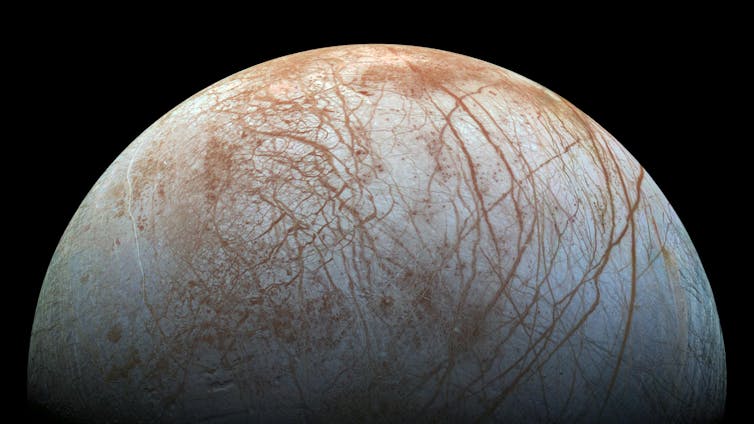
Some ‘water worlds’ like Jupiter’s moon Europa could potentially be habitable for life. NASA/JPL-Caltech/SETI Institute

The search for life beyond Earth is a key driver of modern astronomy and planetary science. The U.S. is building multiple major telescopes and planetary probes to advance this search. However, the signs of life – called biosignatures – that scientists may find will likely be difficult to interpret. Figuring out where exactly to look also remains challenging.

I am an astrophysicist and astrobiologist with over 20 years of experience studying extrasolar planets – which are planets beyond our solar system.

My colleagues and I have developed a new approach that will identify the most interesting planets or moons to search for life and help interpret potential biosignatures. We do this by modeling how different organisms may fare in different environments, informed by studies of limits of life on Earth.

New telescopes to search for life

Astronomers are developing plans and technology for increasingly powerful space telescopes. For instance, NASA is working on its proposed Habitable Worlds Observatory, which would take ultrasharp images that directly show the planets orbiting nearby stars.

My colleagues and I are developing another concept, the Nautilus space telescope constellation, which is designed to study hundreds of potentially Earthlike planets as they pass in front of their host stars.

A number of spherical telescopes next to a spaceship.
Future telescopes, like the proposed Nautilus, could help search the skies for habitable planets. Katie Yung, Daniel Apai /University of Arizona and AllThingsSpace /SketchFab, CC BY-ND

These and other future telescopes aim to provide more sensitive studies of more alien worlds. Their development prompts two important questions: “Where to look?” and “Are the environments where we think we see signs of life actually habitable?”

The strongly disputed claims of potential signs of life in the exoplanet K2-18b, announced in April 2025, and previous similar claims in Venus, show how difficult it is to conclusively identify the presence of life from remote-sensing data.

When is an alien world habitable?

Oxford Languages defines “habitable” as “suitable or good enough to live in.” But how do scientists know what is “good enough to live in” for extraterrestrial organisms? Could alien microbes frolic in lakes of boiling acid or frigid liquid methane, or float in water droplets in Venus’ upper atmosphere?

To keep it simple, NASA’s mantra has been “follow the water.” This makes sense – water is essential for all Earth life we know of. A planet with liquid water would also have a temperate environment. It wouldn’t be so cold that it slows down chemical reactions, nor would it be so hot that it destroys the complex molecules necessary for life.

However, with astronomers’ rapidly growing capabilities for characterizing alien worlds, astrobiologists need an approach that is more quantitative and nuanced than the water or no-water classification.

A community effort

As part of the NASA-funded Alien Earths project that I lead, astrobiologist Rory Barnes and I worked on this problem with a group of experts – astrobiologists, planetary scientists, exoplanet experts, ecologists, biologists and chemists – drawn from the largest network of exoplanet and astrobiology researchers, NASA’s Nexus for Exoplanet System Science, or NExSS.

Over a hundred colleagues provided us with ideas, and two questions came up often:

First, how do we know what life needs, if we do not understand the full range of extraterrestrial life? Scientists know a lot about life on Earth, but most astrobiologists agree that more exotic types of life – perhaps based on different combinations of chemical elements and solvents – are possible. How do we determine what conditions those other types of life may require?

Second, the approach has to work with incomplete data. Potential sites for life beyond Earth – “extrasolar habitats” – are very difficult to study directly, and often impossible to visit and sample.

For example, the Martian subsurface remains mostly out of our reach. Places like Jupiter’s moon Europa’s and Saturn’s Moon Enceladus’ subsurface oceans and all extrasolar planets remain practically unreachable. Scientists study them indirectly, often only using remote observations. These measurements can’t tell you as much as actual samples would.

A view of Mars' dusty, rocky surface.
Mars’ hot, dusty surface is hostile for life. But scientists haven’t been able to study whether some organisms could lurk beneath. NASA/JPL-Caltech/Malin Space Science Systems

To make matters worse, measurements often have uncertainties. For example, we may be only 88% confident that water vapor is present in an exoplanet’s atmosphere. Our framework has to be able to work with small amounts of data and handle uncertainties. And, we need to accept that the answers will often not be black or white.

A new approach to habitability

The new approach, called the quantitative habitability framework, has two distinguishing features:

First, we moved away from trying to answer the vague “habitable to life” question and narrowed it to a more specific and practically answerable question: Would the conditions in the habitat – as we know them – allow a specific (known or yet unknown) species or ecosystem to survive?

Even on Earth, organisms require different conditions to survive – there are no camels in Antarctica. By talking about specific organisms, we made the question easier to answer.

Second, the quantitative habitability framework does not insist on black-or-white answers. It compares computer models to calculate a probabilistic answer. Instead of assuming that liquid water is a key limiting factor, we compare our understanding of the conditions an organism requires (the “organism model”) with our understanding of the conditions present in the environment (the “habitat model”).

Both have uncertainties. Our understanding of each can be incomplete. Yet, we can handle the uncertainties mathematically. By comparing the two models, we can determine the probability that an organism and a habitat are compatible.

As a simplistic example, our habitat model for Antarctica may state that temperatures are often below freezing. And our organism model for a camel may state that it does not survive long in cold temperatures. Unsurprisingly, we would correctly predict a near-zero probability that Antarctica is a good habitat for camels.

An image of thick plumes of smoke coming from rocks under the sea.
A hydrothermal vent deep in the Atlantic Ocean. These vents discharge incredibly hot plumes of water, but some host hearty microorganisms. P. Rona / OAR/National Undersea Research Program (NURP); NOAA

We had a blast working on this project. To study the limits of life, we collected literature data on extreme organisms, from insects that live in the Himalayas at high altitudes and low temperatures to microorganisms that flourish in hydrothermal vents on the ocean floor and feed on chemical energy.

We explored, via our models, whether they may survive in the Martian subsurface or in Europa’s oceans. We also investigated if marine bacteria that produce oxygen in Earth’s oceans could potentially survive on known extrasolar planets.

Although comprehensive and detailed, this approach makes important simplifications. For example, it does not yet model how life may shape the planet, nor does it account for the full array of nutrients organisms may need. These simplifications are by design.

In most of the environments we currently study, we know too little about the conditions to meaningfully attempt such models – except for some solar system bodies, such as Saturn’s Enceladus.

The quantitative habitability framework allows my team to answer questions like whether astrobiologists might be interested in a subsurface location on Mars, given the available data, or whether astronomers should turn their telescopes to planet A or planet B while searching for life. Our framework is available as an open-source computer model, which astrobiologists can now readily use and further develop to help with current and future projects.

If scientists do detect a potential signature of life, this approach can help assess if the environment where it is detected can actually support the type of life that leads to the signature detected.

Our next steps will be to build a database of terrestrial organisms that live in extreme environments and represent the limits of life. To this data, we can also add models for hypothetical alien life. By integrating those into the quantitative habitability framework, we will be able to work out scenarios, interpret new data coming from other worlds and guide the search for signatures of life beyond Earth – in our solar system and beyond.The Conversation

Daniel Apai, Associate Dean for Research and Professor of Astronomy and Planetary Sciences, University of Arizona

This article is republished from The Conversation under a Creative Commons license. Read the original article.

  • 175
  • 176
  • 177
  • 178
  • 179
  • 180
  • 181
  • 182
  • 183
  • 184

Community

  • Lake County Wine Alliance offers sponsor update; beneficiary applications open 

  • Mendocino National Forest announces seasonal hiring for upcoming field season

Public Safety

  • Lakeport Police logs: Thursday, Jan. 15

  • Lakeport Police logs: Wednesday, Jan. 14

Education

  • Woodland Community College receives maximum eight-year reaffirmation of accreditation from ACCJC

  • SNHU announces Fall 2025 President's List

Health

  • California ranks 24th in America’s Health Rankings Annual Report from United Health Foundation

  • Healthy blood donors especially vital during active flu season

Business

  • Two Lake County Mediacom employees earn company’s top service awards

  • Redwood Credit Union launches holiday gift and porch-to-pantry food drives

Obituaries

  • Rufino ‘Ray’ Pato

  • Patty Lee Smith

Opinion & Letters

  • The benefits of music for students

  • How to ease the burden of high electric bills

Veterans

  • CalVet and CSU Long Beach team up to improve data collection related to veteran suicides

  • A ‘Big Step Forward’ for Gulf War Veterans

Recreation

  • Wet weather trail closure in effect on Upper Lake Ranger District

  • Mendocino National Forest seeking public input on OHV grant applications

  • State Parks announces 2026 Anderson Marsh nature walk schedule 

  • BLM lifts seasonal fire restrictions in central California

Religion

  • Kelseyville Presbyterian to host Ash Wednesday service and Lenten dinner Feb. 18

  • Kelseyville Presbyterian Church to hold ‘Longest Night’ service Dec. 21

Arts & Life

  • Auditions announced for original musical ‘Even In Shadow’ set for March 21 and 28

  • ‘The Rip’ action heist; ‘Steal’ grounded in a crime thriller

Government & Politics

  • Lake County Democrats issue endorsements in local races for the June California Primary

  • County negotiates money-saving power purchase agreement

Legals

  • March 3 hearing on ordinance amending code for commercial cannabis uses

  • Feb. 12 public hearing on resolution to establish standards for agricultural roads

How to resolve AdBlock issue?
Refresh this page