 How to resolve AdBlock issue?
News
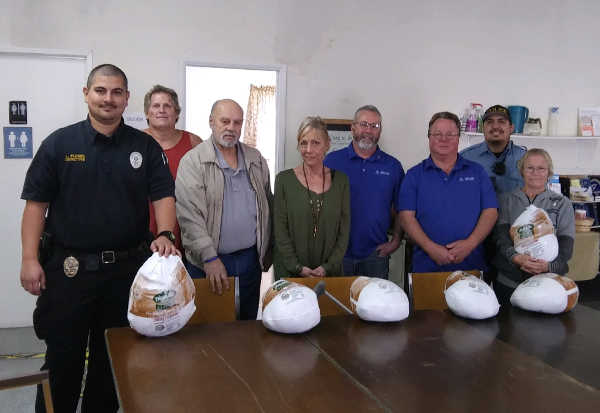
CLEARLAKE, Calif. – Clearlake United Methodist Church furnished 47 families with a turkey and all the trimmings to go with it to local Clearlake residences who may not otherwise have celebrated Thanksgiving Day with their families.
With the help of the city of Clearlake, Clearlake Police Association and Golden State Water Co., the Outreach Team of Clearlake UMC quickly got the word out to their pantry clientele, neighbors and sister churches to come pick up a Thanksgiving meal.
“We are very fortunate to have these agencies to help us serve the Clearlake community during the holiday season. The city of Clearlake and Golden State Water Co. provided the turkeys, while our Clearlake Police went out to shop for all the sides and pies for the dinners. These agencies have great compassion for the community,” said Rev. Dawn Roberts, pastor to the church.
Clearlake United Methodist Church is a full community outreach and teaching ministry. Sunday begins the week with worship service, with Pastor Roberts, at noon. All are welcome.
The members, known for their warmth and friendliness, have a saying, “Come as You Are, Leave with A Blessing!”
The services are contemporary, while honoring tradition. Live music and video, Sunday School and Fellowship following. Communion first Sundays the month.
During the week, there are classes to wind down, center and help heal mind and body in one of the long-time established Tai Chi or Yoga classes.
“Our approach is safe for those with limitations, open to men and women, no previous yoga experience is necessary. This benefits many ailments such as arthritis, asthma, anxiety, and high blood pressure. Relaxation practice balances our overworked nervous systems,” explained Marion Kaiser, certified instructor for Relax with Yoga.
AA “Bacon & Egos” group, meets every morning. The Disaster Relief office is open Monday through Friday and by appointment. The food pantry is open to the community each Sunday at 1 p.m., providing fresh, canned and boxed goods. The award-winning Fresh Start Program serves approximately 30 children under age 3 during the school year. CCUMC Thrift Shops as been noted as one of the best in town.
Clearlake Community United Methodist Church campus located at 14501 Pearl Ave. in Clearlake. Call the church at 707-994-2134 or check Facebook.
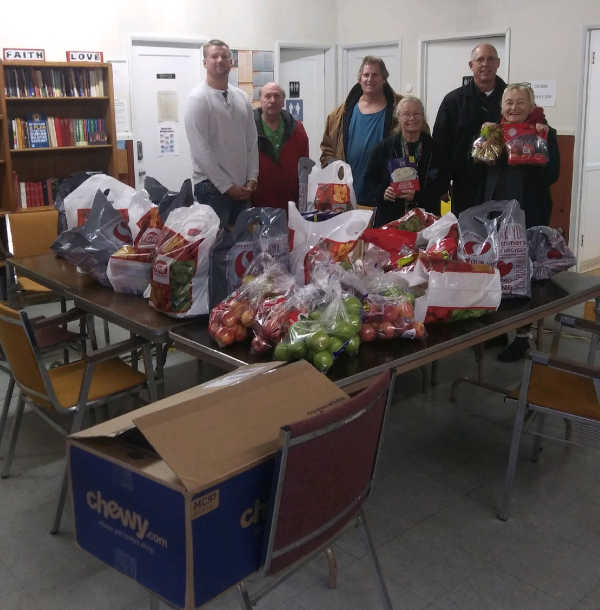
LAKE COUNTY, Calif. – To help house displaced farm animals during times of disaster, portable livestock pens have been deployed to seven fairgrounds around California, including the Lake County Fairgrounds.
The pens, purchased through a partnership between the California Farm Bureau Federation’s charitable foundation and the California Department of Food and Agriculture, were formally dedicated during a ceremony this week at the Yuba-Sutter Fairgrounds in Yuba City.
“During wildfires, floods and other emergencies, farmers and ranchers take great care to be sure their animals can be safely evacuated, often to nearby fairgrounds,” CFBF President Jamie Johansson said. “These portable livestock pens will make it easier for fairgrounds to fulfill their role as shelters during disasters.”
After the Camp fire ravaged part of rural California last year, the California Bountiful Foundation – a charitable foundation established by CFBF – created a Farm and Rural Disaster Fund.
Donations from 50 individuals and companies allowed the foundation to contribute $75,000 toward purchase of the portable livestock pens.
With additional funds from CDFA, a total of 280 pens were acquired.
CDFA has distributed 40 pens apiece to fairgrounds in Anderson, Auburn, Lakeport, Merced, San Mateo, Ventura and Yuba City.
Manufactured by Plymouth Industries of Nebraska, the panels to create the pens are stored on racks so they can be quickly mobilized and transported during a disaster.
“Already this fall, we’ve seen the pens used to help livestock during the Kincade Fire in Sonoma County,” Johansson said. “We also look forward to having them used for happier occasions, such as ongoing events at county fairgrounds around the state.”
For more information about the Farm and Rural Disaster Fund, see the CFBF website at www.cfbf.com .
The pens, purchased through a partnership between the California Farm Bureau Federation’s charitable foundation and the California Department of Food and Agriculture, were formally dedicated during a ceremony this week at the Yuba-Sutter Fairgrounds in Yuba City.
“During wildfires, floods and other emergencies, farmers and ranchers take great care to be sure their animals can be safely evacuated, often to nearby fairgrounds,” CFBF President Jamie Johansson said. “These portable livestock pens will make it easier for fairgrounds to fulfill their role as shelters during disasters.”
After the Camp fire ravaged part of rural California last year, the California Bountiful Foundation – a charitable foundation established by CFBF – created a Farm and Rural Disaster Fund.
Donations from 50 individuals and companies allowed the foundation to contribute $75,000 toward purchase of the portable livestock pens.
With additional funds from CDFA, a total of 280 pens were acquired.
CDFA has distributed 40 pens apiece to fairgrounds in Anderson, Auburn, Lakeport, Merced, San Mateo, Ventura and Yuba City.
Manufactured by Plymouth Industries of Nebraska, the panels to create the pens are stored on racks so they can be quickly mobilized and transported during a disaster.
“Already this fall, we’ve seen the pens used to help livestock during the Kincade Fire in Sonoma County,” Johansson said. “We also look forward to having them used for happier occasions, such as ongoing events at county fairgrounds around the state.”
For more information about the Farm and Rural Disaster Fund, see the CFBF website at www.cfbf.com .
Moving to strengthen safeguards for fish and expand science-based decision making, the California Department of Water Resources has taken formal steps to begin environmental review of long-term operations of the State Water Project, or SWP.
The action enables California’s water project operations to avoid relying on proposed federal biological opinions announced last month to achieve environmental approval to operate consistent with state law.
Instead, DWR will seek approval from the California Department of Fish and Wildlife to operate the SWP in a way that improves protections for fish and complies with the California Endangered Species Act, or CESA.
In a key step toward that goal, DWR today issued a draft document prepared under the California Environmental Quality Act or CEQA, that identifies potential operational changes to protect species and manage the SWP based on real-time conditions in the Delta ecosystem, including additional flows dedicated to the environment.
DWR’s draft environmental impact report, or EIR, draws on a decade of science and a quantitative analysis of best-available data on flows, modeling, habitat and climate change impacts.
The draft EIR is available here and the appendices can be found here.
“This draft points to a more sophisticated and nimble way to manage the State Water Project to improve our ability to protect species and operate more flexibly. This is essential in order to capture water when it’s available and leave more water when and where fish need it,” said DWR Director Karla A. Nemeth.
The SWP captures and stores water that originates in the Sierra Nevada and delivers it to 27 million Californians in the Bay Area, Central California and Southern California.
DWR’s draft EIR is separate from the proposed biological opinions issued by federal agencies on Oct. 22 for long-term operation of the federal Central Valley Project and the SWP.
Earlier this year, out of concern for the scientific rigor of the federal process, DWR indicated it would pursue its own environmental review and permit process to ensure protection of endangered species under state law.
Concurrent with the environmental review under CEQA, DWR is developing an application for a permit from CDFW for long-term SWP operations under CESA.
CDFW will determine requirements for the permit in the coming months, with a specific focus on mitigating impacts of SWP operations on longfin smelt, Delta smelt, winter-run and spring-run Chinook salmon.
The draft EIR assesses impacts of proposed project operations, a “no project” alternative that reflects current operating rules, three alternatives that provide fresh water flows in the spring and summer, and an alternative that uses physical barriers and other deterrents to keep fish away from the SWP pumps.
Historically, DWR had relied on federal Biological Opinions to cover the SWP under the federal ESA, with a consistency determination provided by CDFW.
Securing a separate permit under CESA provides flexibility for CDFW to consider amendments to the permit based on better scientific understanding as part of the adaptive management program, without relying on changes to be made to the federal biological opinions.
It also provides CESA authorization for SWP regardless of any potential changes in federal law.
DWR’s draft proposal differs from the federal biological opinions in several key ways:
– It improves species protection by vesting authority in CDFW to stop operational changes if it determines they will violate CESA standards.
– It includes multiple alternatives that provide a block of environmental water that can be used to offset pumping impacts in the Delta, with adjustments made over time as new information is learned.
– It provides clear direction on when Delta pumping can be increased during storm events and caps the amount that exports can be increased in those events.
– It includes updated modeling and quantitative analyses to support habitat actions in summer and fall to benefit Delta smelt.
– It includes specific protections for longfin smelt, a protected species under CESA, and a commitment to implementing a longfin smelt science plan.
– It does not seek to increase SWP exports.
DWR’s draft EIR will be available for public comment through Jan. 6, 2020.
DWR anticipates completing a final document in early 2020, with a permit from CDFW expected to follow.
The action enables California’s water project operations to avoid relying on proposed federal biological opinions announced last month to achieve environmental approval to operate consistent with state law.
Instead, DWR will seek approval from the California Department of Fish and Wildlife to operate the SWP in a way that improves protections for fish and complies with the California Endangered Species Act, or CESA.
In a key step toward that goal, DWR today issued a draft document prepared under the California Environmental Quality Act or CEQA, that identifies potential operational changes to protect species and manage the SWP based on real-time conditions in the Delta ecosystem, including additional flows dedicated to the environment.
DWR’s draft environmental impact report, or EIR, draws on a decade of science and a quantitative analysis of best-available data on flows, modeling, habitat and climate change impacts.
The draft EIR is available here and the appendices can be found here.
“This draft points to a more sophisticated and nimble way to manage the State Water Project to improve our ability to protect species and operate more flexibly. This is essential in order to capture water when it’s available and leave more water when and where fish need it,” said DWR Director Karla A. Nemeth.
The SWP captures and stores water that originates in the Sierra Nevada and delivers it to 27 million Californians in the Bay Area, Central California and Southern California.
DWR’s draft EIR is separate from the proposed biological opinions issued by federal agencies on Oct. 22 for long-term operation of the federal Central Valley Project and the SWP.
Earlier this year, out of concern for the scientific rigor of the federal process, DWR indicated it would pursue its own environmental review and permit process to ensure protection of endangered species under state law.
Concurrent with the environmental review under CEQA, DWR is developing an application for a permit from CDFW for long-term SWP operations under CESA.
CDFW will determine requirements for the permit in the coming months, with a specific focus on mitigating impacts of SWP operations on longfin smelt, Delta smelt, winter-run and spring-run Chinook salmon.
The draft EIR assesses impacts of proposed project operations, a “no project” alternative that reflects current operating rules, three alternatives that provide fresh water flows in the spring and summer, and an alternative that uses physical barriers and other deterrents to keep fish away from the SWP pumps.
Historically, DWR had relied on federal Biological Opinions to cover the SWP under the federal ESA, with a consistency determination provided by CDFW.
Securing a separate permit under CESA provides flexibility for CDFW to consider amendments to the permit based on better scientific understanding as part of the adaptive management program, without relying on changes to be made to the federal biological opinions.
It also provides CESA authorization for SWP regardless of any potential changes in federal law.
DWR’s draft proposal differs from the federal biological opinions in several key ways:
– It improves species protection by vesting authority in CDFW to stop operational changes if it determines they will violate CESA standards.
– It includes multiple alternatives that provide a block of environmental water that can be used to offset pumping impacts in the Delta, with adjustments made over time as new information is learned.
– It provides clear direction on when Delta pumping can be increased during storm events and caps the amount that exports can be increased in those events.
– It includes updated modeling and quantitative analyses to support habitat actions in summer and fall to benefit Delta smelt.
– It includes specific protections for longfin smelt, a protected species under CESA, and a commitment to implementing a longfin smelt science plan.
– It does not seek to increase SWP exports.
DWR’s draft EIR will be available for public comment through Jan. 6, 2020.
DWR anticipates completing a final document in early 2020, with a permit from CDFW expected to follow.
The wind speed of a devastating Category 5 hurricane can top over 150 miles per hour.
Now imagine another kind of wind with an average speed of 0.87 million miles per hour.
Welcome to the wind that begins in our sun and doesn’t stop until after it reaches the edge of the heliosphere: the solar wind.
The corona is the sun’s inner atmosphere – the brightness that can be seen surrounding an eclipsed sun – and home to the continually expanding solar wind.
Right now, the Parker Solar Probe – a NASA mission launched in 2018 – is orbiting the sun and will get as close as 3.83 million miles of the sun’s surface.
Parker is gathering new data about the solar particles and magnetic fields that comprise the solar wind. More specifically, two of its main goals are to examine the energy that heats the corona and speeds up the solar wind, and determine the structure of the wind’s magnetic fields.
While many theories describe the solar wind’s history, this is what we do know: The solar wind impacting Earth’s magnetosphere is responsible for triggering those majestic auroras typically seen at locations close to our north and south poles.
In some cases it can also set off space weather storms that disrupt everything from our satellites in space, to ship communications on our oceans, to power grids on land.
Nicky Fox is the division director for heliophysics at NASA Headquarters. She explains in more detail how the solar wind disrupts our magnetosphere: “As the wind flows toward Earth, it carries with it the Sun’s magnetic field. It moves very fast, then smacks right into Earth’s magnetic field. The blow causes a shock to our magnetic protection, which can result in turbulence.”
NASA also has another reason to study the solar wind and its properties – the solar wind is part of a larger space weather system that can affect astronauts and technology.
As Fox notes: “We not only have to ensure our astronauts are protected from the harmful effects of radiation. We have to protect our equipment too. So, we’ve already found aluminum to be a good shield to protect our crafts from many energetic particles. But there are also faster particles that travel at 80 percent of the speed of light, which can cause havoc with parts of a spacecraft. They can smash into and damage solar panels, disrupt electronics, or affect electric currents that flow along power grids. So, we’re currently conducting tests with small pieces of technology to study how well they can survive in intense radiation areas.”
Knowing more about the effects of the solar wind is not only important to those of us who live on Earth. It will be critical to know how to mitigate its effects once our astronauts travel back to the Moon and beyond for extended periods of time.
Fox concludes: “My feeling is – if the Sun sneezes, Earth catches a cold, because we always feel the impact of what happens on the Sun thanks to the solar wind.”
Get blown away by the science behind the solar wind at http://science.nasa.gov .

LAKE COUNTY, Calif. – The two men charged with the murder of a Lucerne man have made their first court appearance in the case while the Lake County Sheriff’s Office said it is continuing to try to locate the truck belonging to the victim.
The body of Nicky Dale Smith, 70, was found on the side of the road in the 4550 block of Scotts Valley Road near Lakeport shortly before 7:30 a.m. Saturday, as Lake County News has reported.
Within hours, sheriff’s detectives had identified Daniel Wayne Ford, 49, of Lakeport and Michael Sean Shaffer, 35, of Upper Lake as the suspects in Smith’s killing.
Both men were arrested on Saturday night, as Lake County News has reported.
The sheriff’s office subsequently asked for the community’s help in locating Darlene Geneva Anderson, a Northshore resident they believed had information needed in the investigation.
Sheriff’s Lt. Corey Paulich said detectives were able to locate and interview Anderson.
He said they weren’t commenting on what statements Anderson made to investigators.
Paulich also reported that Smith’s autopsy took place on Wednesday.
“It was determined that he died from blunt force trauma and gunshot wounds,” Paulich said.
Detectives are working hard to contact potential witnesses and searching for evidence, according to Paulich.
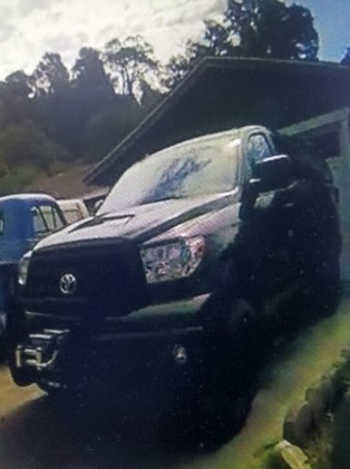
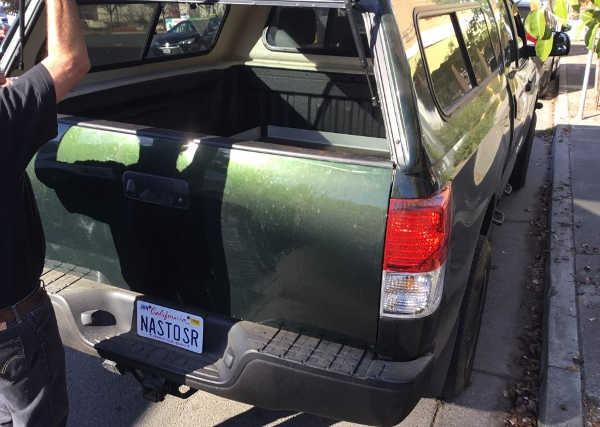
Paulich said Smith’s dark green Toyota Tundra pickup, with the license plate “NASTOSR,” is still missing.
The sheriff’s office is asking anyone with information regarding this investigation or the location of Smith’s missing truck to contact Sheriff’s Central Dispatch at 707-263-2690.
Suspects make first court appearance
District Attorney Susan Krones said Ford and Shaffer were arraigned in Lake County Superior Court on Tuesday.
Krones has charged the men together with the following crimes:
– Count one: murder, with special allegations that the murder was committed during an attempted robbery, an attempted kidnapping and a carjacking;
– Count two: attempted robbery;
– County three: kidnapping;
– Count four: carjacking, with special allegations of Ford discharging a firearm causing great bodily injury and death, and Ford personally using and firing a handgun;
– Count five (Ford only): assault with a firearm, with a special allegation of Ford using a handgun;
– Count six: (Ford only): assault with a deadly weapon, a flashlight;
– Count seven: Assault by means likely to produce great bodily injury, with a special allegation of inflicting great bodily injury on a person who was 70 years old;
– Count eight (Ford only): felon in possession of a firearm.
Court records indicate that Ford has previous felony convictions, including reckless evading in Mendocino County in 2007, possession of methamphetamine for sale in Mendocino County in 2011 and for criminal threats in 2015 in Del Norte County.
Shaffer has felony convictions in Lake County including in 2012 for assault with a deadly weapon and for reckless evading in 2017.
Krones said both men indicated on Tuesday they wanted to hire a private attorney. “So they did not enter a plea.”
She said Ford and Shaffer are scheduled to return to court at 8:15 a.m. Dec. 10 for appearance of counsel and plea entry.
Asked if there is any idea of motive, Krones said, “At this point, no.”
She added, “At this point it’s still an early investigation.”
Krones said, however, that it wasn’t a random killing, with Smith having had prior contact with Ford and Shaffer.
Both Ford and Shaffer are being held at the Lake County Jail without bail, according to jail records.
Email Elizabeth Larson at
MIDDLETOWN, Calif. – One death was reported on Thursday evening as the result of a structure fire.
Shortly after 6 p.m. firefighters were dispatched to a residential structure fire in the 19100 block of Grange Road near Middletown, according to radio reports.
Dispatch had received multiple reports of the fire, and when firefighters got on scene they reported finding a fully involved RV.
The RV was located next to a structure, with firefighters reporting they had no water supply.
Just before 6:30 p.m., incident command reported over the air that a primary search of the trailer had confirmed one fatality.
The fire was reported to be under control shortly before 6:40 p.m.
Additional details will be published as they become available.
Email Elizabeth Larson atThis email address is being protected from spambots. You need JavaScript enabled to view it. . Follow her on Twitter, @ERLarson, or Lake County News, @LakeCoNews.
Shortly after 6 p.m. firefighters were dispatched to a residential structure fire in the 19100 block of Grange Road near Middletown, according to radio reports.
Dispatch had received multiple reports of the fire, and when firefighters got on scene they reported finding a fully involved RV.
The RV was located next to a structure, with firefighters reporting they had no water supply.
Just before 6:30 p.m., incident command reported over the air that a primary search of the trailer had confirmed one fatality.
The fire was reported to be under control shortly before 6:40 p.m.
Additional details will be published as they become available.
Email Elizabeth Larson at