 How to resolve AdBlock issue?
News
New time-lapse videos of Earth’s glaciers and ice sheets as seen from space – spanning nearly 50 years – are providing scientists with new insights into how the planet’s frozen regions are changing.
At a media briefing Dec. 9 at the annual meeting of the American Geophysical Union in San Francisco, scientists released new time series of images of Alaska, Greenland, and Antarctica using data from satellites including the NASA-U.S. Geological Survey Landsat missions.
One series of images tells illustrates the dramatic changes of Alaska’s glaciers and could warn of future retreat of the Hubbard Glacier.
Over Greenland, different satellite records show a speed-up of glacial retreat starting in 2000, as well as meltwater ponds spreading to higher elevations in the last decade, which could potentially speed up ice flow.
And in Antarctic ice shelves, the view from space could reveal lakes hidden beneath the winter snow.
Using images from the Landsat mission dating back to 1972 and continuing through 2019, glaciologist Mark Fahnestock of the University of Alaska Fairbanks, has stitched together six-second time-lapses of every glacier in Alaska and the Yukon.
“We now have this long, detailed record that allows us to look at what’s happened in Alaska,” Fahnestock said. “When you play these movies, you get a sense of how dynamic these systems are and how unsteady the ice flow is.”
The videos clearly illustrate what’s happening to Alaska’s glaciers in a warming climate, he said, and highlight how different glaciers respond in varied ways. Some show surges that pause for a few years, or lakes forming where ice used to be, or even the debris from landslides making its way to the sea. Other glaciers show patterns that give scientists hints of what drives glacier changes.
The Columbia Glacier, for example, was relatively stable when the first Landsat satellite launched 1972. But starting in the mid-1980s, the glacier’s front began retreating rapidly, and by 2019 was 12.4 miles upstream. In comparison, the Hubbard Glacier has advanced 3 miles in the last 48 years. But Fahnestock’s time-lapse ends with a 2019 image that shows a large indentation in the glacier, where ice has broken off.
“That calving embayment is the first sign of weakness from Hubbard Glacier in almost 50 years – it’s been advancing through the historical record,” he said. If such embayments persist in the coming years, it could be a sign that change could be coming to Hubbard, he said: “The satellite images also show that these types of calving embayments were present in the decade before Columbia retreated.”
The Landsat satellites have provided the longest continuous record of Earth from space. The USGS has reprocessed old Landsat images, which allowed Fahnestock to handpick the clearest Landsat scenes for each summer, over each glacier. With software and computing power from Google Earth Engine, he created the series of time-lapse videos.
Scientists are using long-term satellite records to look at Greenland glaciers as well. Michalea King of Ohio State University analyzed data from Landsat missions dating back to 1985 to study more than 200 of Greenland’s large outlet glaciers. She examined how far the glacier fronts have retreated, how fast the ice flows, and how much ice glaciers are losing over this time span.
She found that Greenland’s glaciers retreated an average of about 3 miles between 1985 and 2018 – and that the most rapid retreat occurred between 2000 and 2005. And when she looked at the amount of glacial ice entering the ocean, she found that it was relatively steady for the first 15 years of the record, but then started increasing around 2000.
“These glaciers are calving more ice into the ocean than they were in the past,” King said. “There is a very clear relationship between the retreat and increasing ice mass losses from these glaciers during the 1985-through-present record. "While King is analyzing ice lost from the front of glacier, James Lea of the University of Liverpool in the United Kingdom is using satellites data to examine ice melting on top of Greenland’s glaciers and ice sheets, which creates meltwater lakes.
These meltwater lakes can be up to 3 miles across and can drain through the ice in a matter of hours, Lea said, which can impact how fast the ice flows. With the computing power of Google Earth Engine, Lea analyzed images of the Greenland ice sheet from the Moderate Resolution Imaging Spectroradiometer (MODIS) on the Terra satellites for every day of every melt seasons over last 20 years – more than 18,000 images in all.
“We looked at how many lakes there are per year across the ice sheet and found an increasing trend over the last 20 years: a 27 percent increase in lakes,” Lea said. “We’re also getting more and more lakes at higher elevations – areas that we weren’t expecting to see lakes in until 2050 or 2060.”
When these high-elevation meltwater ponds punch through the ice sheet and drain, it could cause the ice sheet to speed up, he said, thinning the ice and accelerating its demise.
It doesn’t always take decades worth of data to study polar features – sometimes just a year or two will provide insights. The Antarctic ice sheet experiences surface melt, but there are also lakes several meters below the surface, insulated by layers of snow. To see where these subsurface lakes are, Devon Dunmire of the University of Colorado, Boulder, used microwave radar images from the European Space Agency’s Sentinel-1 satellite. Snow and ice are basically invisible to microwave radiation, but liquid water strongly absorbs it.
Dunmire’s new study, presented at the AGU meeting, found lakes dotting the George VI and Wilkins ice shelves near the Antarctic Peninsula – even a few that remained liquid throughout the winter months. These hidden lakes might be more common than scientists had thought, she said, noting that she is continuing to look for similar features across the continent’s ice shelves.
“Not much is known about distribution and quantity of these subsurface lakes, but this water appears to be prevalent on the ice shelf near the Antarctic peninsula,” Dunmire said, “and it’s an important component to understand because meltwater has been shown to destabilize ice shelves.”
For more information on Landsat and the upcoming Landsat 9 mission, visit: https://nasa.gov/landsat or https://usgs.gov/landsat .
Kate Ramsayer works for NASA's Godddard Space Flight Center in Greenbelt, Maryland.
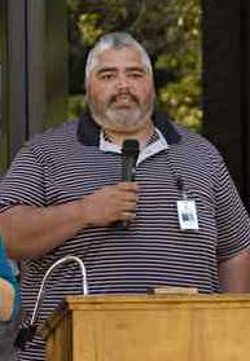
MIDDLETOWN, Calif. – District 1 Supervisor Moke Simon said he plans to seek a second term on the Lake County Board of Supervisors.
Last week, the Lake County Registrar of Voters Office reported that Simon’s name was on the list of those who had filed to run for local offices, as Lake County News has reported.
Simon is being challenged by Julia Mary Bono, a businesswoman, minister and scientist.
“It has been a privilege to serve my first term as District 1 supervisor, and thanks to the work of so many, our efforts have brought us to a pivotal point in fire recovery, protection of Clear Lake and our remarkable environment, supporting and expanding housing opportunities, and partnering with communities, agriculture and the private sector to determine the economic direction and future of our region,” Simon said.
“In addition to acting on my pledge to be accessible to the people of District 1 by creating regular local office hours, attending community meetings and events, and coaching high school football, I am proud to be the governor’s appointee to the State Board of Fire Services – the only county supervisor out of California’s 58 counties to serve on the board. I also now advocate for District 1 and county interests as a member of numerous state and regional commissions and organizations,” he said.
Simon added, “As supervisor, my focus will always be on serving local interests and strengthening our sense of community. It is our common welfare that energizes and motivates me to seek re-election – and to pledge a lifetime of service to the people of District 1 and the county. I ask for your support as we work together to realize our enormous potential.
Simon can be reached at
In previous years, the county observed a three-day closure surrounding Christmas day.
Beginning in July of this year, the Board of Supervisors took action to provide employees in all represented and unrepresented groups five days off in consideration of the winter holidays.
The Lake County Library’s branches will also be closed Saturday, Dec. 28, and Lake County Animal Care and Control will be closed to the general public that day as well, as Lake County News has reported.
“Historically, demand for most County services has lulled around the holidays,” said County Administrative Officer, Carol J. Huchingson. “Our board saw this norm as an opportunity to partner with labor representatives to provide employees a meaningful benefit, without prohibitive additional cost to the county’s general fund. Employees have in recent years been provided two annual personal days, and those were exchanged by our employee groups for more time off around the holidays.”
Huchingson said that while county offices will generally be closed to the public, county officials and select staff will work behind closed doors to fulfill mandates and support critical functions.
“Behavioral Health Crisis services, jail staff, sheriff patrol and Central Dispatch, for example, will remain available 24/7. Some departments have made additional accommodations for local independent Special Districts, and our Auditor-Controller anticipates issuing payroll checks for the local entities their office supports,” Huchingson said.
Concern has been expressed regarding late-December real estate transactions, and County Assessor-Recorder Richard Ford reported that he will open the office on Friday, Dec. 20, to compensate for the added year-end volume.”
“We evaluate the calendar and adjust accordingly, every year,” Ford said.
“Road crews will be on-call and available to respond to road hazards, as required,” said County Public Works Director Scott De Leon.
Any hazards should first be reported to the California Highway Patrol, which will appropriately route the inquiry.
Public Services Director Lars Ewing reported the Eastlake Landfill will be closed to the public Dec. 24 to 26, but otherwise open daily from 7 a.m. to 3 p.m.
Outdoor county park facilities will be available during their customary hours.
The Lower Lake Historic Schoolhouse Museum and the Historic Courthouse Museum in Lakeport will be open Friday, Dec. 27, and Saturday, Dec. 28, from 10 a.m. to 4 p.m.
The Courthouse Museum will likewise maintain its customary Sunday hours – noon to 4 p.m. – on Dec. 29. Gibson Museum and Cultural Center in Middletown is closed for a building remodel through Jan. 2.
The Lake County Superior Court will be open the week of Dec. 23, with the exception of Christmas Day.
All county offices with responsibilities to support court-related matters and proceedings have planned to provide appropriate coverage.
The Sheriff’s Records Bureau and Civil Division will be open 8 a.m. to noon, with the exception of Christmas Day.
Officials said 36 hospitals met performance standards in both maternity care and patient safety, 134 hospitals met performance standards in maternity care, 77 hospitals met performance standards in patient safety, and 60 hospitals are being recognized for participating in the pilot year of the opioid care honor roll program.
Lake County’s two hospitals, Adventist Health Clear Lake and Sutter Lakeside Hospital, are on the Maternity and Patient Safety Honor Roll, and also were listed among the hospitals that met the maternity care and patient safety standards, with Adventist Health Clear Lake also participating in the opioid care honor roll program pilot.
“Improving the quality of patient care in hospitals is critically important,” said Dr. Ghaly. “These annual measurements through Cal Hospital Compare allow us to acknowledge hospitals doing excellent work and also inform hospitals when improvement is needed.”
“Cal Hospital Compare is proud to contribute to the statewide effort to improve quality in the hospital setting by providing a roadmap and way to evaluate performance for hospitals in the important areas of maternity, patient safety, and opioid care – and show where improvement is needed,” said Bruce Spurlock, MD, the executive director of Cal Hospital Compare. “We invite all California hospitals to use these honor rolls as a tool to evaluate and benchmark performance against other hospitals.”
Cal Hospital Compare, a nonprofit organization, has been providing Californians with objective hospital performance ratings for more than a decade.
For the last four years, California has also recognized hospitals that meet or surpass a statewide target of C-section rates of 23.9 percent for low-risk, first-births.
For mothers, overuse of C-sections can result in higher rates of complications like hemorrhage, transfusions, infection, and blood clots. The surgery also brings risks for babies, including higher rates of infection, respiratory complications, neonatal intensive care unit stays, and lower breastfeeding rates.
The California Maternal Quality Care Collaborative collects the data and actively works with hospitals to safely reduce low-risk C-sections.
Between 2014 and 2018, the percentage of California hospitals meeting the target went from 40 percent to 57 percent, representing 134 hospitals statewide.
While there is still significant opportunity for improvement, the fact that so many hospitals have already reached or surpassed this target indicates that reducing unnecessary C-sections is a top priority for California hospitals providing maternity care.
Cal Hospital Compare is also releasing its first Patient Safety Honor Roll today, recognizing 77 hospitals with high safety profiles in comparison to other California hospitals. Cal Hospital Compare has rigorously evaluated a set of publicly available patient safety measures to evaluate hospitals across several areas in patient safety, including hospital acquired infections, adverse events, sepsis management, patient experience and more.
This year Cal Hospital Compare launched the Opioid Care Honor Roll to help address the ongoing opioid crisis.
According to state data, nearly 2,200 Californians died of an opioid-related overdose in 2017. Patients with opioid use disorder are frequently hospitalized or visit the emergency department due to complications of the condition without also receiving treatment for the underlying disease of opioid addiction. This is a missed opportunity and leaves patients untreated and at high risk of future overdose.
In this pilot year of the program, 60 hospitals voluntarily reported their progress on addressing the opioid crisis. While results show that all participating hospitals are making progress, it is clear more work is needed.
In 2020, Cal Hospital Compare will continue to offer learning opportunities to support the rapid spread of evidence-based practices among hospitals.
“I encourage all hospitals to participate in the Opioid Care Honor Roll program next year,” said Dr. Ghaly. “Participating in the Opioid Care Honor Roll demonstrates a hospital’s commitment to treating opioid use disorder and reducing deaths from addiction.”
The California Health and Human Services Agency and Cal Hospital Compare recognize the following 36 hospitals for achieving recognition on the Maternity and Patient Safety Honor Rolls.
For more information on individual honor rolls and recipients, please refer to the Cal Hospital Compare website here.
36 Hospitals with Maternity and Patient Safety Honor Roll Status
Adventist Health Bakersfield, Bakersfield
Adventist Health Clear Lake, Clearlake
Adventist Health Hanford, Hanford
Barton Memorial Hospital, South Lake Tahoe
Centinela Hospital Medical Center, Inglewood
Community Memorial Hospital, Ventura
Doctors Hospital of Manteca, Manteca
Doctors Medical Center of Modesto, Modesto
El Camino Hospital Los Gatos, Los Gatos
French Hospital Medical Center, San Luis Obispo
John Muir Medical Center - Walnut Creek Campus, Walnut Creek
Kaiser Permanente Downey Medical Center, Downey
Kaiser Permanente Fontana Medical Center, Fontana
Kaiser Permanente Fresno Medical Center, Fresno
Kaiser Permanente Modesto Medical Center, Modesto
Kaiser Permanente Orange County - Anaheim Medical Center, Anaheim
Kaiser Permanente Panorama City Medical Center, Panorama City
Kaiser Permanente Redwood City Medical Center, Redwood City
Kaiser Permanente Riverside Medical Center, Riverside
Kaiser Permanente Roseville Medical Center, Roseville
Kaiser Permanente Santa Clara Medical Center, Santa Clara
Kaiser Permanente South Sacramento Medical Center, Sacramento
Kaiser Permanente Vallejo Medical Center, Vallejo
Memorial Hospital Los Banos, Los Banos
PIH Health Hospital – Whittier, Whitter
Redwood Memorial Hospital, Fortuna
Sharp Chula Vista Medical Center, Chula Vista
St. Elizabeth Community Hospital, Red Bluff
St. Louise Regional Hospital, Gilroy
Sutter Lakeside Hospital, Lakeport
Sutter Roseville Medical Center, Roseville
Sutter Santa Rosa Regional Hospital, Santa Rosa
Sutter Solano Medical Center, Vallejo
UC Irvine Health, Orange
UC San Diego Health - Hillcrest, UC San Diego Medical Center, La Jolla
UCLA Medical Center - Santa Monica, Santa Monica


If you are one of those people who will settle in this evening with a hot cup of apple cider to watch a holiday movie, you are not alone. Holiday movies have become firmly embedded in Americans’ winter celebrations.
The New York Times reports a massive increase in new holiday movies this year. Disney, Netflix, Lifetime and Hallmark are now in direct competition for viewers’ attention, with both new releases and reruns of the classics.
Holiday movies are so popular not simply because they are “escapes,” as my research on the relation between religion and cinema argues. Rather, these films offer viewers a glimpse into the world as it is could be.
Christmas movies as reflection
This is particularly true with Christmas movies.
In his 2016 book “Christmas as Religion,” the religious studies scholar Christopher Deacy states that Christmas movies act as a “barometer of how we might want to live and how we might see and measure ourselves.”
These movies offer a variety of portraits of everyday life while affirming ethical values and social mores along the way.
The 1946 classic “It’s a Wonderful Life” – about a man who longs to travel but remains stuck in his childhood town – represents visions of a community in which every citizen is a vital component.
Another movie commonly replayed this time of year is 2005’s “The Family Stone” which portrays the clashes of a mostly average family but shows viewers that quarrels can be worked through and harmony is possible.
The 2003 British holiday film “Love Actually,” which follows the lives of eight couples in London, brings to viewers the perennial theme of romance and the trials of relationships.

Movie watching as ritual practice
As holiday movies bring viewers into a fictional world, people are able to work through their own fears and desires about self-worth and relationships. Such movies can provide solace, reaffirmation and sometimes even courage to continue working through difficult situations. The movies offer hope in believing it all might turn out alright in the end.
When people see some part of their own lives unfold on screen, the act of viewing operates in a fashion that’s strikingly similar to how a religious ritual works.
As anthropologist Bobby Alexander explains, rituals are actions that transform people’s everyday lives. Rituals can open up “ordinary life to ultimate reality or some transcendent being or force,” he writes in the collection “Anthropology of Religion.”
For example, for Jews and Christians, ritually observing the Sabbath day by sharing meals with family and not working connects them with the creation of the world. Prayer rituals in the Muslim, Christian and Jewish traditions connect those praying with their God, as well as with their fellow believers.
Holiday movies do something similar, except that the “transcendent force” they make viewers feel is not about God or another supreme being. Instead, this force is more secular: It’s the power of family, true love, the meaning of home or the reconciliation of relationships.
Movies create an idealized world
Take the case of the 1942 musical “Holiday Inn.” It was one of the first movies – after the silent era’s various versions of Charles Dickens’ “A Christmas Carol” – where the plot used Christmas as a backdrop, telling the story of a group of entertainers who have gathered at a country inn.
In reality, it was a deeply secular film about romantic interests, couched in a desire to sing and dance. When it was released, the United States had been fully involved in the World War II for a year and national spirits were not high.

The movie hasn’t endured as a classic. But Bing Crosby’s song “White Christmas,” which appeared in it, quickly became etched in the holiday consciousness of many Americans, and a 1954 film called “White Christmas” became better known.
As historian Penne Restad puts it in her 1995 book “Christmas in America,” Crosby’s crooning offers the “quintessential expression” of the holidays, a world which “has no dark side” – one in which “war is forgotten.”
In subsequent Christmas movies, the main plots have not been set in the context of war, yet there is nonetheless often a battle: that of overcoming a materialistic, gift-buying and gift-giving kind of holiday.
Movies like “Jingle all the Way,” “Deck the Halls” and “How the Grinch Stole Christmas” center around the idea that the true meaning of Christmas is not in rampant consumerism but in goodwill and family love.
Dr. Seuss’s famously grouchy Grinch thinks he can ruin Christmas by taking all the gifts away. But as the people gather together, giftless, they join hands and sing while the narrator tells viewers, “Christmas came anyway.”
“All’s right with the world”
Though Christmas is a Christian holiday, most holiday films are not religious in the traditional sense. There is hardly ever a mention of Jesus or the biblical setting of his birth.
As media studies scholar John Mundy writes in a 2008 essay, “Christmas and the Movies,” “Hollywood movies continue to construct Christmas as an alternative reality.”
These movies create on-screen worlds that kindle positive emotions while offering a few laughs.
“A Christmas Story,” from 1983, waxes nostalgic for childhood holidays when life seemed simpler and the desire for a Red Ryder air rifle was the most important thing in the world. The plot of 2003’s “Elf” centers on the quest to reunite with a lost father.
In the end, as the narrator says late in “A Christmas Story” – after the family has overcome a serious of risible mishaps, the presents have been unwrapped and they’ve gathered for Christmas goose – these are times when “all’s right with the world.”
[ Like what you’ve read? Want more? Sign up for The Conversation’s daily newsletter. ]
S. Brent Rodriguez-Plate, Associate Professor of Religious Studies and Cinema and Media Studies, by special appointment, Hamilton College
This article is republished from The Conversation under a Creative Commons license. Read the original article.
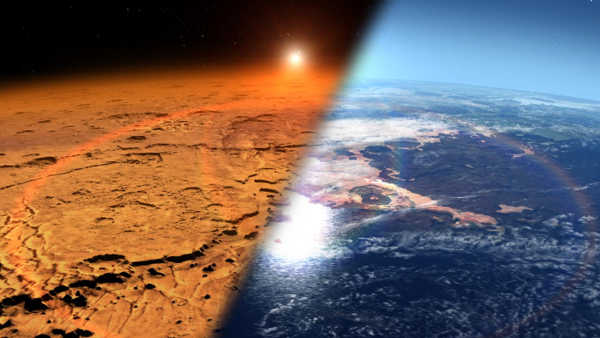
A type of Martian aurora first identified by NASA's MAVEN spacecraft in 2016 is actually the most common form of aurora occurring on the Red Planet, according to new results from the mission.
The aurora is known as a proton aurora and can help scientists track water loss from Mars' atmosphere.
At Earth, aurora are commonly seen as colorful displays of light in the night sky near the polar regions, where they are also known as the northern and southern lights.
However, the proton aurora on Mars happens during the day and gives off ultraviolet light, so it is invisible to the human eye but detectable to the Imaging UltraViolet Spectrograph (IUVS) instrument on the MAVEN (Mars Atmosphere and Volatile EvolutioN) spacecraft.
MAVEN's mission is to investigate how the Red Planet lost much of its atmosphere and water, transforming its climate from one that might have supported life to one that is cold, dry, and inhospitable.
Since the proton aurora is generated indirectly by hydrogen derived from Martian water that's in the process of being lost to space, this aurora could be used to help track ongoing Martian water loss.
"In this new study using MAVEN/IUVS data from multiple Mars years, the team has found that periods of increased atmospheric escape correspond with increases in proton aurora occurrence and intensity," said Andréa Hughes of Embry-Riddle Aeronautical University in Daytona Beach, Florida. Hughes is lead author of a paper on this research published December 12 in the Journal of Geophysical Research, Space Physics.
"Perhaps one day, when interplanetary travel becomes commonplace, travelers arriving at Mars during southern summer will have front-row seats to observe Martian proton aurora majestically dancing across the dayside of the planet (while wearing ultraviolet-sensitive goggles, of course). These travelers will witness firsthand the final stages of Mars losing the remainder of its water to space,” Hughes said.
Hughes presented the research on Dec. 12 at the American Geophysical Union meeting in San Francisco.
Different phenomena produce different kinds of aurora. However, all aurora at Earth and Mars are powered by solar activity, whether it be explosions of high-speed particles known as solar storms, eruptions of gas and magnetic fields known as coronal mass ejections, or gusts in the solar wind, a stream of electrically conducting gas that blows continuously into space at around a million miles per hour.
For example, the northern and southern lights at Earth happen when violent solar activity disturbs Earth's magnetosphere, causing high velocity electrons to slam into gas particles in Earth's nightside upper atmosphere and make them glow.
Similar processes generate Mars' discrete and diffuse aurora – two types of aurora that were previously observed on the Martian nightside.
Proton aurora form when solar wind protons (which are hydrogen atoms stripped of their lone electrons by intense heat) interact with the upper atmosphere on the dayside of Mars.
As they approach Mars, the protons coming in with the solar wind transform into neutral atoms by stealing electrons from hydrogen atoms in the outer edge of the Martian hydrogen corona, a huge cloud of hydrogen surrounding the planet.
When those high-speed incoming atoms hit the atmosphere, some of their energy is emitted as ultraviolet light.
When the MAVEN team first observed the proton aurora, they thought it was a relatively unusual occurrence.
"At first, we believed that these events were rather rare because we weren't looking at the right times and places," said Mike Chaffin, research scientist at the University of Colorado Boulder's Laboratory for Atmospheric and Space Physics, or LASP, and second author of the study. "But after a closer look, we found that proton aurora are occurring far more often in dayside southern summer observations than we initially expected."
The team has found proton aurora in about 14 percent of their dayside observations, which increases to more than 80 percent of the time when only dayside southern summer observations are considered.
"By comparison, IUVS has detected diffuse aurora on Mars in a few percent of orbits with favorable geometry, and discrete aurora detections are rarer still in the dataset," said Nick Schneider, coauthor and lead of the IUVS team at LASP.
The correlation with the southern summer gave a clue as to why proton aurora are so common and how they could be used to track water loss. During southern summer on Mars, the planet is also near its closest distance to the Sun in its orbit and huge dust storms can occur.
Summer warming and dust activity appear to cause proton auroras by forcing water vapor high in the atmosphere. Solar extreme ultraviolet light breaks the water into its components, hydrogen and oxygen.
The light hydrogen is weakly bound by Mars' gravity and enhances the hydrogen corona surrounding Mars, increasing hydrogen loss to space. More hydrogen in the corona makes interactions with solar-wind protons more common, making proton aurora more frequent and brighter.
"All the conditions necessary to create Martian proton aurora (e.g., solar wind protons, an extended hydrogen atmosphere, and the absence of a global dipole magnetic field) are more commonly available at Mars than those needed to create other types of aurora," said Hughes. "Also, the connection between MAVEN's observations of increased atmospheric escape and increases in proton aurora frequency and intensity means that proton aurora can actually be used as a proxy for what's happening in the hydrogen corona surrounding Mars, and therefore, a proxy for times of increased atmospheric escape and water loss."
This research was funded by the MAVEN mission. MAVEN's principal investigator is based at the University of Colorado's Laboratory for Atmospheric and Space Physics in Boulder, Colorado, and NASA Goddard manages the MAVEN project. NASA is exploring our Solar System and beyond, uncovering worlds, stars, and cosmic mysteries near and far with our powerful fleet of space and ground-based missions.