 How to resolve AdBlock issue?
News
- Details
- Written by: LAKE COUNTY NEWS REPORTS
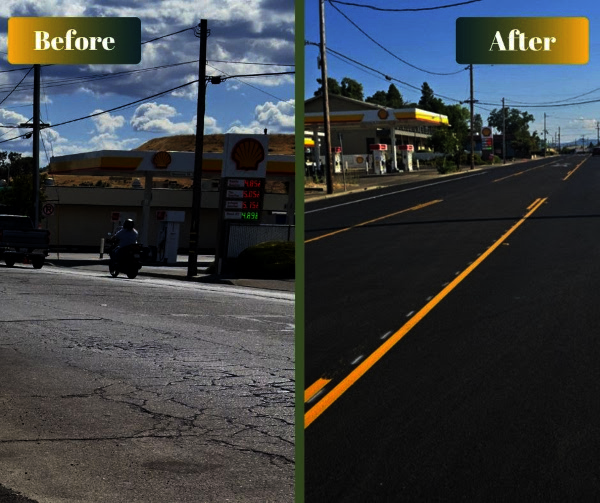
LAKEPORT, Calif. — The city of Lakeport has completed a significant series of infrastructure improvements along South Main Street, one of the city’s most heavily traveled corridors.
This multi-phase effort included sidewalk reconstruction, accessibility enhancements, and full roadway resurfacing from First Street to Lakeport Boulevard.
Additional rehabilitation work is scheduled to begin in September on Martin Street and Lakeshore Boulevard.
The South Main Sidewalk Project, completed earlier this year, addressed long-standing gaps in pedestrian safety and accessibility. The project included the removal of tree stumps and damaged concrete, relocation of utility poles, installation of new curbs and gutters, and the construction of ADA-compliant curb ramps at key intersections.
Following the sidewalk improvements, the city completed the South Main Street Paving Project, which involved nearly 3,000 tons of asphalt and resurfacing of the entire corridor between First Street and Lakeport Boulevard.
The project also included new striping, upgraded crosswalks at seven intersections, and the installation of rectangular rapid flashing beacons to improve pedestrian visibility and safety.
The next phase of roadway rehabilitation is scheduled to begin in September, with major work scheduled on Martin Street (from Main Street to Bevins Street) and Lakeshore Boulevard.
Prior to paving, the city said it has completed essential water and sewer system upgrades beneath both corridors, ensuring that aging underground infrastructure is addressed before surface restoration begins.
The upcoming paving work will include significant roadway reconstruction and surface restoration. Based on current engineering estimates:
• Martin Street will receive approximately 1,815 tons of new asphalt.
• Lakeshore Boulevard will receive approximately 1,830 tons.
A total of 3,645 tons of new pavement will be installed this fall. Ghilotti Construction, the lowest responsive bidder, will complete the project.
City officials said these projects are part of the city’s “ongoing commitment to improving transportation infrastructure, enhancing safety, and extending the service life of Lakeport’s roadways.”
For more information about current and upcoming Public Works projects, contact the Lakeport Public Works Department at 707-263-5614 or visit www.cityoflakeport.com.
- Details
- Written by: LAKE COUNTY NEWS REPORTS
Safe and Sane firework sales start Tuesday at noon in some jurisdictions throughout California, resulting in fire officials emphasizing the dangers of fireworks.
Prevent fires and injuries and always check local regulations before buying.
Safe and sane fireworks are only legal in Lake County within the city of Lakeport.
Note that fireworks bought outside California are illegal without a license. Consider enjoying a professional display instead of purchasing fireworks.
If safe and sane fireworks are legal in your area and you choose to use them, it's important that you follow these safety tips:
• Use only state fire marshal approved fireworks.
• Local ordinances should be verified before purchasing and/or using fireworks.
• Always read directions.
• Always have an adult present.
• Only use fireworks outdoors.
• Never use fireworks near dry grass or other flammable materials.
• Light one firework at a time.
• Have a bucket of water and a hose nearby.
• It is recommended that you use a bucket of gray/reused water to submerge your fireworks after they are used to fully extinguish them.
• It is illegal to transport safe and sane fireworks through any city or county where they are not allowed.
"Since 2024, fireworks have caused over $35 million in property damage across California, sparking 1,230 fires," said California State Fire Marshal Chief Daniel Berlant. "It is your responsibility to prevent fires and injuries. Don’t let your Fourth of July celebration end in flames."
To learn more about fireworks safety, visit https://readyforwildfire.org/prevent-wildfire/fireworks-safety/.
- Details
- Written by: LAKE COUNTY NEWS REPORTS
California is now collecting more groundwater data than ever before as highlighted in the Semi-Annual Groundwater Conditions Update released by the Department of Water Resources, or DWR.
Made up of groundwater data gathered over the past year from various DWR tools and annual reports from local groundwater sustainability agencies, or GSAs, the update includes information on statewide groundwater levels, groundwater storage, recharge, land subsidence, well infrastructure and the status of California’s groundwater conditions.
“When it comes to water management in California, it’s important that state and local water decisions are made with the latest, most accurate data in mind. Thanks to the information collected from our local partners, we’re gaining more knowledge about the challenges our groundwater-dependent communities are facing and their progress towards meeting the overall goals set by the Sustainable Groundwater Management Act,” said Paul Gosselin, DWR deputy director of sustainable water management.
Water Year 2024 marked a significant milestone for groundwater management in California, as the state celebrated the 10-year anniversary of the Sustainable Groundwater Management Act, or SGMA, the statewide regulatory framework established to ensure the sustainability of our groundwater basins by 2040.
Over the course of 2024, the state received average precipitation, helping sustain recharge efforts after the exceptionally wet 2023.
These last three years (2023, 2024, and 2025) have seen continued increases in groundwater storage. Water Year 2024 increased by 2.2 million acre-feet reported across 98 basins — a direct result of state and local actions to capture and store more water underground.
However, the first five months of WY 2025 were notably dry across much of the state, especially in the Central Valley and southern regions.
In contrast, portions of Northern California experienced above-average or record-setting rainfall. These sharp contrasts highlight California’s weather shifts and increasing need for dynamic water management.
Additional findings from the report include:
Groundwater management
Groundwater storage increased by 2.2 million acre-feet reported across the 97 basins during water year 2024. This increase reflects actions such as capturing and recharging high flows during winter storms, expanding recharge basins, improving groundwater monitoring, and coordination among local agencies to reduce groundwater pumping.
SGMA implementation
Local GSAs are executing Groundwater Sustainability Plans, or GSPs, that incorporate recharge projects, demand reduction, efficiency programs, and land use coordination.
GSAs are expanding monitoring networks and using annual reports to track key sustainability indicators such as groundwater levels, subsidence, use patterns, and recharge volumes.
DWR is investing in tools like InSAR, Airborne Electromagnetic surveys, advanced modeling, and telemetry to improve data quality and inform water management decisions.
Groundwater storage in the Central Valley remains highly sensitive to drought and wet periods.
Land subsidence
Active land subsidence continues to be observed in the Sacramento River, San Joaquin River, and Tulare Lake Hydrologic Regions. DWR continues to expand data collection on subsidence in these areas and plans to release guidance for GSAs later this year.
Dry wells
Fewer dry wells were reported in water year 2024 compared to water years 2021, 2022 and 2023.
DWR is now entering a new era of groundwater sustainability driven by action and implementation of GSPs. Throughout this process, DWR continues to provide support to help GSAs implement their plans through improved communications utilizing facilitation support for sensitive or challenging meetings, and translation services to improve critical information sharing.
Additionally, DWR will release guidance on depletions of interconnected surface water and subsidence later this year.
DWR’s goal with these two documents is to provide local groundwater sustainability partners with the information and direction they need to understand how to address the impacts of overdraft on our groundwater basins and support our water supply for future generations.
Across the state, 85 percent of Californians depend on groundwater for some portion of their water needs, with groundwater also acting as a buffer and supplying up to 60 percent of the state’s water supply during drought years.
While the water beneath our feet is unseen and often overlooked, sustainable management of this resource is critical for long-term water supply reliability.
By monitoring and tracking conditions and collecting new data, state and local agencies can better manage water resources during average and wet years to ensure groundwater will be available as a buffer during dry years.
- Details
- Written by: LINGZI CHEN
LAKEPORT, Calif. — The Lakeport City Council will hold a special meeting on Monday to adopt the city’s final budget of $37 million for fiscal year 2025-2026, following its budget workshop presentations held June 17.
The council will meet Monday, June 30, at 6 p.m. in the council chambers at Lakeport City Hall, 225 Park St.
The agenda can be found here.
If you cannot attend in person, and would like to speak on an agenda item, you can access the Zoom meeting remotely at this link or join by phone by calling toll-free 669-900-9128 or 346-248-7799.
The webinar ID is 973 6820 1787, access code is 477973; the audio pin will be shown after joining the webinar. Those phoning in without using the web link will be in “listen mode” only and will not be able to participate or comment.
Comments can be submitted by email to
By state law, June 30 is the city’s deadline for budget adoption.
The city’s recommended budget for fiscal year 2025-26 now sits at $37,289,272, an increase by more than 50% from the city’s 2024-25 estimated total expenditure of $24,060,022. Five years ago, it was $18,825,050.
The city’s revenue totals $31,970,097, despite lower than the recommended expenditure, showing an increase by about 100% from previous year’s revenue of $15,737,368.
The increase in revenue was not due to a growing local economy, but pumped up by special revenue funding streams such as $2.7 million from the state’s Permanent Local Housing Allocation program and $9.5 million from a federal Community Development Block Grant.
In total, these special funds came to $16,422,610, ten times the amount of $1,669,402 in 2024-25.
In the meantime, recommended General Fund allocation is $7,523,632, up from $6,285,887 last year.
Out of all expenditures proposed, salaries and benefits take up $7,288,627, increased from $6,571,328 in 2024-25.
Operation expenses take up $18,430,362, more than four times the $4,309,381 of 2024-25.
Allocations to Capital Improvement Projects, however, see a drop — from previous year’s $9,825,353 to the currently proposed $8,363,831.
The staff memo identified the “central theme” of this year’s budget: “the rapid acceleration of fixed costs outpacing revenue growth.”
The cost increase primarily stems from general liability and property insurance expenses, which have doubled over the past five years, and from rising pension obligations — significantly higher than last year and expected to double again within five years, the memo said.
Meanwhile, revenue growth remains “flat,” the staff memo noted.
Sales tax, which makes up two-thirds of Lakeport’s General Fund, has seen “modest recent gains” thanks to new retailers like Marshalls and Tractor Supply, and growth in the restaurant sector. But the memo called this core revenue source “highly volatile.”
One reason: 20% of Lakeport’s sales tax revenue comes from retail fuel sales — a source threatened as California continues its “transition away from gas-powered vehicles,” the memo said.
“The most pressing challenge facing the city of Lakeport is the steep rise in fixed operating costs — particularly in insurance, pensions, and medical benefits — which are climbing at a pace far beyond that of the City’s revenue growth,” the staff memo said.
The memo highlighted some of the city’s key goals in the upcoming fiscal year:
The city looks to finalize design and funding strategies on the South Lakeport Water Resilience and Fire Suppression project, and maintain a fully staffed police department. It also aims to complete the 2024 water and sewer main replacement — a multiple-year project that is now more than halfway completed.
Also on the list is the city’s multi-year Pavement Management Program. Projects set to be executed during fiscal year 2025-26 include rehabilitation of Lakeport Boulevard, Martin Street and Lakeshore Boulevard.
Email Lingzi Chen at