How to resolve AdBlock issue?
Refresh this page
How to resolve AdBlock issue?
Refresh this page
Lake County News,California
  • Home
    • Registration Form
  • News
    • Education
    • Veterans
    • Community
      • Obituaries
      • Letters
      • Commentary
    • Police Logs
    • Business
    • Recreation
    • Health
    • Religion
    • Legals
    • Arts & Life
    • Regional
  • Calendar
  • Contact us
    • FAQs
    • Phones, E-Mail
    • Subscribe
  • Advertise Here
  • Login
How to resolve AdBlock issue?
Refresh this page

News

Seventh annual Broadband Summit focuses on North State connectivity

Details
Written by: LAKE COUNTY NEWS REPORTS
Published: 08 July 2025

NORTHERN CALIFORNIA — The North State Planning and Development Collective at California State University, Chico, along with the Northeastern and Upstate California Connect Broadband Consortia, will hold its seventh annual Virtual Broadband Summit next month.

The event will take place on Thursday, Aug. 28, from 9 to 11 a.m.

Registration is free and is now open through Eventbrite.com.

The event brings together regional and state leaders in broadband for a morning dedicated to the current broadband programs and initiatives underway in the California North State region.  

“Broadband is critical to the way we all live, do business and learn,” said Jason Schwenkler, executive director for the collective and manager of the Upstate and Northeastern California Connect Broadband Consortia. “This annual event allows us the opportunity to inform the region about current broadband policy, infrastructure developments and more affecting the North State region.

The agenda includes: 

• Welcome and update from Jason Schwenkler.
• Legislation and Policy Update by Sunne Wright-McPeak, President and CEO, California Emerging Technology Fund, or CETF. 
• Broadband for All Update by Scott Adams, deputy director of broadband and digital literacy, California Department of Technology and an update from Mark Monroe, deputy director of California's Middle-Mile Initiative, California Department of Technology.
• Update from Maria Ellis, deputy director of broadband, California Public Utilities Commission
 
To register, search “7th Annual Virtual Broadband Summit” on Eventbrite.com.

For additional information about the event agenda or registration, contact Sabrina Oregel, outreach coordinator, at This email address is being protected from spambots. You need JavaScript enabled to view it.. 

Middletown Area Town Hall to meet July 10

Details
Written by: Elizabeth Larson
Published: 08 July 2025

MIDDLETOWN, Calif. — The Middletown Area Town Hall, or MATH, will get updates on a new park project and other projects in the south county area.

MATH will meet at 7 p.m. Thursday, July 10, in the Middletown Community Meeting Room/Library at 21256 Washington St., Middletown. The meeting is open to the public.

Zoom will not be available. Viewers can participate via PEG TV at www.youtube.com/LakeCountyPegTV. 

On the agenda is a presentation by Public Services Director Lars Ewing regarding a new park in Middletown.

The group will consider voting to finalize MATH’s updated bylaws, which will then be sent to the Board of Supervisors for approval.

In other business, the group will get an update on a public meeting on Aug. 7 regarding Caltrans projects in the Middletown area and the Lake Lake Area Planning Council’s Zero Emission Vehicle Infrastructure Plan.

MATH — established by resolution of the Lake County Board of Supervisors on Dec. 12, 2006 — is a municipal advisory council serving the residents of Anderson Springs, Cobb, Coyote Valley (including Hidden Valley Lake), Long Valley and Middletown.

For more information email This email address is being protected from spambots. You need JavaScript enabled to view it.. 

Email Elizabeth Larson at This email address is being protected from spambots. You need JavaScript enabled to view it.. Follow her on Twitter, @ERLarson, and on Bluesky, @erlarson.bsky.social. Find Lake County News on the following platforms: Facebook, @LakeCoNews; X, @LakeCoNews; Threads, @lakeconews, and on Bluesky, @lakeconews.bsky.social. 

‘Big’ legislative package shifts more of SNAP’s costs to states, saving federal dollars but causing fewer Americans to get help paying for food

Details
Written by: Tracy Roof, University of Richmond
Published: 08 July 2025

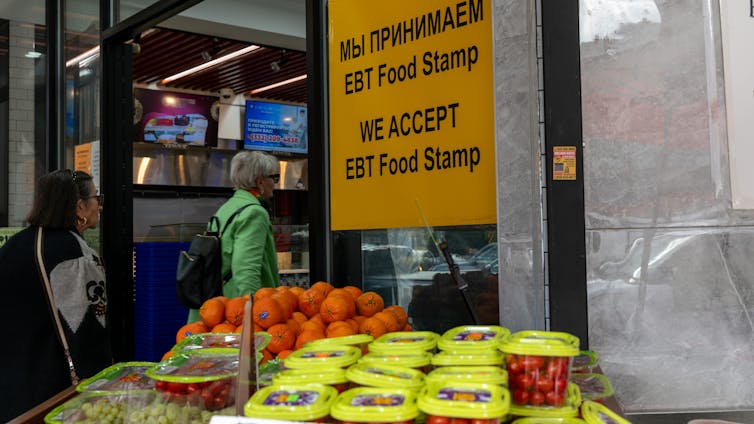
People shop for food in Brooklyn in 2023 at a store that makes sure that its customers know it accepts SNAP benefits, also known as food stamps and EBT. Spencer Platt/Getty Images

The legislative package that President Donald Trump signed into law on July 4, 2025, has several provisions that will shrink the safety net, including the Supplemental Nutrition Assistance Program, long known as food stamps. SNAP spending will decline by an estimated US$186 billion through 2034 as a result of several changes Congress made to the program that today helps roughly 42 million people buy groceries – an almost 20% reduction.

In my research on the history of food stamps, I’ve found that the program was meant to be widely available to most low-income people. The SNAP changes break that tradition in two ways.

The Congressional Budget Office estimates that about 3 million people are likely to be dropped from the program and lose their benefits. This decline will occur in part because more people will face time limits if they don’t meet work requirements. Even those who meet the requirements may lose benefits because of difficulty submitting the necessary documents.

And because states will soon have to take on more of the costs of the program, which totaled over $100 billion in 2024, they may eventually further restrict who gets help due to their own budgetary constraints.

Summing up SNAP’s origins

Inspired by the plight of unemployed coal miners whom John F. Kennedy met in Appalachia when he campaigned for the presidency in 1960, the early food stamps program was not limited to single parents with children, older people and people with disabilities, like many other safety net programs were at the time. It was supposed to help low-income people afford more and better food, regardless of their circumstances.

In response to national attention in the late 1960s to widespread hunger and malnutrition in other areas of the country, such as among tenant farmers in the rural South, a limited food stamps program was expanded. It reached every part of the country by 1974.

From the start, the states administered the program and covered some of its administrative costs and the federal government paid for the benefits in full. This arrangement encouraged states to enroll everyone who needed help without fearing the budgetary consequences.

Who could qualify and how much help they could get were set by uniform national standards, so that even the residents of the poorest states would be able to afford a budget-conscious but nutritionally adequate diet.

The federal government’s responsibility for the cost of benefits also allowed spending to automatically grow during economic downturns, when more people need assistance. These federal dollars helped families, retailers and local economies weather tough times.

The changes to the SNAP program included in the legislative package that Congress approved by narrow margins and Trump signed into law, however, will make it harder for the program to serve its original goals.

Restricting benefits

Since the early 1970s, most so-called able-bodied adults who were not caring for a child or an adult with disabilities had to meet a work requirement to get food stamps. Welfare reform legislation in 1996 made that requirement stricter for such adults between the ages of 18 and 50 by imposing a three-month time limit if they didn’t log 20 hours or more of employment or another approved activity, such as verified volunteering.

Budget legislation passed in 2023 expanded this rule to adults up to age 54. The 2025 law will further expand the time limit to adults up to age 64 and parents of children age 14 or over.

States can currently get permission from the federal government to waive work requirements in areas with insufficient jobs or unemployment above the national average. This flexibility to waive work requirements will now be significantly limited and available only where at least 1 in 10 workers are unemployed.

Concerned senators secured an exemption from the work requirements for most Native Americans and Native Alaskans, who are more likely to live in areas with limited job opportunities.

A 2023 budget deal exempted veterans, the homeless and young adults exiting the foster care system from work requirements because they can experience special challenges getting jobs. The 2025 law does not exempt them.

The new changes to SNAP policies will also deny benefits to many immigrants with authorization to be in the U.S., such as people granted political asylum or official refugee status. Immigrants without authorization to reside in the U.S. will continue to be ineligible for SNAP benefits.

Tracking ‘error rates’

Critics of food stamps have long argued that states lack incentives to carefully administer the program because the federal government is on the hook for the cost of benefits.

In the 1970s, as the number of Americans on the food stamp rolls soared, the U.S. Department of Agriculture, which oversees the program, developed a system for assessing if states were accurately determining whether applicants were eligible for benefits and how much they could get.

A state’s “payment error rate” estimates the share of benefits paid out that were more or less than an applicant was actually eligible for. The error rate was not then and is not today a measure of fraud. Typically, it just indicates the share of families who get a higher – or lower – amount of benefits than they are eligible for because of mistakes or confusion on the part of the applicant or the case worker who handles the application.

Congress tried to penalize states with error rates over 5% in the 1980s but ultimately suspended the effort under state pressure. After years of political wrangling, the USDA started to consistently enforce financial penalties on states with high error rates in the mid-1990s.

States responded by increasing their red tape. For example, they asked applicants to submit more documentation and made them go through more bureaucratic hoops, like having more frequent in-person interviews, to get – and continue receiving – SNAP benefits.

These demands hit low-wage workers hardest because their applications were more prone to mistakes. Low-income workers often don’t have consistent work hours and their pay can vary from week to week and month to month. The number of families getting benefits fell steeply.

The USDA tried to reverse this decline by offering states options to simplify the process for applying for and continuing to get SNAP benefits over the course of the presidencies of Bill Clinton, George W. Bush and Barack Obama. Enrollment grew steadily.

Penalizing high rates

Since 2008, states with error rates over 6% have had to develop a detailed plan to lower them.

Despite this requirement, the national average error rate jumped from 7.4% before the pandemic, to a record high of 11.7% in 2023. Rates rose as states struggled with a surge of people applying for benefits, a shortage of staff in state welfare agencies and procedural changes.

Republican leaders in Congress have responded to that increase by calling for more accountability.

Making states pay more

The big legislative package will increase states’ expenses in two ways.

It will reduce the federal government’s responsibility for half of the cost of administering the program to 25% beginning in the 2027 fiscal year.

And some states will have to pay a share of benefit costs for the first time in the program’s history, depending on their payment error rates. Beginning in the 2028 fiscal year, states with an error rate between 6-8% would be responsible for 5% of the cost of benefits. Those with an error rate between 8-10% would have to pay 10%, and states with an error rate over 10% would have to pay 15%. The federal government would continue to pay all benefits in states with error rates below 6%.

Republicans argue the changes will give states more “skin in the game” and ensure better administration of the program.

While the national payment error rate fell from 11.68% in the 2023 fiscal year to 10.93% a year later, 42 states still had rates in excess of 6% in 2024. Twenty states plus the District of Columbia had rates of 10% or higher.

At nearly 25%, Alaska has the highest payment error rate in the country. But Alaska won’t be in trouble right away. To ease passage in the Senate, where the vote of Sen. Lisa Murkowski, an Alaska Republican, was in doubt, a provision was added to the bill allowing several states with the highest error rates to avoid cost sharing for up to two years after it begins.

Democrats argue this may encourage states to actually increase their error rates in the short term.

The effect of the new law on the amount of help an eligible household gets is expected to be limited.

About 600,000 individuals and families will lose an average of $100 a month in benefits because of a change in the way utility costs are treated. The law also prevents future administrations from increasing benefits beyond the cost of living, as the Biden Administration did.

States cannot cut benefits below the national standards set in federal law.

But the shift of costs to financially strapped states will force them to make tough choices. They will either have to cut back spending on other programs, increase taxes, discourage people from getting SNAP benefits or drop the program altogether.

The changes will, in the end, make it even harder for Americans who can’t afford the bare necessities to get enough nutritious food to feed their families.The Conversation

Tracy Roof, Associate Professor of Political Science, University of Richmond

This article is republished from The Conversation under a Creative Commons license. Read the original article.

Supervisors to consider delinquent utility fee collections, Sonoma Clean Power expansion and cannabis policies

Details
Written by: LINGZI CHEN
Published: 07 July 2025

LAKE COUNTY, Calif. — The Board of Supervisors this week will consider placing delinquent water, sewer and lighting fees on the 2024-25 tax rolls for collection, review a feasibility study by Sonoma Clean Power suggesting lower electricity costs, and discuss the cannabis policy recommendations.

The‌ ‌board will meet beginning ‌at‌ ‌9‌ ‌a.m. Tuesday, July 8, in the board chambers on the first floor of the Lake County Courthouse, 255 N. Forbes St., Lakeport.

The‌ ‌meeting‌ ‌can‌ ‌be‌ ‌watched‌ ‌live‌ ‌on‌ ‌Channel‌ ‌8, ‌online‌ ‌at‌ ‌https://countyoflake.legistar.com/Calendar.aspx‌‌ and‌ ‌on‌ ‌the‌ ‌county’s‌ ‌Facebook‌ ‌page. ‌Accompanying‌ ‌board‌ ‌documents, ‌the‌ ‌agenda‌ ‌and‌ ‌archived‌ ‌board‌ ‌meeting‌ ‌videos‌ ‌also‌ ‌are‌ ‌available‌ ‌at‌ ‌that‌ ‌link. ‌ ‌

To‌ ‌participate‌ ‌in‌ ‌real-time, ‌join‌ ‌the‌ ‌Zoom‌ ‌meeting‌ ‌by‌ ‌clicking‌ ‌this‌ ‌link‌. ‌ ‌

The‌ ‌meeting‌ ‌ID‌ ‌is‌ 865 3354 4962, ‌pass code 726865.‌ ‌The meeting also can be accessed via one tap mobile at +16694449171,,86533544962#,,,,*726865#. The meeting can also be accessed via phone at 669 900 6833.

At 9:30 a.m., the board will consider adopting an increase in the fire mitigation fee. The staff memo noted that the fee will be automatically adjusted for inflation each year on July 1, commencing immediately. 

The board will then hold a public hearing at 10 a.m. on the placement of lighting fees and delinquent water and sewer fees on the 2024-2025 tax rolls for collection, before the approval of related resolutions. 

At 10:30 a.m., the board will hear a presentation from Sonoma Clean Power evaluating the feasibility of expanding their Community Choice Aggregation program, or the CCA program, into Lake County. 

Under the conditions of the study, it is estimated that if the program expands to Lake County, customers may save between 4.2% and 12.9% on their electricity bills compared to their current provider.

The chief executive officer and staff from Sonoma Clean Power will answer questions from and discuss potential next steps with the board.

At 11a.m., the board will consider a summary of cannabis policy recommendations and provide direction to staff who will draft an ordinance to create a new Article 73 in the Lake County Zoning Code. 

The draft will be sent out for review by stakeholders and the Agriculture Advisory Committee. It will then be brought back to the board for consideration and possible adoption, according to the staff memo. 

The summary of policy recommendations includes cannabis-related business types, possible zoning districts to locate these businesses, the level of permit required, development standards and options to align with existing state regulations. 

At 1 p.m., the board will consider a report from consulting firm Municipal Resource Group on a governance and organizational workshop attended by the board and staff in March in which they discussed the possibility of moving from a chief administrative officer to a chief executive officer model. 

In the untimed items, the board will consider an annual update by Lake County Behavior Health Services and the department’s several contracts adding up to over $4.5 million. 

The board will also consider an agreement for construction management services for the 2024 Pavement Rehabilitation Project in the Cobb area with GHD. 

The agreement amount is not to exceed $634,478, or 12% of the construction contract amount. 

The staff memo noted that construction began on June 18, with Argonaut Contractors Inc. as the builder and GHD providing construction management services.

In the closed session, the board will consider an employee grievance complaint and conduct a public employee evaluation of the county’s Water Resources director. 

The full agenda follows. 

CONSENT AGENDA

5.1: Adopt resolution approving Agreement #25-7306-0256-RA with the USDA Animal and Plant Health Inspection Services for July 1, 2025, through June 30, 2026, for $143,263.10; July 1, 2026, through June 30, 2027, for $146,638.26 and July 1, 2027, through June 30, 2028, for $149,007.30.

5.2: Adopt resolution approving Agreement No. 25-0268-000-SA with the California Department of Food and Agriculture for compliance with the Nursery Inspection Program for period July 1, 2025, through June 30, 2026, for $500.

5.3: Adopt resolution approving Agreement with California Department of Food Agriculture for Certified Farmer’s Market Program Investigation and Enforcement Agreement #25-0120-000-SA for $944.00 for the period of July 1, 2025, through June 30, 2026.

5.4: Approve amendment between County of Lake and CliftonLarsonAllen LLP for accounting and advisory services; an increase of $50,000 total compensation not to exceed $150,000 and authorize the chair to sign.

5.5: Approve a) budget transfer in Budget Unit 4014 – Behavioral Health of $514,650 from Inventory account 740.38-00 to Capital Asset account 740.63-13; and b) amend the list of capital assets of the 2024-2025 budget to increase the South Shore Clinic to $681,250 and authorize the chair of the board to sign.

5.6: Approve Board of Supervisors meeting minutes June 3, 2025 and June 10, 2025.

5.7: Adopt resolution authorizing the Community Development Department to apply for the Sustainable Agricultural Lands Conservation Program (SALC) grant from the California Department of Conservation and authorize the chair to sign.

5.8: Approve long distance travel for Liberty Francis, Tobacco Education & Prevention Coordinator and Patricia Wingler, Tobacco Education & Prevention Health Programs Support Specialist to attend the National Conference on Tobacco or Health Training in Chicago, Illinois from August 24, 2025 to August 29, 2025.

5.9: Approve request to close the Probation Department on Friday, July 24, 2025, from 11:30 a.m. – 5 p.m. for all-staff training.

5.10: a) Approve the purchase agreement for wetland mitigation credits at Seigler Valley Wetland Bank – FMAG HMGP Culvert Replacement No. 1 and authorize the Public Works director to sign; and b) approve the purchase agreement for wetland mitigation credits at Seigler Valley Wetland Bank – FMAG HMGP Culvert Replacement No. 2 and authorize the Public Works director to sign.

5.11: Approve late travel claims for election technicians for the November 5, 2024, general election and authorize the Auditor-Controller to process payments to be paid out of FY 2024/2025.

5.12: (Sitting as the Lake County Watershed Protection District, Board of Directors) Approve Local Cooperation Agreement between Central Valley Flood Protection Board of the State of California (CVFPB) and Lake County Watershed Protection District (LCWPD) for Middle Creek Flood Control Project work and authorize the chair to sign.

5.13: Approve the agreement between County of Lake and Clean Lakes, Inc. for the Aquatic Vegetation Management Program for Fiscal Year 2024-2025 not to exceed an amount of $271,210 and authorize the chair to sign.

TIMED ITEMS

6.1, 9:02 a.m.: Public input.

6.2, 9:03 a.m.: Pet of the Week.

6.3, 9:04 a.m.: New and noteworthy at the Library.

6.4, 9:10 a.m.: Consideration of presentation of Brown Act.

6.5, 9:30 a.m.: Public hearing – Consideration of a proposed resolution approving resolutions submitted by Lake County fire agencies and making findings and requesting the County of Lake to implement fire mitigation fees with the automatic inflation pursuant to the Lake County Fire Mitigation Fee Ordinance.

6.6, 10 a.m.: Public hearing – (Sitting concurrently as Clearlake Keys CSA #1, #2, #6, #13, #20, #21–Board of Supervisors, Kelseyville County Waterworks District #3 and Lake County Sanitation District–Board of Directors) – Consideration of (a) resolution confirming collections of annual lighting fees; (b) resolution confirming collections of delinquent water fees; (c) resolution confirming collections of delinquent water and sewer fees; (d) resolution of delinquent sewer fees for Lake County Sanitation District.

6.7, 10:30 a.m.: Consideration of a presentation by Sonoma Clean Power on a feasibility study for Sonoma Clean Power Lake County expansion.

6.8, 10:45 a.m.: Public hearing – Consideration of resolution appointing Road Commissioner for the County of Lake.

6.9, 11:00 a.m.: Consideration of summary of cannabis policy recommendations and request for board direction.

6.10, 1:00 p.m.: Consideration of a report from Municipal Resource Group on your board's March 21, 2025, training workshop on general governance, priority development and organizational effectiveness.

NON-TIMED ITEMS

7.1: Supervisors’ weekly calendar, travel and reports.

7.2: Consideration of Board of Supervisors Rules of Procedure, General Protocol and Committees Policy update.

7.3: Consideration of Amendment No. 2 to the agreement between County of Lake and California Mental Health Services Authority "CalMHSA" Semi-Statewide Enterprise Health Record Program in the amount of $1,528,816.56.

7.4: a) Consideration of presentation on Lake County Behavioral Health Services Mental Health Services Act annual update for Fiscal Year 2025-26 and approval of modifications to the three-year plan spanning 2023-24, 2024-25, and 2025-26; and b) resolution adopting the annual FY 2025-26 update to the three-year Lake County Mental Health Services Act program and expenditure plan.

7.5: Consideration of agreement between the County of Lake and Crestwood Behavioral Health, Inc. for adult residential support services and specialty mental health services for Fiscal Year 2025-26 in the amount of $1,200,000.

7.6: Consideration of Amendment No. 2 to the agreement between County of Lake and Davis Guest Home, Inc. for adult residential support services and specialty mental health services in the amount of $380,000 for Fiscal Year 2024-25.

7.7: Consideration of agreement between the County of Lake and Redwood Community Services, Inc. for provision of the Lake County Wrap Program, Foster Care Program, and Intensive Services Foster Care (ISFC) Program for specialty mental health services for Fiscal Year 2025-26 in the amount of $1,500,000.

7.8: Consideration of agreement for construction management services for the 2024 Pavement Rehabilitation Project with GHD with an amount not to exceed $634,478.00, and authorize the chair to sign.

7.9: Consideration of (a) waiving the formal bidding process, pursuant to Lake County Code Section 38.2, as it is not in the public interest due to the unique nature of goods or services; (b) ratifying payment in the amount of $7,892.37 for Ad Order 0006900014; (c) approving payment to the Lake County Record-Bee not to exceed $50,000.00 annually.
7.10: Consideration of (a) waiving the formal bidding process, pursuant to Lake County Code Section 38.2, as it is not in the public interest due to the unique nature of goods or services; (b) approving payment of Pre-Sort Center postage deposit for $5,905.41; (c) approving agreement with the Presort Center for printing and mailing services in an amount not to exceed $200,000.

CLOSED SESSION

8.1, 2 p.m.: Closed session: Employee grievance complaint pursuant to Gov. Code sec. 54957.

8.2: Public employee evaluation: Water Resources Director.

Email staff reporter Lingzi Chen at This email address is being protected from spambots. You need JavaScript enabled to view it.. 

  1. Berryessa Snow Mountain National Monument anniversary celebration planned for July 10
  2. Rural hospitals will be hit hard by Trump’s signature spending package
  3. Census: Older adults outnumber children in 11 states and nearly half of U.S. counties
  • 233
  • 234
  • 235
  • 236
  • 237
  • 238
  • 239
  • 240
  • 241
  • 242
How to resolve AdBlock issue?
Refresh this page