 How to resolve AdBlock issue?
News
- Details
- Written by: Jim Cawley
For Artemis missions, NASA’s Orion spacecraft will be traveling at 25,000 miles per hour as it reenters the Earth’s atmosphere, which will slow it down to 325 mph. Parachutes will then bring it down to about 20 mph.
During the parachute deploy sequence, hardware will be jettisoned and fall into the Pacific Ocean below while the recovery ship awaits near the landing site. Keeping the ship and recovery team safe is critical to mission success.
The Landing and Recovery team, led by Exploration Ground Systems at NASA’s Kennedy Space Center in Florida, is prepared to safely recover Orion and attempt to recover the jettisoned hardware.
A four-person team of engineers from NASA’s Johnson Space Center in Houston will also be onboard the U.S. Navy recovery ship with a “Sasquatch” — no, not an elusive hairy creature, but a very important software tool created specifically for Orion.
“Sasquatch is the software NASA uses to predict large footprints — that’s why we call it Sasquatch — of the various debris that is released from the capsule as it is reentering and coming through descent,” said Sarah Manning, a Sasquatch operator and aerospace engineer from the Engineering Directorate at Johnson.
The hardware jettisoned, or released, during parachute deployment includes drogue and pilot parachutes that help initially slow and stabilize Orion, along with other elements necessary for the parachute sequence to deploy.
The primary objective for the Sasquatch team is to help get the ship as close as possible to recover Orion quickly. A secondary objective is to recover as much hardware as possible.

Incorporating wind data gathered from the balloons with Sasquatch’s information about the debris, such as how quickly it falls, will show how the debris will spread based on the winds that day — scenarios the team has practiced for years in the Arizona desert where the Orion program conducted parachute testing.
That’s where Sasquatch and eight weather balloons, released from the recovery ship by a team from Cape Canaveral Air Force Station in Florida and Vandenberg Air Force Base in California, come into play.
They will use that information to position the recovery ship, small boats and helicopters outside the debris field to avoid injuries or damage.
“The upper-level wind speed and direction are critical in modeling the debris trajectories,” said Air Force Maj. Jeremy J. Hromsco, operations officer, 45th Weather Squadron at Cape Canaveral Air Force Station. “Data provided to U.S. Navy and NASA forecast teams will allow them to accurately characterize and forecast the atmosphere during recovery operations.”
Positioning is paramount to recovering the hardware before it sinks. The team will first focus on recovering the capsule’s forward bay cover, a protective ring that covers the back shell of the capsule and protects the parachutes during most of the mission, as well as the three main parachutes. If they are successful, engineers can inspect the hardware and gather additional performance data.
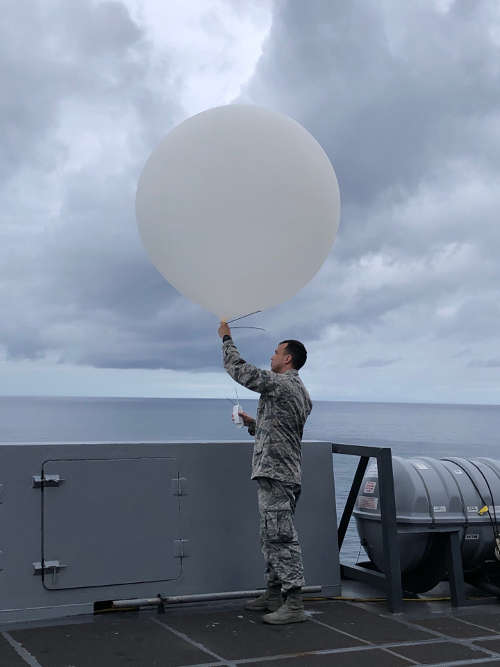
About five days before splashdown, the Landing and Recovery team heads to a midway point between shore and where Orion is expected to land.
As the spacecraft approaches, the Navy ship with the team continues its approach. How close they can get — and how quickly they can get to the capsule — depends on the work of the Sasquatch team.
“We have locations ready two hours before splashdown, but anything could change,” Manning said. “Then we have to make real-time decisions and people need to move.”
Helicopters that capture valuable imagery during descent and landing take off about an hour before splashdown. These aircraft set their flight plans based on the latest information from the Sasquatch team.
Artemis I will be an uncrewed flight test of NASA’s Orion spacecraft, Space Launch System rocket, with the newly upgraded ground systems at Kennedy. During future Artemis missions, crew will be onboard. The recovery team intends to recover the crew and capsule within two hours of splashing down.
“Safety is absolutely very important,” Manning said. “We want to get as close as we can — far enough away that the recovery team is safe, but close enough that they can get there quickly.”
Jim Cawley works for NASA's Kennedy Space Center.
- Details
- Written by: Elizabeth Larson
On Friday, the Lake County Rodeo Association reported it had decided to cancel this year’s event, which had been set for July 10 and 11.
The association board of directors made the decision to cancel the 91st annual event after “much heartfelt discussion,” said President Adam Peters in a Friday statement.
“This decision has not come easily but with all the current restrictions in place due to the coronavirus pandemic we see no way to hold the rodeo this year,” Peters said.
Peters thanked the groups and local businesses that have made the rodeo possible over the years, including the California Cowboy Professional Rodeo Association, as well as the local barrel racing, team roping and queen competitions, and the children’s events for cutest cowpoke and mutton bustin’.
Peters said that the board believes that with a year to heal the communities from the impacts of the pandemic, the 91st annual Lake County Rodeo can be rescheduled and take place on July 9 and 10, 2021, at its usual location, the Lake County Fairgrounds in Lakeport.
“Our all-volunteer board, comprised of a variety of private residents of the county, takes great pride in bringing this community event to you every year,” Peters said.
Peters said they plan on returning with all the events connected to the rodeo – including the Saturday evening Rodeo Dance – plus great vendors in 2021.
The California Cowboy Professional Rodeo Association reported that several other rodeos have been canceled so far this season, but plans are still on for nearly 20 rodeo events between now and the association’s finals in September.
Email Elizabeth Larson at
- Details
- Written by: Elizabeth Larson
Lake County and other parts of northwest California remain under a hazardous weather watch through next week.
Forecasters said there are chances of rain during the day on Saturday, with a 100-percent chance on Saturday night.
Rainfall totals on Saturday night are estimated at between a quarter and a half an inch, and between a tenth and quarter of an inch on Sunday, according to the forecast.
Thunderstorms are possible on Sunday and Sunday night, as well as on Monday morning, with more rain expected on Monday night and into Tuesday. Conditions are then forecast to clear until Friday.
Winds of up to 14 miles per hour are forecast on Saturday and Sunday, with gusts of above 20 miles per hour on Monday.
Daytime temperatures will range from the high 50s to high 60s through Wednesday, rising into the low 70s on Thursday and Friday. Nighttime temperatures will range from the low 40 to low 50s.
Email Elizabeth Larson at
- Details
- Written by: Lake County News reports
“We continue to recommend that you follow local shelter in place orders and recreate close to home,” Mendocino National Forest Supervisor Ann Carlson said. “All visitors should practice self-sufficiency during their visit to the Mendocino National Forest. Recreating responsibly will help ensure that expanded access to recreational facilities, services, and opportunities continues. All services may not be available, so please plan accordingly.”
Responsible recreation practices include:
• Maintaining at least 6 feet distancing from others.
• Not gathering in groups and following the latest guidance from officials.
• Communicating with others as you pass, alerting users of your presence and stepping aside to let others pass.
• Packing out your trash and leaving with everything you bring in and use.
• Bringing your own water, soap, sanitizer and toilet paper.
Please check the forest website and social media pages for the most up-to-date information on what is open so that you can plan your visit. You can call the Supervisor’s Office at 530-934-3316 during regular business hours Monday through Friday, 8 a.m. to 4:30 p.m.
The following sites will open on the Mendocino National Forest beginning Saturday, May 16:
Grindstone – open:
OHV trails
Boating sites
Sacramento River Boat Launch and Day Use Area
Campgrounds
Davis Flat – OHV
Fouts – OHV
Kingsley Glade
Little Stony – OHV
Mill Creek – OHV
Mill Valley – OHV
North Fork – OHV
Old Mill – OHV
Rocky Cabin
South Fork – OHV
Sugarfoot
Sugar spring
Three Prong
Toomes Camp
Whitlock
Group campgrounds
Grey Pine – OHV
Info site/fee station
Wolf Creek Vis – OHV
Interpretive site
Firefighter memorial
Nye cabin site
Upper Lake OPEN
Pine Point Picnic Area
Covelo OPEN
Hammerhorn Lake Day Use Area and Campground
Eel River Campground
Howard Meadow CG
Howard Lake CG
Little Doe
Atchison Campground
Closed recreation sites:
Grindstone Ranger District
Camp Discovery Group Camp
Masterson Group Camp
Plaskett Meadows Campground and Day Use Area
Sycamore Grove Campground
Wells Cabin Campground
West Crockett Campground
Upper Lake Ranger District
Bear Creek Campground
Deer Valley Campground
Fuller Grove Campground
Middle Creek Campground
Navy Campground
Oak Flat Campground
Penny Pines Campground
Pine Mountain Lookout Rental Cabin
Pogie Point Campground
Sunset Campground
The following remain closed by the Ranch fire, Forest Order No. 08-20-02:
Cedar Camp
Dixie Glade
Main Letts Lake
Saddle Camp Loop
Spillway
Stirrup
Big Springs
Summit Springs Th
Various OHV trails on Upper Lake Ranger District
For more information, visit the Mendocino National Forest on the Web, Facebook or Twitter.