How to resolve AdBlock issue?
News
- Details
- Written by: Elizabeth Larson
The meeting will take place via webinar beginning at 6 p.m. Tuesday, June 16.
The agenda can be found here.
To speak on an agenda item, access the meeting remotely here or join by phone by calling 213-929-4221 or toll-free, 877-309-2074. The access code is 723-557-820; the audio pin will be shown after joining the webinar. Those phoning in without using the web link will be in “listen mode” only and will not be able to participate or comment.
Comments can be submitted by email to
Please indicate in the email subject line "for public comment" and list the item number of the agenda item that is the topic of the comment. Comments that read to the council will be subject to the three minute time limitation (approximately 350 words). Written comments that are only to be provided to the council and not read at the meeting will be distributed to the council prior to the meeting.
A closed session will be held at 5:30 p.m. to discuss labor negotiations with the city manager and with unrepresented employees.
During the meeting, the council will present a proclamation honoring Chief Building Official Tom Carlton on his retirement from the city after 20 years of dedicated service to the community.
On Tuesday, staff will ask the council to authorize City Manager Margaret Silveira to execute a professional services agreement with SSA Landscape Architects Inc. for the planning, design, engineering and project management of the seven-acre lakefront park project, located at the former Natural High School property on North Main Street.
Assistant City Manager Kevin Ingram’s report to the council explained that the city received 13 proposals and ultimately chose SSA, which a selection committee determined to be the most qualified firm.
“Staff recommends the City Council authorize the City Manager to negotiate costs and select a firm for the design of the Lakefront Park,” Ingram wrote in his report.
In other business, Police Chief Brad Rasmussen will present a report regarding his agency’s policies and procedures that’s being provided in light of current national events, and Ingram will offer a resolution declaring dry weeds, brush and similar vegetation creating a fire hazard upon lands throughout the city to constitute a public nuisance in order for staff to be able to use the administrative citation procedures outlined in Chapter 8.30 of the Lakeport Municipal Code to abate said public nuisance weeds.
Also on Tuesday, the council will consider adopting a resolution and authorize the city manager to submit the Local Early Action Planning Grant, will consider authorizing the city manager to develop, maintain and revise a Lakeport Community Center Facility Rental Policy and adopt a resolution approving use and rental fees for the Lakeport Community Center, and discuss classification and salary schedule updates relating to the classifications for Public Works superintendent and building inspector, and revising of the master pay schedule.
On the consent agenda – items considered noncontroversial and usually accepted as a slate on one vote – are ordinances; minutes of the regular meeting of June 2 and the special meeting of June 9; confirmation of the continuing existence of a local emergency for the Mendocino Complex fire; confirmation of the continuing existence of a local emergency for the February 2019 storms; confirmation of the continuing existence of a local emergency for the October 2019 public safety power shutoff; confirmation of the continuing existence of a local emergency for the COVID-19 public health emergency; the June 9 warrant register; adoption of a resolution
accepting construction of the Library Park Seawall Replacement Project by West Coast Contractors Inc. and authorize the filing of the notice of completion; approval and authorization for the city manager to execute the professional services agreement with Polestar Computers for the provision of IT support services; approval and authorization for the city manager to execute the professional services agreement with NHA Advisors LLC; approval and authorization for the city manager to execute the professional services; rejection of all bids for the 2020 Sewer Main Replacement Project because doing so best serves the interests of the city; introduce the proposed ordinance to the Lakeport Municipal Code and schedule a
public hearing for July 14, 2020; and adoption of a resolution approving the Compensation and Benefits Program for the City of Lakeport Unrepresented Employees for the period of July 1, 2020 through June 30, 2021.
Email Elizabeth Larson at
- Details
- Written by: Elizabeth Larson
The board will meet virtually beginning at 9 a.m. Tuesday, June 16, in the board chambers on the first floor of the Lake County Courthouse, 255 N. Forbes St., Lakeport.
The meeting can be watched live on Channel 8, online at https://countyoflake.legistar.com/Calendar.aspx and on the county’s Facebook page. Accompanying board documents, the agenda and archived board meeting videos also are available at that link.
Because the meeting will be held virtually, members of the public are asked to submit comments on items to
In an untimed item that is the result of a discussion from last week’s meeting, the board will consider an urgency ordinance to establish temporary compliance officers to assist local businesses and members of the public in the gradual reopening of Lake County during the continuing public health emergency.
That ordinance will include assessing administrative fines for those who violate state and local public health orders.
At 11 a.m., the board will hold a public hearing to consider the Fiscal Year 2020-2021 Recommended Budget.
In other business, at 10 a.m. the board will consider the draft Lake County Housing Element and at 10:30 a.m. will hold a public hearing to consider a proposed two year extension to the Valley Oaks Subdivision vesting tentative subdivision map.
The full agenda follows.
CONSENT AGENDA
5.1: Approve addition of special meeting to the board’s annual meeting calendar for 2020.
5.2: Approve to waive the 900 hour extra help limit for Samuel Euston, senior videographer, for Fiscal Year 2019-20.
5.3: Adopt resolution establishing 2020-2021 appropriations limit for the county of Lake and Special Districts governed by the Board of Supervisors.
5.4: (a) Waive the formal bidding process, pursuant to the Lake County Code Section 38.2, as it is not in the public interest due to the unique nature of goods or services; and (b) approve the agreement between the county of Lake and Hardeep Singh, MD to fulfill the responsibilities of the substance use disorder medical director for Fiscal Year 2020-21 for a contract maximum of $90,000 and authorize the board chair to sign.
5.5: (a) Waive the formal bidding process, pursuant to Lake County Code Section 38.2, as it is not in the public interest due to the state of emergency: and (b) approve first amendment to the agreement between the county of Lake and CrackerJack Cleaning LLC for the cleaning of the Child Support office at 3980 Gard St., Kelseyville, for Fiscal Year 20-21 for a maximum increase of $26,400 and authorize the board chair to sign the agreement.
5.6: Approve resolution of the city council of the city of lakeport calling for and providing for and giving notice of the general municipal election to be held in the city of Lakeport, county of Lake, state of California, on the third day of November, 2020, for the purpose of electing three (3) city council members, each to hold office for a term of four years, or until their successors are elected and qualified, requesting consolidation of that election with the state general election and requesting approval of the Lake County Board of Supervisors for election services to be provided by the Lake County Registrar of Voters.
5.7: Adopt resolution approving the AIDS Drug Assistance Program site enrollment agreement between the California Department of Public Health and the county of Lake Health Services department for Fiscal Years 2020-2023 and authorize the Health Services director to sign.
5.8: Approve contract between the county of Lake Health Services and Sheila McCarthy for occupational therapy services in support of the California Children’s Services Program and the Medical Therapy Program for a term starting July 1, 2020, through June 30, 2021, and a maximum amount of $33,436.80; and authorize the board chair to sign.
5.9: Approve agreement amendment between the county of Lake Health Services Department and Sheila McCarthy, occupational therapist to increase total hours worked and total compensation for contracted occupational therapy services in support of the California Children’s Services Program and the Medical Therapy Program and authorize the board chair to sign.
5.10: Approve the continuation of local health emergency related to the 2019 Coronavirus (COVID-19) as proclaimed by the Lake County Public Health office.
5.11: Approve the continuation of a local emergency due to the Mendocino Complex Fire Incident (River and Ranch fires).
5.12: Approve the continuation of a local emergency due to the Pawnee fire Incident.
5.13: Approve the continuation of a local emergency due to COVID-19.
5.14: (a) Approve rental agreement between the county of Lake and Paul and Shery Loewen for Hangar No. 1 at Lampson Field for the Monthly Amount of $300, and authorize the chair to sign; and (b) approve the rental agreement between the county of Lake and Paul and Shery Loewen for Hangar No. 2 at Lampson Field for the monthly amount of $500 and authorize the chair to sign.
5.15: Adopt resolution to amend the Adopted Budget for FY 2019/2020 Fund 168 Budget Unit 5011 Social Services Administration by appropriating unanticipated revenue in the amount of $100,000 awarded to Lake County for COVID-19 non congregate sheltering and authorizing the Social Services director to sign award related documents.
5.16: (a) Approval of agreement with International Business Information Technologies Inc; (b) waive the formal bidding process, pursuant to Lake County Code Section 38.2, as it is not in the public interest due to the unique nature of goods or services and (c) authorize the sheriff/coroner or his designee to sign the agreement.
TIMED ITEMS
6.1, 9:01 a.m.: Public input.
6.2, 9:02 a.m.: Consideration of update on COVID-19.
6.3, 9:45 a.m.: Consideration of continuation of a local health emergency and order prohibiting the endangerment of the community through the unsafe removal, transportation, and disposal of fire debris for the Mendocino Complex fire.
6.4, 10 a.m.: Public hearing, consideration of the Draft Lake County Housing Element as an interim housing element to bring Lake County back into compliance with state regulations.
6.5, 10:30 a.m.: Public hearing, consideration of Valley Oaks Subdivision Vesting Tentative Subdivision Map Extension, SDX 19-02.
6.6, 11 a.m.: Public hearing, a) consideration of the Fiscal Year 2020-2021 Recommended Budget; b) consideration of the proposed resolution amending the position allocation chart for Fiscal Year 2020-2021 to conform to the recommended budget; and c) consideration of authorization for affected department heads to proceed with purchasing selected capital assets prior to the adoption of the Fiscal Year 2020-2021 Final Recommended Budget.
UNTIMED ITEMS
7.2: Consideration of update to return to work protocol.
7.3: Consideration of a resolution amending Resolution No. 2020-32, revising and extending the county of Lake COVID-19 interim policy for working remotely.
7.4: Consideration of urgency ordinance establishing temporary compliance officers to assist local businesses and members of the public in the gradual reopening of Lake County during the continuing public health emergency and to provide a process for the assessment of administrative fines for violators of state and local public health orders.
7.5: Consideration of resolution of the Board of Supervisors of the county of Lake, state of California, authorizing the Konocti Unified School District to Issue its Konocti Unified School District general obligation bonds, election of 2016, Series 2020.
Email Elizabeth Larson at
- Details
- Written by: Elizabeth Larson
NORTHERN CALIFORNIA – As the nation continues to respond to the killing of George Floyd, members of Congress are presenting legislation meant to help dismantle racism, racial inequality and systemic injustice.
Bay Area Congresswoman Barbara Lee is helping lead the charge on a package of bills meant to address racial inequality and its broader social impacts.
One of the key efforts is Lee’s legislation to establish the first United States Commission on Truth, Racial Healing and Transformation.
It’s an approach that Lee said 40 other countries – including Rwanda – have taken to transform their countries by effecting social change and addressing racial disparities.
Lee’s announcement on the legislation said the commission’s purpose is to properly acknowledge, memorialize and “be a catalyst for progress toward jettisoning the belief in a hierarchy of human value based on race, embracing our common humanity and permanently eliminating persistent racial inequities.”
She said the commission will examine the effects of slavery, institutional racism, and discrimination against people of color, and how history impacts laws and policies today.
Members of Congress included in the coalition signing on to support the legislation include Rep. John Lewis (GA-05), a legendary Civil Rights leader; Rep. Karen Bass (CA-37), chair of the Congressional Black Caucus; Rep. Deb Haaland (NM-01), co-chair of the Congressional Native American Caucus; as well as Congressman Mike Thompson (CA-05), who represents the southern portion of Lake County.
Lee discussed the proposal and answered questions from North Coast residents during a virtual June 4 town hall meeting hosted by Thompson, her colleague and longtime friend, and a co-author of the legislation.
Lee and Thompson have served in government beginning with their time in the California Legislature. Both were elected to Congress in 1998.
Thompson’s virtual town hall on June 4, one in a series that has been used to discuss current issues, focused on Floyd’s killing, which he said “has rocked the nation, from one corner of the country to another.”
He said it’s a reminder about the discrimination that some people in the community face every day and, for the rest, a reminder that we need to do a better job.
During the discussion, he recounted how a member of his own staff, who is Asian American, told him recently about an encounter with an individual who acted in a bigoted and threatening way toward her in a store.
Bigotry and prejudice, he said, are "alive and well in every corner of my district, in your district, in this country and people are real quick to point out that that it's not them but it's there. It is absolutely there. We see it all the time."
Thompson said he and his colleagues have been discussing providing legislative responses to fix some of these systemic problems that have been plaguing the United States.
“I’m heartened that our colleagues are focused on this and they want to do something,” he said.
He added, “Congressional action is going to happen and it’s going to happen quick.”
In addition to working on legislation to collect data on bad cops, Thompson said they will also focus on areas including education, justice and civil rights, health care, labor and employment, and housing.”
On Monday, the Justice in Policing Act was introduced, with Thompson an original coauthor. The bill includes four main categories to allow for structural change that will begin the process of reforming policing nationwide. Thompson’s office said the bill includes accountability for police through the judiciary; improved transparency, widespread changes to the training programs that will address bias, ban practices such as chokeholds, and change the use of force standards; and making lynching a federal crime.
On Thursday Lee also reintroduced a bill to remove Confederate statues from the US Capitol.
A convergence of injustices
During the June 4 town hall – the same day that Lee’s legislation to create the Commission on Truth, Racial Healing and Transformation was formally introduced, with 114 cosponsors – Lee recounted how that when she and Thompson were in the California Legislature, they started the California Commission on the Status of African American Males, the first commission of its kind in the United States.
They worked on that effort for seven years, studying gaps and disparities in health care, and coming up with specific policy recommendations on what to do in California, which has one of the biggest prison populations.
“I hope people resurrect that here in California because we did quite a bit of work on that,” said Lee.
Despite this being a moment when people are sad and angry, “I see a lot of hope with our young people,” said Lee, describing protesters of different backgrounds and races coming together to call for change, not a return to the old ways.
“The old ways for some of us have been deadly,” she said.
At the same time, Lee said the black community is in a counter pandemic, with blacks dying at higher rates of COVID-19. She said the health system has been discriminatory and blacks have higher rates of underlying conditions.
African Americans and Latinx people also tend to be essential frontline workers and so more exposed to the virus, she said.
“We’re at that moment, that moment where we see a convergence of all of these injustices coming together,” she said.
In response, she and her colleagues are putting forward a package of bills that include her commission, as well as legislation to promote accountability and transparency for police departments, and a bill to establish the Commission on the Social Status of Black Men and Boys.
“Forty countries have done it, we’ve never done it,” she said of her proposed commission, explaining that most people don’t understand what has taken place when it comes to slavery and a wide range of other human rights violations against groups including Native Americans and Chinese immigrations.
She said many people also don’t see the connection between the past and historical context and George Floyd’s murder.
Lee was asked by a member of the virtual audience about how she would measure progress in reducing racism and discrimination in the United States.
She said that first it would be measured in a reduction of deaths involving police and health disparities, expunging records of African Americans and Latinx young people disproportionately impacted by marijuana arrests and offering them restorative justice, and seeing more of the tech industry include African Americans.
“The measurements would be clear. We would see more racial equity everywhere in the country and we would see less discrimination,” she said.
Lee also noted the huge wealth gap, with measures of success to include seeing more of the country’s low-wage workers making a living wage that allows them to take care of their families.
“So there are clear measures that we could see and it wouldn't take long if in fact we have the political will to do this,” Lee said.
In her final comments, Lee noted that the essence of patriotism is “liberty and justice for all.”
“I think we’re witnessing the birth of a new nation,” she said.
Email Elizabeth Larson at
- Details
- Written by: Kathleen Scavone
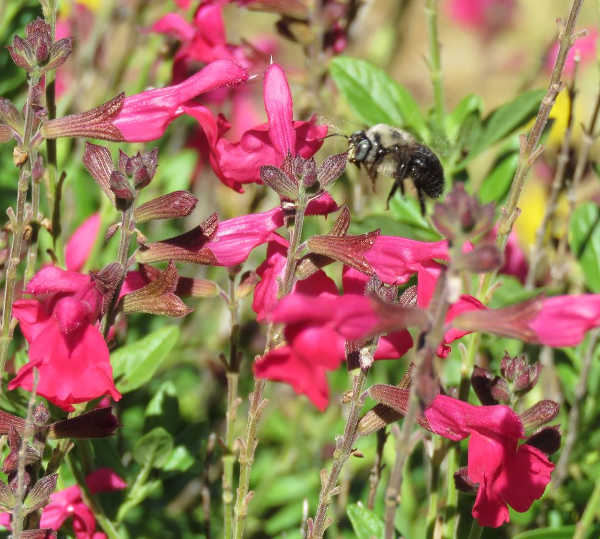
LAKE COUNTY, Calif. – Like so many others sheltering at home lately, I find myself looking more closely at flowering plants whether they grow in the garden or are found in the wild.
Each flower is like a cup of light, illuminating miniature worlds occurring on the asterisks of honeysuckle or within the nectary of a bright blue Ithuriel's spear inflorescence.
I've been taking a number of classes online, via Zoom, such as the free webinars offered by Sonoma State University's Center for Environmental Inquiry, California Native Plant Society and also by Pepperwood Preserve, etc.
In the webinar, "A Match Made in Evolution: Plants and Pollinators" presented by professional botanist and instructor of botany at Santa Rosa Junior College and Napa Valley College, Caprice Disbrow discussed the diversity and evolution of California native plants.
The up-close-and-personal relationships between flowering plants and their pollinators happen all around us during this time of profuse flowering, and presents a free show entailing both active and passive pollination.
Then, as Darwin outlined in his publications, the special coevolution between flowering plants and pollinators continues with the transfer of pollen grains from an anther to the stigma of each flower.
We all know that the great Central Valley is the fruit basket of the country, and without plant pollination, a significant portion of which occurs by honey bees, we would not eat as well as we do.
Our own gardens' zucchinis, tomatoes and peppers profit from the most critical events of their flowering lives with the help of a variety of native bees, honey bees, butterflies, wasps, beetles and birds' assistance.
Moths and bats also get in on the action of pollination, but they visit during the night hours when they scope out flowers that contain long corolla tubes and are, usually, white in color.
Mother nature did not waste energy providing night-blooming flowers with color, however, when they open during the night their scents attract many pollinators.
The California native soap plant is one such plant. Although plenty of passive pollination in plants occurs via wind or water, over time plants evolved from simple structures to those that encouraged pollination by insects. The pollen transfers in those cases proved to be more efficient and less pollen was needed.
Several differing methods of pollination evolved over time with generalist pollinator plants developing which encouraged a variety of insects to visit such as the aforementioned bees, butterflies, wasps, beetles, etc.
The generalist pollinators developed strategies for proliferating with colorations such as yellow, white, green-tinted and scented flowers.
Along with generalist pollinators there are those that specialize in order to invite hummingbirds and other visitors to sip their nectar and which, while the bird is imbibing on a treat, they also provide a pollen transfer service.
Now botanists know that bees can see ultraviolet along with yellow and blue pigments, and butterflies are also endowed with photoreceptors that allow them to see in ultraviolet.
This specialized behavior encouraged floral traits to occur over time as they were driven by natural selection between pollinator and plant.
To encourage native pollinators, Bay Nature Magazine recommends planting a garden incorporating wildflowers that are native to our area.
It's important to select flowers with differing sizes and shapes and those with staggered bloom times. Bees are especially attracted to the colors yellow, white, blue and purple.
You may want to think of leaving a portion of the garden bare to encourage beneficial ground-nesting bees, and of course, steer clear of pesticides and herbicides.
Kathleen Scavone, M.A., is a retired educator, potter, freelance writer and author of “Anderson Marsh State Historic Park: A Walking History, Prehistory, Flora, and Fauna Tour of a California State Park” and “Native Americans of Lake County.”