 How to resolve AdBlock issue?
News
- Details
- Written by: Lake County News reports
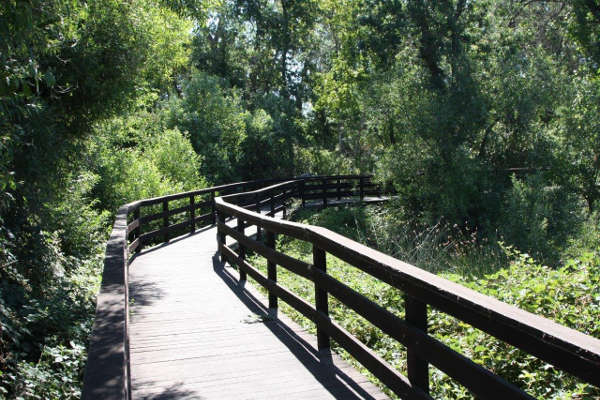
LOWER LAKE, Calif. – Anderson Marsh Interpretive Association has received a grant that will help it purchase materials necessary to repair the boardwalk on the Cache Creek Nature Trail located at Anderson Marsh State Historic Park.
Part of the cost of the materials is being provided by a $5,000 “Keeping Parks Whole” grant that AMIA has received from the California State Parks Foundation, a member-supported nonprofit that works to create support for California state parks.
“Critical funding from state resources as well as revenue generated from park visitation has been greatly jeopardized by the COVID-19 crisis, and this impact has been felt by park partners who provide financial, educational, and programmatic resources to the community,” said California State Parks Foundation Executive Director Rachel Norton. “Supporting partners like Anderson Marsh Interpretive Association with our Keeping Parks Whole Grant ensures Anderson Marsh State Historic Park will remain protected while also preparing a safe and welcoming experience when the park fully reopens.”
“The iconic wooden boardwalk on the Cache Creek Nature Trail allows access to the Cache Creek habitat at the Park, home to unique flora and wildlife,” explained Henry Bornstein, AMIA treasurer. “Due to the lack of funding, the boardwalk is suffering from serious deferred maintenance and unless repaired, it could become unavailable for guided nature walks and public-school field trips when the park fully reopens. AMIA thanks the California State Parks Foundation for its financial support.”
The repair work will be done by State Parks maintenance personnel using the materials donated by AMIA.
“California State Parks appreciates the ongoing help and support of our partner Anderson Marsh Interpretive Association,” said Park Maintenance Chief Wendy Lieberg. “In times of need, they are always there to help keep the park safe and maintained.”
In compliance with current COVID-19 guidelines, guided public tours at Anderson Marsh State Historic Park have been temporarily suspended. All of the hiking trails, however, remain open and available to the public.
Roberta Lyons, AMIA president, noted that “getting some outdoors exercise has been shown to reduce the stress that we are all now experiencing. AMIA invites the public to take advantage of the opportunity to get into nature and take a walk in the park, while observing recommended guidelines regarding social distancing, face coverings and hygiene.”
Anderson Marsh State Historic Park is located off of Highway 53 between Lower Lake and Clearlake and is open to the public during daylight hours.
More information about hiking at the Park can be found at www.andersonmarsh.org or by calling AMIA at 707-995-2658.
- Details
- Written by: Elizabeth Larson
The Lake County Public Health COVID-19 dashboard showed on Friday that cases had risen to 140, up by three over the previous day.
Of those 140 cases, 36 are active, 103 are recovered and one has died, Public Health reported.
On Friday night, COVID-19 cases statewide totaled more than 371,000 with nearly 7,600 deaths, based on a compilation of data posted online by county public health departments.
Lake’s neighboring counties had the following case totals on Friday night: Colusa, 173; Glenn, 214; Mendocino, 177; Napa, 583; Sonoma, 2,068; and Yolo, 1,101
Lake County Public Health said three local patients currently are hospitalized and there have been a total of 12 hospitalizations for Lake County COVID-19 patients.
Tests to date total 5,770, including the 140 positive cases and 5,630 negative test results, Public Health reported.
The California Department of Public Health said Friday that 6,044,099 tests have been conducted in California, an increase of 128,591 over the prior 24-hour reporting period.
The state said local health departments have reported 18,857 confirmed positive cases in health care workers and 105 deaths statewide.
Lake County’s daily variance metrics show that it has a case rate of 67.8 per 100,000 for a 14-day period, with a 2.9 percent positivity rate – down from 4 percent earlier in the week – and an average of 159.4 tests per day.
As for hospital bed availability, 48.6 percent of medical/surgical beds and 25 percent of ICU beds are available, and 95 percent of the county’s ventilators are free.
On Friday, both Lake County’s hospitals had more than a 14-day supply of personal protective equipment on hand, Public Health said.
Email Elizabeth Larson at
- Details
- Written by: LAKE COUNTY NEWS REPORTS
“Learning is non-negotiable,” said Gov. Newsom. “The virus will be with us for a year or more, and school districts must provide meaningful instruction in the midst of this pandemic. In California, health data will determine when a school can be physically open – and when it must close – but learning should never stop. Students, staff, and parents all prefer in-classroom instruction, but only if it can be done safely.”
The governor’s plan centers on the following five key areas.
1. Safe in-person school based on local health data
The California Department of Public Health today issued updated schools guidance that includes using existing epidemiological metrics to determine if school districts can start in-person instruction.
CDPH currently uses six indicators to track the level of COVID-19 infection in each California county as well as the preparedness of the county health care system – data that includes the number of new infections per 100,000 residents, the test positivity rate, and the change in hospitalization rate, among others.
Any county that does not meet the state’s benchmarks is put on the County Monitoring List.
Schools located in counties that are on the Monitoring List must not physically open for in-person instruction until their county has come off the Monitoring List for 14 consecutive days.
Schools in counties that have not been on the Monitoring List for the prior 14 days may begin in-person instruction, following public health guidelines.
School community members – including parents, teachers, staff and students – can track daily data on whether and why their county is on the Monitoring List here.
There is a single exception. Local health officers may grant a waiver to allow elementary schools to reopen in-person instruction if the waiver is requested by the district superintendent, in consultation with labor, parents and community-based organizations.
When considering a waiver request, the local health officer must consider local data and consult with the California Department of Public Health.
The department also issued updated guidance for when schools must physically close and revert to distance learning because of COVID-19 infections.
Following a confirmed case of a student who was at school during his or her infectious period, other exposed students and staff should be quarantined for 14 days. The school should revert to distance learning when multiple cohorts have cases or 5 percent of students and staff test positive within a 14-day period. The district should revert to distance learning when 25 percent or more of its schools have been physically closed due to COVID-19 within 14 days.
Closure decisions should be made in consultation with local health officers. After 14 days, school districts may return to in-person instruction with the approval of the local public health officer.
2. Strong mask requirements for anyone in the school
In the updated guidance, all staff and students in third grade and above will be required to wear a mask or face covering. Students in second grade and below are strongly encouraged to wear a face covering. Students should be provided a face covering if they do not have one. The state has delivered over 18 million face coverings to schools to support them to reopen and ensure all students can participate in learning.
3. Physical distancing requirements & other adaptations
In the updated guidance, CDPH requires that all adults stay 6 feet from one another and 6 feet away from children, while students should maintain 6 feet of distance from one another as practicable. Anyone entering the school must do a health screen, and any student or staff exhibiting a fever or other symptoms will be immediately sent home. The guidance also provides that if anyone in a student or staff member’s household is sick, they too should stay home.
4. Regular testing and dedicated contact tracing for outbreaks at schools
The public health guidance recommends staff in every California school be tested for COVID-19 periodically based on local disease trends and as testing capacity allows. The governor also announced today that the state will provide resources and technical assistance for COVID-19 investigations in school settings.
5. Rigorous distance learning
Over the course of the pandemic, most schools will likely face physical closure at some point due to COVID-19. The Legislature and Gov. Newsom enacted a budget that provided $5.3 billion in additional funding to support learning, and set requirements to ensure schools provide rigorous and grade-appropriate instruction.
Under newly enacted state law, school districts are required to provide:
– Devices and connectivity so that every child can participate in distance learning.
– Daily live interaction for every child with teachers and other students.
– Class assignments that are challenging and equivalent to in-person instruction.
– Targeted supports and interventions for English learners and special education students.
The full guidance from the California Department of Public Health can be found here.
- Details
- Written by: Lake County News reports
The data showed there were 1,181 felony marijuana arrests in California in 2019, down 27 percent from 2018 (1,617 arrests) and the lowest number since 1954.
Hispanics accounted for 493 or 41.7 percent of arrests; Blacks for 263 (22.3%) and Whites for 252 (21.3%).
Males were 87.9 percent of those arrested for felonies, and juvenile felony arrests numbered 91.
Misdemeanor marijuana arrests were down slightly in 2019. They numbered 3,769, versus 3,835 in 2018.
Hispanics were even more disproportionately arrested for misdemeanors, coming in at 1,869 or 49.6 percent of arrests, with Blacks accounting for 509 arrests (13.5%) and Whites 837 (22.2%).
Again males were most often arrested for marijuana misdemeanors (78.1%) with females arrested 21.9 percent of the time.
Juvenile misdemeanor arrests totaled 1,209 or 32 percent of the total.
In an analysis of the findings, California NORML said that, weighting the arrest data by population – using 2018 California Census data: 36.6 percent, non-Hispanic white, 5.8 percent Black and 39.3 percent Hispanic) – means that arrest disparities went up slightly for each race versus whites compared to the previous year.
Blacks were 4.47 times more likely than whites to be arrested for a marijuana crime in California in 2019, versus 4.05 times as often in 2018; for Latinx people the arrest disparity versus whites rose to 2.02 times in 2019 versus 1.66 times in 2018, NORML said.
A recent report by the ACLU found persistent racial disparities in marijuana possession arrests in all US states, including California, from the years 2010 to 2018.
In addition, NORML said two recent reports drilled down on arrest rates in cities and neighborhoods in California, finding arrest disparities between blacks and whites as high as 30 times, and large increases in police budgets in some cities due to local taxes collected from the sales of cannabis following the passage of Proposition 64, which legalized recreational marijuana for adults in 2016.