 How to resolve AdBlock issue?
News
- Details
- Written by: Kathleen Scavone
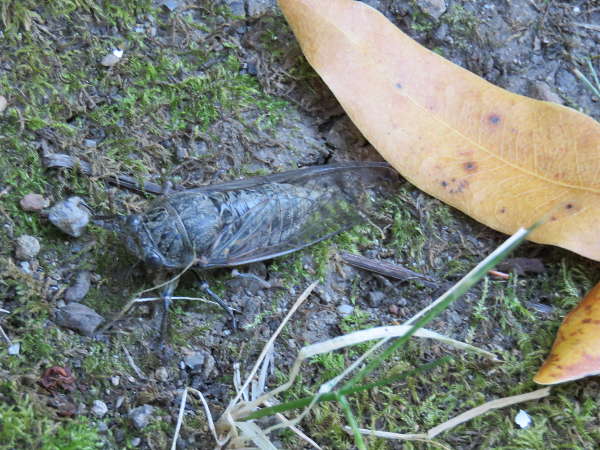
LAKE COUNTY, Calif. – Their humming, thrumming, clicking sounds provide a summer soundtrack on warm days.
When I happened upon a cicada under a bay tree, I immediately brightened and searched around for more. I thought, "That's right! The cicadas are emerging from their 17-year hideouts!"
After a quick web search I realized my mistake. Here in California where there are 65 species of cicadas, we won't meet up with the throngs of bugs brought out of 17 years of hiding, but instead will find cicadas in smaller numbers who emerge annually.
Cicadas in California begin their egg-to-nymph-to-adult life cycles beginning with around 400 eggs which have been laid in, or on tree branches.
Next, nymphs hatch by ascending a tree trunk to shed their now useless skins, then burrow underground to dine on the juicy plant roots found there. They will surface from their burrows beneath the earth every year.
Cicadas can use the sound produced by their wings to attract a mate. After mating they scope out a willow, oak or madrone bough on which to lay their eggs. Watch for the distinctive diagonal blemishes left behind on branches they have selected.
According to the University of California Press publication, “The Cicadas of California,” here in Lake County we can find eight kinds of cicadas as reported to them through county records.
These alien-looking creatures have prominent, OK, I'll say it – bug eyes – and are considered a superfamily called Cicadoidea, who have “cousin” species around the world numbering in the thousands.
Like dragonflies, they have been in existence for millions of years. According to fossil records, cicadas are known to have existed since the Upper Permian period.
It is believed that the mysterious breeding cycle of the Southern United States' 17-year cicada is due to, what else? Self-preservation. In order to evade predators who eat these bugs, they have “figured out” how to emerge every 17 years. Then, around 1.5 million hungry cicadas per acre will participate in the phenomenon.
These southern cicadas, although not as destructive as locusts, are still voracious and impressive in both their noise and appetites.
Entomologists report that besides the din of millions of cicada's chirps and clicks that are used by males of the species to garner a mate, these cicadas are poised to drink the sap of trees and can be quite destructive in large numbers.
Cicadas have many predators: squirrels, wasps, bats, birds, spiders and more.
If you look, you will find cicadas featured throughout mythology, art and music. These humble creatures were portrayed in Aristotle's “History of Animals,” in the Japanese novel, “The Tale of Genji” and in myths of many cultures, such as a myth known as “Kapampangan” from the Philippines.
In ancient Greece cicadas were consumed during meals, and their husks used in Chinese traditional medicine.
Since cicadas don't sting or bite, they deserve a closer look!
Kathleen Scavone, M.A., is a retired educator, potter, freelance writer and author of “Anderson Marsh State Historic Park: A Walking History, Prehistory, Flora, and Fauna Tour of a California State Park” and “Native Americans of Lake County.”
- Details
- Written by: Elizabeth Larson
In fall, motorists are encouraged to be particularly aware of wild animals on highways during mating season.
However, recent issues in Lake County and other parts of California are a reminder that bears are on the move throughout the year.
Last week, four bears were reported to be hit by cars in Yosemite National Park and in Truckee a bear walked onto a golf course during a PGA event.
Over the past month, there also have been extensive reports of issues with bears in and around Lassen National Park, where portions of the park were closed to camping due to foraging bears.
In Lake County, there have been isolated issues with bears during recent months.
On June 2 at about 6 p.m., the California Highway Patrol’s Clear Lake Area office received a call that a bear cub had been hit by a car on Highway 20 near Paradise Cove, according to CHP Officer Joel Skeen.
Then, on June 23, two vehicles hit a bear shortly before 10 p.m. on Highway 29 at Diener Drive near Lower Lake. Skeen said the bear was killed but the motorists were uninjured.
Skeen also noted that CHP took a call in the middle of the afternoon on June 22 involving a black bear walking on the beach in Glenhaven. He said that call was transferred to the California Department of Fish and Wildlife.
“I don’t recall the last time I’ve had a bear hit on the highway in Lake County,” said Josh Bush, the California Department of Fish and Wildlife unit wildlife biologist for Lake, Colusa and Yolo counties. “It is much more of an occurrence in Tahoe where the bears are much more habituated to people and there’s a larger density of bears.”
Bush said issues with bears – especially on Lake County’s Northshore, where they’re prevalent – is nothing new.
“I’ve had issues with bears in Glenhaven and Paradise Cove for the past seven years,” he said.
This year, however, has actually seen an overall decrease in bear-human issues locally, Bush said. “I got zero calls for that area, which is unusual.”
Bears are more common in the Northshore communities, Bush explained, because they’re adjacent to wildland and the Mendocino National Forest.
The narrow strip of houses along Northshore is more prone to bear incidents because it’s right up against the shoreline and the forest, he said.
In winter, the bears have cubs. Bush said the bears that call Lake County home don’t hibernate. “They do decrease their metabolic demands during the winter.”
When he’s seen bear problems with people, it is usually in the springtime. The recent issues with bears were a little later than normal, but Bush said they weren’t surprising because resources are drying up and the weather is hot.
He said they are looking for water and easy sources of food, like garbage and ripening fruit trees, cat food and birdseed.
In May 2019, a black bear that had climbed into a tree in a Lakeport neighborhood was safely removed after it was tranquilized with a chemical dart and then relocated to the South Cow Mountain area.
The following month, the California Department of Fish and Wildlife reported an uptick in bear activity across the state, with other urban bear incidents in Davis, Napa and Rohnert Park.
Bush said he previously captured a bear in Clearlake and moved it. “We will take them to the nearest suitable and available habitat,” he said. “They are adaptable.”
The bears are given ear tags and then wildlife officers let them go on their way. The bears aren’t taken so far away that the habitat would be foreign to them. “They do have the ability to come back,” he said, noting they can travel a long way. However, Bush said he hasn’t had an incident where a bear has returned to the same spot where it was captured.
Across his service area, Bush said Lake County typically has more bear-related issues.
Yolo hasn’t had historically had problems, Bush said, but then over recent years they had two situations with bears in the city of Davis and in the spring of this year a bear named Gilligan was hit on Highway 113.
There have been very few issues in Colusa County. One Bush referred to occurred in 2015, when a bear used the Sacramento River as a corridor and came out in downtown Colusa, where it was safely captured.
Fish and Wildlife says there are three regional black bear subpopulations in California: the North Coast/Cascade, the Sierra and Central Western/Southwestern.
The North Coast/Cascade area, which includes Lake County, covers the area north and west of the Sierra Nevada Mountains and is where about half of the state’s black bear population lives, the agency said.
There aren’t local or regional bear population counts, but Bush said the Department of Fish and Wildlife maintains a statewide estimate of between 25,000 and 36,000 animals, based on a population model.
All indications are that the bear population is rising, he said.
Black bears in California also are a hunted species, he said. “Their season opens concurrently with most general deer seasons,” with a statewide limit of 1,700 bears.
For more information visit the California Department of Fish and Wildlife’s Keep Me Wild page on bears.
Email Elizabeth Larson at
- Details
- Written by: Elizabeth Larson
Dogs available for adoption this week include mixes of Australian Shepherd, Belgian Malinois, border collie, chow chow, Labrador Retriever, Newfoundland, pit bull, shepherd and terrier.
Dogs that are adopted from Lake County Animal Care and Control are either neutered or spayed, microchipped and, if old enough, given a rabies shot and county license before being released to their new owner. License fees do not apply to residents of the cities of Lakeport or Clearlake.
The following dogs at the Lake County Animal Care and Control shelter have been cleared for adoption (additional dogs on the animal control Web site not listed are still “on hold”).
Call Lake County Animal Care and Control at 707-263-0278 or visit the shelter online at http://www.co.lake.ca.us/Government/Directory/Animal_Care_And_Control.htm for information on visiting or adopting.

Male Belgian Malinois
This male Belgian Malinois mix has a medium-length black and tan coat.
He is in kennel No. 4, ID No. 13862.

Male border collie
This young male border collie has a short tricolor coat.
He is in kennel No. 5, ID No. 13838.

‘Solito’
“Solito” is a male pit bull terrier with a black and white coat.
He is in kennel No. 6, ID No. 13839.

‘Oso Panda’
“Oso Panda” is a male border collie with a long black and white coat.
He is in kennel No. 7, ID No. 13840.

‘Manotas’
“Manotas” is a male German Shepherd-pit bull mix with a long black and brindle coat.
He is in kennel No. 8, ID No. 13841.
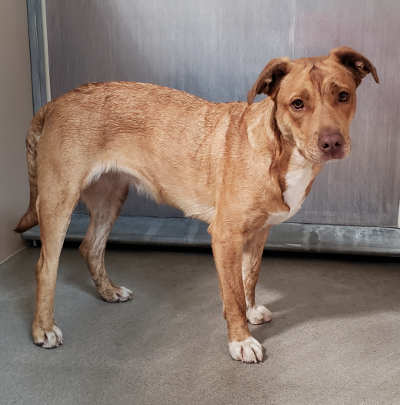
‘Pina’
“Pina” is a young female pit bull terrier with a short tan and brindle coat.
She is in kennel No. 9, ID No. 13842.

‘Luna’
“Luna” is a female German Shepherd with a medium-length black and tan coat.
She is in kennel No. 10, ID No. 13843.

Male pit bull terrier
This young male pit bull has a short brindle and white coat.
He is in kennel No. 14, ID No. 13831.

Female pit bull terrier
This young female pit bull terrier has a short brown and white coat.
She is in kennel No. 15, ID No. 13832.

Male pit bull terrier
This young male pit bull terrier has a short tan and white coat.
He is in kennel No. 16, ID No. 13833.

‘Lucy’
“Lucy” is a female terrier with a short black coat.
She is in kennel No. 21, ID No. 13830.

Pit bull terrier-hound mix
This young male pit bull terrier-hound mix has a short tricolor coat.
He is in kennel No. 23, ID No. 13861.

‘Mugsy’
“Mugsy” is a male pit bull terrier with a short tan and white coat.
He is in kennel No. 26, ID No. 13797.

‘Roscoe’
“Roscoe” is a male Newfoundland-Australian Shepherd mix.
He has been neutered.
He is in kennel No. 28, ID No. 13845.

Female Belgian Malinois
This female Belgian Malinois Shepherd has a short black and tan coat.
She is in kennel No. 31, ID No. 13793.

Male chow chow
This male chow chow has a medium-length black coat.
He is in kennel No. 33, ID No. 13795.
Email Elizabeth Larson at
- Details
- Written by: NATIONAL AERONAUTICS AND SPACE ADMINISTRATION
Taking advantage of a total lunar eclipse, astronomers using NASA's Hubble Space Telescope have detected Earth's own brand of sunscreen – ozone – in our atmosphere.
This method simulates how astronomers and astrobiology researchers will search for evidence of life beyond Earth by observing potential "biosignatures" on exoplanets (planets around other stars).
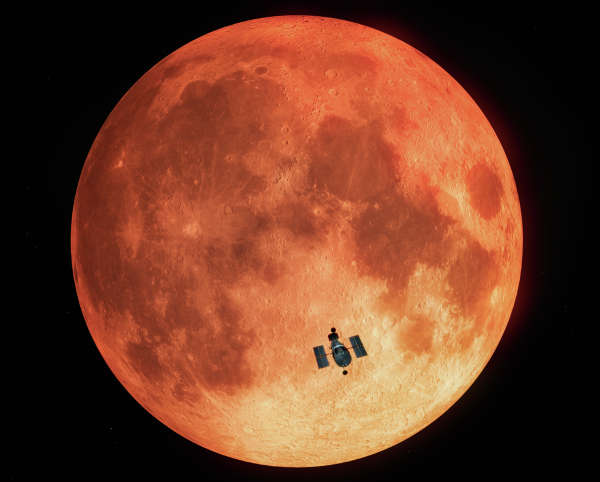
Hubble did not look at Earth directly. Instead, the astronomers used the Moon as a mirror to reflect sunlight, which had passed through Earth's atmosphere, and then reflected back towards Hubble.
Using a space telescope for eclipse observations reproduces the conditions under which future telescopes would measure atmospheres of transiting exoplanets. These atmospheres may contain chemicals of interest to astrobiology, the study of and search for life.
Though numerous ground-based observations of this kind have been done previously, this is the first time a total lunar eclipse was captured at ultraviolet wavelengths and from a space telescope. Hubble detected the strong spectral fingerprint of ozone, which absorbs some of the sunlight. Ozone is important to life because it is the source of the protective shield in Earth's atmosphere.
On Earth, photosynthesis over billions of years is responsible for our planet's high oxygen levels and thick ozone layer. That's one reason why scientists think ozone or oxygen could be a sign of life on another planet, and refer to them as biosignatures.
"Finding ozone is significant because it is a photochemical byproduct of molecular oxygen, which is itself a byproduct of life," explained Allison Youngblood of the Laboratory for Atmospheric and Space Physics in Boulder, Colorado, lead researcher of Hubble's observations.
Although ozone in Earth's atmosphere had been detected in previous ground-based observations during lunar eclipses, Hubble's study represents the strongest detection of the molecule to date because ozone – as measured from space with no interference from other chemicals in the Earth's atmosphere – absorbs ultraviolet light so strongly.
Hubble recorded ozone absorbing some of the Sun's ultraviolet radiation that passed through the edge of Earth's atmosphere during a lunar eclipse that occurred on January 20 to 21, 2019. Several other ground-based telescopes also made spectroscopic observations at other wavelengths during the eclipse, searching for more of Earth's atmospheric ingredients, such as oxygen and methane.
"One of NASA's major goals is to identify planets that could support life," Youngblood said. "But how would we know a habitable or an uninhabited planet if we saw one? What would they look like with the techniques that astronomers have at their disposal for characterizing the atmospheres of exoplanets? That's why it's important to develop models of Earth's spectrum as a template for categorizing atmospheres on extrasolar planets."
Her paper is available online in The Astronomical Journal.
Sniffing out planetary atmospheres
The atmospheres of some extrasolar planets can be probed if the alien world passes across the face of its parent star, an event called a transit. During a transit, starlight filters through the backlit exoplanet's atmosphere. (If viewed close up, the planet's silhouette would look like it had a thin, glowing "halo" around it caused by the illuminated atmosphere, just as Earth does when seen from space.)
Chemicals in the atmosphere leave their telltale signature by filtering out certain colors of starlight. Astronomers using Hubble pioneered this technique for probing exoplanets. This is particularly remarkable because extrasolar planets had not yet been discovered when Hubble was launched in 1990 and the space observatory was not initially designed for such experiments.
So far, astronomers have used Hubble to observe the atmospheres of gas giant planets and super-Earths (planets several times Earth's mass) that transit their stars. But terrestrial planets about the size of Earth are much smaller objects and their atmospheres are thinner, like the skin on an apple. Therefore, teasing out these signatures from Earth-sized exoplanets will be much harder.
That's why researchers will need space telescopes much larger than Hubble to collect the feeble starlight passing through these small planets' atmospheres during a transit. These telescopes will need to observe planets for a longer period, many dozens of hours, to build up a strong signal.
To prepare for these bigger telescopes, astronomers decided to conduct experiments on a much closer and only known inhabited terrestrial planet: Earth. Our planet's perfect alignment with the Sun and Moon during a total lunar eclipse mimics the geometry of a terrestrial planet transiting its star.
But the observations were also challenging because the Moon is very bright, and its surface is not a perfect reflector because it is mottled with bright and dark areas. The Moon is also so close to Earth that Hubble had to try and keep a steady eye on one select region, despite the Moon's motion relative to the space observatory. So, Youngblood's team had to account for the Moon's drift in their analysis.
Where there's ozone, there's life?
Finding ozone in the skies of a terrestrial extrasolar planet does not guarantee that life exists on the surface. "You would need other spectral signatures in addition to ozone to conclude that there was life on the planet, and these signatures cannot necessarily be seen in ultraviolet light," Youngblood said.
On Earth, ozone is formed naturally when oxygen in the Earth's atmosphere is exposed to strong concentrations of ultraviolet light. Ozone forms a blanket around Earth, protecting it from harsh ultraviolet rays.
"Photosynthesis might be the most productive metabolism that can evolve on any planet, because it is fueled by energy from starlight and uses cosmically abundant elements like water and carbon dioxide," said Giada Arney of NASA's Goddard Space Flight Center in Greenbelt, Maryland, a co-author of the science paper. "These necessary ingredients should be common on habitable planets."
Seasonal variability in the ozone signature also could indicate seasonal biological production of oxygen, just as it does with the growth seasons of plants on Earth.
But ozone can also be produced without the presence of life when nitrogen and oxygen are exposed to sunlight. To increase confidence that a given biosignature is truly produced by life, astronomers must search for combinations of biosignatures. A multiwavelength campaign is needed because each of the many biosignatures are more easily detected at wavelengths specific to those signatures.
"Astronomers will also have to take the developmental stage of the planet into account when looking at younger stars with young planets. If you wanted to detect oxygen or ozone from a planet similar to the early Earth, when there was less oxygen in our atmosphere, the spectral features in optical and infrared light aren't strong enough," Arney explained. "We think Earth had low concentrations of ozone before the mid-Proterozoic geological period (between roughly 2.0 billion to 0.7 billion years ago) when photosynthesis contributed to the build up of oxygen and ozone in the atmosphere to the levels we see today. But because the ultraviolet-light signature of ozone features is very strong, you would have a hope of detecting small amounts of ozone. The ultraviolet may therefore be the best wavelength for detecting photosynthetic life on low-oxygen exoplanets."
NASA has a forthcoming observatory called the James Webb Space Telescope that could make similar kinds of measurements in infrared light, with the potential to detect methane and oxygen in exoplanet atmospheres. Webb is currently scheduled to launch in 2021.