 How to resolve AdBlock issue?
News
- Details
- Written by: Elizabeth Larson
The council had held an initial discussion on the topic at its Aug. 6 meeting and directed City Attorney Ryan Jones to return with a draft ordinance, as Lake County News has reported.
The current monthly salary for council members is $300, an amount that Jones said was set in 1989.
While, by state statute, that’s the maximum amount for cities with a population of under 35,000, Jones told the council at its Aug. 6 meeting that the law allows for 5-percent annual raises.
As such, the council faced the option of raising the current monthly amount by $465 – which is the amount of a 5-percent raise over the past 31 years – to a total of $765.
However, at its last meeting, the council settled on a smaller total figure, $500.
On Thursday, Jones presented a draft ordinance with the $500 monthly amount.
He also reported that the law does not allow the council to set up an automatic 5-percent raise each year. The council would have to take separate action to do that in the future.
The current annual cost for the council members’ salaries totals $18,000. By raising it to $500 per month, the total cost would rise to $30,000. Jones’ report said the additional funds would come from the city’s general fund.
That amount does not include the cost of health coverage for council members. A specific figure for that was not included in Jones’ report.
Following Jones’ brief presentation, there was no council discussion before Councilman Phil Harris – who had asked last month for the matter to be brought forward for discussion – moved to approve it, with Councilman Russ Perdock seconding.
The vote was 4-1, with Vice Mayor Dirk Slooten voting against it. Slooten had made clear at the Aug. 6 meeting that he thought it was a bad time to raise council members’ salaries.
If the council approves the ordinance’s second and final reading at its next meeting, the ordinance and the salary increase will go into effect on Jan. 1, 2021.
Email Elizabeth Larson at
- Details
- Written by: Elizabeth Larson
The following dogs are ready for adoption or foster.

‘Bella’
“Bella” is a female American Bully mix.
She has a short beige and tan coat.
She is dog No. 3537.

‘Diesel’
“Diesel” is a male border collie mix with a black and white coat.
He is dog No. 4023.

‘Isis’
“Isis” is a female American Staffordshire Terrier mix with a brindle and white coat.
She is dog No. 3732.

‘Lady’
“Lady” is a female German Shepherd mix.
She has been spayed.
She is dog No. 3683.

‘Wilbur’
“Wilbur” is a male American Bully mix with a short gray and white coat.
He is dog No. 3999.
Clearlake Animal Control’s shelter is located at 6820 Old Highway 53, off Airport Road.
Hours of operation are noon to 4 p.m. Tuesday through Saturday. The shelter is closed Sundays, Mondays and major holidays; the shelter offers appointments on the days it’s closed to accommodate people.
Call the Clearlake Animal Control shelter at 707-273-9440, or email
Visit Clearlake Animal Control on Facebook or on the city’s website.
Email Elizabeth Larson at
- Details
- Written by: NATIONAL AERONAUTICS AND SPACE ADMINISTRATION
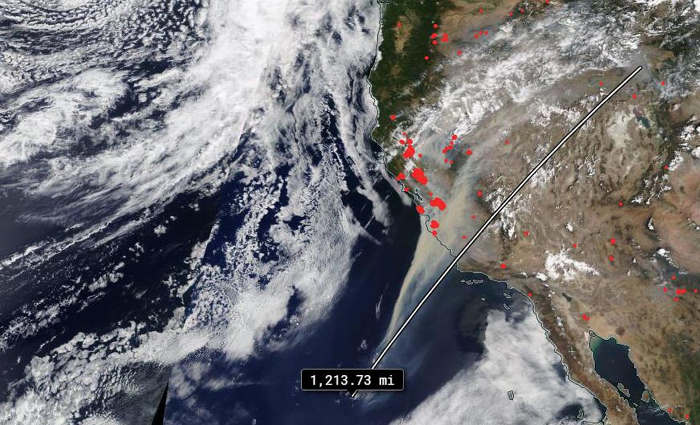
NASA's Terra satellite was able to capture the huge swath of smoke that has been generated by the California wildfires and dispersed by the winds surrounding those fires on Thursday, Aug. 20.
The NASA Worldview website has an application that can measure distances within the app and measuring this smoke trail showed the trail's northeast to southwest trail is approximately 1,214 miles long.
The smoke has moved as far north and east as Pocatello, Idaho and as far west and south as mid-Baja California, Mexico.
Although the smoke did not go into Baja California it has remained offshore over the Pacific Ocean.
Fire is devastating, and the effects of smoke on humans can also be devastating. The smoke released by any type of fire (forest, brush, crop, structure, tires, waste or wood burning) is a mixture of particles and chemicals produced by incomplete burning of carbon-containing materials.
All smoke contains carbon monoxide, carbon dioxide and particulate matter (PM or soot). Smoke can contain many different chemicals, including aldehydes, acid gases, sulfur dioxide, nitrogen oxides, polycyclic aromatic hydrocarbons (PAHs), benzene, toluene, styrene, metals and dioxins.
The type and amount of particles and chemicals in smoke varies depending on what is burning, how much oxygen is available, and the burn temperature. Exposure to high levels of smoke should be avoided.
Individuals are advised to limit their physical exertion if exposure to high levels of smoke cannot be avoided. Individuals with cardiovascular or respiratory conditions (e.g., asthma), fetuses, infants, young children, and the elderly may be more vulnerable to the health effects of smoke exposure.
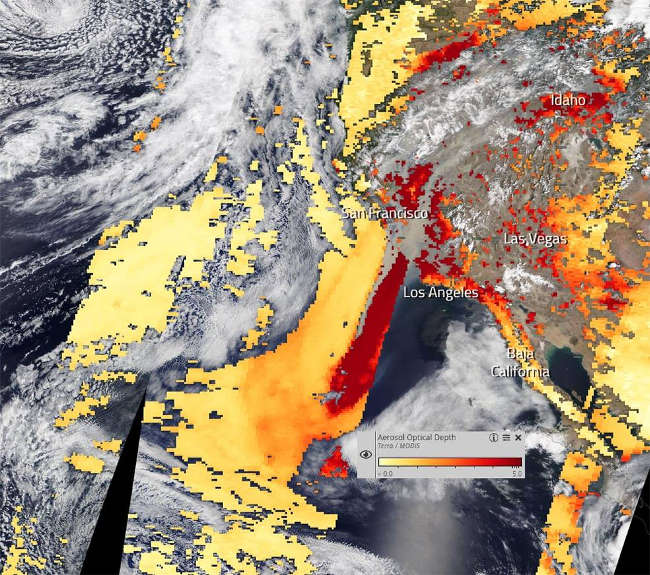
From the Worldview site: "Aerosol Optical Depth (AOD) (or Aerosol Optical Thickness) indicates the level at which particles in the air (aerosols) prevent light from traveling through the atmosphere. Aerosols scatter and absorb incoming sunlight, which reduces visibility. From an observer on the ground, an AOD of less than 0.1 is “clean” (lightest yellow) - characteristic of clear blue sky, bright sun and maximum visibility. As AOD increases to 0.5, 1.0, and greater than 3.0, aerosols become so dense that sun is obscured (ranging from yellow to dark red on the scale). Sources of aerosols include pollution from factories, smoke from fires, dust from dust storms, sea salt, and volcanic ash and smog. Aerosols compromise human health when inhaled by people, particularly those with asthma or other respiratory illnesses. Aerosols also have an effect on the weather and climate by cooling or warming the Earth, helping or preventing clouds from forming. Since aerosols are difficult to identify when they occur over different types of land surfaces and ocean surfaces, Worldview provides several different types of imagery layers to assist in the identification."
In the image below there are many areas that are completely obscured by smoke including Los Angeles, Las Vegas, parts of San Francisco and into Idaho, following along the trail of smoke from the fires and out into the Pacific Ocean.
NASA's Earth Observing System Data and Information System, or EOSDIS, Worldview application provides the capability to interactively browse over 700 global, full-resolution satellite imagery layers and then download the underlying data. Many of the available imagery layers are updated within three hours of observation, essentially showing the entire Earth as it looks "right now.”
- Details
- Written by: Elizabeth Larson
LAKE COUNTY, Calif. – The LNU Lightning Complex continued to blaze through five counties on Thursday, burning another 84,000 acres and destroying or damaging hundreds of more structures.
Cal Fire said Thursday evening that the fire had grown to 215,000 acres – up from 131,000 reported that morning.
So far, firefighters have not been able to achieve any containment on the fire, according to the report.
On Thursday night, Cal Fire said there have been four fatalities associated with the fire – three in Napa County and one in Solano County – and four civilian injuries.
The complex continues to threaten 30,500 structures. It has destroyed 480 and damaged 125 structures, numbers that had grown by several hundred over the course of the day, Cal Fire said.
Multiple fires in the complex have merged on the north side of Lake Berryessa into the Hennessey Fire, which stretches across Napa County. Those fires are moving into large areas of timber, Cal Fire said.
In Lake County, the Aetna and Round fires also have merged into the main Hennessey fire, which Cal Fire said had burned 192,000 acres with zero containment. It includes the Gamble, Green, Markley, Spanish and Morgan fires.
Cal Fire stated in its Thursday evening report that, “Significant fire growth is expected throughout the rest of the operational period.”
The agency reported extreme fire behavior with short- and long-range spotting that are continuing to challenge firefighting efforts. The fires are continuing to make runs in multiple directions and impact multiple communities.
On Thursday the firefighting force grew substantially, with an almost doubling of firefighting personnel, up to 1,059, with 102 engines, 31 water tenders, 11 helicopters, 12 hand crews and 35 dozers also assigned.
In a Thursday evening video, Sheriff Brian Martin – who earlier in the day issued a state of emergency in Lake County in response to the complex – reported that State Sen. Mike McGuire had visited the fire scene that day.
Martin said state and local officials worked behind the scenes to get more resources assigned to the fire. Even so, he said he’s not seeing the level of resources he’d like to see. “There just aren’t resources.”
On Thursday evacuation orders for several areas of southern Lake County remained in effect, along with an evacuation advisory issued in the afternoon for Middletown proper.
Martin reported that the LNU Lighting Complex is different from past fires – such as the Valley – that moved with devastating speed.
This fire is not moving as quickly, which Martin said gives south county residents time to prepare to evacuate. “Let’s use this time,” he said.
Elsewhere around the region, the August Complex, which began Sunday on the Mendocino National Forest, had burned 117,365 acres by Thursday evening, with containment up to 6 percent.
The complex consists of 35 fires on the Glenn County side of the forest. It had nearly doubled overnight but on Thursday firefighters were able to hold it to 1,335 acres, according to Forest Service officials.
Heavy smoke created an inversion layer, which officials said kept the temperatures cooler and helped moderate the spread of the fire.
More firefighting personnel also were added to the ranks fighting the August Complex, with the Forest Service reporting on Thursday night that 353 personnel are now assigned.
Email Elizabeth Larson at