How to resolve AdBlock issue?
News
- Details
- Written by: Lonnie Shekhtman
Several years ago, planetary scientist Lynnae Quick began to wonder whether any of the more than 4,000 known exoplanets, or planets beyond our solar system, might resemble some of the watery moons around Jupiter and Saturn.
Though some of these moons don’t have atmospheres and are covered in ice, they are still among the top targets in NASA’s search for life beyond Earth. Saturn’s moon Enceladus and Jupiter’s moon Europa, which scientists classify as “ocean worlds,” are good examples.
“Plumes of water erupt from Europa and Enceladus, so we can tell that these bodies have subsurface oceans beneath their ice shells, and they have energy that drives the plumes, which are two requirements for life as we know it,” said Quick, a NASA planetary scientist who specializes in volcanism and ocean worlds. “So if we’re thinking about these places as being possibly habitable, maybe bigger versions of them in other planetary systems are habitable too.”
Quick, of NASA’s Goddard Space Flight Center in Greenbelt, Maryland, decided to explore whether — hypothetically — there are planets similar to Europa and Enceladus in the Milky Way galaxy. And, could they, too, be geologically active enough to shoot plumes through their surfaces that could one day be detected by telescopes.
Through a mathematical analysis of several dozen exoplanets, including planets in the nearby TRAPPIST-1 system, Quick and her colleagues learned something significant: More than a quarter of the exoplanets they studied could be ocean worlds, with a majority possibly harboring oceans beneath layers of surface ice, similar to Europa and Enceladus. Additionally, many of these planets could be releasing more energy than Europa and Enceladus.
Scientists may one day be able to test Quick’s predictions by measuring the heat emitted from an exoplanet or by detecting volcanic or cryovolcanic (liquid or vapor instead of molten rock) eruptions in the wavelengths of light emitted by molecules in a planet’s atmosphere. For now, scientists cannot see many exoplanets in any detail. Alas, they are too far away and too drowned out by the light of their stars. But by considering the only information available — exoplanet sizes, masses and distances from their stars — scientists like Quick and her colleagues can tap mathematical models and our understanding of the solar system to try to imagine the conditions that could be shaping exoplanets into livable worlds or not.
While the assumptions that go into these mathematical models are educated guesses, they can help scientists narrow the list of promising exoplanets to search for conditions favorable to life so that NASA’s upcoming James Webb Space Telescope or other space missions can follow up.
“Future missions to look for signs of life beyond the solar system are focused on planets like ours that have a global biosphere that’s so abundant it’s changing the chemistry of the whole atmosphere,” said Aki Roberge, a NASA Goddard astrophysicist who collaborated with Quick on this analysis. “But in the solar system, icy moons with oceans, which are far from the heat of the Sun, still have shown that they have the features we think are required for life.”
To look for possible ocean worlds, Quick’s team selected 53 exoplanets with sizes most similar to Earth, though they could have up to eight times more mass. Scientists assume planets of this size are more solid than gaseous and, thus, more likely to support liquid water on or below their surfaces. At least 30 more planets that fit these parameters have been discovered since Quick and her colleagues began their study in 2017, but they were not included in the analysis, which was published on June 18 in the journal Publications of the Astronomical Society of the Pacific.
With their Earth-size planets identified, Quick and her team sought to determine how much energy each one could be generating and releasing as heat. The team considered two primary sources of heat.
The first, radiogenic heat, is generated over billions of years by the slow decay of radioactive materials in a planet’s mantle and crust. That rate of decay depends on a planet’s age and the mass of its mantle.
Other scientists already had determined these relationships for Earth-size planets. So, Quick and her team applied the decay rate to their list of 53 planets, assuming each one is the same age as its star and that its mantle takes up the same proportion of the planet’s volume as Earth’s mantle does.
Next, the researchers calculated heat produced by something else: tidal force, which is energy generated from the gravitational tugging when one object orbits another. Planets in stretched out, or elliptical, orbits shift the distance between themselves and their stars as they circle them. This leads to changes in the gravitational force between the two objects and causes the planet to stretch, thereby generating heat. Eventually, the heat is lost to space through the surface.
One exit route for the heat is through volcanoes or cryovolcanoes. Another route is through tectonics, which is a geological process responsible for the movement of the outermost rocky or icy layer of a planet or moon. Whichever way the heat is discharged, knowing how much of it a planet pushes out is important because it could make or break habitability.
For instance, too much volcanic activity can turn a livable world into a molten nightmare. But too little activity can shut down the release of gases that make up an atmosphere, leaving a cold, barren surface. Just the right amount supports a livable, wet planet like Earth, or a possibly livable moon like Europa.
In the next decade, NASA’s Europa Clipper will explore the surface and subsurface of Europa and provide insights about the environment beneath the surface. The more scientists can learn about Europa and other potentially habitable moons of our solar system, the better they’ll be able to understand similar worlds around other stars — which may be plentiful, according to today’s findings.
"Forthcoming missions will give us a chance to see whether ocean moons in our solar system could support life,” said Quick, who is a science team member on both the Clipper mission and the Dragonfly mission to Saturn’s moon Titan. “If we find chemical signatures of life, we can try to look for similar signs at interstellar distances.”
When Webb launches, scientists will try to detect chemical signatures in the atmospheres of some of the planets in the TRAPPIST-1 system, which is 39 light years away in the constellation Aquarius. In 2017, astronomers announced that this system has seven Earth-size planets. Some have suggested that some of these planets could be watery, and Quick’s estimates support this idea. According to her team’s calculations, TRAPPIST-1 e, f, g and h could be ocean worlds, which would put them among the 14 ocean worlds the scientists identified in this study.
The researchers predicted that these exoplanets have oceans by considering the surface temperatures of each one. This information is revealed by the amount of stellar radiation each planet reflects into space. Quick’s team also took into account each planet’s density and the estimated amount of internal heating it generates compared to Earth.
“If we see that a planet’s density is lower than Earth’s, that’s an indication that there might be more water there and not as much rock and iron,” Quick said. And if the planet’s temperature allows for liquid water, you’ve got an ocean world.
“But if a planet’s surface temperature is less than 32 degrees Fahrenheit (0 degrees Celsius), where water is frozen,” Quick said, “then we have an icy ocean world, and the densities for those planets are even lower.”
Other scientists who participated in this analysis with Quick and Roberge are Amy Barr Mlinar from the Planetary Science Institute in Tucson, Arizona, and Matthew M. Hedman from the University of Idaho in Moscow.
Lonnie Shekhtman works for NASA’s Goddard Space Flight Center in Greenbelt, Maryland.
- Details
- Written by: Elizabeth Larson
By Friday evening, Cal Fire said the fire’s acreage had reached 302,388 acres, which is a growth of more than 83,000 acres since morning. That follows the 84,000 acres the fire burned on Thursday.
The good news included that the fire’s containment rose from 7 to 15 percent during the course of the day.
More good news: Cal Fire said personnel and resources assigned to the fire increased on Friday, with nearly 400 firefighters and almost 100 engines arriving.
By evening, Cal Fire reported that 1,429 personnel were on the fire, along with 194 engines, 36 water tenders, 11 helicopters, 13 hand crews and 36 dozers.
The complex continues to threaten 30,500 structures. The number of those destroyed and damaged – 480 and 125, respectively – hasn’t changed since Thursday, according to Cal Fire’s Friday evening report.
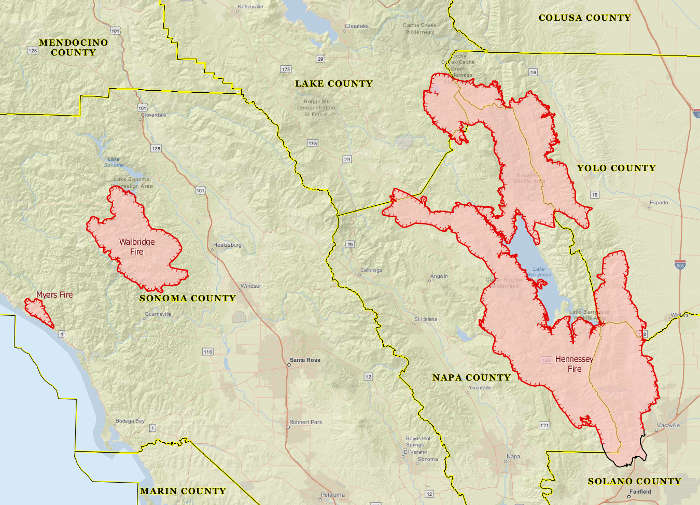
The portion of the complex burning into Lake County is the Hennessey fire, which is sized at 256,102 acres, Cal Fire said. The fire began in Napa County on Monday before burning into Lake, Solano and Yolo counties.
Thousands of south Lake County residents remain under evacuation order or warning because of the approach of the Hennessey fire.
One prong of the Hennessey fire has entered southeastern Lake County along Morgan Valley Road, with the second portion coming over the county line south of Middletown.
The Hennessey fire has burned around much of Lake Berryessa in Napa County, according to fire mapping.
The other portion of the complex in Sonoma County includes the Walbridge fire, west of Healdsburg, now at 43,286 acres and the Meyers fire, north of Jenner, which has burned 3,000 acres, Cal Fire reported.
Email Elizabeth Larson at
- Details
- Written by: Elizabeth Larson
LAKE COUNTY, Calif. – Firefighters held the LNU Lightning Complex to a small amount of growth overnight, but on Friday a new evacuation order was issued in Lake County in response to the incident.
As of Friday morning, the complex’s acreage stood at 219,067, up from 215,000 on Thursday night. Containment is now at 7 percent, up from zero, Cal Fire reported.
The fire is burning in southern Lake County as well as across Napa, Solano, Sonoma and Yolo counties, with 30,500 structures threatened. So far, 480 structures have been destroyed and 125 damaged.
Resources assigned on Friday included 1,059 personnel, 102 engines, 31 water tenders, 11 helicopters, 12 hand crews and 34 dozers.
Late Friday morning, officials issued a new evacuation order in Lake County for all areas and residents north and south of Morgan Valley Road – north of the evacuation line previously established on Wednesday – from Highway 29 and Hofacker Lane to Morgan Valley Road, east of Sky High Ridge Road (extending north to Highway), south of SR-20 and west of the Lake County line.
An evacuation warning was issued for all areas and residents along Morgan Valley Road between Rocky Creek Road and Reiff Road.
The portions of the complex burning within Lake County are the Aetna and Round fire, which have merged with the larger Hennessey fire, which also includes the Gamble, Green, Markley,
Spanish and Morgan fires.
Cal Fire said the Hennessey fire was 194,942 acres and 7-percent contained as of Friday morning.
Email Elizabeth Larson at
- Details
- Written by: Lake County News reports

LOWER LAKE, Calif. – The Shannon Ridge Family of Wines announced it has acquired Steele Wines of Finley.
Shannon Ridge has purchased the Lake County winery facilities and their diverse portfolio of brands and trademarks, including Shooting Star, Stymie and Writer's Block.
"This merger represents the perfect solution for both parties," says Shannon Ridge founder and president, Clay Shannon. "Strategically, the increased production capacity and storage space allows us to continue our expansion goals while providing the Steele Wines family of brands a local partner to further their market distribution."
Shannon Ridge can now easily surpass its 310,000 annual case volume and continue to champion 21st-century winemaking methods for high-elevation varietals.
Shannon’s mission since 1996 has been to promote Lake County as a premier wine-producing region in California, combined with an unwavering commitment to sustainable operations.
To underscore this point: only 45 percent of the winery's 2,500 acres have been converted to vineyards, preserving the rest of the property for natural wildlife to pass through peacefully.
Shannon Ridge plans to use the newly acquired facilities not only for the increased winemaking capacity and storage – 2,500 tons and 6,000 barrels, respectively – but also for introducing a new on-site property experience, “Shannon Mercantile,” at the current Steele tasting room in Kelseyville.
In addition to the Shannon Ridge and Steele wine portfolios, the planned Lake County establishment will offer the ranch's grass-fed lamb, farm eggs, and other home goods and merchandise.
“We aim to make Shannon Mercantile a family-friendly destination where folks can enjoy their wine with a picnic lunch on the lawn, movie nights on warm summer evenings, and festivities to celebrate various holidays throughout the year,” Shannon said.
Shannon aims to make the mercantile a go-to destination in Lake County. It’s tentatively scheduled to open in spring 2021.
Steele Wines celebrated its 28th anniversary in 2020 and has spent nearly the last three decades specializing in producing high-quality, small-batch (under 1,000 cases), varietals sourced from the finest vineyards in Lake and Mendocino counties.
After 50 years of winemaking in California, founder Jed Steele will assume a supporting role in the winery, assisting in the production of Steele Wines and enjoying retirement at his properties in Lake County, Montana, and Florida.
Shannon ridge was advised in this transaction by former and now-retired Shannon Ridge chief financial officer, Don Chase of Don Chase Wine Industry Management Services.