 How to resolve AdBlock issue?
News
- Details
- Written by: Lake County News reports
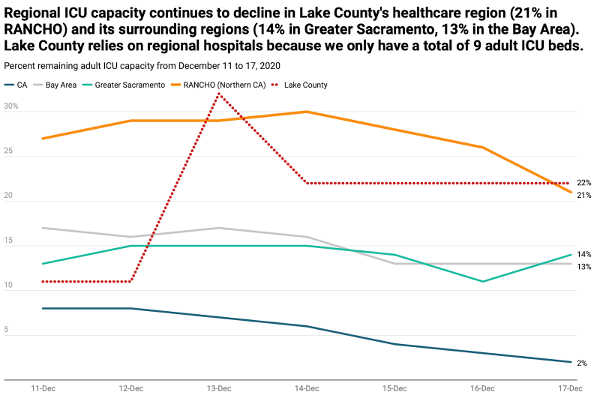
LAKE COUNTY, Calif. – The Northern California Region continues to be the only one in California not under a regional stay home order due to COVID-19, but health officials are urging community members to continue to use caution to protect against the virus’ winter surge.
The Northern California Region includes Lake and Mendocino counties and others going North to the Oregon border, an area with unique needs and resources.
In a joint statement from the Rural Association of Northern California Health Officers, or RANCHO, about the current situation, the group called COVID-19 “a North State wildfire by another name.”
The RANCHO statement explained, “The North State is in a state of emergency. COVID-19 cases are rising, hospitalizations are reaching record highs and new deaths are reported daily. We need to respond quickly to protect our community from this growing, devastating threat.
“Our beautiful region is no stranger to emergency situations. In years past, the resilient people of Northern California have worked together to survive disasters as a strong, united community.
“When wildfires plagued us, we became all too familiar with prevention and response practices, including defensible space, sheltering safely, mitigating poor air quality and using resources wisely.
RANCHO said the following terms, familiar during times of wildland fire, apply during the COVID-19 emergency:
· Defensible space: Remaining 6 feet away from others and limiting mixing with crowds.
· Air quality: Wearing a face covering when outside the home, for ourselves and for others, and maximizing ventilation.
· Sheltering safely: Sticking close to home and limiting contact to household members only. Coupled with the above two strategies, this could result in an 80 percent decrease in COVID-19 cases in three weeks.
· Using resources wisely: The Northern California region still has adequate ICU capacity, but projections show this could change by Christmas.
“Unlike what we experienced with the wildfires, our entire nation is on fire at the same time, so accessing mutual aid is increasingly challenging. Social gatherings, travel, not masking and going out when you’re sick are like fuel for this fire. Risk is higher than its been at any point in the pandemic.
“Even as a region, we only have about 120 ICU beds, and 15 percent capacity leaves fewer than 20 beds – that’s for people with heart attacks, strokes, trauma, and COVID-19. We, the Rural Association of Northern California Health Officers, are gravely concerned that this cushion of beds could be easily overwhelmed, and many facilities in our region are already stretched to staff hospital beds for patients requiring a higher level of health care,” the group said.
The association reported that the critical care capacity in the RANCHO region has declined from 30 percent on Dec. 14 to 21 percent on Dec. 17.
Critical care capacity also is declining in the Bay Area and Greater Sacramento regions to 13 percent and 14 percent, respectively.
“This is worrisome because in Lake County we rely on hospitals in both the greater Sacramento region and the Bay Area,” RANCHO said.
“As your Public Health Officers, we are asking our communities to do what they’ve done during times of disaster so many times before, which is to band together and do everything we can to stop this firestorm.
“Please adhere to the guidelines that we know slows this disease down and will keep us out of the Regional Stay at Home Order. Availability of an effective and safe vaccine is hope on the horizon, like a caravan of CAL FIRE trucks. But we will need to equip ourselves with all these tools until we have manageable spot fires.
“Like a fire hose, a vaccine has minimal impact during a firestorm, but is effective at putting out a smoldering fire. Eventually, we will be in a ‘fire recovery state’ when enough people have been vaccinated, likely in late summer or early fall. Until then, we implore you to do your part to slow the spread.
“As local and regional communities, we have survived many disasters. Together, we can extinguish the COVID-19 wildfire,” the RANCHO statement concluded.
- Details
- Written by: DENNIS FORDHAM
California is a community property state. Ownership interests of married persons are categorized as either the couple’s joint community property or as either spouse’s own separate property.
Assets acquired while married and living together in California are presumed to be community property assets and assets acquired prior to marriage and as gifts during marriage are separate property, unless commingled or transmuted.
Let us discuss the liability of a married person for their spouse’s debts while both are alive and then after when one spouse dies.
While both spouses are living, community property assets are generally liable for the debts of either spouse incurred before or during marriage (Family Code sections 900 et. seq.).
This is true even if only one spouse is a party to the debt or to the judgment (Family Code section 910(a)).
Two important exceptions exist: First, if a married person puts his or her earnings earned during marriage (i.e., community property) into a separate bank account that their spouse cannot access then these deposited earnings are not liable for the spouse’s debts incurred prior to marriage; and second, the debts of a deceased spouse’s last illness and funeral are chargeable against the deceased spouse’s own estate, i.e., the deceased spouse’s separate property and one-half of the community property estate.
Conversely, a married person’s separate property is not answerable for their spouse’s own premarital debts or for any marital debts allocated by court order, either at divorce or at death, to their spouse.
Thus, a married person who does not commingle their own separate property can protect it from their spouse’s own creditors.
Next, when one spouse dies the surviving spouse is generally liable for the deceased spouse’s debts.
The surviving spouse’s liability, however, is limited to the total fair market value, at date of death, of the couple’s community property assets (less any encumbrances – i.e., secured debts) plus any of decedent’s separate property assets (less encumbrances) that are received by the surviving spouse outside of probate.
The fair market value of any joint tenancy assets received by the surviving spouse are also included.
However, a surviving spouse may avoid such liability for their deceased spouse’s debts by placing both halves of the couple’s community property and all of the decedent’s separate property into probate for the decedent’s creditors to file their claims.
Whether the surviving spouse does so depends on circumstances. That is, consider a surviving spouse who is the sole surviving owner on the couple’s valuable joint tenancy home.
Nonetheless, the surviving spouse may not be the sole beneficiary of the decedent’s probate estate and may have to share the probate assets with the decedent’s children. Accordingly, probating the joint tenancy assets may not work so well for the surviving spouse.
Nonetheless, a surviving spouse is more likely to probate all community property assets and the decedent’s separate property if the decedent’s debts exceed the current value of all such assets.
In a probate court proceeding, as in divorce court proceedings, debts can be allocated between the surviving spouse and the estate of the deceased spouse. That means categorizing debts as community property debts or as separate property debts of either spouse.
Debt acquired in pursuit of community goals (such as employment) are community property debts chargeable first against the couple’s community property assets and secondarily, if necessary, against the couple’s separate properties.
Debts of either spouse from before marriage or in pursuit of either spouse’s separate goals (e.g., gambling debts) are separate property debts. Separate debts are chargeable first against that spouse’s own separate property assets and secondarily, if necessary, against the community property assets.
In sum, planning opportunities and pitfalls exist when entering into a marriage, when inheriting property (either before or while married) and at the death of a spouse. Anyone needing legal guidance on any issues discussed above should consult an attorney.
Dennis A. Fordham, attorney, is a State Bar-Certified Specialist in estate planning, probate and trust law. His office is at 870 S. Main St., Lakeport, Calif. He can be reached at
- Details
- Written by: NATIONAL AERONAUTICS AND SPACE ADMINISTRATION
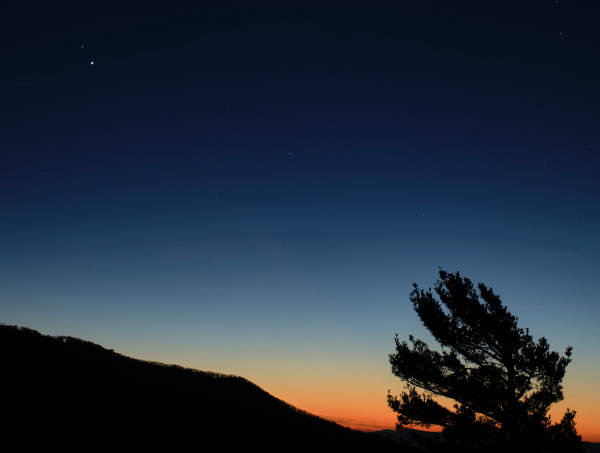
Skywatchers are in for an end-of-year treat.
What has become known popularly as the “Christmas Star” is an especially vibrant planetary conjunction easily visible in the evening sky over the next two weeks as the bright planets Jupiter and Saturn come together, culminating on the night of Monday, Dec. 21.
In 1610, Italian astronomer Galileo Galilei pointed his telescope to the night sky, discovering the four moons of Jupiter – Io, Europa, Ganymede, and Callisto. In that same year, Galileo also discovered a strange oval surrounding Saturn, which later observations determined to be its rings. These discoveries changed how people understood the far reaches of our solar system.
Thirteen years later, in 1623, the solar system’s two giant planets, Jupiter and Saturn, traveled together across the sky. Jupiter caught up to and passed Saturn, in an astronomical event known as a “Great Conjunction.”
“You can imagine the solar system to be a racetrack, with each of the planets as a runner in their own lane and the Earth toward the center of the stadium,” said Henry Throop, astronomer in the Planetary Science Division at NASA Headquarters in Washington. “From our vantage point, we’ll be able to be to see Jupiter on the inside lane, approaching Saturn all month and finally overtaking it on Dec. 21.”
The planets regularly appear to pass each other in the solar system, with the positions of Jupiter and Saturn being aligned in the sky about once every 20 years.
What makes this year’s spectacle so rare, then? It’s been nearly 400 years since the planets passed this close to each other in the sky, and nearly 800 years since the alignment of Saturn and Jupiter occurred at night, as it will for 2020, allowing nearly everyone around the world to witness this “great conjunction.”
The closest alignment will appear just a tenth of a degree apart and last for a few days. On the 21st, they will appear so close that a pinkie finger at arm’s length will easily cover both planets in the sky. The planets will be easy to see with the unaided eye by looking toward the southwest just after sunset.
From our vantage point on Earth the huge gas giants will appear very close together, but they will remain hundreds of millions of miles apart in space. And while the conjunction is happening on the same day as the winter solstice, the timing is merely a coincidence, based on the orbits of the planets and the tilt of the Earth.
“Conjunctions like this could happen on any day of the year, depending on where the planets are in their orbits,” said Throop. “The date of the conjunction is determined by the positions of Jupiter, Saturn and the Earth in their paths around the Sun, while the date of the solstice is determined by the tilt of Earth’s axis. The solstice is the longest night of the year, so this rare coincidence will give people a great chance to go outside and see the solar system.”
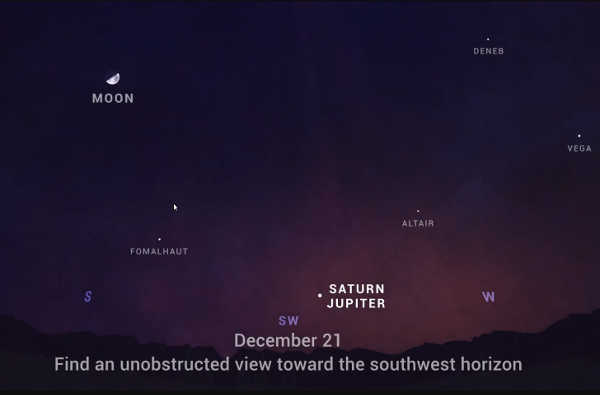
For those who would like to see this phenomenon for themselves, here’s what to do:
– Find a spot with an unobstructed view of the sky, such as a field or park. Jupiter and Saturn are bright, so they can be seen even from most cities.
– An hour after sunset, look to the southwestern sky. Jupiter will look like a bright star and be easily visible. Saturn will be slightly fainter and will appear slightly above and to the left of Jupiter until Dec. 21, when Jupiter will overtake it and they will reverse positions in the sky.
– The planets can be seen with the unaided eye, but if you have binoculars or a small telescope, you may be able to see Jupiter’s four large moons orbiting the giant planet.
Learn these tips and trick on how to photograph planets:
https://solarsystem.nasa.gov/news/1615/how-to-photograph-the-conjunction-of-saturn-and-jupiter/
Night Sky Network:
https://nightsky.jpl.nasa.gov/
Visitors to Both Jupiter and Saturn:
https://nightsky.jpl.nasa.gov/news-display.cfm?News_ID=931
Want to learn more about planetary conjunctions? Take a look at some of these resources:
https://blogs.nasa.gov/Watch_the_Skies/2015/06/30/jupiter-and-venus-conjunction/
https://youtu.be/sofRYcfaqy0
Read these skywatching Tips from NASA:
https://solarsystem.nasa.gov/whats-up-skywatching-tips-from-nasa/
- Details
- Written by: Elizabeth Larson
Public Health Officer Dr. Gary Pace confirmed to Lake County News that the vaccine truck arrived at the Public Health Department in Lakeport.
He said the first doses will be given at Sutter Lakeside Hospital in Lakeport on Friday.
Pace said Lake County received 975 doses, “which is really great for us.”
The vaccine offers hope for a way out of the pandemic and back to a more normal life starting in the spring and summer, Pace said, but he advises community members that they must continue for the foreseeable future to follow protocols including social distancing, masking and forgoing holiday travel.
The vaccine comes as the state and the nation are seeing surging caseloads and death rates.
“We’re in this very challenging time. I think the next couple of months are going to be something like we’re not used to seeing,” Pace told the Board of Supervisors on Tuesday, explaining that his department is planning for major disruptions for the hospital and life in general. “I think this winter is going to be tough.”
The two-dose Pfizer vaccine arrived in Lake County less than a week after it was approved by the Food and Drug Administration on Dec. 11.
The FDA’s Vaccines and Related Biological Products Advisory Committee met Thursday to discuss emergency use authorization for a second COVID-19 vaccine, this one from Moderna Inc., which the committee ultimately endorsed.
In a Thursday statement, FDA Commissioner Stephen M. Hahn, M.D., and Peter Marks, M.D., Ph.D., director of the FDA’s Center for Biologics Evaluation and Research, said that the FDA has informed Moderna “that it will rapidly work toward finalization and issuance of an emergency use authorization.”
As the vaccines are getting rolled out, federal officials said this week that investigations are underway regarding health care workers who had allergic reactions to the vaccine, specifically, two cases in the United Kingdom and two in Alaska.
While the Moderna vaccine is still awaiting final approval, Pace said that his department has already ordered 100 doses of it and hopes to have it by next week.
That means that 1,075 people in Lake County will have received the first course of the vaccination regimen by the end of next week, Pace said.
Pace said Public Health plans to order more doses of the vaccine weekly.
In reports Pace made to the Board of Supervisors and the Lakeport City Council on Tuesday, he said the first tier of vaccinations would go to health care workers at Adventist Health Clear Lake Hospital and Sutter Lakeside Hospital, along with emergency medical services providers, which includes firefighters and paramedics.
Once all of those individuals are covered, the distribution will move to the second tier, which he said is expected to include outpatient workers, law enforcement and essential workers before moving on to those with chronic medical illness.
“The supply and demand don’t match very well in the beginning,” Pace told the council Tuesday.
He told Lake County News earlier this week that the county’s skilled nursing facilities will source the vaccine separately through pharmacies they’ve partnered with, and Lake County Tribal Health will receive a supply through the federal Indian Health Service.
Case and death rates continue to surge statewide
Pace told the supervisors that cases “continue to rise without any sign of slowing down” and that it was important for county leadership and community members to understand “what’s lying in front of us right now.”
California’s 58 Public Health departments reported a total of more than 50,000 cases on Wednesday and again on Thursday, nearly 400 deaths on Wednesday and almost 300 on Thursday.
Statewide, deaths have topped, 22,100 and total cases are at nearly 1.75 million.
Rural counties like Lake have seen climbing case numbers over the past month.
In Lake County, cases on Thursday totaled 1,375 with deaths at 21; an additional death in an out-of-county resident was incorrectly counted in Lake, Public Health said.
On Thursday, Public Health said 12 Lake County residents were hospitalized due to the virus.
Pace said that by Christmas, it’s estimated there will be no more intensive care beds available in California.
Sarah Marikos, Lake County Public Health’s epidemiologist, told the Board of Supervisors in a video report on Tuesday that Lake County’s daily case rate went from 6 per 100,000 in early October to 26 per 100,000 for the week ending Dec. 5, just a week after Thanksgiving, with the county’s positivity rate up to 11.5 percent at that point.
“Our numbers have never been this high,” she said.
In the previous three weeks, 400 new COVID-19 cases have come in, which account for one third of Lake County’s total caseload, Marikos said.
Hope for the new vaccine
Dr. Mollie Charon, who is contracting with Lake County Public Health to assist with infection prevention and public messaging, told the Board of Supervisors on Tuesday that there have been numerous meetings to go over the technical details, safety and efficacy of the COVID-19 vaccine.
Based on her study, she said she’s impressed by the vaccine’s safety record.
“It’s our job to worry so that the rest of the community doesn’t have to about these safety concerns,” Charon said, referring to the responsibilities she and Pace carry.
Charon said she has poured over information about vulnerable populations, and that she’s “so heartened and impressed” by the vaccine’s safety.
The quicker everyone can be immunized, the better it will be for businesses and families, Charon said.
She added that the vaccine offers a better chance that each person we want to spend the holidays with but can’t this year will be alive to spend the holidays with next year.
Charon said she’s very hopeful for a quick local rollout of the vaccine.
Pace told the Lakeport City Council that by spring and summer, people should be able to move back toward a normal life due to the vaccine and continued safety measures such as masking.
“This is going to be the potential way out,” he said of the vaccine, noting that safety concerns seem to be “pretty minimal,” while the risk of the illness that COVID-19 brings can be devastating.
Email Elizabeth Larson at