 How to resolve AdBlock issue?













People rely on data from federal agencies every day – often without realizing it.
Rural residents use groundwater level data from the U.S. geological survey’s National Water Information System to decide where to dig wells. High school coaches turn to weather apps supported by data from the National Weather Service to decide when to move practice inside to avoid life-threatening heat. Emergency managers use data from the Census Bureau’s American Community Survey to ensure that residents without vehicles have seats on evacuation buses during local emergencies.
On Jan. 31, 2025, websites and datasets from across the federal government began to disappear. As that happened, archivists and researchers from around the world sprang into action, grabbing what they could before it was gone.
Trust in the federal statistical system took another hit when Bureau of Labor Statistics Commissioner Erika McEntarfer was fired on the heels of a dismal Aug. 1, 2025, employment report.
And reduced data collection at the bureau was already causing concern before her dismissal. The bureau has ceased collection of critical inputs to the Consumer Price Index, likely reducing that inflation indicator’s accuracy, especially at the level of specific locations and products.
As researchers of economics and epidemiology at the University of Michigan, we have spent years working with data, often from the federal government. When data and information began to disappear, we were spurred into action to preserve these important public goods.
The Inter-university Consortium for Political and Social Research, where we work – commonly known as ICPSR – has been making data from governments and researchers available for more than 60 years. We are stewards of this data, preserving it and ensuring that it is accessible in a safe and responsible manner.
Unfortunately, government data is now at risk of becoming less available or disappearing. But there are steps that researchers – and the public – can take to reduce that risk.
Data at risk
Some 8,000 pages were removed from federal websites within a few days of Jan. 31, 2025. Though many were soon restored following substantial outcry and some court orders, it’s still unclear how the restored webpages and datasets may have been changed.

In one preliminary examination, researchers found that 49% of the 232 datasets they reviewed had been substantially altered, including the replacement of the word “gender” with “sex.” This alteration can obscure nonbinary gender identities. Only 13% of the changes the researchers found were documented by the government.
U.S. government data has also become less accessible because of mass firings of federal workers and the dismantling of entire agencies.
Important efforts like the Data Rescue Project and the Internet Archive have been able to preserve a great deal of knowledge and data, but they are mostly limited to publicly available data and information.
No one left to vet data
Many important government data resources contain sensitive or identifying information. This means officials must vet requests before they grant access to data rescue efforts. But many agencies have had their ability to conduct vetting and manage access severely curtailed and, in some cases, eliminated altogether.
Take the Pregnancy Risk Assessment Monitoring System, which provides key data on maternal and child health from around the United States. The Centers for Disease Control and Prevention integrates data collected at state and local levels and adds population information to come up with estimates. While some of this data is publicly available, access to most data from 2016 and later requires a request to the CDC and a signed data use agreement.
At the start of 2025, multiple researchers reported to our team at the Inter-university Consortium for Political and Social Research that the CDC had stopped processing these requests. In February, researchers discovered that the Pregnancy Risk Assessment Monitoring System would be discontinued.
The CDC suggested that data collection would restart at some point. But on April 1, the entire Pregnancy Risk Assessment Monitoring System team was laid off. This made one of the most valuable sources of data on the health of mothers and babies largely inaccessible, and put plans for its future in limbo.
Similar situations have played out at other agencies, including the dismantled U.S. Agency for International Development and the National Center for Education Statistics. Data collected, cleaned and harmonized using taxpayer dollars is now languishing on inaccessible servers.
Inaccessible data
The portal that researchers use to apply for access to restricted federal statistical data now includes a list of data that researchers can no longer access.
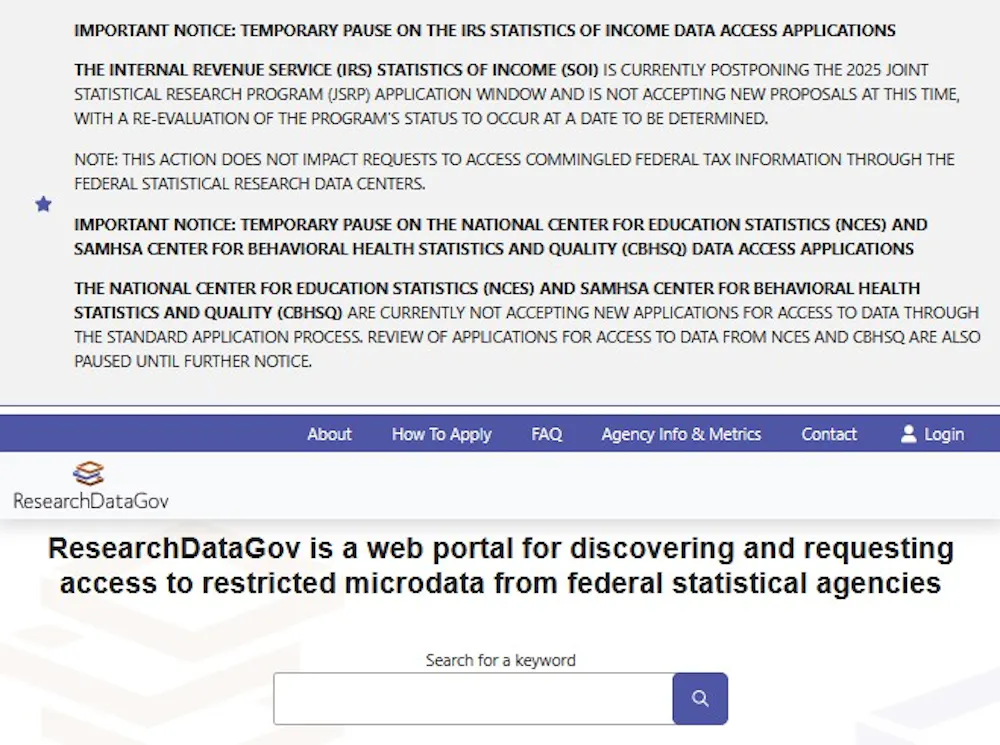
Some organizations are leading efforts to restore access to particular datasets. The Inter-university Consortium for Political and Social Research, for instance, has an agreement with USAID to preserve and provide access to USAID’s education data. Unfortunately, these efforts barely scratch the surface. With very few staff left, there isn’t a clear estimate of which other USAID resources remain inaccessible.
According to our count, 354 restricted datasets from the federal statistical system’s Standard Application Portal have become unavailable due to firings, layoffs and funding cuts.
Data is critical for people and the state and local governments that represent them to make good decisions. Federal data is also used for oversight, so that researchers can verify that the government is doing what it’s supposed to in accordance with its congressionally mandated missions. Government efficiency requires accountability.
And accountability requires high-quality and timely data on operations.
The mass firings of federal employees means that those tasked with ensuring this accountability are doing so while struggling to obtain necessary data.
So where do we go from here?
While the pace of intentional government data removal appears to have slowed, it hasn’t stopped. New datasets under threat of disappearing are being rescued daily. Restructured federal agencies and related changes to – or neglect of – official websites can make data difficult or impossible to find.
What you can do
If you identify data that is at risk, perhaps because its collection has been discontinued or it covers a controversial topic, you can report your observations to the Data Rescue Project, a grassroots effort of archivists, librarians and other concerned people.
The Data Rescue Project has been working for months to identify data and preserve government data, including in the Inter-university Consortium for Political and Social Research’s DataLumos open-access archive.
Similarly, the Public Environmental Data Partners, a coalition of nonprofits, archivists and researchers, are preserving federal environmental data and have a nomination form.
Efforts to identify restored data that has been altered are also gaining steam.
Dataindex tracks Federal Register notices that describe proposed changes to 24 widely used datasets from across the federal government, including the American Community Survey from the Census Bureau, the National Crime Victimization Survey from the Bureau of Justice Statistics, and the National Health Interview Survey from the CDC. The website also facilitates comment on proposed alterations.
You can help researchers understand the scale of data alterations that have been, and continue to be, made. If you notice changes in public datasets, you can share that information with the American Statistical Association’s FedStatMonitoring project.
The Inter-university Consortium for Political and Social Research is continuing our efforts to ensure the preservation of, and access to, existing data, including from the Bureau of Labor Statistics and the Consumer Financial Protection Bureau.
At the same time, we and other groups are planning future efforts in data collection to avoid gaps in our knowledge.
The federal statistical system is both large and complex, including hundreds of thousands of datasets that people depend on in many ways, from weather forecasts to local economic indicators. If the federal government continues to step back from its role as a provider of high-quality, trusted data, others – including state and local governments, academia, nonprofits and companies – may need to fill the gap by stepping up to collect it.
Margaret Levenstein, Research Professor at the Institute for Social Research, University of Michigan and John Kubale, Research Assistant Professor at the Institute for Social Research, University of Michigan
This article is republished from The Conversation under a Creative Commons license. Read the original article.