 How to resolve AdBlock issue?
News
- Details
- Written by: NATIONAL AERONAUTICS AND SPACE ADMINISTRATION
An unprecedented heat wave that started around June 26 smashed numerous all-time temperature records in the Pacific Northwest and western Canada. NASA’s Atmospheric Infrared Sounder, or AIRS, aboard the Aqua satellite, captured the progression of this slow-moving heat dome across the region from June 21 to 30.
An animation of some of the AIRS data show surface air temperature anomalies – values above or below long-term averages. Surface air temperature is something that people directly feel when they are outside.
In many cases, the highs exceeded previous temperature records by several degrees or more. On June 28, Quillayute, Washington, set an all-time high temperature record of 110 degrees Fahrenheit, shattering the old record of 99 degrees Fahrenheit.
Numerous weather stations broke records on consecutive days, showing the unprecedented nature of this extreme heat, which is also being blamed for a number of fatalities.
In British Columbia, the village of Lytton set a new all-time record for Canada at 119 degrees Fahrenheit on June 29, only to break it the next day with a reading of 121 degrees Fahrenheit.
The AIRS instrument recorded similar temperature anomalies at an altitude of about 10,000 feet, showing that the extreme heat also affected mountainous regions. And temperature anomalies at roughly 18,000 feet demonstrated that the heat dome extended high into Earth’s troposphere, creating the conditions for intense heat at the planet’s surface that are normally found farther south.
AIRS, in conjunction with the Advanced Microwave Sounding Unit, or AMSU, senses emitted infrared and microwave radiation from Earth to provide a three-dimensional look at the planet’s weather and climate.
Working in tandem, the two instruments make simultaneous observations down to Earth’s surface.
With more than 2,000 channels sensing different regions of the atmosphere, the system creates a global, three-dimensional map of atmospheric temperature and humidity, cloud amounts and heights, greenhouse gas concentrations and many other atmospheric phenomena.
Launched into Earth orbit in 2002 aboard NASA’s Aqua spacecraft, the AIRS and AMSU instruments are managed by NASA’s Jet Propulsion Laboratory in Southern California, under contract to NASA. JPL is a division of Caltech.
More information about AIRS can be found at https://airs.jpl.nasa.gov/.
- Details
- Written by: Lake County News reports
Jamie Rae Lukens, 34, who police said is a transient and Lakeport resident, was taken into custody on Wednesday night, the agency reported.
At 8:45 p.m. Wednesday, Lakeport Police Department officers received information from the Lake County Sheriff’s Office Dispatch Center of an active fire in the area of WestAmerica Bank, located at 650 N. Main St.
The department said its officers quickly arrived, along with fire service personnel from the Lakeport Fire Protection District, and located shrubs and a tree burning in the parking lot immediately adjacent to the bank building.
Fire personnel successfully suppressed the fire with only property damage to the nearby vegetation, the department said.
Officers received information from two witnesses who described a female subject who they said set the fire before leaving the scene on foot before first responders arrived. They provided police with descriptions of her physical appearance and what she was wearing.
Police conducted an intensive investigation which, along with further assistance from the two community members that witnessed the event, led them to arresting Lukens just before 9:30 p.m.
Lukens was arrested for the felony violation of arson with the malicious intent of causing damage to the personal property of another.
She was booked into the Lake County Jail on $15,000 bail and remained in custody on Thursday.
Booking records show she is due to appear in Lake County Superior Court for arraignment on Friday.
Anyone with information regarding this incident is asked to contact LPD Officer Ryan Cooley at
- Details
- Written by: Lake County News reports
For some, county library branches and peer support centers may be a great option.
While none of these are formal cooling centers, and capacity is limited at each site, they are invaluable community resources when temperatures climb.
Lake County’s four public library branches are open during their normal business hours.
While you cool off, check out the many new materials and digital services the Library has to offer — there is something for everyone.
If you are planning to visit, please be advised face coverings are required for people that are not vaccinated.
Library visitors self-attest they are fully vaccinated by entering the building with no mask on. Here is a list of Lake County Library locations, and their hours of operation:
Lakeport Library
1425 N. High St.
707-263-8817
Tuesday, 10 a.m. to 5 p.m.
Wednesday, 10 a.m. to 7 p.m.
Thursday through Saturday, 10 a.m. to 5 p.m.
Redbud Library (Clearlake)
14785 Burns Valley Road
707-994-5115
Tuesday, 10 a.m. to 5 p.m.
Wednesday, 10 a.m. to 7 p.m.
Thursday through Saturday, 10 a.m. to 5 p.m.
Middletown Library
21256 Washington St.
707-987-3674
Tuesday through Saturday, 10 a.m. to 5 p.m.
Upper Lake Library
310 Second St.
707-275-2049
Tuesday through Friday, noon to 5 p.m.
Saturday, 10 a.m. to 3 p.m.
With another summer heat wave upon us, Lake County Behavioral Health Services also reminds their peer support centers are open as a refuge from the heat.
Each provides an air-conditioned place to sit and rest. Water and light snacks are offered to guests, and restrooms are available. Referrals to social services can also be made. All are welcome.
The Big Oak Peer Support Center
13300 East Highway 20, Suite “O”
Clearlake Oaks
707-998-0310
Monday through Friday, 8:30 a.m. to 4:30 p.m.
Weekends, noon to 4 p.m.
Circle of Native Minds Cultural Center
845 Bevins St.
Lakeport
707-263-4880
Monday through Friday, 8:30 a.m. to 4:30 p.m.
The Harbor on Main
154 South Main St.
Lakeport
707-994-5486
Monday through Friday, 8:30 a.m. to 4:30 p.m.
La Voz de la Esperanza Centro Latino
14092 Lakeshore Drive
Clearlake
707-994-4261
Monday through Friday, 8:30 a.m. to 4:30 p.m.
Weekends, noon to 4 p.m.
Family Support Center
21389 Stewart St., Suite “E”
Middletown
707-987-9601
Monday through Friday, 8:30 a.m. to 4:30 p.m.
- Details
- Written by: Lake County News reports
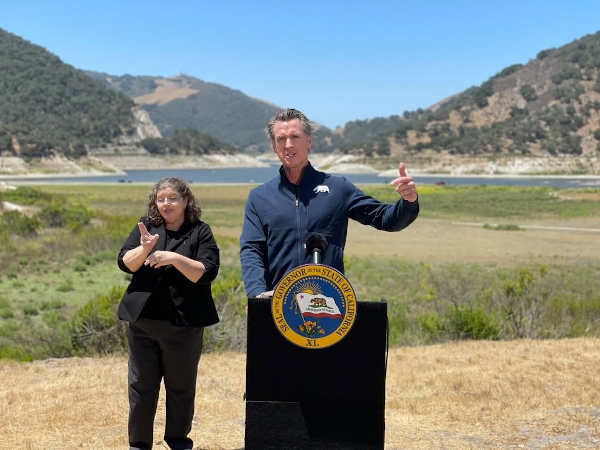
Amid intensifying drought and record-breaking temperatures across the Western United States, Gov. Gavin Newsom on Thursday added nine counties to the regional drought state of emergency and called on Californians to voluntarily reduce their water use by 15% with simple measures to protect water reserves if drought conditions continue and to help maintain critical flows for fish and wildlife wherever possible.
“The realities of climate change are nowhere more apparent than in the increasingly frequent and severe drought challenges we face in the West and their devastating impacts on our communities, businesses and ecosystems,” said Gov. Newsom. “The entire state is in a drought today, and to meet this urgent challenge we must all pull together and do our part to reduce water use as California continues to build a more climate resilient water system to safeguard the future of our state. We’re proud of the tremendous strides made to use water more efficiently and reduce water waste, but we can all find opportunities this summer to keep more water in reserve as this drought could stretch into next year and beyond.”
The governor on Thursday signed an executive order calling on all Californians to voluntarily reduce their water use by 15% compared to 2020 levels through simple actions such as reducing landscape irrigation, running dishwashers and washing machines only when full, finding and fixing leaks, installing water-efficient showerheads and taking shorter showers.
These voluntary efforts complement specific local conservation mandates already in place in some communities experiencing acute water shortage conditions this summer.
State officials estimate an additional 15% voluntary reduction by urban water users from 2020 levels could save as much as 850,000 acre-feet of water over the next year for future use, or enough to supply more than 1.7 million households for a year.
The State Water Resources Control Board and the Department of Water Resources will monitor progress on voluntary conservation, reservoir storage, soil moisture and other metrics in the coming months to determine whether additional drought response actions are needed.
To help Californians take simple action to reduce water use by 15 percent, state agencies are partnering with local water suppliers to promote conservation tips through the Save Our Water campaign.
The campaign and website were critical resources for Californians during the 2012-2016 drought and remain a trusted information source on using water wisely.
During the 2012-2016 drought, Californians responded to the call to conserve, with many taking permanent actions that continue to yield benefits.
Statewide per capita residential water use declined 21% between the years 2013 and 2016 and today, the urban sector is using approximately 16% less on average statewide than in 2013.
Building California’s drought and climate resilience, local water suppliers and communities are also bolstering their drought planning and making forward-looking investments in water recycling, stormwater capture and reuse, groundwater storage and other strategies. Agricultural water users have made significant investments in irrigation efficiencies since the last drought.
Despite those efforts, many agricultural producers are experiencing severe reductions in water supplies this year and are fallowing land in response.
At Lopez Lake in San Luis Obispo County on Thursday, Gov. Newsom also signed a proclamation expanding the regional drought state of emergency to include nine additional counties where drought effects are increasingly severe or where state emergency response may be needed: Inyo, Marin, Mono, Monterey, San Luis Obispo, San Mateo, Santa Barbara, Santa Clara and Santa Cruz.
This action will enable state agencies to more quickly and effectively support drought response through actions such as expediting purchasing and contracting to complete projects that shore up water supplies.
While drought conditions exist across the state, the counties covered by the proclamations are experiencing severe impacts and are likely to benefit from these emergency actions.
Following the initial emergency proclamation issued in April for the hardest-hit counties, and its expansion in May, today’s executive action brings a total of 50 of the state’s 58 counties under the drought state of emergency.
The governor has also directed state agencies to take further actions to preserve critical water supplies, address drought impacts and protect people, natural resources and economic activity.
The governor in May proposed $5.1 billion in water resiliency investments over four years to bolster the state’s emergency drought response, build regional capacity to endure drought and safeguard water supplies for communities, the economy and the environment.
The administration is working with the Legislature to finalize budget investments that will address drinking water challenges in small and disadvantaged communities, support Sustainable Groundwater Management Act implementation and multi-benefit land repurposing and fund projects that improve ecosystem health for native fish and other wildlife, among other priorities.
Actions by the administration to address drought to date include:
— Since the 2019 enactment of legislation to help provide safe and affordable drinking water to communities that lack it, the Water Board so far has provided interim drinking water solutions to 496 communities, provided planning assistance to another 164 communities and provided long-term solutions to 110 small water systems to make them more climate resilient.
— State agencies in recent weeks have provided emergency support to several small communities and domestic well users with inadequate water supply problems.
— In close coordination with a wide range of stakeholders, state agencies assessed the drought vulnerability of water suppliers and ranked the most vulnerable systems in need of support. The effort also gathered recommendations from stakeholders on ways to improve drought contingency planning.
— Building on that assessment of drought vulnerability, the State Water Resources Control Board this year completed the state’s first drinking water needs assessment in which it identified small water systems and domestic wells that are failing or at risk of failing to meet the state’s drinking water standards.
— State review of voluntary water transfers between water right holders has been made more efficient to facilitate the movement of water to places where it is needed most.
— The Department of Water Resources, or DWR, updated its Household Water Supply Shortage Reporting website, which tracks voluntarily reported supply issues by counties.
— DWR installed a temporary emergency rock barrier across a channel in the Sacramento-San Joaquin Delta this summer to help slow the movement of saltwater and prevent contamination of water supplies for Delta agriculture and millions of Californians.
— State regulators have modified reservoir operations and water quality regulations to conserve water supplies in key reservoirs.
— With stakeholder input, the Administration in 2020 finalized a Water Resilience Portfolio, with more than 100 separate actions to be taken by state agencies to help California’s diverse regions endure drought, flood and changing precipitation patterns.
For more tips on saving water, visit www.saveourwater.com.
Learn more about current conditions, the state’s response and informational resources available to the public at the state’s new drought preparedness website.