 How to resolve AdBlock issue?
News
- Details
- Written by: NATIONAL AERONAUTICS AND SPACE ADMINISTRATION
Often portrayed as destructive monsters that hold light captive, black holes take on a less villainous role in the latest research from NASA's Hubble Space Telescope.
A black hole at the heart of the dwarf galaxy Henize 2-10 is creating stars rather than gobbling them up.
The black hole is apparently contributing to the firestorm of new star formation taking place in the galaxy. The dwarf galaxy lies 30 million light-years away, in the southern constellation Pyxis.
A decade ago this small galaxy set off debate among astronomers as to whether dwarf galaxies were home to black holes proportional to the supermassive behemoths found in the hearts of larger galaxies. This new discovery has little Henize 2-10, containing only one-tenth the number of stars found in our Milky Way, poised to play a big part in solving the mystery of where supermassive black holes came from in the first place.
"Ten years ago, as a graduate student thinking I would spend my career on star formation, I looked at the data from Henize 2-10 and everything changed," said Amy Reines, who published the first evidence for a black hole in the galaxy in 2011 and is the principal investigator on the new Hubble observations, published in the January 19 issue of Nature.
"From the beginning I knew something unusual and special was happening in Henize 2-10, and now Hubble has provided a very clear picture of the connection between the black hole and a neighboring star forming region located 230 light-years from the black hole," Reines said.
That connection is an outflow of gas stretching across space like an umbilical cord to a bright stellar nursery. The region was already home to a dense cocoon of gas when the low-velocity outflow arrived.
Hubble spectroscopy shows the outflow was moving about 1 million miles per hour, slamming into the dense gas like a garden hose hitting a pile of dirt and spreading out. Newborn star clusters dot the path of the outflow's spread, their ages also calculated by Hubble.
This is the opposite effect of what's seen in larger galaxies, where material falling toward the black hole is whisked away by surrounding magnetic fields, forming blazing jets of plasma moving at close to the speed of light.
Gas clouds caught in the jets' path would be heated far beyond their ability to cool back down and form stars. But with the less-massive black hole in Henize 2-10, and its gentler outflow, gas was compressed just enough to precipitate new star formation.
"At only 30 million light-years away, Henize 2-10 is close enough that Hubble was able to capture both images and spectroscopic evidence of a black hole outflow very clearly. The additional surprise was that, rather than suppressing star formation, the outflow was triggering the birth of new stars," said Zachary Schutte, Reines' graduate student and lead author of the new study.
Ever since her first discovery of distinctive radio and X-ray emissions in Henize 2-10, Reines has thought they likely came from a massive black hole, but not as supermassive as those seen in larger galaxies.
Other astronomers, however, thought that the radiation was more likely being emitted by a supernova remnant, which would be a familiar occurrence in a galaxy that is rapidly pumping out massive stars that quickly explode.
"Hubble's amazing resolution clearly shows a corkscrew-like pattern in the velocities of the gas, which we can fit to the model of a precessing, or wobbling, outflow from a black hole. A supernova remnant would not have that pattern, and so it is effectively our smoking-gun proof that this is a black hole," Reines said.
Reines expects that even more research will be directed at dwarf galaxy black holes in the future, with the aim of using them as clues to the mystery of how supermassive black holes came to be in the early universe. It's a persistent puzzle for astronomers.
The relationship between the mass of the galaxy and its black hole can provide clues. The black hole in Henize 2-10 is around 1 million solar masses. In larger galaxies, black holes can be more than 1 billion times our Sun's mass. The more massive the host galaxy, the more massive the central black hole.
Current theories on the origin of supermassive black holes break down into three categories: 1) they formed just like smaller stellar-mass black holes, from the implosion of stars, and somehow gathered enough material to grow supermassive, 2) special conditions in the early universe allowed for the formation of supermassive stars, which collapsed to form massive black hole "seeds" right off the bat, or 3) the seeds of future supermassive black holes were born in dense star clusters, where the cluster's overall mass would have been enough to somehow create them from gravitational collapse.
So far, none of these black hole seeding theories has taken the lead. Dwarf galaxies like Henize 2-10 offer promising potential clues, because they have remained small over cosmic time, rather than undergoing the growth and mergers of large galaxies like the Milky Way. Astronomers think that dwarf galaxy black holes could serve as an analog for black holes in the early universe, when they were just beginning to form and grow.
"The era of the first black holes is not something that we have been able to see, so it really has become the big question: where did they come from? Dwarf galaxies may retain some memory of the black hole seeding scenario that has otherwise been lost to time and space," Reines said.
The Hubble Space Telescope is a project of international cooperation between NASA and the European Space Agency. NASA's Goddard Space Flight Center in Greenbelt, Maryland, manages the telescope. The Space Telescope Science Institute, or STScI, in Baltimore, Maryland, conducts Hubble science operations. STScI is operated for NASA by the Association of Universities for Research in Astronomy in Washington, D.C.
- Details
- Written by: KELSEYVILLE UNIFIED SCHOOL DISTRICT

KELSEYVILLE, Calif. — A $7,270 grant from the Guy Fieri Foundation has paved the way for Kelseyville High School culinary arts students to fully participate in a newly formed local chapter of the Family, Career and Community Leaders of America, a national career and technical student organization.
The grant will be used to incorporate Family, Career and Community Leaders of America, or FCCLA, into the KHS Culinary Arts Program.
KHS Culinary Teacher Tami Cramer explained, “FCCLA is to culinary arts as FFA is to agricultural sciences.”
According to its website, FCCLA helps students develop real-world skills, explore career pathways and become college- and career-ready through participation in competitive events, becoming involved in community service opportunities, student leadership, and attending leadership conferences.”
In 2018, Kelseyville Unified used Career Technical Education funds to help in the Culinary Arts program including upgrades to facilities such as a new demonstration kitchen, new stoves, commercial refrigerator and freezer, three compartment sinks, an ice machine, a dishwasher, a bar refrigerator, new countertops, electrical and plumbing work, and the refacing of all culinary cabinets.
These upgrades also included a handicap-accessible kitchen and technology that allows all students equal access to learning.
In 2019, Cramer worked with a FCCLA program adviser to research and develop a program at KHS. Students were registered, officers were selected, and members attended a regional conference. Then COVID-19 put a halt in their efforts to expand on the work they started.
“Without being fully established, it was hard to expand and grow during online learning,” Cramer said.
When Cramer learned of the grant opportunity to support KHS’s participation in FCCLA through the Guy Fieri Foundation, she quickly received encouragement from KHS Career Tech Coordinator Donelle McCallister and KHS Principal Mike Jones to apply.
Jones said, “Membership in this leadership organization provides students the opportunity to develop both leadership and culinary skills.”
Without the grant, it would have been difficult for KHS to afford FCCLA registration fees, the red blazers required for students to attend FCCLA meetings and conventions, and travel expenses for students to attend events out-of-town competitions and leadership conferences, including the California State FCCLA Leadership Conference scheduled for April 23 to 26 in Riverside.
“The Guy Fieri grant enables our students to have opportunities they wouldn’t have otherwise,” McCallister said.
The Guy Fieri Foundation is a nonprofit charity based in Petaluma with a mission to help local culinary arts programs in the middle schools, high schools, and community colleges. The Guy Fieri Foundation is committed to helping youth through nutrition education, exploring careers in hospitality, and encouraging goals for their future.
“I am thrilled Guy has given support to our culinary students and future community leaders. I’m ready to put this grant to good use,” said Cramer.
- Details
- Written by: California Governor’s Office
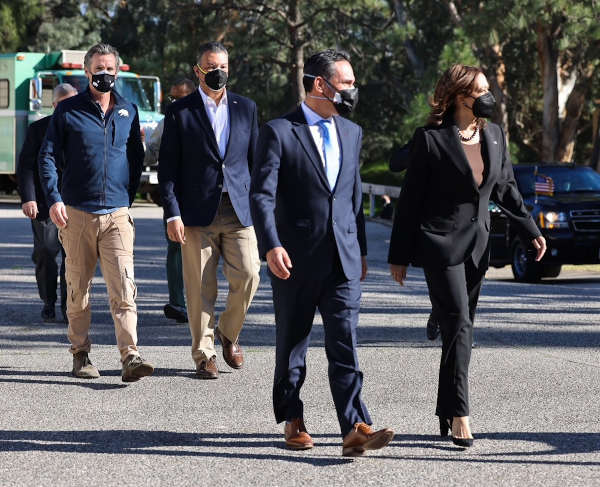
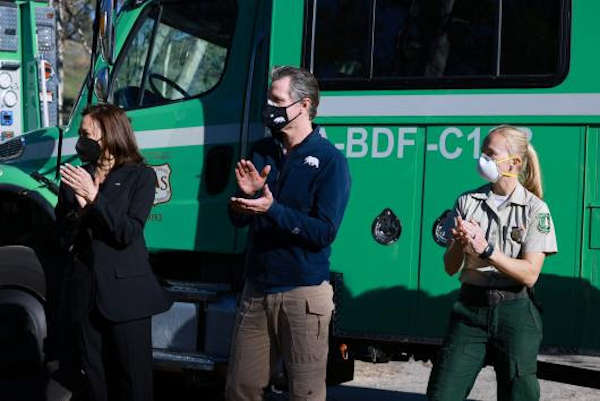
Gov. Gavin Newsom on Friday joined Vice President Kamala Harris and U.S. Agriculture Secretary Tom Vilsack on a visit to the San Bernardino National Forest to highlight new federal funding for wildfire recovery and mitigation efforts and discuss state-federal collaboration to tackle the wildfire crisis, complementing California’s bold investments and ongoing work to build wildfire resilience statewide.
The California Blueprint proposes an additional $1.2 billion as part of a total $2.7 billion multiyear package to step up forest management and other projects to decrease catastrophic wildfire risk amid the extreme climate impacts across the West.
“California is on the front lines of the climate crisis, experiencing record-breaking heat waves, wildfire seasons, and droughts. We’re fortunate to have the Biden-Harris Administration’s partnership in meeting this existential challenge head-on,” said Gov. Newsom. “Our state is leading the nation with transformative investments and innovative strategies to protect Californians and the environment. We look forward to our continued collaboration with the federal government to scale up this vital work, and I thank Vice President Harris for her leadership in this space.”
Vice President Harris announced $1.3 billion in federal funding for post-wildfire and hurricane recovery in states across the country, including $600 million to support California communities hit hard by recent wildfires with cleanup efforts, reforestation, watershed restoration and infrastructure repairs.
In addition, the vice president announced more than $48 million in funding for Joint Chief’s Landscape Restoration Partnership projects — including four in California — that mitigate catastrophic wildfire risk and help create climate-resilient landscapes, protect water quality and enhance wildlife habitat.
Friday’s announcements build on the Biden-Harris Administration’s recently-released 10-year strategy that aligns with the Governor’s Wildfire and Forest Resilience Action Plan.
The strategy calls for the U.S. Forest Service to significantly expand fuels and forest health treatments, prioritizing high-risk areas including the Sierra Nevada Range in California. Joint state-federal management is crucial to California’s overall forest health and wildfire resilience, as the federal government owns 57% of California’s forestlands while the state owns 3 percent.
Following an aerial tour of fire scars from the 2020 El Dorado Fire and Apple Fire, the governor, vice president and Secretary Vilsack joined officials including Sen. Alex Padilla (D-CA) and Rep. Pete Aguilar (D-CA) at the USFS Del Rosa Fire Station for a briefing by state and federal fire officials.
USFS Chief Randy Moore, USFS Regional Forester Jennifer Eberlien, California Natural Resources Agency Secretary Wade Crowfoot and Cal Fire Acting Director Michael Richwine provided an overview of this year’s fire outlook, current drought impacts and the extreme weather conditions that are driving catastrophic wildfires in the Western U.S.
Building on the governor’s previous budget investments in emergency management and executive actions to help combat catastrophic wildfires, the California Blueprint proposes an additional $1.2 billion as part of a total $2.7 billion multiyear investment to step up forest management and other projects to decrease catastrophic wildfire risk.
The blueprint also includes $648 million for firefighters and firefighting equipment, including new fire hawks and helitankers.
In addition, a proposed $175.2 million, as part of a planned $1.1 billion investment over the next five years, will fund major capital outlay projects that include replacing fire stations and making improvements to accommodate Cal Fire’s new helicopter and aircraft fleet.
In 2020, the Newsom Administration and the U.S. Forest Service announced a shared stewardship agreement under which they are working to treat one million acres of forest and wildland annually to reduce the risk of catastrophic wildfire.
The governor last year launched an expanded and refocused Wildfire and Forest Resilience Task Force with federal, local and tribal leaders to deliver on key commitments in his Wildfire and Forest Resilience Action Plan.
Additional information on the California Blueprint’s proposals to advance the state’s climate leadership and protect communities from wildfire, drought, extreme heat and carbon pollution can be found here.
- Details
- Written by: Paul Shafer, Boston University and Katherine Gutierrez, University of New Mexico
The Research Brief is a short take about interesting academic work.
The big idea
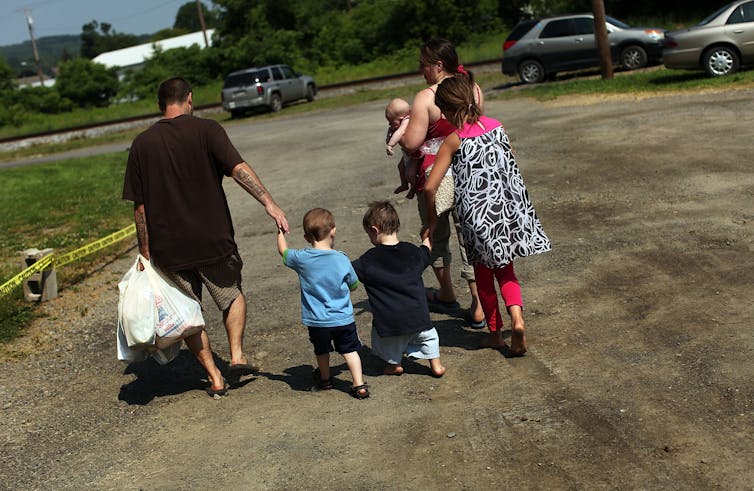
The discontinuation of the Biden administration’s monthly payments of the child tax credit could leave millions of American families without enough food on the table, according to our new study in JAMA Network Open. The first missed payment on Jan. 15, 2022, left families that had come to rely on them wondering how they would make ends meet, according to many news reports.
The American Rescue Plan Act, a $1.9 trillion COVID-19 relief package passed in March 2021, made significant changes to the existing child tax credit. It increased the size of the credit by 50% or more, depending on a child’s age, to either $3,000 or $3,600 per year. It also made more low-income families eligible and paid half of this money out as a monthly “advance” payment.
Biden’s Build Back Better plan calls for a second year of an expanded child tax credit disbursed monthly. But that package of measures stalled in the Senate after passing the House in November 2021. As a result, the monthly advance payments of the child tax credit that American families with children had been receiving since July 2021 were left hanging in the balance.
Nearly 60 million families with children received the first payment, which was sent out in July 2021. The payments were widely credited with bringing about huge declines in poverty and malnutrition. Our study found that the introduction of these advance payments was associated with a 26% drop in the share of American households with children without enough food.
We used nationally representative data from over 585,000 responses to the Census Household Pulse Survey from January through August 2021 to assess how the introduction of the child tax credit advance payments affected food insufficiency in the weeks following the first payment on July 15, 2021. Food insufficiency is a measure of whether a household has enough food to eat. It is a much narrower measure than food insecurity, which is a more comprehensive measure based on 18 questions used by the U.S. Department of Agriculture.
Importantly, we were able to separate the effect of these payments from other types of support, like the use of food pantries, the Supplemental Nutrition Assistance Program, unemployment benefits and COVID-19 stimulus payments.
Why it matters
Food insufficiency spiked during the COVID-19 pandemic, particularly among families with children: It rose from 3% among all households in December 2019 to 18% in December 2020. Even after many, if not most, U.S. families received pandemic stimulus checks and other benefits, food insufficiency still hovered around 14% in June 2021. But following the first advance payment, from July 23 to August 2, 2021, food insufficiency among households with children fell drastically, to 10%.
This support is ending just as the omicron variant of COVID-19 is leaving many families without work, child care and, in many places, child care via in-person instruction at school.
All these factors are leading to lower income and, where school is virtual once again, creating the need for more meals at home. Other analyses of the Census Household Pulse Survey have found that most families were using the child tax credit advance payments for food and other necessities, such as housing and utilities.
What’s next
We are going to look further into how the advance payments affected low-income families through the rest of 2021, analyzing which groups of Americans saw the most benefit and what happened once the advance payments expired in 2022.
[Over 140,000 readers rely on The Conversation’s newsletters to understand the world. Sign up today.]
The full impact of the expansion of the child tax credit for the 2021 tax year has not yet been seen either. Eligible families will get the rest of that money, equal to all six monthly payments combined, when they file their 2021 tax returns this year.
Paul Shafer, Assistant Professor of Health Law, Policy and Management, Boston University and Katherine Gutierrez, PhD Candidate in Economics, University of New Mexico
This article is republished from The Conversation under a Creative Commons license. Read the original article.