 How to resolve AdBlock issue?
News
- Details
- Written by: NATIONAL AERONAUTICS AND SPACE ADMINISTRATION
NASA’s Psyche mission is almost ready for its moment in the Sun — a 1.5-billion-mile solar-powered journey to a mysterious, metal-rich asteroid of the same name.
Twin solar arrays have been attached to the spacecraft body, unfolded lengthwise and then restowed. This test brings the craft that much closer to completion before its August launch.
“Seeing the spacecraft fully assembled for the first time is a huge accomplishment; there’s a lot of pride,” said Brian Bone, who leads assembly, test, and launch operations for the mission at NASA’s Jet Propulsion Laboratory in Southern California. “This is the true fun part. You’re feeling it all come together. You feel the energy change and shift.”
At 800 square feet, the five-panel, cross-shaped solar arrays are the largest ever installed at JPL, which has built many spacecraft over the decades. When the arrays fully deploy in flight, the spacecraft will be about the size of a singles tennis court.
After a 3 ½-year solar-powered cruise, the craft will arrive in 2026 at the asteroid Psyche, which is 173 miles (280 kilometers) at its widest point and thought to be unusually rich in metal. The spacecraft will spend nearly two years making increasingly close orbits of the asteroid to study it.
Venturing to the asteroid belt between Mars and Jupiter, far from the Sun, presents challenges for this mission, which adapted standard Earth-orbiting commercial satellite technology for use in the cold and dark of deep space. Near Earth, the solar arrays generate 21 kilowatts — enough electricity to power three or four average U.S. homes. But at Psyche, they’ll produce only about 2 kilowatts — sufficient for little more than a hair dryer.
The underlying technology isn’t much different from solar panels installed on a home, but Psyche’s are hyper-efficient, lightweight, radiation resistant, and able to provide more power with less sunlight, said Peter Lord, Psyche technical director at Maxar Technologies in Palo Alto, California, where the arrays and solar electric propulsion chassis were built.
“These arrays are designed to work in lowlight conditions, far away from the Sun,” he added.
After the successful installation and deployment of the three center panels inside a clean room at JPL, Psyche’s arrays were folded back against the chassis and stowed for additional spacecraft testing.
The arrays will return to Maxar, which has specialized equipment to test the deployment of the two perpendicular cross panels. Later this spring, the arrays will be reunited with the spacecraft at NASA’s Kennedy Space Center in Florida and stowed for launch from Cape Canaveral.
About an hour after launch, the arrays will deploy and latch into place in a process that will take 7 ½ minutes per wing. They will then provide all the power for the journey to asteroid Psyche, as well as the power needed to operate the science instruments: a magnetometer to measure any magnetic field the asteroid may have, imagers to photograph and map its surface, and spectrometers to reveal the composition of that surface.
The arrays also power the Deep Space Optical Communications technology demonstration that will test high-data-rate laser communications.
What those instruments relay to scientists will help them better understand the mysterious asteroid. One possible explanation for Psyche’s unusually high metal content is that it formed early in our solar system’s history, either as remnant core material from a planetesimal — one of the building blocks of rocky planets — or as primordial material that never melted.
This mission aims to find out, and to help answer fundamental questions about Earth’s own metal core and the formation of our solar system.
Arizona State University leads the Psyche mission. JPL, which is managed for NASA by Caltech in Pasadena, California, is responsible for the mission’s overall management, system engineering, integration and test, and mission operations. Maxar is providing the high-power solar electric propulsion spacecraft chassis. Psyche was selected in 2017 as the 14th mission under NASA’s Discovery Program.
For more information about NASA’s Psyche mission go to http://www.nasa.gov/psyche and https://psyche.asu.edu/.
- Details
- Written by: LAKE COUNTY NEWS REPORTS
The California Nurses Association/National Nurses United said the picket in Lakeport will take place at the hospital from 9 to 10:30 a.m. Tuesday, March 15.
“We have been on the front lines before and during this pandemic,” said Amy Erb, critical care RN at California Pacific Medical Center of San Francisco. “Throughout this time, we have witnessed Sutter Health become profitable while they refuse to invest in the resources we need in order for us to provide safe and effective care to our patients and community.”
Nurses notified Sutter Health corporate officials on March 4 that they would hold an informational picket.
The unions said Sutter Health RNs have been in contract negotiations since June 2021 for a new contract with little to no movement on key issues.
The RNs are asking Sutter’s management to invest in nursing staff and agree to a contract that provides safe staffing that allows nurses to provide safe and therapeutic care; pandemic readiness protections that require the hospitals to invest in personal protective equipment stockpiles and comply with California's PPE stockpile law; presumptive eligibility for workers’ compensation that covers infectious diseases and protocols that ensure nurses have the resources needed to keep their patients and themselves safe; and workplace violence protections that include plans to mitigate and prevent violence within the hospitals and comply with the state's workplace violence prevention law.
“Sutter Health is not investing in us, the nurses, or the community they should be serving,” said Renee Waters, RN in the trauma neuro intensive care unit at Sutter Roseville. “Instead, they are frequently using the word ‘commitment’ in their responses to us without actually agreeing to proposals that hold them accountable. Sutter failed us during the pandemic. Our proposals are intended to correct Sutter’s gaps in pandemic readiness and workplace violence prevention. We want to have a proactive approach to the protections we deserve. We need Sutter to back up their statements that we are heroes and valued, with agreements to our proposals at the bargaining table.”
- Details
- Written by: Elizabeth Larson
Daylight Saving Time begins at 2 a.m. Sunday, March 13.
California goes from Pacific Standard Time to Pacific Daylight Time when clocks “spring forward” by one hour.
Besides adjusting the clock, fire officials urge community members to use the beginning of Daylight Saving Time to remember to change batteries in smoke and carbon monoxide detectors as well as in NOAA weather radios.
This year, Daylight Saving Time ends on Sunday, Nov. 6.
Email Elizabeth Larson at
- Details
- Written by: Scott L. Montgomery, University of Washington
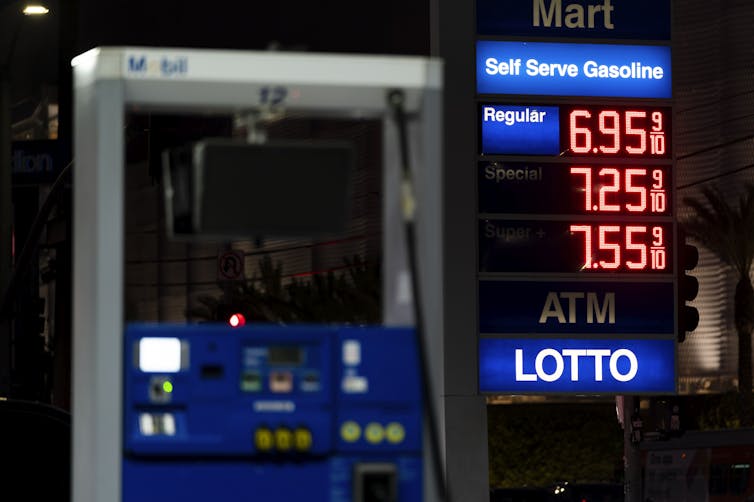
The world is in the grip of an oil price shock. In just a few months, prices have risen from US$65 a barrel to over $130, causing fuel costs to surge, inflationary pressure to rise and consumer tempers to flare. Even before Russia’s invasion of Ukraine, prices were climbing rapidly because of roaring demand and limited supply growth.
Price shocks aren’t new. Viewed historically, they are an integral part of oil market dynamics, not anomalies. They have occurred since the birth of the industry.
Many factors can trigger oil price shocks. They include large shifts in either demand or supply anywhere in the world, since oil is a global commodity. Shocks can also result from war and revolution; periods of rapid economic growth in major importing nations; and domestic problems in supplier countries, such as political conflict or lack of investment in the oil industry. Overall, the worst spikes have combined two or more of these factors – and that’s the situation today.
50 years of ups and downs
Global oil production began in the mid-1800s and grew rapidly in the first half of the 20th century. For much of that time, oil majors – companies like Chevron, Amoco and Mobil that were created after the Supreme Court ordered the breakup of Standard Oil in 1911 – operated effectively as a cartel, maintaining production at levels that kept oil abundant and cheap to encourage its consumption.
This ended when Iran, Iraq, Kuwait, Saudi Arabia and Venezuela formed the Organization of Petroleum Exporting Countries in 1960, nationalizing their oil reserves and gaining real supply power. Over the following decades, other nations in the Middle East, Asia, Africa and Latin America joined – some temporarily, others permanently.
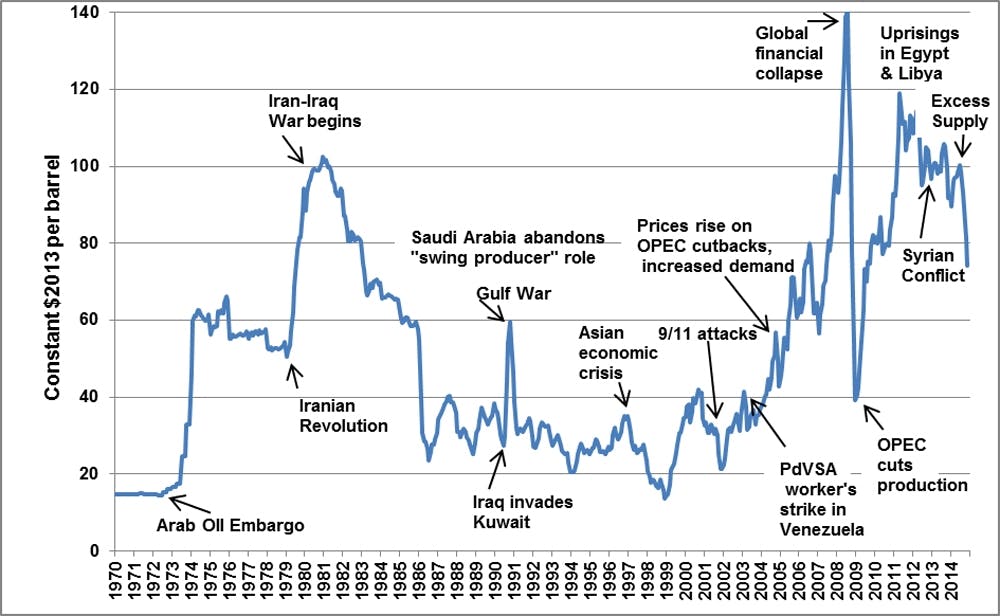
In 1973, Arab members of OPEC cut their oil production when Western countries supported Israel in the Yom Kippur War with Egypt and Syria. World oil prices shot up fourfold, from an average of $2.90 per barrel to $11.65.
In response, government leaders in wealthy countries introduced policies to stabilize oil supplies. These included finding more oil, investing in energy research and development, and creating strategic oil reserves that governments could use to mitigate future price shocks.
But six years later, oil prices more than doubled again when Iran’s revolution halted that country’s output. Between mid-1979 and mid-1980, oil rose from $13 per barrel to $34. Over the next several years, a combination of economic recession, replacing oil with natural gas for heating and industry, and shifting to smaller vehicles helped to mitigate oil demand and prices.
The next major shock came in 1990 when Iraq invaded Kuwait. The United Nations imposed an embargo on trade with Iraq and Kuwait, which raised oil prices from $15 per barrel in July 1990 to $42 in October. U.S. and coalition troops moved into Kuwait and defeated the Iraqi army in just a few months. During the campaign, Saudi Arabia increased oil production by more than 3 million barrels per day, roughly the amount previously supplied by Iraq, to help dampen the increase and shorten the period of higher prices.

More disruptive price shocks occurred in 2005-2008 and 2010-2014. The first resulted from increased demand generated by economic growth in China and India. At that time, OPEC was unable to expand production due to long-term lack of investment.
The second shock reflected the impacts of Arab Spring pro-democracy protests in the Middle East and North Africa, combined with conflict in Iraq and international sanctions that Western nations placed on Iran to slow its nuclear weapons program. Together, these events pushed oil prices above $100 per barrel for a four-year stretch – the longest such period on record. Relief finally came via a flood of new oil from shale production in the U.S..
A pefect storm in 2022
Today, multiple factors are raising oil prices. There are three key elements:
-
Oil demand has grown more rapidly than expected in recent months as countries emerged from pandemic lockdowns.
-
OPEC+, a loose partnership between OPEC and Russia, has not raised production at a commensurate level, and neither have U.S. shale oil companies.
-
Countries have drawn on stocks of oil and fuel to fill the supply gap, reducing this emergency cushion to low levels.
These developments have made oil traders worry about looming scarcity. In response, they have bid oil prices up. It’s worth noting that while consumers often blame oil companies (and politicians) for high oil prices, these prices are set by commodity traders in venues such as the New York, London and Singapore stock exchanges.
Against this backdrop, Russia attacked Ukraine on Feb. 24, 2022. Traders saw the potential for sanctions on Russian oil and gas exports and bid energy prices even higher.
Unexpected factors also have emerged. Major oil companies including Shell, BP and ExxonMobil are ending their operations in Russia. Spot market buyers have rejected seaborne Russian crude, probably for fear of sanctions.
And on March 8, the U.S. and U.K. governments announced bans on imports of Russian oil. Neither country is a major Russian buyer, but their actions set a precedent that some analysts and traders fear could lead to escalation, with Russia reducing or eliminating exports to U.S. allies.
In my view, this set of conditions is unprecedented. It reflects not just increased complexity in the global market, but also an imperative for energy firms – which already are under pressure from shareholder climate activists – to avoid further reputational damage and leave one of the most oil-rich countries in the world. Some companies, such as BP, are abandoning assets worth tens of billions of dollars.
What could ease this shock?
As I see it, the key players that can help curtail this price shock are OPEC – mainly, Saudi Arabia – and the U.S. For these entities, holding back oil supply is a choice. However, there’s no evidence yet that they are likely to change their positions.
Restoring the Iran nuclear deal and lifting sanctions on Iranian oil would add oil to the market, though not enough to greatly reduce prices. More output from smaller producers, such as Guyana, Norway, Brazil and Venezuela, would also help. But even combined, these countries can’t match what the Saudis or the U.S. could do to increase supply.
All of these uncertainties make history only a partial guide to this oil shock. Currently there is no way to know how long the factors driving it will last, or whether prices will go higher. This isn’t much comfort to consumers facing higher fuel costs around the world.
[Climate change, AI, vaccines, black holes and much more. Get The Conversation’s best science and health coverage.]
Scott L. Montgomery, Lecturer, Jackson School of International Studies, University of Washington
This article is republished from The Conversation under a Creative Commons license. Read the original article.