 How to resolve AdBlock issue?
News
- Details
- Written by: California Department of Fish and Wildlife

Late spring and early summer is the peak time for California’s deer herds to give birth to fawns, and the California Department of Fish and Wildlife, or CDFW, is issuing a reminder to well-intentioned people to not interact with the baby deer — even if they find one that appears to be abandoned.
Adult female deer often stash their fawns in tall grass or brush for many hours while they are out foraging for food.
“Each year dozens of fawns across the state have their lives shortened by well-meaning residents,” said Axel Hunnicutt, Siskiyou unit biologist with CDFW’s Northern Region. “For the first several weeks of their lives, young deer are left for extended periods by their mother as a survival strategy. People who interfere with this process always mean well but end up disrupting nature and the life of both mother and fawn.”
Each year, CDFW and wildlife rehabilitation facilities are called to assist with fawns that have been removed from the wild by concerned members of the public recreating outdoors.
With limited long-term placement options in zoos or other wildlife sanctuaries, the animals often have to be euthanized since they lack the survival skills to be released back into the wild and can become dangerous and difficult to keep as they become bigger.
To report an injured, sick or suspected orphaned fawn, contact your local CDFW regional office directly.
Anyone who removes a young animal from the wild is required to notify CDFW or take the animal to a permitted wildlife rehabilitator within 48 hours. Only a limited number of wildlife rehabilitation facilities are licensed to accept fawns.
It is both illegal to feed deer and keep deer in your personal possession. Both crimes are misdemeanors, each subject to penalties of up to $1,000 and/or six months in jail.
Learn more about the dangers and consequences of feeding deer in the CDFW video below.
Deer PSA from barbara daLY on Vimeo.
- Details
- Written by: Preston Dyches
What are some skywatching highlights in May 2022?
May provides some great planet spotting, including a close conjunction of Jupiter and Mars. At mid-month, a total eclipse of the Moon should delight skywatchers across the Americas, Europe, and Africa.
And all month long, the Coma star cluster (aka, the Coma Berenices star cluster, or Melotte 111) is a great target for binoculars in the evening.
May begins and ends with a couple of great planet-spotting opportunities. On May 2, look to the west about 45 minutes after sunset to find Mercury about 10 degrees off the horizon, accompanied by a slim crescent moon.
Just to the south of the Moon is brilliant red giant star Aldebaran, which should be roughly the same brightness as Mercury. (And by the way, this is the only chance to spot a naked-eye planet in the early evening until August.)
Then in the last week of May, you can watch each morning as Jupiter and Mars get increasingly close in the predawn sky. Their morning meetup culminates in a close conjunction that you can watch on May 28 through 30, where they'll be separated by barely the width of the full moon. Should look incredible with binoculars, where you can also see Jupiter's largest moons.
Skywatchers in the Western Hemisphere can look forward to a total lunar eclipse in mid-May. The event will be visible across the Americas, Europe, and Africa — basically anywhere the Moon is above the horizon at the time.
The visible part of the eclipse begins about 10:30pm U.S. Eastern time on May 15, with totality starting an hour later and lasting for about an hour and a half.
Those in the Eastern U.S. will see the eclipse start with the Moon well above the horizon. For the Central U.S., the eclipse starts about an hour and a half after dark, with the Moon relatively low in the sky. On the West coast of the U.S., the Moon rises with totality beginning or already underway, so you'll want to find a clear view toward the southeast if viewing from there.
Now, lunar eclipses are the ones that are safe to look at directly with your eyes, binoculars, or a telescope (unlike solar eclipses).
The Moon takes on a dim, reddish hue during the period of totality. Even though the Moon is fully immersed in Earth's shadow at that time, red wavelengths of sunlight filter through Earth's atmosphere and fall onto the Moon's surface. One way to think of this is that a total lunar eclipse shows us a projection of all the sunrises and sunsets happening on the planet at that moment.
So check your local details for this eclipse, and find lots more eclipse info from NASA at the address on your screen.
Finally in May, a really nice target for binoculars: the Coma star cluster. This loose, open star cluster displays 40 or 50 stars spread over a region of sky about three finger-widths wide. The brightest stars in the cluster form a distinctive Y shape, as seen here.
The Coma star cluster is located about 300 light years away, making it the second closest open cluster to Earth after the Hyades cluster in Taurus.
To find the Coma star cluster, look southward for the constellation Leo. It can be easiest to start from the Big Dipper, toward the north, and use the two "pointer stars" on the end which always point you toward Leo.
Once you've identified Leo, the Coma star cluster is about 15 degrees to the east of the triangle of stars representing the lion's hindquarters. It's relatively easy to find with binoculars, even under light-polluted urban skies — as long as it's clear out.
So here's wishing you clear skies for finding the Coma star cluster and any other wonders you discover in the night sky in May.
Stay up to date with all of NASA's missions to explore the solar system and beyond at nasa.gov.
Preston Dyches works for NASA's Jet Propulsion Laboratory.
- Details
- Written by: Elizabeth Larson
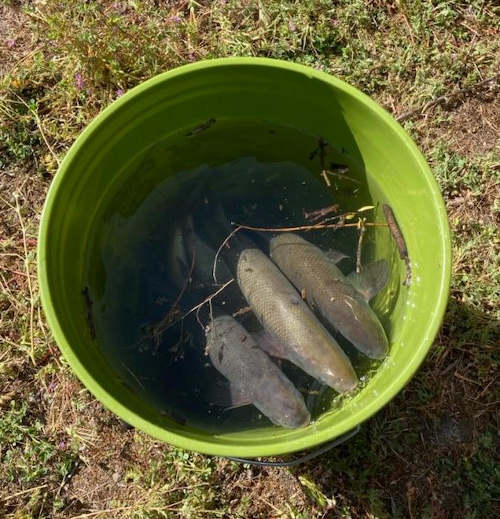
LAKE COUNTY, Calif. — Lake County’s drought conditions led this week to the need to rescue hundreds of threatened native fish.
Lake County Water Resources staff and the California Department of Fish and Wildlife, working alongside of Robinson Rancheria and Habematolel Pomo tribal members, leapt to the rescue on Thursday when it was reported that there were Clear Lake hitch in an isolated pool in Adobe Creek near Soda Bay in Lakeport.
The hitch, a large minnow found only in Clear Lake and its tributaries, has been a culturally important fish for the Pomo tribes, which considered it a staple food.
However, in recent decades it has significantly declined in numbers.
In 2014, the hitch was listed as a threatened species under the California Endangered Species Act.
A federal endangered species listing was denied for the hitch in December 2020 but is now the basis of a lawsuit filed in August by the Center for Biological Diversity, which submitted both the state and federal listing petitions for the hitch in an effort to save it.
Lake County Water Resources reported that the low water levels, warm weather and groundwater use can cause streams to dry up more quickly than usual at this time of year.
That’s a problem for hitch and other fish that are swimming up streams to spawn.
“This sometimes leaves isolated, non-connected pools or runs in streams around Clear Lake. Any fish caught in these isolated pools can't access the Lake and sometimes, they can die when the pool dries up later in spring or summer,” Lake County Water Resources reported on its Facebook page.
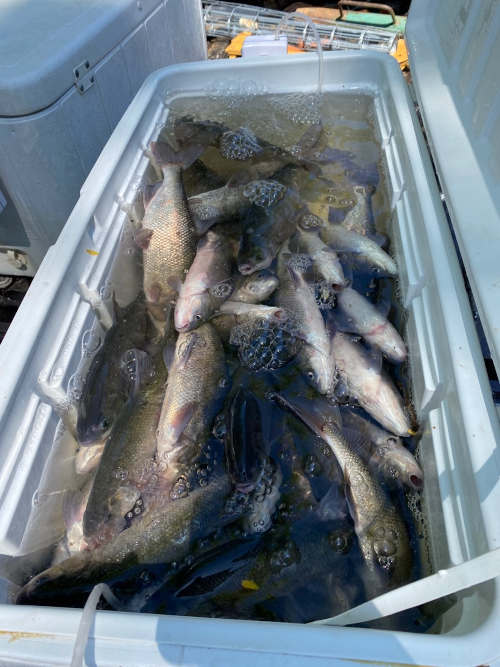
Lake County Water Resources said Friday that, in all, 240 hitch were rescued.
The agency credited the successful rescue of the fish to a fast and coordinated effort between its staff, the state Department of Fish and Wildlife and the tribal partners.
The team of rescuers was able to move the hitch, one by one, using backpack electroshockers — which stun the fish without harming them — buckets and nets.
They put the fish into aerated coolers and drove them to a site near Konocti Vista Casino and Resort Marina in Lakeport where the fish were released into Clear Lake.
Water Resources said no fish died during the rescue, and all reports on the released hitch were positive.
Community members who see stranded fish in isolated pools or disconnected creeks are asked to contact Water Resources to help the fish.
That’s because officials emphasized that only permitted fisheries professionals from the state Department of Fish and Wildlife are allowed to conduct and supervise hitch rescues at this time. Any other type of hitch handling in streams is illegal.
Water Resources staffer Angela DePalma-Dow, who also writes the twice-monthly “Lady of the Lake” column for Lake County News, said they are encouraging reporting of strandings in the hope of saving more fish.
She said they also want to discourage illegal dumping in streams and creeks. “We see a lot of trash out there.”
If you see any stranded fish in creeks, call Water Resources at 707-263-2344 or message them on Facebook and they will investigate to see if a rescue is needed.
Email Elizabeth Larson at
- Details
- Written by: Elizabeth Larson
The City of Clearlake Animal Association also is seeking fosters for the animals waiting to be adopted.
Call the Clearlake Animal Control shelter at 707-273-9440, or email
Visit Clearlake Animal Control on Facebook or on the city’s website.
The following dogs are available for adoption.

‘Captain’
“Captain” is a male border collie mix with a black, white and blue coat.
He is dog No. 49623709.

‘Big Phil’
“Big Phil” is a 13-year-old male American pit bull terrier mix with a blue coat.
He is dog No. 49951647.

‘Andy’
“Andy” is a male American pit bull mix with a short gray and white coat.
He is dog No. 48995415.

‘Bear’
“Bear” is a male Labrador retriever-American pit bull mix with a short charcoal and fawn coat.
He has been neutered.

‘Chai’
“Chai” is a female Alaskan husky mix with a gray and white coat.
She has been spayed.
She is dog No. 49279552.

‘Colt’
“Colt” is a male Rhodesian Ridgeback mix with a short rust and black coat.
He has been neutered.
He is dog No. 49812106.

‘Fritz’
“Fritz” is a male Australian shepherd mix with a black and white coat.
He is dog No. 49278179.

‘Snowball’
“Snowball” is a male American Staffordshire mix terrier with a white coat.
He has been neutered.
He is dog No. 49159168.

‘Terry’
“Terry” is a male shepherd mix with a short brindle coat.
He is dog No. 48443693.
Email Elizabeth Larson at