 How to resolve AdBlock issue?
News
- Details
- Written by: Elizabeth Larson
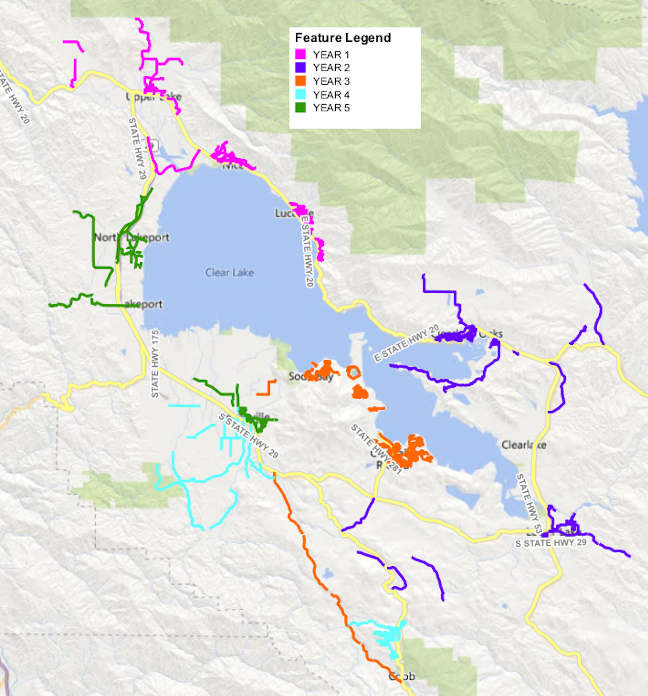
LAKE COUNTY, Calif. — The Lake County Public Works director has presented a plan to the Board of Supervisors that proposes to complete more than $84 million in roadwork over the coming five years.
Director Scott De Leon presented the 5-Year Pavement Rehabilitation Plan to the supervisors at their April 26 meeting.
He said he’s excited about the plan, which gives the county a path and a visual for taking on millions of dollars in needed road work and improvements.
De Leon, who acknowledged that he makes a lot of reports and presentations, told the supervisor, “This is perhaps the most important presentation I’ve made to this board or any boards in my career as the Public Works director.”
He said the plan has been a long time coming, and he hopes it’s a step toward changing the conditions of Lake County’s roads.
However, he acknowledged, “This is going to be a pretty expensive proposition.”
Public Works maintains over 600 miles of road, a couple hundred bridges and thousands of culverts, De Leon said.
“Historically, we’ve been reactionary,” he explained, with the department focusing on patching potholes and responding to safety concerns.
When funding becomes available, they do pavement preservation or capital improvement projects, many of which are grant driven. De Leon said the discretionary funding that they have through the gas tax is limited.
By the time they pay for equipment, labor and materials, they don’t have a lot of money to do large scale pavement projects. However, De Leon said they are seeing an increase in funding with SB 1.
De Leon said he felt it was time to start looking ahead, be less reactionary and begin planning for the future. He went to the board in October and asked them to approve a contract with NCE, the preeminent pavement engineering company, which has a lot of history in Lake County.
NCE subsequently put together the five-year pavement rehabilitation plan for the county, De Leon said.
Initially, De Leon said Public Works wanted to pursue a pavement condition index target of 70 in five years. He said they knew it was going to be extremely ambitious.
NCE looked at that proposal and had not gotten too far into their study when they called Public Works and said they didn’t think it was financially attainable. That’s because the estimated cost was put at $174 million.
“That’s just not really an option,” said De Leon.
So they lowered the target to a pavement condition index of 50 in five years. De Leon said that would be better than the county’s current pavement condition index, which is hovering in the mid 30s.
Next, De Leon wants to hire a consultant to develop plans and specifications based on the list of roads the plan contains in order to begin preliminary environmental work. That, in turn, will ensure Public Works is prepared to pursue funding opportunities when they arise.
The plan gives the annual breakdown as follows:
• 2023: $15 million, focus on the Northshore.
• 2024: $15.4 million, areas would include Clearlake Oaks, Lower Lake and some roadways along Highway 175 in Cobb.
• 2025: $17.8 million, Buckingham, Soda Bay, Kelseyville Riviera, Riviera West, Cobb.
• 2026: $18.2 million, areas in and around Cobb, Kelseyville proper and Middletown.
• 2027: $18.1 million, north Lakeport and Kelseyville.
Public Works is very close to being able to handle the first year of the plan with some reserves they have developed over the last couple of years, De Leon said. Several projects that have been placed in year two, including some projects in the Clearlake Oaks area, will actually be handled by crews this summer.
When NCE established the road work list, they wanted to group neighborhoods and treatment types together, with the plan being community focused. De Leon said they roughly allocated 50% of available funding for local streets and roads, then to arterials.
All roads with a pavement condition index of less than 25, which means that the road has basically failed, were included in the plan. “Historically, we have not done that,” De Leon said, explaining that if roads failed, they would instead work on other roads.
The first year of the plan, 2023, focuses predominantly on the Northshore, with work set to take place in the communities of Nice, Lucerne and Upper Lake, De Leon said.
De Leon said Public Works needs to contact utility companies to make them aware that there is a plan to rebuild the roads in their area and that if they have projects, they need to get them done now. That’s because once the roads are reconstructed and repaved, no encroachment or retrenching permits will be issued for five years.
Supervisor Bruno Sabatier suggested having De Leon return between years three and four years for review, and to have another five-year plan ready to go for continuity. De Leon agreed.
De Leon said the road department has been setting aside funds and reserves in expectation of needing a lot of money for a big project. For 2023, they will be getting close to the necessary $15 million for that year’s road work. However, in the years after that, getting the money will be more of a challenge.
The road department will have an estimated $5 million in discretionary funding to put toward projects annually. However, De Leon said there’s a shortfall, as the department’s annual projects total $15 million to $17 million.
He said they need to find more money and go after every grant that’s available. So he’s spoken to administrative and auditor-controller staff, who have told him about capital improvement funding programs.
De Leon also raised the proposal for a sales tax. A half-cent sales tax could bring in an additional $2 million a year for road projects. He pointed to the city of Clearlake’s success with its Measure V road sales tax.
Sabatier asked about De Leon’s next steps. De Leon said he wants to hire a consultant to begin design work. And while he hadn’t initially planned to seek the board’s formal acceptance, he agreed to do so.
County Counsel Anita Grant suggested that he might seek formal approval by coming back with a resolution. Sabatier said he liked formalizing the plan with a resolution, as it holds the county accountable.
Grant added that the resolution can speak to the need for flexibility in how the plan is carried out.
Email Elizabeth Larson at
- Details
- Written by: LAKE COUNTY NEWS REPORTS
In a Wednesday statement, Dr. Erik McLaughlin said state and local public health professionals are closely watching COVID-19 and doing their best to preserve the health and wellbeing of our communities.
“At this time, it is important to keep in mind that the COVID-19 pandemic is ongoing and is still changing from week to week, as new variants develop and more information is learned,” McLaughlin said.
McLaughlin pointed to a global increase in cases due to the spread of recently discovered variants such as BA.4 and BA.5, which are variants of Omicron.
“Once again, we are seeing concerning information coming out of South Africa where they are experiencing a 173% increase in cases and 20% of all COVID-19 tests administered are coming back positive,” McLaughlin said. “Sadly, hospitalizations have increased by 63% there. However, the number of those being hospitalized with severe illness remains much lower compared to previous surges, as do death rates.”
In the United States, there is a 49% increase in cases mostly from the BA.2.12.1 variant. McLaughlin said the newer variants of Omicron such as BA.4 and BA.5 are active in the U.S, but at lower levels.
“This will likely change in the next few weeks,” he said.
He said the Northeastern region of the nation continues to have the highest numbers of new cases. Puerto Rico has shown a 271% increase in cases over the last two weeks, with Puerto Rico seeing a 120% increase in hospitalizations.
In California, McLaughlin said there are 4,302 new cases and 14 deaths per day, with 3.1% of all COVID-19 tests administered having tested positive.
“Case counts are slowly increasing, along with hospitalizations and death rates. However, this is not nearly as severe as previous surges such as the Delta variant,” he said.
In Lake County, COVID-19 cases also are increasing slightly, McLaughlin said.
He said there is no significant increase in hospitalizations and there have been 10 new cases since last week, with 2.7% of all COVID-19 tests administered coming back positive.
As of Thursday, Lake County had a total of 137 deaths and 10,758 cases, according to the state’s COVD-19 dashboard.
As case rates rise nationally, McLaughlin said oral antiviral treatments for COVID-19 are also increasingly available in Lake County by prescription from a health care provider.
McLaughlin said medications can reduce the chance of severe illness, hospitalization or death when taken soon after symptom onset. An oral five-day course of Paxlovid, for example, has been shown to reduce hospitalization risk by 89% in higher-risk individuals when initiated within five days of symptom onset.
Lake County Health Services is promoting awareness and access to potentially life-saving treatments for COVID-19 infections for residents who are at highest risk for severe outcomes.
While vaccination continues to provide the best protection against COVID-19, ensuring access to therapeutics to treat the virus can reduce the chance of severe illness, hospitalization or death, when taken soon after the onset of symptoms.
Lake County Health Services recommends that residents who are at higher risk for serious outcomes should have home test kits available and test promptly for any COVID-19 symptoms and if positive, reach out to their medical provider to discuss a possible prescription for oral antiviral medication.
Medical providers across the county are equipped to review with patients whether treatment is indicated and prescribe medication in one of several Lake County pharmacies that carry COVID-19 treatments.
Both testing and treatment are time-sensitive to be fully effective, McLaughlin said.
- Details
- Written by: CALIFORNIA HIGHWAY PATROL
The California Highway Patrol emphasizes the importance of paying close attention to a motorcycle rider’s location, sharing the roadway and working together to keep all motorists safe as we travel throughout the state.
“Motorcycle riders statistically face greater danger than other motorists,” said CHP Commissioner Amanda Ray. “Safe riding practices and cooperation from all road users will greatly help reduce the number of fatalities and injuries.”
In 2020, the CHP responded to approximately 6,500 crashes involving a motorcycle. Nearly 80% of those crashes involved an injury and 328 motorcyclists tragically lost their lives.
As part of May’s Motorcycle Safety Awareness Month, the CHP will employ education and enforcement efforts to help call attention to the dangers and vulnerabilities motorcyclists face on the road.
As motorcyclists are often vulnerable on the road and may be difficult to see, riders should always be keenly aware of their surroundings, follow all traffic laws, and wear protective clothing, including a legally required U.S. Department of Transportation-approved helmet.
To help both new and experienced riders understand the laws and refine their safe riding skills, the CHP is proud to oversee California’s official motorcycle training program.
Students who pass the California Motorcyclist Safety Program will be issued a Certificate of Completion of Motorcycle Training, which may be used to waive the motorcycle skills test at the Department of Motor Vehicles.
Graduates would only be required to pass the DMV knowledge test to receive the motorcycle endorsement.
For more information or to register for a California Motorcyclist Safety Program training course near you, please visit https://motorcyclesafetyca.com.
- Details
- Written by: Caltrans
As stormwater travels into storm drains, it captures pollutants from highways, streets, sidewalks and yards that flow into waterways.
The top six pollutants have an outsized impact on the water quality of lakes, rivers, streams and the ocean, and many are preventable through small actions Californians can take.
The following lists the top six pollutants and actions to stop them at the source:
• Trash and litter: Properly secure items in truck beds and put trash and recycling in the correct bin.
• Sediments: Prevent soil erosion by using mulch in the garden, planting trees and shrubs, and sweeping driveways instead of hosing them off.
• Nutrients: Avoid overfertilizing lawns and plants and limit vegetation waste by keeping fallen leaves out of storm drains.
• Bacteria: Limit pet and RV waste by picking up after your pet and using appropriate RV dumping stations.
• Metals: Regularly check tire pressure, change oil and fluids, and use commercial car washes to prevent metals generated from vehicle, tire, and brake wear from ending up on highways.
• Pesticides: Use organic pesticides and properly dispose of unused portions.
Caltrans is tasked with managing stormwater runoff and mitigating pollution within its 350,000 acres of right of way, which includes more than 15,000 centerline miles of highways.
This effort involves picking up roadside litter and clearing out storm drains to preserve roadway safety and drivability during all types of weather conditions.
Unlike water that goes down the sink or toilet in a home, stormwater is untreated and flows directly into lakes, rivers and other waterways. Stopping pollutants at the source is critical Caltrans’ efforts to keep stormwater runoff clean
“Preventing stormwater pollution requires the help and support of every Californian, and it starts with keeping highways and roadways clean,” said Steven Keck, acting director of Caltrans. “Californians must work together to take necessary steps to prevent pollution at the source and keep our waterways clean.”
Summer is the peak season for recreation in and around local waterways. This year, as hot, dry weather is expected to intensify drought conditions throughout the state, Caltrans is amplifying water quality as a top priority.
During a drought, the state’s lakes, rivers, and streams have lower water levels, which leads to a higher concentration of pollutants. By preventing a buildup of metals, trash and other pollutants on highways and roadways in dry conditions, Californians can help keep pollutants from traveling into local waterways during rainstorms.
The “Let’s Change This to That” stormwater public education campaign is calling on Californians to pledge to do their part to keep stormwater clean. Visit CleanWaterCA.com to take the pledge and learn more about the sources and pathways of stormwater pollution.