 How to resolve AdBlock issue?
News
- Details
- Written by: Lake County Association of Realtors
In March, 117 total homes sold through the multiple listing service last month, compared to 68 in February. These include traditionally built “stick-built” houses as well as manufactured homes on land.
There were seven sales of mobile homes in parks in March, unchanged from February, and 31 bare land (lots and acreage) sales, compared with 60 in February.
Homes bought for all cash totaled 36%, compared to 28% in February, while 32% were financed by Fannie Mae or Freddie Mac (“conventional loans”) compared to 41% in February. Twenty percent were financed by FHA, compared to 13% the previous month.
At the end of April there were 281 homes on the market, compared to 197 in March. If the rate of sales stays the same at 117 homes sold per month, there are currently 2.4 months of inventory on the market at the moment.
That means that if no new homes are brought to the market for sale, in 2.4 months all of these homes would be sold and there would be none available.
Less than six months of inventory is generally considered to be a “sellers’ market” while more than six months of inventory is often called a “buyers’ market.”
Most homes were selling very close to the asking price, at 98% of the asking price. This is in contrast to other areas, where homes sell for more than the asking price.
The median time on the market in March was 14 days, very similar to last year.
The median price of a single family home in Lake County at the end of April was $330,500, the association reported.
- Details
- Written by: GOVERNOR’S OFFICE
Newsom’s office said his administration is continuing its efforts to maintain and improve availability of safe and accessible reproductive health care services and prepare for a potential influx of people from other states seeking reproductive health care and abortion services.
“California will not stand idly by as extremists roll back our basic constitutional rights; we’re going to fight like hell, making sure that all women — not just those in California — know that this state continues to recognize and protect their fundamental rights,” said Newsom. “We’re expanding access to these critical services, welcoming businesses and their employees fleeing anti-abortion states, and reaffirming our commitment to continuing to work closely with the Legislature and reproductive rights stakeholders to further solidify California’s leadership on abortion rights.”
Newsom’s reproductive health package includes $125 million to further bolster California’s health care infrastructure, expand access to services for patients and help prepare for the influx of people seeking reproductive health care from other states.
The package, which would add $57 million to January's $68 million proposal, includes the following:
• Cover uncompensated care for peoples uninsured for abortion services: $40 million for grants to reproductive health care providers to offset the cost of providing care to low- and moderate-income individuals who do not have health care coverage for abortion care services.
• California Reproductive Justice & Freedom Fund: $15 million for grants to community-based reproductive health, rights, and justice organizations to conduct medically accurate and culturally competent outreach and education on sexual health and reproductive health issues.
• Comprehensive reproductive rights website: $1 million to develop and maintain a website that provides accurate and updated information to the public on the right to abortion under state law, information about reproductive health care providers, and options for coverage for reproductive health services, including state-funded coverage and programs.
• Research on the unmet needs for reproductive health care services. $1 million for research regarding the unmet needs for access to reproductive health care services.
These new proposed investments build off of Governor Newsom’s California Blueprint in January, a $68 million package to:
• Invest in reproductive health clinical infrastructure: To support California’s clinical infrastructure of reproductive health care services, the blueprint included $20 million to provide scholarships and loan repayments to health care providers that commit to providing reproductive health care services.
• Capital infrastructure, improved security: The blueprint included $20 million to assist reproductive health care facilities in securing their physical and information technology infrastructure and to enhance facility security.
• Make reproductive health care more affordable: The blueprint included $20 million to subsidize the cost of abortion care for Covered California consumers due to federal payment limitations for abortion coverage.
• Remove barriers for reproductive health: To make it easier to get the medical care needed for family planning and reproductive health, the Blueprint removed Medi-Cal requirements for in-person follow-up visits and ultrasounds if not medically necessary.
• Family Planning, Access, Care and Treatment (PACT) HPV Vaccine Coverage: The blueprint included $8 million to add the human papillomavirus vaccine as a covered benefit under the Family PACT program, effective July 1, 2022.
Newsom also is proposing incentive opportunities for businesses to relocate to California or grow jobs and their economic footprint here from states with anti-abortion and anti-LGBTQ+ laws.
He plans to update existing business incentive programs to provide additional consideration for companies leaving states that have enacted restrictions on reproductive rights and anti-LGBTQ+ laws. Newsom’s office said he is “welcoming companies that share California’s values and doubling down on the diversity that makes our economy a global leader.”
- Details
- Written by: Kavita Babu, UMass Chan Medical School
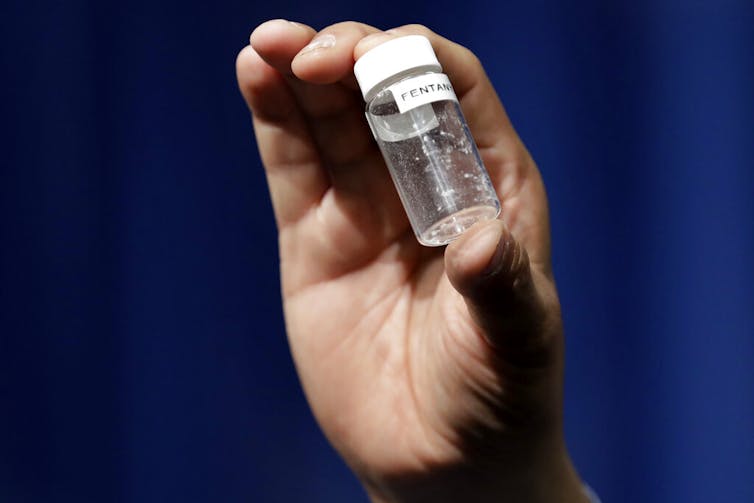
Buying drugs on the street is a game of Russian roulette. From Xanax to cocaine, drugs or counterfeit pills purchased in nonmedical settings may contain life-threatening amounts of fentanyl.
Physicians like me have seen a rise in unintentional fentanyl use from people buying prescription opioids and other drugs laced, or adulterated, with fentanyl. Heroin users in my community in Massachusetts came to realize that fentanyl had entered the drug supply when overdose numbers exploded. In 2016, my colleagues and I found that patients who came to the emergency department reporting a heroin overdose often only had fentanyl present in their drug test results.
As the Chief of Medical Toxicology at UMass Chan Medical School, I have studied fentanyl and its analogs for years. As fentanyl has become ubiquitous across the U.S., it has transformed the illicit drug market and raised the risk of overdose.
Fentanyl and its analogs
Fentanyl is a synthetic opioid that was originally developed as an analgesic – or painkiller – for surgery. It has a specific chemical structure with multiple areas that can be modified, often illicitly, to form related compounds with marked differences in potency.
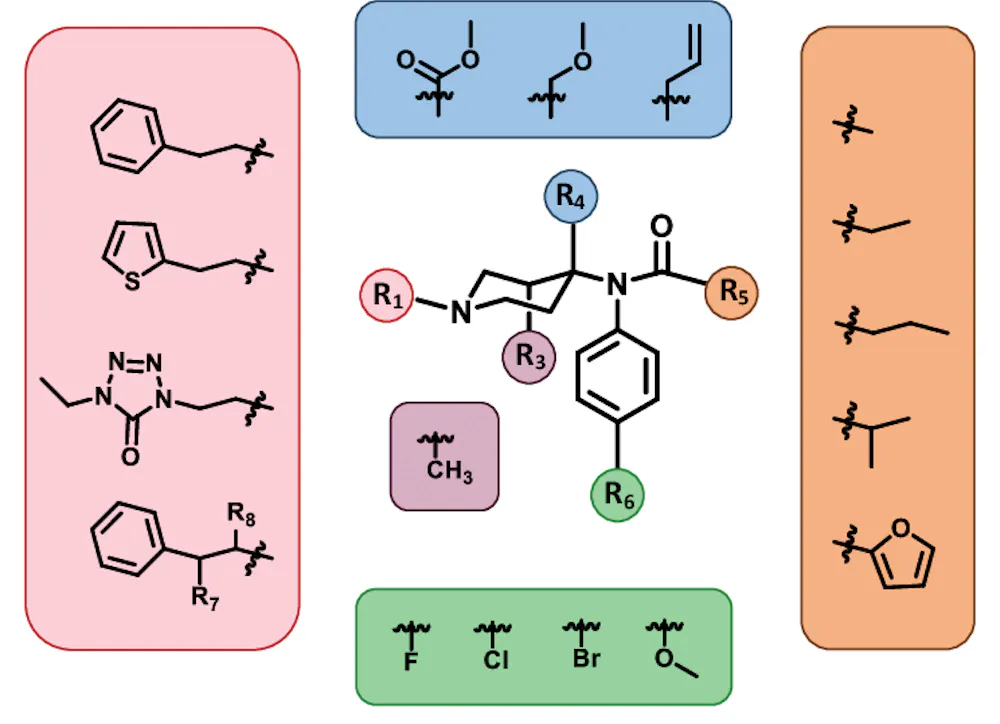
For example, carfentanil, a fentanyl analog formed by substituting one chemical group for another, is 100 times more potent than its parent structure. Another analog, acetylfentanyl, is approximately three times less potent than fentanyl, but has still led to clusters of overdoses in several states.
Despite the number and diversity of its analogs, fentanyl itself continues to dominate the illicit opioid supply. Milligram per milligram, fentanyl is roughly 50 times more potent than heroin and 100 times more potent than morphine.
Lacing or replacing drugs with fentanyl
Drug dealers have used fentanyl analogs as an adulterant in illicit drug supplies since 1979, with fentanyl-related overdoses clustered in individual cities.
The modern epidemic of fentanyl adulteration is far broader in its geographic distribution, production and number of deaths. Overdose deaths roughly quadrupled, going from 8,050 in 1999 to 33,091 in 2015. From May 2020 to April 2021, more than 100,000 Americans died from a drug overdose, with over 64% of these deaths due to synthetic opioids like fentanyl and its analogs.
Illicitly manufactured fentanyl is internationally synthesized in China, Mexico and India, then exported to the United States as powder or pressed pills. Additionally, the emergence of the dark web, an encrypted and anonymous corner of the internet that’s a haven for criminal activity, has facilitated the sale of fentanyl and other opioids shipped through traditional delivery services, including the U.S. Postal Service.
Fentanyl is both sold alone and often used as an adulterant because its high potency allows dealers to traffic smaller quantities but maintain the drug effects buyers expect. Manufacturers may also add bulking agents, like flour or baking soda, to fentanyl to increase supply without adding costs. As a result, it is much more profitable to cut a kilogram of fentanyl compared to a kilogram of heroin.
Unfortunately, fentanyl’s high potency also means that even just a small amount can prove deadly. If the end user isn’t aware that the drug they bought has been adulterated, this could easily lead to an overdose.
Preventing fentanyl deaths
As an emergency physician, I give fentanyl as an analgesic, or painkiller, to relieve severe pain in an acute care setting. My colleagues and I choose fentanyl when patients need immediate pain relief or sedation, such as anesthesia for surgery.
But even in the controlled conditions of a hospital, there is still a risk that using fentanyl can reduce breathing rates to dangerously low levels, the main cause of opioid overdose deaths. For those taking fentanyl in nonmedical settings, there is no medical team available to monitor someone’s breathing rate in real time to ensure their safety.
One measure to prevent fentanyl overdose is distributing naloxone to bystanders. Naloxone can reverse an overdose as it occurs by blocking the effects of opioids.
Another measure is increasing the availability of opioid agonists like methadone and buprenorphine that reduce opioid withdrawal symptoms and cravings, helping people stay in treatment and decrease illicit drug use. Despite the lifesaving track records of these medications, their availability is limited by restrictions on where and how they can be used and inadequate numbers of prescribers.
Other strategies to prevent overdose deaths include lowering the entry barrier to addiction treatment, fentanyl test strips, supervised consumption sites and even prescription diamorphine (heroin).
Despite the evidence supporting these measures, however, local politics and funding priorities often limit whether communities are able to give them a try. Bold strategies are needed to interrupt the ever-increasing number of fentanyl-related deaths.
Kavita Babu, Professor of Emergency Medicine, UMass Chan Medical School
This article is republished from The Conversation under a Creative Commons license. Read the original article.
- Details
- Written by: LAKE COUNTY NEWS REPORTS
The three-day event will take place from Friday, May 13, through Sunday, May 15.
On the shores of the highly productive and ancient Clear Lake, the little town of Clearlake Oaks transforms once a year when the best catfishing tournament west of the Mississippi draws hundreds of fishing enthusiasts and their families into town for the ever-popular Catfish Derby.
The traffic along Highway 20 through the Clearlake Oaks community gets heavy at times but increases substantially at derby time as trucks hauling fishing boats line up to check in.
“It gets pretty congested, but nobody complains,” said Dennis Locke, the Catfish Derby Committee chairman. “It’s like a festival setting in any small rural town, where people gather and excitement builds in anticipation of a grand finale. In the case of the derby, the grand finale occurs on the last day at noon, when the announcement ceremony draws a huge crowd.”
After a scaled-down tournament last year, event organizers are ready to resume the signature fundraiser for the Clearlake Oaks-Glenhaven Business Association, who sponsors the event.
“All proceeds from the derby go right back into the community,” said Association President Alvaro Valencia.
In its 38th year, the family-oriented event brings people in from all over the state and beyond who shop, stay in hotels and resorts, and enjoy dining and other opportunities found on the shores of Clear Lake.
“It’s fun and benefits the entire Lake County economy,” Valencia said. “Last year, after missing a year due to the pandemic, we raised over $30,000. We’re hoping to do even better this year.”
“We’re expecting about 1,000 entries, adults and kids,” said Locke. “Sign-ups are going very well. It’s great to see some of the regulars, like the Lanes who have been coming to the Derby for years — all the way from Oregon. They signed up early.”
The fishing contest begins on Friday and concludes on Sunday at noon.
As in past years, the event will be at the Northshore Fire Protection District 75 station on 12655 Highway 20.
Locke explained that although the first day of fishing begins on Friday, event volunteers are set up the day before, Thursday, when many anglers arrive to check in early to begin fishing at noon on Friday.
“Due to low lake levels, derby contestants will be weighing in on Friday and Saturday at the Clearlake Oaks public launch ramp, 12684 Island Drive,” Locke said.
Registrations, Sunday weigh-ins, and the awards ceremony will be at the fire station.
As anglers bring in their best catch, volunteers weigh the fish and record the information on a large billboard at the boat launch for all to view.
The data is also entered into a database and results are posted on the derby website and social media sites including Facebook and Twitter, which have become popular with participants and followers who enjoy keeping up with the latest results.
“Many of the posts and comments we see on these social media sites are from family and friends of Derby contestants who want to stay current on how their friends and family members are doing,” Locke said.
A total of $10,000 in cash prizes will be awarded in the adult and kids categories combined. The prize for the biggest catch is $5,000. Kids can participate in the adult division but must pay the adult entry fee of $50 compared to $10 for the two kids’ divisions.
In addition to the cash prizes $2,500 in raffle prizes are awarded throughout the event. Derby T-shirts, food and beverages will also be available for sale Saturday and Sunday.
“The last day of the derby is open to all and always draws a big crowd. In addition to the anglers and their families, people from around the county show up to celebrate with the winners and enjoy the great food and camaraderie.
The derby committee is supported by volunteers from around the county. Locke said the main committee couldn’t put on the event without the fantastic locals — about 50 — who show up throughout the six-month planning process to help with everything from stuffing envelopes to checking in the contestants to weighing the fish as anglers bring them in.
Most of the volunteers come from Clearlake Oaks, but the derby is also supported by volunteers all around the lake.
“Mary Heare Amodio has been driving in from Lakeport for years to help out as has Russell Jonas from Clearlake, to name just a few,” Locke said. “We are grateful to all, including the support from Northshore Fire Chief Mike Ciancio, who provides the venue.”
There’s still time to sign up for the Derby online or in person at the Derby beginning at noon on Thursday, May 12.
For details about entering the Derby, fees, and other information visit www.clearlakeoaks.org/derby or call 707-596-0248.