 How to resolve AdBlock issue?
News
- Details
- Written by: California Highway Patrol
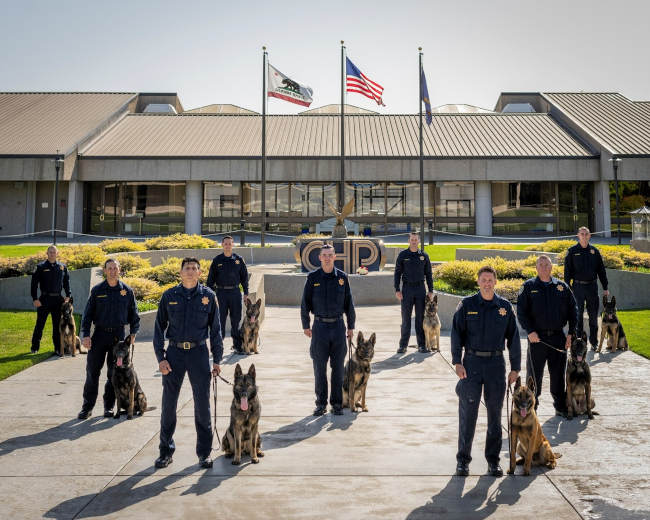
The California Highway Patrol on Friday announced the graduation and deployment of nine new canine teams.
After months of intensive training, the CHP certified its newest members during a ceremony at the CHP Academy’s Canine Training Facility.
“These nine teams are joining an already astonishing unit that serves as a vital part of the Department in protecting the public,” said CHP Commissioner Amanda Ray. “The canines have received hundreds of hours of intense training and are ready to serve and support the mission of the CHP.”
The graduates consist of eight patrol and narcotics detection canine teams and one patrol and explosives detection canine team, all of which meet the guidelines set by the Commission on Peace Officer Standards and Training.
The newest team members include two Belgian malinois, two Dutch shepherds and five German shepherds. The CHP now has a total of 53 canine teams deployed throughout the state.
Each canine’s partner, or handler, is an experienced CHP officer with anywhere from three to 15
years of experience.
The officers represent the CHP’s eight geographic regions of Northern, Valley, Golden Gate, Central, Southern, Border, Coastal and Inland Division.
Once deployed, the handlers will spend a minimum of eight hours every week training with their canines to ensure the highest level of peak performance by creating scenarios similar to what is experienced out in the field.
The CHP uses its canines to perform a variety of tasks, including detecting human scent, contraband, and explosives.
A canine team can improve the safety and effectiveness of officers as well as save time and money.
The CHP canines are also used to assist allied agencies in apprehending criminals, detecting explosives or drugs, and in locating at-risk missing persons.
- Details
- Written by: Chris Impey, University of Arizona

On May 12, 2022, astronomers on the Event Horizon Telescope team released an image of a black hole called Sagittarius A* that lies at the center of the Milky Way galaxy. Chris Impey, an astronomer at the University of Arizona, explains how the team got this image and why it is such a big deal.
1. What is Sagittarius A*?
Sagittarius A* sits at the the center of our Milky Way galaxy, in the direction of the Sagittarius constellation. For decades, astronomers have been measuring blasts of radio waves from an extremely compact source there.
In the 1980s, two teams of astronomers started tracking the motions of stars near this mysterious source of radio waves. They saw stars whirling around a dark object at speeds up to a third of the speed of light. Their motions suggested that at the center of the Milky Way was a black hole 4 million times the mass of the Sun. Reinhard Genzel and Andrea Ghez later shared the Nobel Prize in Physics for this discovery.
The size of a black hole is defined by its event horizon – a distance from the center of the black hole within which nothing can escape. Scientists had previously been able to calculate that Sagittarius A* is 16 million miles (26 million kilometers) in diameter.
The Milky Way’s black hole is huge compared to the black holes left behind when massive stars die. But astronomers think there are supermassive black holes at the center of nearly all galaxies. Compared to most of these, Sagittarius A* is meager and unremarkable.
2. What does the new image show?

Black holes themselves are completely dark, since nothing, not even light, can escape their gravity. But black holes are surrounded by clouds of gas, and astronomers can measure this gas to infer images of the black holes within. The central dark region in the image is a shadow cast by the black hole onto the gas. The bright ring is the gas itself glowing. The bright spots in the ring show areas of hotter gas that may one day fall into the black hole.
Some of the gas visible in the image is actually behind Sagittarius A*. Light from that gas is being bent by the powerful gravity of the black hole toward Earth. This effect, called gravitational lensing, is a core prediction of general relativity.

3. What went into producing this image?
Supermassive black holes are extremely hard to measure. They are far away and shrouded by the gas and dust that clogs the center of galaxies. They are also relatively small compared to the vastness of space. From where Sagittarius A* sits, 26,000 light years away at the center of the Milky Way, only 1 in 10 billion photons of visible light can reach Earth – most are absorbed by gas in the way. Radio waves pass through gas much more easily than visible light, so astronomers measured the radio emissions from the gas surrounding the black hole. The orange colors in the image are representations of those radio waves.

The team used eight radio telescopes spread across the globe to collect data on the black hole over the course of five nights in 2017. Every night generated so much data that the team couldn’t send it through the internet – they had to ship physical hard drives to where they processed the data.
Because black holes are so hard to see, there is a lot of uncertainty in the data the telescopes collect. To turn it all into an accurate image, team used supercomputers to produce millions of different images, each one a mathematically viable version of the black hole based off the data collected and the laws of physics. They then blended all of these images together to produce the final, beautiful, accurate image. The processing time was equivalent to running 2,000 laptops at full speed for a year.
4. Why is the new image such a big deal?
In 2019, the Event Horizon Telescope team released the first image of a black hole – this one at the center of the galaxy M87. The black hole at the center of this galaxy, named M87*, is a behemoth 2,000 times larger than Sagittarius A* and 7 billion times the mass of the Sun. But because Sagittarius A* is 2,000 times closer to Earth than M87*, the Event Horizon Telescope was able to observe both black holes at a similar resolution – giving astronomers a chance to learn about the universe by comparing the two.
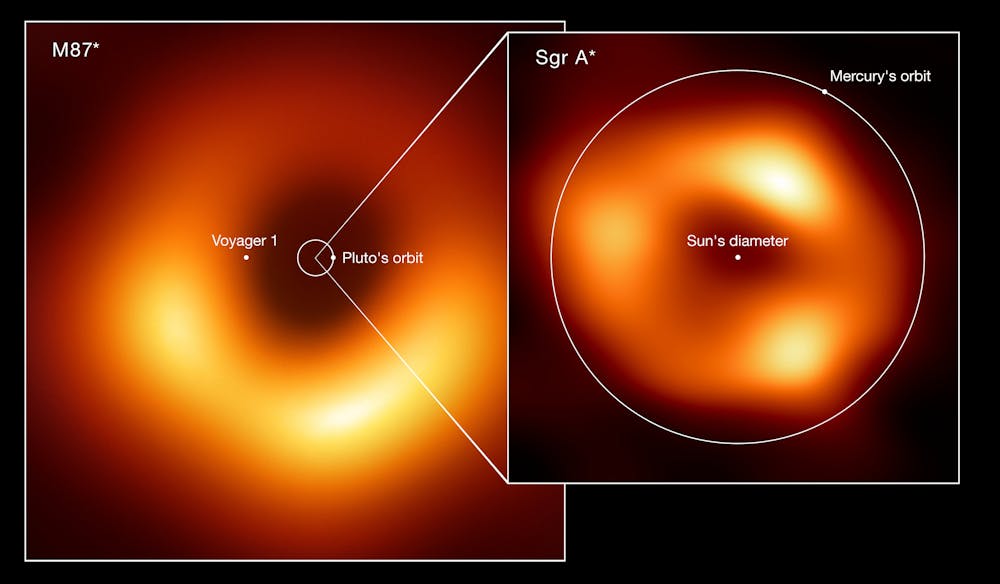
The similarity of the two images is striking because small stars and small galaxies look and behave very differently than large stars or galaxies. Black holes are the only objects in existence that only answer to one law of nature – gravity. And gravity does not care about scale.
For the last few decades, astronomers have thought that there are massive black holes at the center of almost every galaxy. While M87* is an unusually huge black hole, Sagittarius A* is likely pretty similar to many of the hundreds of billions of black holes at the center of other galaxies in the universe.
5. What scientific questions can this answer?
There is a lot more science to be done from the data the team collected.
One interesting avenue of inquiry stems from the fact that the gas surrounding Sagittarius A* is moving at close to the speed of light. Sagittarius A* is relatively small, and matter trickles into it very slowly – if it were the size of a human, it would consume the mass of a single grain of rice every million years. But by taking many images, it would be possible to watch the flow of matter around and into the black hole in real time. This would allow astrophysicists to study how black holes consume matter and grow.
A picture is worth a thousand words, and this new image has already generated 10 scientific papers. I expect there will be many more to come.
Chris Impey, University Distinguished Professor of Astronomy, University of Arizona
This article is republished from The Conversation under a Creative Commons license. Read the original article.
- Details
- Written by: Elizabeth Larson
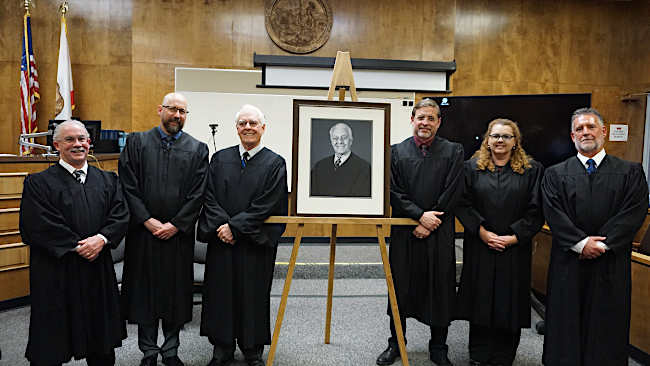
LAKEPORT, Calif. — A special ceremony held on Friday honored a retired Lake County Superior Court judge with the presentation of his portrait.
Judge Richard Martin retired in May of 2017, but the appreciation for the contributions he made during his tenure remains very much a thing of the present, according to the testimony of his peers, friends and family during the Friday afternoon ceremony.
The new black and white portrait of Martin will hang on the wall of the courtroom where he served as judge from 2005 to 2017. It will be hung next to the portrait of his predecessor Judge Robert Krone, who Martin called his mentor.
Since his retirement, Martin and wife, Charlotte, have done some traveling in their travel trailer and lately he’s learning to cook when he’s not working on his property near Lakeport.
Martin was lauded by members of the current bench, the district attorney and her staff, his son Sheriff Brian Martin and sheriff’s command staff, current and former bailiffs, court staff, friends and family.
The gathering was in the courtroom where Martin presided over Department Two. However, today the courtroom has been renumbered so that it’s Department One.
His successor, Judge J. David Markham, was on hand, along with fellow judges Andrew Blum, Michael Lunas and Shanda Harry, and Commissioner John Langan.
Attending via Zoom were retired judges Stephen Hedstrom, who stepped down at the end of his term the year after Martin, and Arthur Mann, who retired from full-time work in 2009 but served in a part-time capacity until the end of January after more than 41 years of service. Martin and Mann had run against each other for a judicial seat in the 1980s, a race which Mann ultimately won.
Before the ceremony, Hedstrom and Mann were chatting and catching up on Zoom and, at one point, Hedstrom asked if people in the courtroom could hear them. The audience responded with a loud chorus of “yes.”
Hedstrom responded by saying they should have put him on mute. Mann quipped that they had tried that in the past and it never worked.
During the ceremony, Markham said Martin was known for his “fair, well-reasoned” decisions and a judicial demeanor that was one of his greatest assets on the bench.
Harry said that a discussion she had with Martin about running for judge was one of the best things she did when considering launching a campaign.
Lunas recalled how he and Martin had gone up against each other when both were civil attorneys. He welcomed Martin back “to the room where it happened.”
Langan, who was coming up through the ranks of the District Attorney’s Office when Martin was a judge, thanked him for his patience with him and other young attorneys. “You impacted a lot of people here.”
The individual who had perhaps the most to say about Martin was Blum, a longtime friend. They worked together in the District Attorney’s Office before Martin came up with the “harebrained” idea of going off to Micronesia to become the attorney general of the island of Kosrae. Within six months, Martin had talked Blum into joining him there.
In that capacity, Martin did all manner of legislative and legal duties. One of the accomplishments Blum highlighted: Martin wrote the sea cucumber conservation legislation.
“It was a pleasure serving with him,” said Blum.
He added that while it’s been five years since Martin retired, “I can’t picture this building without Rick in it.”
Mann congratulated Martin for a spectacular and varied career, and Hedstrom recalled being the master of ceremonies at Martin’s swearing-in ceremony.
“This is a tremendous honor,” Brian Martin told the group.
He said the values that his father displayed on the bench were the same ones he followed at home. Richard Martin, his son said, believed in leaving things better than he found them.
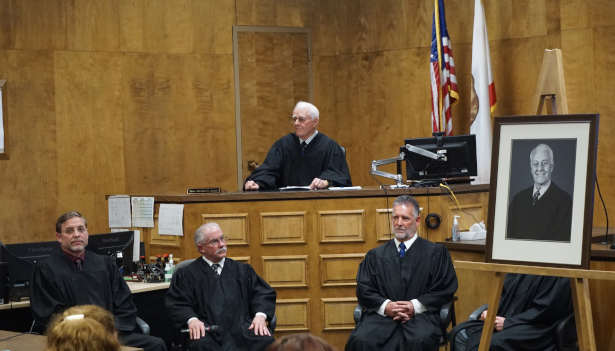
Markham let Martin sit in his former seat on the bench, at which point he noted that, among the thousands of cases he handled, he was mindful that for many people, coming into his courtroom was the first and only time they would be in court. For others, they spent almost as much time as he did in the courtroom.
While the United States’ legal system isn’t perfect, Martin said he considered it the best in the world, which he credited to the people who make it work.
He also spoke about some of his proudest accomplishments, including work with the drug court and establishing a veterans court, which had special meaning for him since his father was a World War II veteran.
Martin took a redemptive view of cases involving veterans. While a veteran who came before him may have done something wrong, he held that such actions didn’t negate the good of their service to the country.
He thanked his fellow judges and attorneys, court staff, the community members who served as jurors, his family and particularly his wife for the years of support.
“It’s been an honor to serve,” he said.
Email Elizabeth Larson at
- Details
- Written by: Lake County Library
In partnership with Blue Zones Project Lake County, the Lake County Library hosted several discussions, cooking classes, and walking groups all designed to help patrons apply the principles of “The Blue Zones of Happiness: Lessons From the World's Happiest People” by Dan Buettner.
All events were free to the public, and free copies of the book were made available to the public.
The library clubs (Book Cubs, Cookbook Club and Garden Book Club) also participated. The monthly book club welcomed new members and had a lively discussion, in which patrons shared their thoughts on the contents of the book.
Several found that the principles resonated with their own experience, including the importance of community and staying connected throughout the pandemic.
Another patron praised the beauty of the Middletown hike on April 27. “I want to keep the weekly walking moai going,” said Amy, the event coordinator at the Lakeport library.
A moai is a small group of friends who encourage each other through life, and a walking moai walks together while they talk. “The Lakeport moai is going to be Thursdays at 8:30 a.m. and Middletown’s is Saturdays at 10 a.m.,” she said.
Lakeport and Middletown patrons also enjoyed a cooking class, in which they made a Tex-Mex bowl with avocado and chunky salsa, a strawberry mango salsa, and black bean seviche tostadas. Pictures from the class are available on the “Blue Zones Project — Lake County” Facebook page.
This project was made possible in part by the Institute of museum and library services.
The Lake County Department of Public Services Parks Division and Lake County Department of Public Health CalFresh Program will also be providing speakers, materials and more for the program.
Visit the Lake County Library website at http://library.lakecountyca.gov.