How to resolve AdBlock issue?
News
- Details
- Written by: Mayuresh Abhyankar, University of Virginia
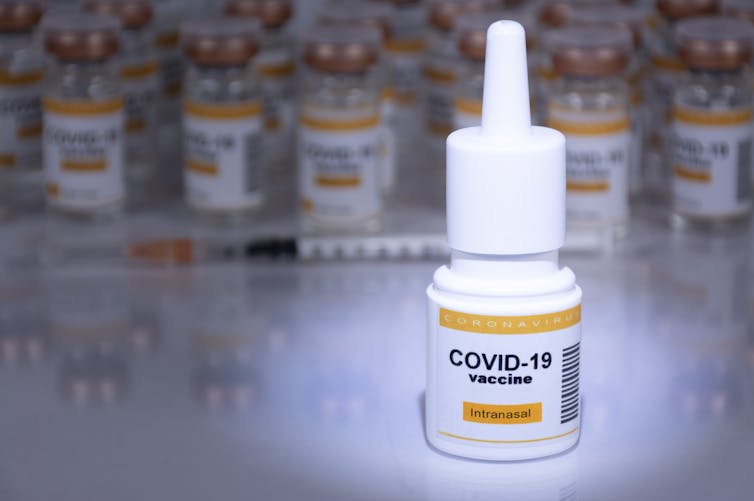
Imagine inhaling just a few drops of liquid or mist to get protected from COVID-19. That is the idea behind nasal COVID-19 vaccines, and they have been getting a lot of attention recently as a spray or liquid. These nasal vaccines would be based on the same technology as normal vaccines given by injection. But as Mayuresh Abhyankar, a University of Virginia researcher who studies infectious diseases and works on nasal vaccines, explains, vaccinating someone right where the coronavirus is likely to start its attack comes with many immunological benefits.
1. What are nasal vaccines?
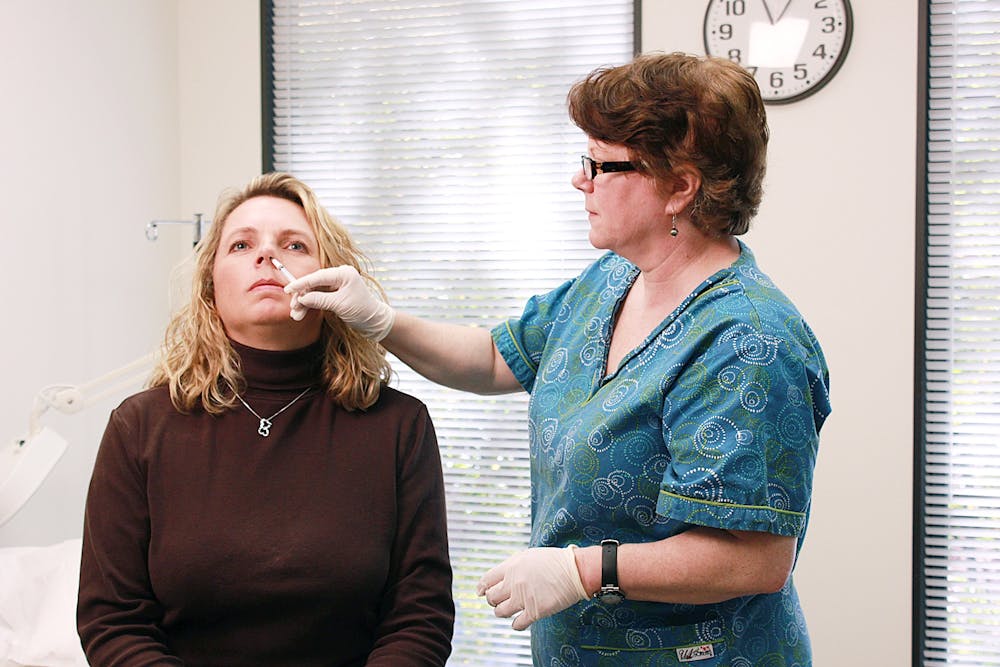
Nasal vaccines are administered, as the name suggests, through the nose. More accurately called intranasal vaccines, these vaccines are liquids that can be given as a spray or through a dropper or syringe. The most common nasal vaccine is FluMist, a nasal spray that uses inactivated flu virus to protect against influenza. An intranasal vaccine could be a weakened live virus similar to FluMist, a nucleic acid vaccine like mRNA coronavirus vaccines or a protein vaccine like Hepatitis B vaccines or the CorbeVax coronavirus vaccine.
Intranasal vaccines are best suited to protect against pathogens that enter through the nose, like the flu or the coronavirus. By mimicking the first step of natural exposure to an airborne pathogen, these vaccines help train a person’s immune system at the potential place of infection. Scientists have shown that the first immune response in the respiratory tract after a person is exposed to an airborne virus can influence how sick a person gets. So in theory, intranasal vaccines could provide better protection than vaccines given through a shot in the arm.
2. How does the coronavirus infect people?
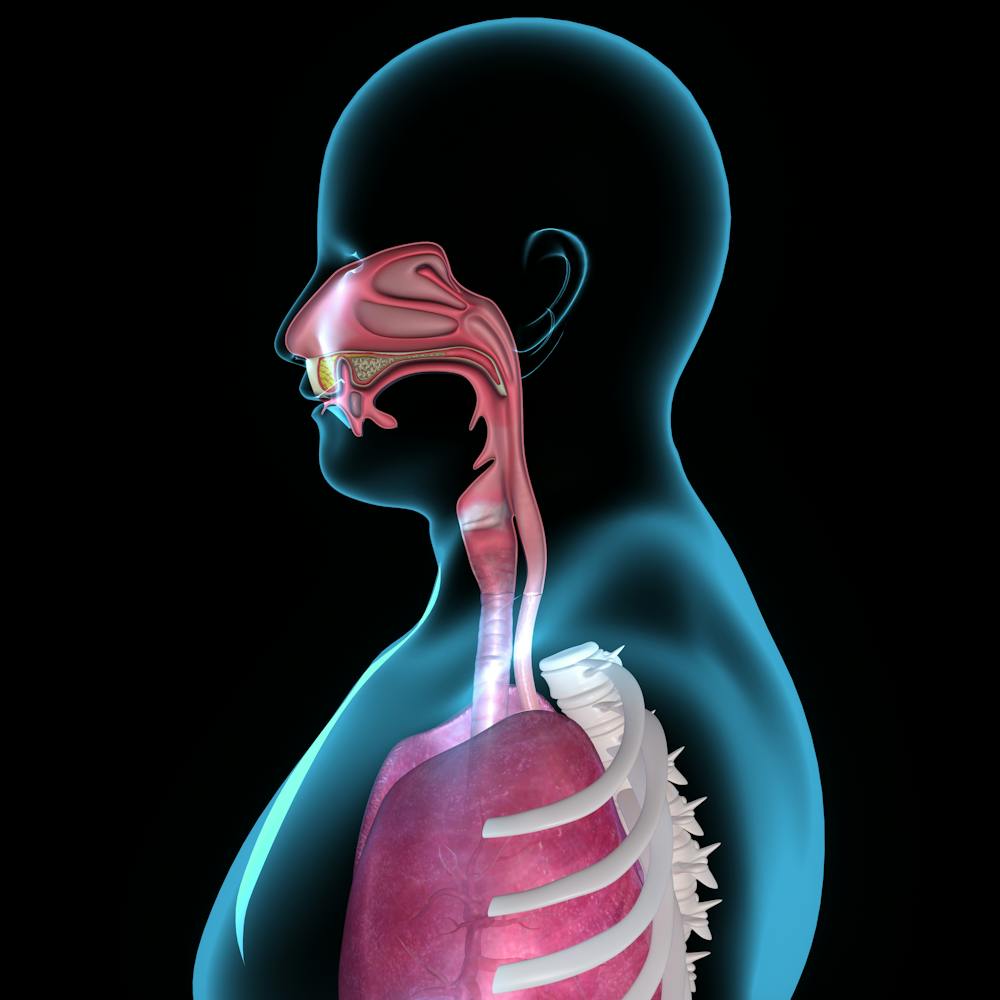
SARS-CoV-2, the virus that causes COVID-19, usually enters the body through the nose and lands on the mucus membrane at the back of the nasal passage and in the throat. The virus then enters the cells it touches, replicates and spreads.
Just underneath these cells of the mucus membrane are many types of immune cells that form what is called the mucosal immune system. Cells of the mucosal immune system are the first to identify invading coronavirus particles and start mounting a protective response.
In an unvaccinated individual, it takes about two weeks for these immune cells to build up a protective response after encountering the coronavirus. By that time, the virus can easily have infected other body parts, like the lungs, which can lead to severe disease.
Nasal vaccines follow a lot of the same steps. When you inhale a nasal vaccine, the particles land on the mucus membrane in your nasal cavity or the back of your throat, enter the cells in those places and trigger an immune response. This process teaches the body about the coronavirus and allows it to deal with any future real infections.
3. How are nasal and intramuscular vaccines different?
When you get a COVID-19 shot in your arm, the vaccine triggers a strong immune response in the cells near where you got the shot. It also causes your immune system to produce some coronavirus-specific antibodies and other immune cells in other locations throughout your body.
When the coronavirus begins infecting cells in a person’s respiratory tract, the immune cells nearby will start mounting a defense. Your body will also send anti-viral immune cells and antibodies from other locations to the site of infection. But by the time enough coronavirus-specific immune cells gather around the infection site to stop the virus from replicating, the virus has likely already begun to spread throughout the body, making it difficult for the immune system to keep up.
Nasal vaccines mimic the virus in order to prepare the immune system against a virus, just like any other vaccine. But importantly, they mimic the process of infection, too, and boost protective response within the mucosal immune system of the nose and throat. In simple terms, intranasal vaccines are like knowing there is going to be a break-in and putting your guards in the right location before the trouble even starts.
The science bears this idea out. In a head-to-head comparison, AstraZeneca’s COVID-19 vaccine provided greater protection in hamsters that were vaccinated intranasally compared to those vaccinated intramuscularly.
Nasal vaccination could also be used in concert with intramuscular immunization. In a recent study, my colleagues and I gave some mice both a nasal and intramuscular vaccine and exposed them to a lethal dose of SARS-CoV-2 – 100% of these mixed-vaccinated mice survived, compared to only 10% of the unvaccinated mice. We are now testing if this mixed approach is superior to just intranasal or just intramuscular approaches on their own.
Finally, intranasal vaccines are painless, noninvasive and do not require specialized training to use.
4. What are the risks of nasal vaccines?
Getting the dosage correct can be harder with nasal vaccines than a shot, especially with young children. If someone has a stuffy nose or sneezes out a part of the vaccine before it’s completely absorbed, this can result in a lower-than-desired dose.
There are some unique health risks too. All vaccines go through rigorous safety testing and clinical trials, but these processes are especially important for nasal vaccines due to the simple fact that the nose is close to the brain. In 2000, 27.7% of people who received an inactivated intranasal influenza vaccine in Switzerland developed transient facial paralysis – also known as Bell’s palsy. Later, researchers found that a bacterial toxin added to the vaccine to enhance the immune response was the culprit.
This is the only reported instance of neurological issues stemming from intranasal vaccines, but it is something to consider.
5. How long until intranasal COVID-19 vaccines are ready?
As of late May 2022, there are no approved COVID-19 intranasal vaccines for human use. There are currently seven in clinical trials, and three of them – manufactured by Beijing Wantai Biological Pharmacy, Bharat Biotech, and Codagenix and Serum Institute of India – are in phase-3 human trials.
In the coming months, the results of these trials will not only show how safe these promising new vaccines are, but also if they perform better than the vaccines in use today.
Mayuresh Abhyankar, Associate Professor of Infectious Diseases and International Health, University of Virginia
This article is republished from The Conversation under a Creative Commons license. Read the original article.
- Details
- Written by: Elizabeth Larson
Dogs available for adoption this week include mixes of Labrador retriever, pit bull and wire-haired terrier.
Dogs that are adopted from Lake County Animal Care and Control are either neutered or spayed, microchipped and, if old enough, given a rabies shot and county license before being released to their new owner. License fees do not apply to residents of the cities of Lakeport or Clearlake.
The following dogs at the Lake County Animal Care and Control shelter have been cleared for adoption.
Call Lake County Animal Care and Control at 707-263-0278 or visit the shelter online for information on visiting or adopting.
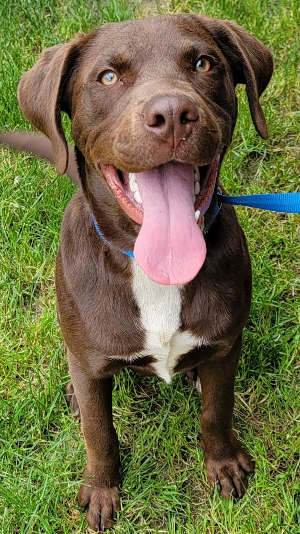
Chocolate lab mix
This young male chocolate Labrador, who is under a year old, has a short coat.
He is in kennel No. 3, ID No. LCAC-A-3385.
‘Rooster’
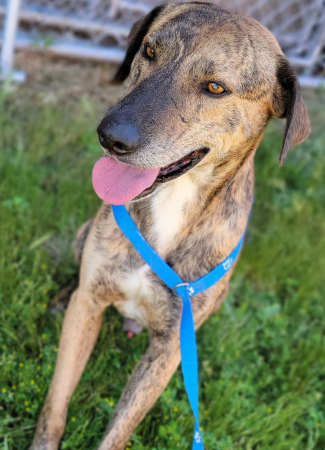
“Rooster” is a 5-year-old male mountain cur with a brown brindle coat.
He is in kennel No. 4, ID No. LCAC-A-3384.

‘Willie’
“Willie” is a 1-year-old male pit bull terrier with a short brown and white coat.
He is in kennel No. 20, ID No. LCAC-A-3301.

Male wire-haired terrier
This 2-year-old male wire-haired terrier has a cream-colored coat.
He is in kennel No. 22, ID No. LCAC-A-3399.
Email Elizabeth Larson at
- Details
- Written by: Margaret W. Carruthers

With its mirror segments beautifully aligned and its scientific instruments undergoing calibration, NASA’s James Webb Space Telescope is just weeks away from full operation. Soon after the first observations are revealed this summer, Webb’s in-depth science will begin.
Among the investigations planned for the first year are studies of two hot exoplanets classified as “super-Earths” for their size and rocky composition: the lava-covered 55 Cancri e and the airless LHS 3844 b.
Researchers will train Webb’s high-precision spectrographs on these planets with a view to understanding the geologic diversity of planets across the galaxy, and the evolution of rocky planets like Earth.
Super-hot super-Earth 55 Cancri e
55 Cancri e orbits less than 1.5 million miles from its Sun-like star (1/25th of the distance between Mercury and the Sun), completing one circuit in less than 18 hours. With surface temperatures far above the melting point of typical rock-forming minerals, the day side of the planet is thought to be covered in oceans of lava.
Planets that orbit this close to their star are assumed to be tidally locked, with one side facing the star at all times. As a result, the hottest spot on the planet should be the one that faces the star most directly, and the amount of heat coming from the day side should not change much over time.
But this doesn’t seem to be the case. Observations of 55 Cancri e from NASA’s Spitzer Space Telescope suggest that the hottest region is offset from the part that faces the star most directly, while the total amount of heat detected from the day side does vary.
Does 55 Cancri e have a thick atmosphere?
One explanation for these observations is that the planet has a dynamic atmosphere that moves heat around.
“55 Cancri e could have a thick atmosphere dominated by oxygen or nitrogen,” explained Renyu Hu of NASA’s Jet Propulsion Laboratory in Southern California, who leads a team that will use Webb’s Near-Infrared Camera, or NIRCam, and Mid-Infrared Instrument, or MIRI, to capture the thermal emission spectrum of the day side of the planet.
“If it has an atmosphere, [Webb] has the sensitivity and wavelength range to detect it and determine what it is made of,” Hu added.
Or is it raining lava in the evening on 55 Cancri e?
Another intriguing possibility, however, is that 55 Cancri e is not tidally locked. Instead, it may be like Mercury, rotating three times for every two orbits (what’s known as a 3:2 resonance). As a result, the planet would have a day-night cycle.
“That could explain why the hottest part of the planet is shifted,” explained Alexis Brandeker, a researcher from Stockholm University who leads another team studying the planet. “Just like on Earth, it would take time for the surface to heat up. The hottest time of the day would be in the afternoon, not right at noon.”
Brandeker’s team plans to test this hypothesis using NIRCam to measure the heat emitted from the lit side of 55 Cancri e during four different orbits. If the planet has a 3:2 resonance, they will observe each hemisphere twice and should be able to detect any difference between the hemispheres.
In this scenario, the surface would heat up, melt, and even vaporize during the day, forming a very thin atmosphere that Webb could detect. In the evening, the vapor would cool and condense to form droplets of lava that would rain back to the surface, turning solid again as night falls.
Somewhat cooler super-Earth LHS 3844 b
While 55 Cancri e will provide insight into the exotic geology of a world covered in lava, LHS 3844 b affords a unique opportunity to analyze the solid rock on an exoplanet surface.
Like 55 Cancri e, LHS 3844 b orbits extremely close to its star, completing one revolution in 11 hours. However, because its star is relatively small and cool, the planet is not hot enough for the surface to be molten. Additionally, Spitzer observations indicate that the planet is very unlikely to have a substantial atmosphere.
What is the surface of LHS 3844 b made of?
While we won’t be able to image the surface of LHS 3844 b directly with Webb, the lack of an obscuring atmosphere makes it possible to study the surface with spectroscopy.
“It turns out that different types of rock have different spectra,” explained Laura Kreidberg at the Max Planck Institute for Astronomy. “You can see with your eyes that granite is lighter in color than basalt. There are similar differences in the infrared light that rocks give off.”
Kreidberg’s team will use MIRI to capture the thermal emission spectrum of the day side of LHS 3844 b, and then compare it to spectra of known rocks, like basalt and granite, to determine its composition. If the planet is volcanically active, the spectrum could also reveal the presence of trace amounts of volcanic gases.
The importance of these observations goes far beyond just two of the more than 5,000 confirmed exoplanets in the galaxy. “They will give us fantastic new perspectives on Earth-like planets in general, helping us learn what the early Earth might have been like when it was hot like these planets are today,” said Kreidberg.
These observations of 55 Cancri e and LHS 3844 b will be conducted as part of Webb’s Cycle 1 General Observers program. General Observers programs were competitively selected using a dual-anonymous review system, the same system used to allocate time on Hubble.
The James Webb Space Telescope is the world's premier space science observatory. Webb will solve mysteries in our solar system, look beyond to distant worlds around other stars, and probe the mysterious structures and origins of our universe and our place in it.
Webb is an international program led by NASA with its partners, European Space Agency and the Canadian Space Agency.
Margaret W. Carruthers works for the Space Telescope Science Institute in Baltimore, Maryland.

- Details
- Written by: KELSEYVILLE UNIFIED SCHOOL DISTRICT

KELSEYVILLE, Calif. — After qualifying at their Spring Regional Leadership Conference in late February, seven students from the Kelseyville High School Advanced Culinary Arts class joined about 700 other attendees at the 75th annual California Family, Careers and Community Leaders of America State Leadership Conference held April 23 to 26 in Riverside.
All KHS students received either gold, silver or bronze seals in recognition of their scores, and KHS senior Karina Sonato placed third in state for her charcuterie board.
The Family, Careers and Community Leaders of America State Leadership Conference, or FCCLA, is a career technical student organization for students in grades sixth through 12th who are enrolled in Family and Consumer Sciences education programs in California public schools and the KHS Culinary Arts class is associated with the organization.
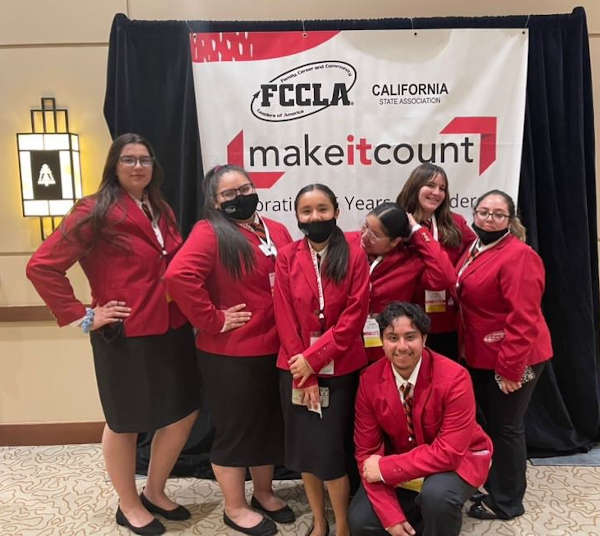
This was the first year KHS competed, and teacher Tami Cramer said she was “thrilled with the results” and looking forward to her students participating again next year.
This year’s participants included Karina Sonata, Sarahi Sonato and Estefani Ramirez Reyes, who) competed in culinary display: appetizers; as well as Delayna Dothage, Emily Jimenez, Briseyda Cacho and Anthony Ruiz Matias, who competed in salad preparation.
The theme of the conference, “Make it Count,” was intended to inspire members to get out of their comfort zone and get involved in all the activities and events.
In addition to competing, students attended statewide and regional meetings, workshops, industry visits, a formal banquet and a dance.
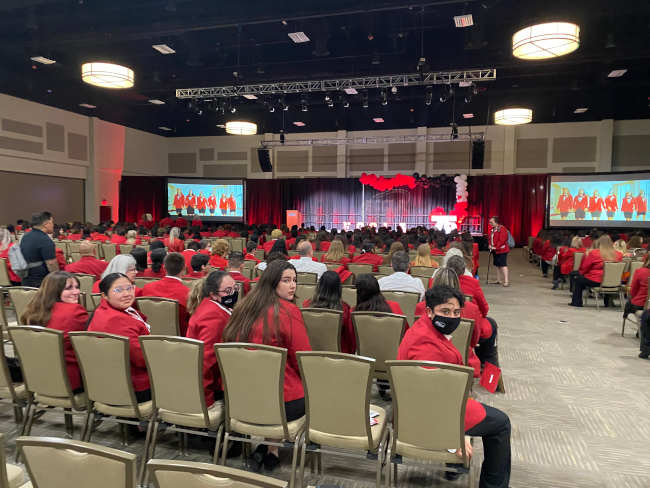
Approximately 70 FCCLA chapters from across the state competed for more than $1.6 million dollars in cash and scholarships in leadership and career development competition events.
This year, the following colleges provided FCCLA scholarships: Auguste Escoffier School of Culinary Arts, Culinary Institute of America, FIDM, Johnson and Wales University, and Sullivan University.
Instructional programs, career education, and competitive events relate to one or more of nine industry sector pathways that are included in FCS education programs, including: child development; education; consumer services; family and human services; fashion design and merchandising; interior design; food science, dietetics, and nutrition; hospitality, tourism and recreation; and food service and hospitality.