 How to resolve AdBlock issue?
News
- Details
- Written by: Elizabeth Larson
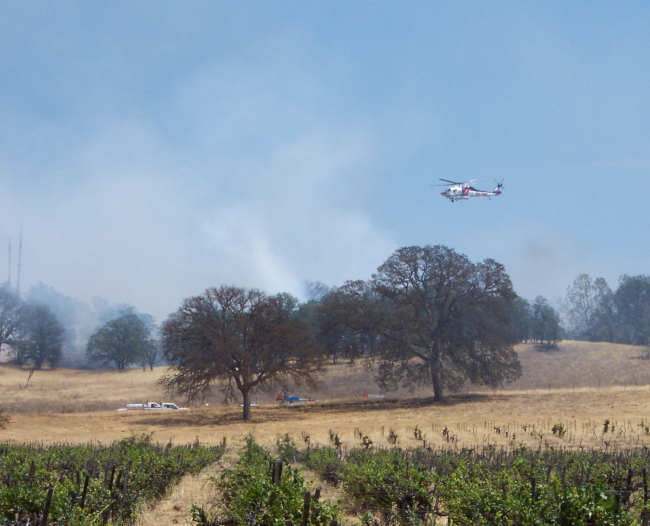
LAKE COUNTY, Calif. — The fire that began Thursday afternoon and moved at a fast rate in the Clearlake area ultimately was controlled before it could destroy any structures, while authorities arrested a woman on suspicion of setting the fire.
The Ogulin fire, first dispatched just before 1 p.m. Thursday in the area of Highway 53 and Ogulin Canyon Road, prompted evacuations along Highway 53 south of Ogulin Canyon Road, and closed a portion of Highway 53 for several hours.
The fire, driven by the wind, grew at what fire officials called an “extreme rate of spread,” quickly going from less than an acre in 10 acres within minutes, according to reports from the scene.
By early evening, the fire had been contained at 17.2 acres, evacuations were called off and the roads reopened.
Lake County Fire Protection District Chief Willie Sapeta said the fire agencies that responded included Cal Fire, Lake County Fire, Northshore Fire, South Lake County Fire and the United States Forest Service.
“Everybody jumped in,” said Sapeta.
At one point there were 14 engines on scene, Sapeta said. That’s in addition to the numerous air tankers, helicopters and air attack from Cal Fire that were part of an aggressive response.
Sapeta said the city of Clearlake sent a water tender, as did Lake County Public Services, whose director, Lars Ewing, sent the truck from the landfill. That was important because the fire area had no water supply.
He said everyone did an amazing job on the ground and in the air, fighting a fire in an area with so much vegetation for fuel.
As a result of the response, Sapeta said no structures were damaged or destroyed, and only one power pole might need to be replaced.
“It’s nice that we live in a county where there's that high level of cooperation” and response, said Clearlake Police Chief Andrew White.
White said the response was seamless, with everyone working together.
White’s agency was on scene and receiving help from the Lake County Sheriff’s Office.
Shortly after firefighters arrived, sheriff’s deputies also got to the scene, where they were in contact with 41-year-old Angela Smith of Clearlake, who made statements about starting the fire.
White said Smith was found to have what were believed to be drugs in her possession and she was making erratic comments. She had mentioned the fire had started due to her lighting a cigarette.
During the encounter with police she invoked her right to counsel, White said.
White said a Cal Fire investigator and Clearlake Police detective took over the investigation and interviewed witnesses.
He said Smith was arrested for unlawful burning of forestland, arson of forestland during a state of emergency — in this case, due to drought conditions — and possession of a controlled substance.
Back on the fire lines, work continued overnight to monitor the fire area, Sapeta said.
“We’ll have crews on it all night,” and hit it again first thing Friday morning, Sapeta told Lake County News Thursday evening.
While fire crews did a good job of overhaul, Sapeta said there were areas within the interior that were still smoldering.
This summer, there have been several close calls with small fires that could have grown to be destructive and devastating, had they not been quickly spotted by community members of volunteers at the Mount Konocti fire lookout — as happened with the 21-acre Main fire in Lower Lake July 8 — and had a strong response from firefighters.
Sapeta acknowledged that the county has been lucky, with firefighters being very aggressive and bringing all of their resources to the fight early.
“We’re stopping them,” he said of the fires.
Email Elizabeth Larson at

- Details
- Written by: LAKE COUNTY NEWS REPORTS
The webinar will take place from 5:30 to 7 p.m.
The event can be accessed through the link or dial-in below or through PG&E’s website, www.pge.com/firesafetywebinars.
Click this link to join: https://bit.ly/3nKIAc9. Attendee dial-in: 800-619-7898; conference ID: 5949849.
PG&E experts will provide a brief presentation, after which participants will have the opportunity to ask questions.
During the webinar event, the PG&E team will discuss:
• PG&E’s wildfire prevention efforts;
• Resources to help customers and communities before, during and after wildfire safety outages;
• Improvements and updates to PG&E’s safety technology and tools.
Closed captioning will be available in English, Spanish and Chinese and dial-in numbers will be available for those who aren’t able to join online.
For additional information on how to join, recordings and presentation materials from past events and to learn more about PG&E’s Community Wildfire Safety Program, visit www.pge.com/wildfiresafety.
More information and resources to help you and your family prepare for and stay safe in the event of an emergency can be found at https://www.safetyactioncenter.pge.com/.
- Details
- Written by: Elizabeth Larson
The City of Clearlake Animal Association also is seeking fosters for the animals waiting to be adopted.
Call the Clearlake Animal Control shelter at 707-273-9440, or email
Visit Clearlake Animal Control on Facebook or on the city’s website.
The following dogs are available for adoption.

‘Terry’
“Terry” is a handsome male shepherd mix with a short brindle coat.
He gets along with other dogs, including small ones, and enjoys toys. He also likes water, playing fetch and keep away, and has been undergoing training.
He is dog No. 48443693.

‘Andy’
“Andy” is a male American pit bull mix with a short gray and white coat.
He is dog No. 48995415.

‘Bear’
“Bear” is a male Labrador retriever-American pit bull mix with a short charcoal and fawn coat.
He has been neutered.
He is dog No. 48443153.

‘Betsy’
“Betsy” is a female American pit bull mix with a short white coat.
She has been spayed.
She is dog No. 50236145.

‘Bluey’
“Bluey” is a male retriever mix with a short black coat.
He has been neutered.
He is dog No. 50552999.

‘Big Phil’
“Big Phil” is a 13-year-old male American pit bull terrier mix with a blue coat.
He has been neutered.
He is dog No. 49951647.

‘Bro’
“Bro” is a male terrier mix with a short tan coat.
He has been neutered.
Bro is dog No. 50262527.

‘Colt’
“Colt” is a male Rhodesian Ridgeback mix with a short rust and black coat.
He has been neutered.
He is dog No. 49812106.

‘Hakuna’
“Hakuna” is a male shepherd mix with a tan coat.
He has been neutered.
He is dog No. 50176912.

‘Kubota’
“Kubota” is a male German shepherd mix with a short tan and black coat.
He has been neutered.
Kubota is dog No. 50184421.

‘Luna’
“Luna” is an 8-month-old Labrador retriever-terrier mix with a black and white coat.
She is dog No. 50339254.

‘Mamba’
“Mamba” is a male Siberian husky mix with a gray and cream-colored coat.
He has been neutered.
He is dog No. 49520569.

‘Matata’
“Matata” is male shepherd mix with a tan coat.
He has been neutered.
He is dog No. 50176912.

‘Newman’
“Newman” is a 1-year-old male American pit bull terrier mix with a black and white coat.
He has been neutered.
Newman is dog No. 49057809.

‘Sadie’
“Sadie” is a female German shepherd mix with a black and tan coat.
She has been spayed.
She is dog No. 49802563.

‘Tiramisu’
“Tiramisu” is a female Alaskan husky mix with a short brown and cream coat.
She is dog No. 49652833.

‘Ziggy’
“Ziggy” is a male American pit bull terrier mix with a short gray and white coat.
He has been neutered.
Ziggy is dog No. 50146247
Email Elizabeth Larson at
- Details
- Written by: Sam Polzin, Purdue University; Ahmad Zia Wahdat, Purdue University, and Jayson Lusk, Purdue University

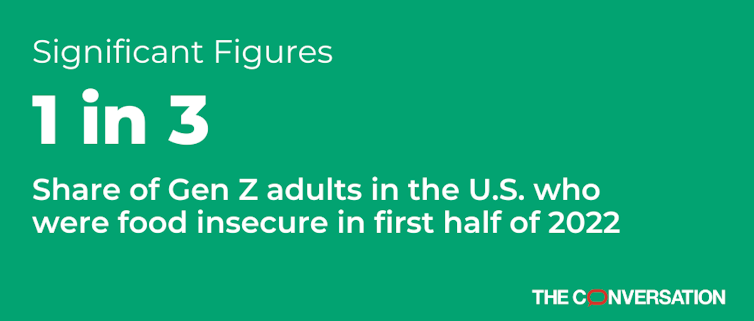
Adult members of Generation Z are experiencing food insecurity at over twice the rate of the average American, according to our latest consumer food survey. In fact, about 1 in 3 Americans born from 1996-2004 have had trouble affording enough food in 2022.
That compares with fewer than 1 in 5 millennials and members of Generation X, and fewer than 1 in 10 baby boomers.
We run the Center for Food Demand Analysis and Sustainability at Purdue University, and every month, through our Consumer Food Insights survey, we query over 1,200 Americans with the goal of tracking national food security as well as many other behaviors, attitudes and preferences related to food.
Food insecurity means having a lack of money or other resources for food. And when food insecurity surges, it can take a long time for affected populations to recover. After the Great Recession that ran from 2007 to 2009, food insecurity increased by 34%. It took a decade for food insecurity to drop to its pre-recession levels.
With COVID-19, food insecurity increased again, particularly among the most vulnerable groups in society, such as seniors and households with children.
But it also increased for members of Gen Z, who were the most likely to face unemployment due to the pandemic. And for those attending college, the pandemic reduced essential food services on campus and increased the number of students dropping out of school.
Now, with inflation soaring at the fastest pace in 40 years, those who lost jobs during the pandemic and college students with fixed incomes must stretch their limited resources even further at the grocery store.
We have found that education, income and race are three of the biggest factors driving food insecurity among America’s youngest generation. Members of Gen Z without a college degree or who make less than the federal poverty line have a much higher risk of being food insecure – over three times the risk of other Gen Z households. The rate of food insecurity among Gen Z Black and Hispanic households is almost double that of white and Asian households.
Other research shows that factors like marriage and owning your own home typically improve food security. Since young people typically aren’t married or own a home, Gen Z by and large isn’t benefiting from these factors.
Additionally, full-time college students are generally not eligible for the Supplemental Nutrition Assistance Program, formerly known as food stamps. Although student eligibility has been expanded during the ongoing COVID-19 public health emergency, the paperwork required to apply can potentially discourage young people who have much less experience navigating the government bureaucracy.
Our survey also shows a significant portion of Gen Z – 30% – has relied on free groceries from a pantry, church or other charity.
Prices for food consumed at home are currently jumping at over 12% a year. That’s the fastest pace since 1979. Our survey data only reflects some of these recent price gains, so it’s unclear yet how much this will affect food insecurity. But what is clear is that Gen Z Americans, like other vulnerable groups, need more support to ensure they can access an affordable diet.
Sam Polzin, Food and Agriculture Survey Scientist, Purdue University; Ahmad Zia Wahdat, Postdoctoral Research Associate, Agricultural Economics, Purdue University, and Jayson Lusk, Professor of Agricultural Economics, Purdue University
This article is republished from The Conversation under a Creative Commons license. Read the original article.