How to resolve AdBlock issue?
News
- Details
- Written by: LAKE COUNTY NEWS REPORTS
The arrangement is the result of a supplemental law enforcement services agreement approved by the city councils of Clearlake and Lakeport in recent weeks.
The agreement also allows for Lakeport Police officers to work in Clearlake should that city ever need the assistance in the future. The city of Lakeport is paying the full cost for this assistance.
“We have a longstanding relationship with Clearlake and have provided each other mutual aid on many occasions,” the Lakeport Police Department said in a Thursday statement. “We have virtually the same policies, procedures and training and do not expect any differences in service provided to our community. We are also members of the same California Intergovernmental Risk Authority which simplifies the process of one agency's staff operating as agents of the other.”
Clearlake Police officers are expected to work a few shifts per week over the next few months, Lakeport officials reported.
Officers will always be wearing the Clearlake Police uniform and generally driving city of Clearlake vehicles although at times they may be in a Lakeport Police vehicle.
There will never be a time when there is not a Lakeport Police officer on duty while Clearlake Police officers are working in the city, officials said.
The arrangement supplements Lakeport’s staffing in order to provide for sufficient officer safety and continued appropriate police services to the Lakeport community, the city reported.
Should a member of the public need to request police records related to work done by Clearlake officers in Lakeport, they shall contact the Lakeport Police Department where all those records will be maintained.
“We also want the public to be aware that this arrangement will not affect the staffing at Clearlake, that is their staffing levels to the Clearlake community will not be shorted to provide coverage here. Clearlake Police officers are only working voluntary overtime when available,” the Lakeport Police Department reported.
Lakeport Police reported that it expects its current staffing to be increased to sufficient levels within the next few months. The most significant reason for the current staffing situation is that four new officers are in training and unable to staff a patrol position. As the public may be aware, for over the past 5 or more years police recruitment and retention has been a significant problem in our state and country. However, we continue to look for innovative ways to address it locally.
- Details
- Written by: LAKE COUNTY NEWS REPORTS
Since Monday, the national average for a gallon of regular gasoline dropped six cents to $3.99.
The national average has not been below $4 per gallon since March 5.
In Lake County on Thursday, gasbuddy.com reported the following gas prices around Lake County:
• Clearlake: $4.59.
• Middletown: $4.99.
• Upper Lake: $5.05.
• Lower Lake: $5.17.
• Kelseyville Riviera: $5.19.
• Kelseyville: $5.23.
• Nice: $5.29.
• Clearlake Oaks: $5.57.
• Lucerne: $5.59.
• Lakeport: $5.69.
In the spring, oil prices spiked in reaction to Russia’s invasion of Ukraine, leading the national average to a new all-time high.
According to new data from the Energy Information Administration, gas demand increased from 8.54 million barrels per day, or b/d, to 9.12 million b/d last week. However, the rate is 307,000 b/d lower than last year.
Moreover, according to EIA, total domestic gasoline stocks decreased by 5 million barrels of crude oil, or bbl, to 220.3 million bbl.
Although gasoline demand has increased and supply has tightened, lower oil prices have helped lower pump prices. If oil prices continue to decline, drivers will likely continue to see pump prices decrease.
At the close of Wednesday’s formal trading session, WTI increased by $1.43 to settle at $91.93. Crude prices rose yesterday after the U.S. Bureau of Labor Statistics reported a smaller than expected increase in inflation last month at 8.5%.
The rise in market optimism helped to boost prices despite EIA reporting that total domestic crude supply increased by 5.4 million bbl last week.
Since last Thursday, these 10 states have seen the largest decreases in their averages: Colorado (−21 cents), Arizona (−21 cents), Illinois (−19 cents), Maine (−19 cents), Ohio (−18 cents), Kansas (−18 cents), West Virginia (−18 cents), Wyoming (−17 cents), Arkansas (−17 cents) and Indiana (−17 cents).
- Details
- Written by: GOVERNOR’S OFFICE

Hotter and drier weather conditions spurred by climate change could reduce California’s water supply by up to 10% by the year 2040.
To replace and replenish what we will lose to thirstier soils, vegetation and the atmosphere, Gov. Gavin Newsom on Thursday announced California’s latest actions to increase water supply and adapt to more extreme weather patterns caused by climate change.
Thursday’s announcement follows $8 billion in state investments over the last two years to help store, recycle, desalt and conserve the water it will need to keep up with the increasing pace of climate change, generating enough water in the future for more than 8.4 million households by 2040.
The actions, outlined in a strategy document published by the Administration called “California’s Water Supply Strategy, Adapting to a Hotter, Drier Future” calls for investing in new sources of water supply, accelerating projects and modernizing how the state manages water through new technology.
This approach to California’s water supply management recognizes the latest science that indicates the American West is experiencing extreme, sustained drought conditions caused by hotter, drier weather.
The warming climate means that a greater share of the rain and snowfall California receives will be absorbed by dry soils, consumed by thirsty plants, and evaporated into the air. This leaves less water to meet the state’s needs.
“The best science tells us that we need to act now to adapt to California’s water future. Climate change means drought won’t just stick around for two years at a time like it historically has — extreme weather is a permanent fixture here in the American West and California will adapt to this new reality,” Gov. Newsom said at the Antioch Brackish Desalination Project. “California is launching an aggressive plan to rebuild the way we source, store and deliver water so our kids and grandkids can continue to call California home in this hotter, drier climate.”

To help make up for the water supplies California could lose over the next two decades, the strategy prioritizes actions to capture, recycle, desalt and conserve more water. These actions include:
• Creating storage space for up to 4 million acre-feet of water, which will allow us to capitalize on big storms when they do occur and store water for dry periods.
• Recycling and reusing at least 800,000 acre-feet of water per year by 2030, enabling better and safer use of wastewater currently discharged to the ocean.
• Freeing up 500,000 acre-feet of water through more efficient water use and conservation, helping make up for water lost due to climate change.
• Making new water available for use by capturing stormwater and desalinating ocean water and salty water in groundwater basins, diversifying supplies and making the most of high flows during storm events.
These actions are identified broadly in the Newsom Administration’s Water Resilience Portfolio — the state’s master plan for water released in 2020 — but they will be expedited given the urgency of climate-driven changes.
To advance the infrastructure and policies needed to adapt, the strategy enlists the help of the Legislature to streamline processes so projects can be planned, permitted and built more quickly, while protecting the environment.
Over the last three years, at the urging of the governor, state leaders have earmarked more than $8 billion to modernize water infrastructure and management.
The historic three-year, $5.2 billion investment in California water systems enacted in 2021-22 has enabled emergency drought response, improved water conservation to stretch water supplies, and enabled scores of local drought resilience projects.
The 2022-23 budget includes an additional $2.8 billion for drought relief to hard-hit communities, water conservation, environmental protection for fish and wildlife and long-term drought resilience projects.
- Details
- Written by: Lake County Health Services
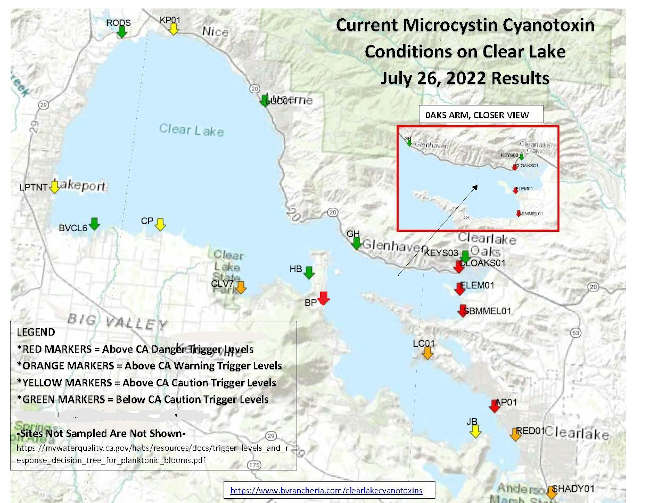
LAKE COUNTY, Calif. — A drinking water advisory remains in effect for households with individual water systems which use private intakes to draw from Clear Lake along the shoreline of the Lower and Oaks arms.
County officials said there is no simple remedy if you are getting your water in this way — boiling or putting chemicals in the lake or tap water does not eliminate the cyanotoxins.
Public water systems remain unaffected by this advisory and continue to provide customers with a safe supply of drinking water absent of cyanotoxins, which meets state and federal water quality standards.
Twenty five gallons per week of drinking water is available at filling stations for affected households, which is generously being provided by Golden State and Mt. Konocti Mutual Water Companies at the following locations:
• 10680 Lakeshore Drive, Clearlake: provided by Golden State Water Co., 1-800-999-4033;
• 4980 Hawaina Way, Kelseyville: provided by Mt. Konocti Mutual Water Co., 707-277-7466.
On July 26, Big Valley Environmental Protection Agency sampled 19 locations on Clear Lake’s shoreline. Visible harmful algal blooms, or HABs, were noted at 14 of the locations sampled.
Sixteen samples were submitted for microcystin toxin analysis and qPCR analysis which indicated the following:
• Five locations indicated the presence of danger levels (>20 µg/L) of cyanotoxins;
• Six locations indicated warning levels (>6 µg/L);
• Two location indicated caution levels (>0.8 µg/L);
• Three locations had toxin levels below caution levels.
The five locations with danger levels of cyanotoxins are the following (also see red danger indicators on the map provided):
• Austin Park (AP01, Lower Arm);
• Buckingham Park (BP, Lower Arm);
• Clearlake Oaks (CLOAKS01, Oaks Arm);
• Elem Indian Colony shoreline (ELEM01, Oaks Arm);
• Sulphur Bank Mercury Mine shoreline (SBMMEL01, Oaks Arm).
Recent cooler weather may have temporarily reduced cyanotoxin levels in Clear Lake. Many visible HABs have somewhat dissipated in recent days, but they will likely reappear soon as the summer heat continues.
Officials noted that, if future sample analysis indicates an improvement in the level of cyanotoxins in Clear Lake, this does not ensure it is safe to drink water from privately managed individual water systems.
Testing has shown other contaminants may also be present in these systems. People using individual water systems must make sure they are regularly maintained and tested; for cyanotoxins, nitrates, coliform bacteria and herbicides.
For households getting their drinking water from individual water systems which use private intakes to draw from Clear Lake (and who have not previously participated), testing for these contaminants is available through Big Valley EPA’s Cal-WATCH program detailed here: www.cal-watch.org.
If you live outside of the Clearlake Oaks and Lower Arms, and you have an individual water system with a private intake that draws from Clear Lake, it is important to maintain awareness of current water quality conditions and assess your risk.
The most recent cyanotoxin monitoring data is available here: www.bvrancheria.com/clearlakecyanotoxins.
Exposure to drinking water contaminated with elevated concentrations of microcystin and cylindrospermopsin could cause liver and kidney damage.
The main source of human health effects data for microcystins is from acute recreational exposure to cyanobacteria blooms.
Symptoms include headache, sore throat, vomiting and nausea, stomach pain, dry cough, diarrhea, blistering around the mouth and pneumonia.
If you are concerned you have symptoms resulting from exposure to cyanotoxins, immediately contact your primary health care provider and call County of Lake Health Services at 707-263-1090.
The table below summarizes the health effects caused by the most common toxin-producing cyanobacteria.
“Clear Lake is a beautiful natural resource, and our community has many visitors who come to the area to experience it. Together, with care and consideration, we need to adapt to these changing times, and ensure residents and guests, alike, understand risks posed by cyanotoxins,” the county reported.
For additional information about cyanobacteria and harmful algal blooms, please visit the following websites.
Centers for Disease Control and Prevention: www.cdc.gov/habs/index.html
Environmental Protection Agency: www.epa.gov/cyanohabs
County of Lake cyanobacteria webpage: www.lakecountyca.gov/Government/Directory/WaterResources/ClearLake/Cyanobacteria.htm
Environmental Protection Agency’s 2015 microcystins report: www.epa.gov/cyanohabs/health-effects-cyanotoxins