 How to resolve AdBlock issue?
News
- Details
- Written by: Elizabeth Larson
The City of Clearlake Animal Association also is seeking fosters for the animals waiting to be adopted.
Call the Clearlake Animal Control shelter at 707-273-9440, or email
Visit Clearlake Animal Control on Facebook or on the city’s website.
The following dogs are available for adoption. The newest additions are at the top.

‘Groucho’
“Groucho” is a male Chihuahua-miniature pinscher mix with a short tricolor coat.
He has been neutered.
He is dog No. 49651597.

‘Sparkles’
“Sparkles” is a female terrier mix with a short brindle coat.
Shehas been spayed.
She is dog No. 50592729.

‘Willie’
“Willie” is a male German shepherd mix with a black and tan coat.
He has been neutered.
He is dog No. 50596003.

‘Andy’
“Andy” is a male American pit bull mix with a short gray and white coat.
He is dog No. 48995415.

‘Bear’
“Bear” is a male Labrador retriever-American pit bull mix with a short charcoal and fawn coat.
He has been neutered.
He is dog No. 48443153.

‘Betsy’
“Betsy” is a female American pit bull mix with a short white coat.
She has been spayed.
She is dog No. 50236145.

‘Bluey’
“Bluey” is a male retriever mix with a short black coat.
He has been neutered.
He is dog No. 50552999.

‘Big Phil’
“Big Phil” is a 13-year-old male American pit bull terrier mix with a blue coat.
He has been neutered.
He is dog No. 49951647.

‘Colt’
“Colt” is a male Rhodesian Ridgeback mix with a short rust and black coat.
He has been neutered.
He is dog No. 49812106.

‘Hakuna’
“Hakuna” is a male shepherd mix with a tan coat.
He has been neutered.
He is dog No. 50176912.

‘Kubota’
“Kubota” is a male German shepherd mix with a short tan and black coat.
He has been neutered.
Kubota is dog No. 50184421.

‘Luna’
“Luna” is an 8-month-old Labrador retriever-terrier mix with a black and white coat.
She is dog No. 50339254.

‘Mamba’
“Mamba” is a male Siberian husky mix with a gray and cream-colored coat.
He has been neutered.
He is dog No. 49520569.

‘Matata’
“Matata” is male shepherd mix with a tan coat.
He has been neutered.
He is dog No. 50176912.

‘Newman’
“Newman” is a 1-year-old male American pit bull terrier mix with a black and white coat.
He has been neutered.
Newman is dog No. 49057809.

‘Sadie’
“Sadie” is a female German shepherd mix with a black and tan coat.
She has been spayed.
She is dog No. 49802563.

‘Terry’
“Terry” is a handsome male shepherd mix with a short brindle coat.
He gets along with other dogs, including small ones, and enjoys toys. He also likes water, playing fetch and keep away.
Staff said he is now getting some training to help him build confidence.
He is dog No. 48443693.

‘Tiramisu’
“Tiramisu” is a female Alaskan husky mix with a short brown and cream coat.
She is dog No. 49652833.

‘Ziggy’
“Ziggy” is a male American pit bull terrier mix with a short gray and white coat.
He has been neutered.
Ziggy is dog No. 50146247
Email Elizabeth Larson at
- Details
- Written by: Asaf Mazar, University of Pennsylvania and Wendy Wood, USC Dornsife College of Letters, Arts and Sciences

If you’re like many Americans, you probably start your day with a cup of coffee – a morning latte, a shot of espresso or maybe a good ol’ drip brew.
A common explanation among avid coffee drinkers is that we drink coffee to wake ourselves up and alleviate fatigue.
But that story doesn’t completely hold up. After all, the amount of caffeine in a cup of coffee can vary wildly. Even when ordering the same type of coffee from the same coffee shop, caffeine levels can double from one drink to the next. And yet, we coffee drinkers don’t seem to notice.
So what else might be driving us in our quest for that morning brew?
That’s one question we set out to answer in our recent research. The answer has far-reaching implications for the way we approach major societal challenges such as diet and climate change.
As behavioral scientists, we’ve learned that people often repeat everyday behaviors out of habit. If you regularly drink coffee, you likely do so automatically as part of your habitual routine – not just out of tiredness.
But habit just doesn’t feel like a good explanation – it’s unsatisfying to say that we do something just because it’s what we’re used to doing. Instead, we concoct more compelling explanations, like saying we drink coffee to ease our morning fog.
This reluctance means that we fail to recognize many habits, even as they permeate our daily lives.
Unpacking what lies behind habits
To test whether people underestimate the role that habit plays in their life, we asked more than 100 coffee drinkers what they think drives their coffee consumption. They estimated that tiredness was about twice as important as habit in driving them to drink coffee. To benchmark these assumptions against reality, we then tracked these people’s coffee drinking and fatigue over the course of one week.
The actual results starkly diverged from our research participants’ explanations. Yes, they were somewhat more likely to drink coffee when tired – as would be expected – but we found that habit was an equally strong influence. In other words, people wildly overestimated the role of tiredness and underestimated the role of habit. Habits, it seems, aren’t considered much of an explanation.
We then replicated this finding in a second study with a behavior that people might consider a “bad” habit – failing to help in response to a stranger’s request. People still overlooked habit and assumed that their reluctance to proffer help was due to their mood at the time.
The gap between the actual and perceived role of habit in our lives matters. And this gap is key to understanding why people often struggle to change repeated behaviors. If you believe that you drink coffee because you are tired, then you might try to reduce coffee drinking by going to bed early. But ultimately you’d be barking up the wrong tree – your habit would still be there in the morning.
Why habits are surprisingly difficult to change
The reason that habits can be so difficult to overcome is that they are not fully under our control. Of course, most of us can control a single instance of a habit, such as by refusing a cup of coffee this time or taking the time to offer directions to a lost tourist. We exert willpower and just push through. But consistently reining in a habit is fiendishly difficult.
To illustrate, imagine you had to avoid saying words that contain the letter “I” for the next five seconds. Pretty simple, right? But now imagine if you had to maintain this rule for a whole week. We habitually use many words that contain “I.” Suddenly, the required 24/7 monitoring turns this simple task into a far more onerous one.
We make a similar error when we try to control unwanted habits and form new, desirable ones. Most of us can achieve this in the short run – think about your enthusiasm when starting a new diet or workout regimen. But we inevitably get distracted, tired or just plain busy. When that happens, your old habit is still there to guide your behavior, and you end up back where you started. And if you fail to recognize the role of habit, then you’ll keep overlooking better strategies that effectively target habits.
The flip side is also true: We don’t recognize the benefits of our good habits. One study found that on days when people strongly intended to exercise, those with weak and strong exercise habits got similar amounts of physical activity. On days when intentions were weaker, however, those with strong habits were more active. Thus, strong habits keep behavior on track even as intentions ebb and flow.
It’s not just willpower
American culture is partly responsible for the tendency to overlook habits. Compared with residents of other developed nations, Americans are more likely to say that they control their success in life.
Accordingly, when asked what stops them from making healthy lifestyle changes, Americans commonly cite a lack of willpower. Granted, willpower is useful in the short term, as we muster the motivation to, for example, sign up for a gym membership or start a diet.
But research shows that, surprisingly, people who are more successful at achieving long-term goals exert – if anything – less willpower in their day-to-day lives. This makes sense: As explained above, over time, willpower fades and habits prevail.
If the answer isn’t willpower, then what is the key to controlling habits?
Changing habits begins with the environments that support them. Research shows that leveraging the cues that trigger habits in the first place can be incredibly effective. For example, reducing the visibility of cigarette packs in stores has curbed cigarette purchases.
Another path to habit change involves friction: in other words, making it difficult to act on undesirable habits and easy to act on desirable ones. For example, one study found that recycling increased after recycle bins were placed right next to trash cans – which people were already using – versus just 12 feet away.
Effectively changing behavior starts with recognizing that a great deal of behavior is habitual. Habits keep us repeating unwanted behaviors but also desirable ones, even if just enjoying a good-tasting morning brew.
Asaf Mazar, Postdoctoral fellow in Behavioral Science, University of Pennsylvania and Wendy Wood, Provost Professor Emeritus of Psychology and Business, USC Dornsife College of Letters, Arts and Sciences
This article is republished from The Conversation under a Creative Commons license. Read the original article.
- Details
- Written by: Carol Rasmussen

New research on Antarctica, including the first map of iceberg calving, doubles the previous estimates of loss from ice shelves and details how the continent is changing.
The greatest uncertainty in forecasting global sea level rise is how Antarctica’s ice loss will accelerate as the climate warms. Two studies published Aug. 10 and led by researchers at NASA’s Jet Propulsion Laboratory in Southern California reveal unexpected new data about how the Antarctic Ice Sheet has been losing mass in recent decades.
One study, published in the journal Nature, maps how iceberg calving – the breaking off of ice from a glacier front – has changed the Antarctic coastline over the last 25 years. The researchers found that the edge of the ice sheet has been shedding icebergs faster than the ice can be replaced. This surprise finding doubles previous estimates of ice loss from Antarctic’s floating ice shelves since 1997, from 6 trillion to 12 trillion metric tons. Ice loss from calving has weakened the ice shelves and allowed Antarctic glaciers to flow more rapidly to the ocean, accelerating the rate of global sea level rise.
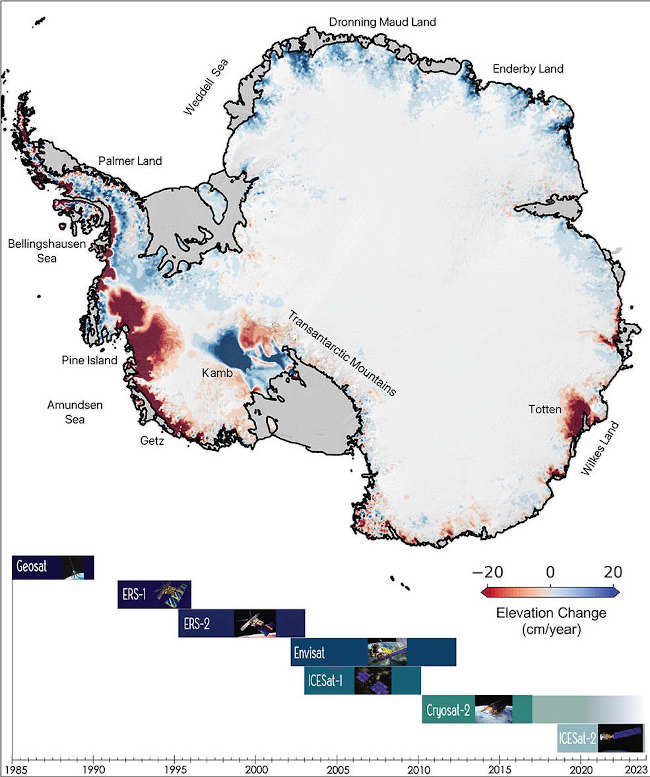
The other study, published in Earth System Science Data, shows in unprecedented detail how the thinning of Antarctic ice as ocean water melts it has spread from the continent’s outward edges into its interior, almost doubling in the western parts of the ice sheet over the past decade. Combined, the complementary reports give the most complete view yet of how the frozen continent is changing.
“Antarctica is crumbling at its edges,” says JPL scientist Chad Greene, lead author of the calving study. “And when ice shelves dwindle and weaken, the continent’s massive glaciers tend to speed up and increase the rate of global sea level rise.”
Most Antarctic glaciers flow to the ocean, where they end in floating ice shelves up to 2 miles (3 kilometers) thick and 500 miles (800 kilometers) across. Ice shelves act like buttresses to glaciers, keeping the ice from simply sliding into the ocean. When ice shelves are stable, they have a natural cycle of calving and replenishment that keeps their size fairly constant over the long term.
But in recent decades, the warming ocean has been destabilizing Antarctica’s ice shelves by melting them from below, making them thinner and weaker. Satellite altimeters measure the thinning process by recording the changing height of the ice, but until this study, there hasn’t been a comprehensive assessment of how climate change might be affecting calving around the continent.
That’s partly because satellite imagery has been challenging to interpret. “For example,” said Greene, “you can imagine looking at a satellite image and trying to figure out the difference between a white iceberg, white ice shelf, white sea ice, and even a white cloud. That’s always been a difficult task. But we now have enough data from multiple satellite sensors to see a clear picture of how Antarctica’s coastline has evolved in recent years.”
For the new study, Greene and his co-authors synthesized satellite imagery of the continent in visible, thermal infrared (heat), and radar wavelengths since 1997. Combining these measurements with an understanding of ice flow gained from an ongoing NASA glacier-mapping project, they charted the edges of ice shelves around 30,000 linear miles (50,000 kilometers) of Antarctic coastline.
Losses from calving have outpaced natural ice-shelf growth so greatly that the researchers think it’s unlikely Antarctica can grow back to its pre-2000 extent by the end of this century. In fact, the findings suggest that greater losses can be expected: Antarctica’s largest ice shelves all appear to be headed for major calving events in the next 10 to 20 years.
Mapping 36 years of ice loss
In the complementary study, JPL scientists have combined almost 3 billion data points from seven spaceborne altimetry instruments to produce the longest continuous data set on the changing height of the ice sheet — an indicator of ice loss — from as early as 1985.
They used radar and laser measurements of ice elevation, accurate to within centimeters, to produce the highest-resolution monthly maps of change ever made of ice loss.
The unparalleled detail in the new record reveals how long-term trends and annual weather patterns affect the ice. It even shows the rise and fall of the ice sheet as subglacial lakes regularly fill and empty miles below the surface.
“Subtle changes like these, in combination with improved understanding of long-term trends from this data set, will help researchers understand the processes that influence ice loss, leading to improved future estimates of sea level rise,” said JPL’s Johan Nilsson, lead author of the study.
Synthesizing and analyzing the massive archives of measurements into a single, high-resolution data set took years of work and thousands of hours of computing time on NASA’s servers. Nilsson says it was all worth it: “Condensing the data into something more widely useful may bring us closer to the big breakthroughs we need to better understand our planet and to help prepare us for the future impacts of climate change.”
Carol Rasmussen works for NASA.
- Details
- Written by: Elizabeth Larson
LAKE COUNTY, Calif. — The Clearlake Planning Commission on Tuesday evening voted unanimously to grant permits to allow an anti-abortion group to begin operating a clinic in the city.
The Pregnancy Counseling Center of Ukiah, doing business as Mendo Lake Women’s Clinic, will be located within an existing commercial building built in 1980 that previously housed an eye clinic, located at 14595 Olympic Drive, Suite C.
The center’s administration sought the conditional use permit, sign permit and an environmental categorical exemption for the 2,000-square-foot licensed medical clinic.
The staff report said the Mendo Lake Women’s Clinic is a nonprofit organization, with its parent clinic located in Ukiah.
Nonprofit filings show that the Pregnancy Counseling Center of Ukiah also is known as The Center for Life Choices.
Cathy Hoyt, chair of the board of directors of the Center for Life Choices, said the center is the funding agency for the new clinic, which she directs.
The Pregnancy Counseling Center’s stated mission is, “To erase the need for abortion by effectively serving pregnant, at-risk women by transforming their fear into confidence.”
Internal Revenue Service filings from 2017 to 2019 showed the organization received contributions and grants totaling around $300,000 annually.
City planning documents state that the proposed outpatient clinic will provide limited services at no charge to women with unplanned pregnancy. Services include pregnancy testing, prenatal vitamin provision, limited ultrasounds, options consultation, sexually transmitted infection testing and limited treatment and an abortion pill recovery treatment program.
The outpatient clinic will operate from 12:30 p.m. to 5 p.m. Monday, Wednesday and Thursdays, and staffed by up to four employees. A maximum of five patients per day is expected, with a total of 200 patients a year.
Staff recommended approval of the project.
“We are excited about the opportunity to serve the women of Lake County as we have served Mendocino County for over 35 years,” Hoyt said.
Hoyt said the organization is not new to Lake County, and operated as a mobile clinic from October 2012 to January 2019. After the demise of the mobile clinic, they planned to establish a permanent setting, resulting in this project, Hoyt said.
She said their services include recovery for post-abortion syndrome which is a form of PTSD. “Contrary to the common narrative, abortion can be a traumatic event for many women and men, as well as family and friends, and we plan to address this silent mental health thief with an outreach that heals and brings hope.”
Hoyt said they also provide treatment for women who begin the abortion pill procedure and then regret it. When the process is started quickly enough, Hoyt claimed it has favorable results.
“The medically underserved county of Lake will benefit greatly from the presence of this clinic,” not only from the services but from referrals, she said.
Hoyt said they offer their services for free, which is made possible by their donors.
She questioned several city requirements because she said they would increase their cost to operate and delay their opening, including parking, lighting and landscape plans, explaining their renovations are for the building’s interior only.
Other requirements she asked to be waived included a requirement for a trash enclosure and a cultural resource consultant.
Senior Planner Mark Roberts explained many of those requirements were boilerplate, and in the case of some of them — for new curb and gutter on the Buckeye Street side of the building and the cultural resource consultant — the commission was willing to waive them.
However, City Manager Alan Flora cautioned against removing conditions in case things come up, explaining there are obligations from the state and federal government on some of the items, particularly if the ground is disturbed during the project.
During public comment, the project’s contractor questioned what the city’s regulations were accomplishing.
Real estate agent Dave Hughes, a former city planning commissioner representing the building’s owner at the meeting, asked why a use permit process was necessary for the new clinic. “To me this is totally unnecessary, and a waste of staff and applicant time.”
Hughes said it was an undue hardship on the property owner and applicant, suggesting the city was abusing the use permit process. He said the city also had raised its permit fees $2,200.
Commissioner Terry Stewart said he thought Hughes raised valid points and asked if the use permit process could be bypassed.
“The city municipal code says that this use requires a use permit. In fact, Mr. Hughes was on the zoning committee that recommended approval of this very zoning ordinance,” said Flora.
While the council recently had approved new fees, Flora said it didn’t impact the clinic project, and added the city’s fees are still the lowest in Lake County and the region.
“We need a consistent standard. It’s my belief that the city is extremely business friendly,” said Flora. “But you can drive around this town and see the impact that the good old boys network has had on development in the city over the years, and those days need to stop.”
Commissioner Erin McCarrick agreed that the city is a business friendly environment, with staff working on each project specifically. She said they could push the project off for two weeks to look at it more closely but added that she didn’t want to do that and delay it.
Flora encouraged the commission to approve it and move forward. If there are areas in the zoning ordinance that the commissioners have concerns about, Flora said staff is not resistant to a more streamlined process.
“We can streamline it so much that the commission has absolutely nothing to do if that’s what you and the city council would like,” but that’s a different discussion, Flora said.
He said he’s happy to take any recs from the commission to the council to streamline it. However, he said they need to make sure there are conditions of approval, and regulations are followed and that there’s “an orderly and consistent development pattern in the city moving forward.”
Commissioner Fawn Williams moved to adopt the conditional use permit, sign permit and categorical exemption to authorize the clinic’s operation. Commissioner Robert Coker seconded and the commission approved the motion 5-0.
Email Elizabeth Larson at