How to resolve AdBlock issue?
News
- Details
- Written by: Cobb Area Council
This year the event has expanded to include activities throughout Cobb over the entire weekend of Friday, Aug. 26, to Sunday, Aug. 28.
The main event will be held Saturday, Aug. 27, at Mountain Meadow Venue 16451 Golf Road on Cobb from 11 a.m. to 5 p.m.
This festival is part of a larger plan created by the Economic Development Ad Hoc Committee of the Cobb Area Council as a way to bring more visitors to the Cobb area to help stimulate growth and to support our local businesses and artisans.
The event will feature live music, food, beer and wine, artisan vendors and a kids area. Home bakers are encouraged to enter the blackberry cobbler contest for a chance at a first prize ribbon.
All blackberry cobbler entries are to be submitted from 11 a.m. until 1:30 p.m. Judging begins at 2 p.m. and the winners will be announced at 3 p.m.
Other events for the weekend include the following:
• Friday evening Blackberry Harvest Dinner at Whispering Pines Resort, information and tickets here: https://www.eventbrite.com/e/blackberry-harvest-dinner-tickets-381180159117.
• Saturday night Bingo at the Lion's Club at the Little Red Schoolhouse.
• Saturday night Cobbler Fest Evening at Mandala Springs: https://tickets.brightstarevents.com/event/cobbler-after-festival.
• Sunday hike in Boggs Forest with Friends of Boggs Mountain at 9 a.m. RSVP at
• Sunday at Pine Grove Resort: PineGrooven dance, food, fun starting at 10:30 a.m.
• Adam Springs Clubhouse: Blackberry menu and drinks.
• Blackberry frozen yogurt and treats at Mtn. High Coffee and Books.
Visit www.ExploreCobbCA.com for more information and to support the artists and businesses in the Cobb community.
The Cobb Area Council is grateful for the generous donation from Calpine Corp. to ensure the success of this annual event.
The group also thanked Whispering Pines Resort, Mountain Meadow Venue, Mandala Springs Resort, PG&E, Hardester’s Market, Reynolds Systems, Jennifer Wall Realtor Re/Max GOLD, Adventist Health, Abby Leu Presents, Jon the Tax Man, James and Inez Wenckus, California Tendai, Wild Bee Creations, Boatique Winery, Kelsey Creek Brewery, Shannon Family of Wines, Fore Family Winery, Pope Valley Winery, R Vineyards, Trinchero Family Estates, Lagunitas Brewery, Bell Haven Flower Farm, A. Nichols Tree Service, Action Sanitary, Big Falls Water, Reynolds Systems, Patrick Lambert Farmers Insurance, CVS Pharmacy, O’Meara Bros. Brewing Co. and many, many volunteers who have come together to help make sure this event is a success.
- Details
- Written by: Elizabeth Larson
Dogs available for adoption this week include mixes of catahoula leopard dog, chow chow, German shepherd, Great Pyrenees, hound, husky, Labrador retriever, pit bull, Rottweiler, shepherd, terrier and treeing walker coonhound.
Dogs that are adopted from Lake County Animal Care and Control are either neutered or spayed, microchipped and, if old enough, given a rabies shot and county license before being released to their new owner. License fees do not apply to residents of the cities of Lakeport or Clearlake.
The following dogs at the Lake County Animal Care and Control shelter have been cleared for adoption.
Call Lake County Animal Care and Control at 707-263-0278 or visit the shelter online for information on visiting or adopting.

German shepherd-chow chow mix
This 3-year-old male German shepherd-chow chow mix has a black and tan coat.
He is in kennel No. 7, ID No. LCAC-A-3866.

Male Labrador retriever mix
This 5-year-old male Labrador retriever mix has a short gold coat.
He is in kennel No. 8, ID No. LCAC-A-3737.

Female pit bull terrier
This 2-year-old female pit bull terrier has a black and white coat.
She is in kennel No. 9, ID No. LCAC-A-3856.

Male pit bull terrier
This 1-year-old male pit bull terrier has a gray and white coat.
He is in kennel No. 10, ID No. LCAC-A-3855.

Male Rottweiler-shepherd mix
This male Rottweiler-shepherd mix puppy has a short black and tan coat.
He is in kennel No. 13, ID No. LCAC-A-3851.

‘June’
“June” is a 2-year-old female catahoula leopard dog mix has a short brindle coat.
She is in kennel No. 18, ID No. LCAC-A-3768.

Female hound mix
This 1-year-old female hound mix has a short brown and white coat.
He is in kennel No. 19, ID No. LCAC-A-3766.

Female treeing walker coonhound
This young female treeing walker coonhound has a short black brindle coat.
She is in kennel No. 22, ID No. LCAC-A-3776.

Female German shepherd
This 1-year-old female German shepherd has a short black and tan coat.
She is in kennel No. 24, ID No. LCAC-A-3780.

Female Labrador retriever
This 7-year-old female Labrador retriever mix has a short gold coat.
She is in kennel No. 26, ID No. LCAC-A-3821.

Female husky
This 1-year-old female husky has a cream and black coat.
She is in kennel No. 27, ID No. LCAC-A-3893.

Male shepherd mix
This 1-year-old male shepherd mix has a black and tan coat.
He is in kennel No. 28, ID No. LCAC-A-3796.

Labrador retriever-hound mix
This 2-year-old male Labrador retriever-black and tan coonhound mix has a short black and tan coat.
He is in kennel No. 29, ID No. LCAC-A-3849.

Female Great Pyrenees
This young female Great Pyrenees has a gray and white coat.
She is in kennel No. 30, ID No. LCAC-A-3790.

‘Maya’
“Maya” is a 2-year-old female German shepherd with a short black and tan coat.
She is in kennel No. 32, ID No. LCAC-A-2598.

Female Great Pyrenees
This young female Great Pyrenees has a short white coat.
She is in kennel No. 34, ID No. LCAC-A-3789.
Email Elizabeth Larson at
- Details
- Written by: Uisdean Nicholson, Heriot-Watt University; Sean Gulick, University of Texas at Austin, and Veronica Bray, University of Arizona

The ocean floor is famously less explored than the surface of Mars. And when our team of scientists recently mapped the seabed, and ancient sediments beneath, we discovered what looks like an asteroid impact crater.
Intriguingly, the crater, named “Nadir” after the nearby volcano Nadir Seamount, is of the same age as the Chicxulub impact caused by a huge asteroid at the end of the Cretaceous period, around 66 million years ago, which wiped out the dinosaurs and many other species.
The finding, published in Science Advances, raises the question of whether the crater might be related to Chicxulub in some way. If confirmed, it would also be of huge general scientific interest as it would be one of a very small number of known marine asteroid impacts and so give unique new insights into what happens during such a collision.
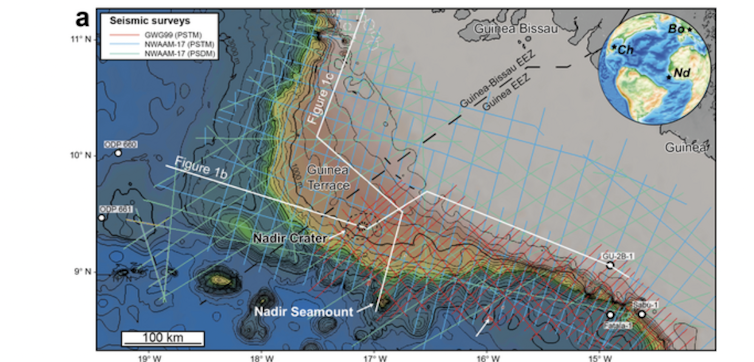
The crater was identified using “seismic reflection” as part of a wider project to reconstruct the tectonic separation of South America from Africa back in the Cretaceous period. Seismic reflection works in a similar manner to ultrasound data, sending pressure waves through the ocean and its floor and detecting the energy that is reflected back. This data allows geophysicists and geologists to reconstruct the architecture of the rocks and sediments.
Scrolling through this data at the end of 2020, we came across a highly unusual feature. Among the flat, layered sediments of the Guinea Plateau, west of Africa, was what appeared to be a large crater, a little under 10km wide and several hundred metres deep, buried below several hundred metres of sediment.
Many of its features are consistent with an impact origin, including the scale of the crater, the ratio of height to width and the height of the crater rim. The presence of chaotic deposits outside of the crater floor also look like “ejecta” – material expelled from the crater immediately following a collision.
We did consider other possible processes that could have formed such a crater, such as the collapse of a submarine volcano or a pillar (or diapir) of salt below the seabed. An explosive release of gas from below the surface could also be a cause. But none of these possibilities are consistent with the local geology or the geometry of the crater.
Earthquakes, airblast, fireball and tsunamis
After identifying and characterising the crater, we built computer models of an impact event to see if we could replicate the crater and characterise the asteroid and its impact.
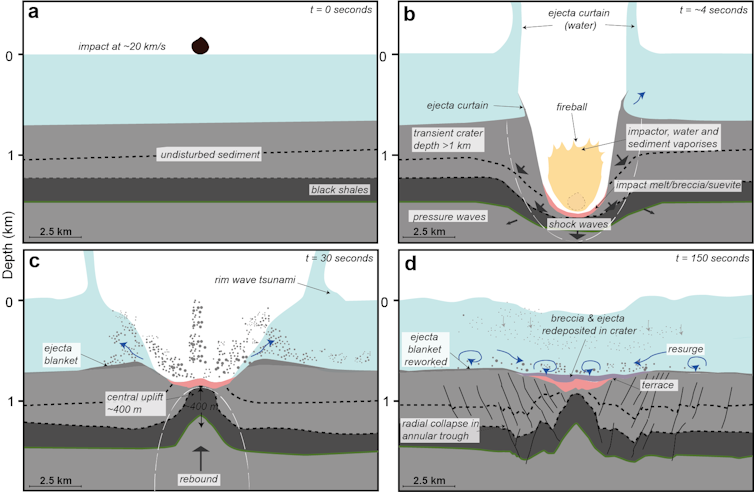
The simulation that best fits the crater shape is for an asteroid 400 metres in diameter hitting an ocean that was 800 metres deep. The consequences of an impact in the ocean at such water depths are dramatic. It would result in an 800-metre thick water column, as well as the asteroid and a substantial volume of sediment being instantly vapourised – with a large fireball visible hundreds of kilometres away.
Shock waves from the impact would be equivalent to a magnitude 6.5 or 7 earthquake, which would likely trigger underwater landslides around the region. A train of tsunami waves would form.
The air blast from the explosion would be larger than anything heard on Earth in recorded history. The energy released would be approximately a thousand times larger than that from the recent Tonga eruption. It is also possible that the pressure waves in the atmosphere would further amplify the tsunami waves far away from the crater.
Chicxulub relative?
One of the most intriguing aspects of this crater is that it is the same age as the giant Chicxulub event, give or take one million years, at the boundary between the Cretaceous and Paleogene periods 66 million years ago. Again, if this really is an impact crater, might there be some relationship between them?
We have three ideas as to their possible relationship. The first is that they might have formed from the break-up of a parent asteroid, with the larger fragment resulting in the Chicxulub event and a smaller fragment (the “little sister”) forming the Nadir crater. If so, the damaging effects of the Chicxulub impact could have been added to by the Nadir impact, exacerbating the severity of the mass extinction event.
The break-up event could have formed by an earlier near-collision, when the asteroid or comet passed close enough to Earth to experience gravitational forces strong enough to pull it apart. The actual collision could then have occurred on a subsequent orbit.
Although, this is less likely for a rocky asteroid, this pull-apart is exactly what happened to the Shoemaker-Levy 9 comet that collided with Jupiter back in 1994, where multiple comet fragments collided with the planet over the course of several days.
Another possibility is that Nadir was part of a longer lived “impact cluster”, formed by a collision in the asteroid belt earlier in solar system history. This is known as the “little cousin” hypothesis.
This collision may have sent a shower of asteroids into the inner solar system, which may have collided with the Earth and other inner planets over a more extended time period, perhaps a million years or more. We have a precedent for such an event back in the Ordovician period – over 400 million years ago – when there were numerous impact events in a short period of time.
Finally, of course, this may just be a coincidence. We do expect a collision of a Nadir-sized asteroid every 700,000 years or so. For now, however, we cannot definitively state that the Nadir crater was formed by an asteroid impact until we physically recover samples from the crater floor, and identify minerals that can only be formed by extreme shock pressures. To that end, we have recently submitted a proposal to drill the crater through the International Ocean Discovery Program.
As with the main impact crater hypothesis, we can only test the little sister and little cousin hypotheses by accurately dating the crater using these samples, as well as by looking for other candidate craters of a similar age.
Perhaps more importantly, could such an event happen in the near future? It is unlikely, but the size of the asteroid that we model is very similar to the Bennu asteroid currently in near-Earth orbit. This asteroid is considered to be one of the two most hazardous objects in the solar system, with a one-in-1,750 chance of collision with Earth in the next couple of centuries.
Uisdean Nicholson, Associate Professor of Geoscience, Heriot-Watt University; Sean Gulick, Research Professor of Geoscience, University of Texas at Austin, and Veronica Bray, Research Scientist, Lunar & Planetary Laboratory, University of Arizona
This article is republished from The Conversation under a Creative Commons license. Read the original article.
- Details
- Written by: Elizabeth Larson
This story is being updated as new information is available.
LAKE COUNTY, Calif. — Firefighters are working to stop a Saturday evening fire near Lower Lake.
The Point fire was first reported just before 5:45 p.m. Saturday in the area of Point Lakeview Road near Highway 29.
Firefighters at the scene later put the fire closer to the area of Panorama Road near Lake Road.
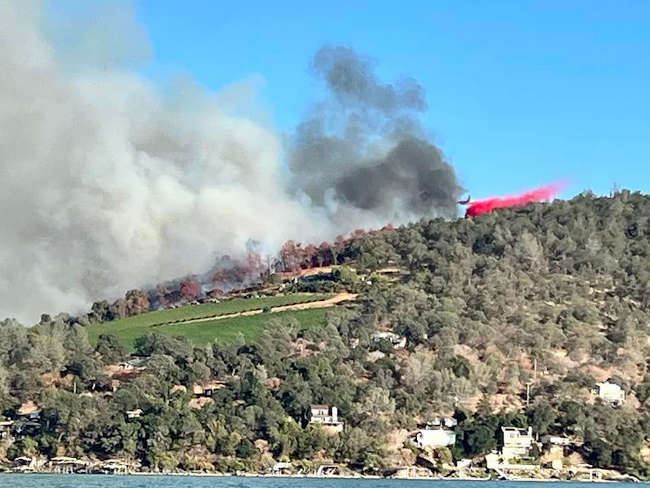
Several local fire agencies including Lake County Fire, Kelseyville Fire, Lakeport Fire and Northshore Fire responded, with Cal Fire sending a full wildland fire dispatch including air attack, helicopters and four air tankers.
Evacuations were ordered in the area of sunrise Drive, Black Oak Drive and near Sunrise Shore.
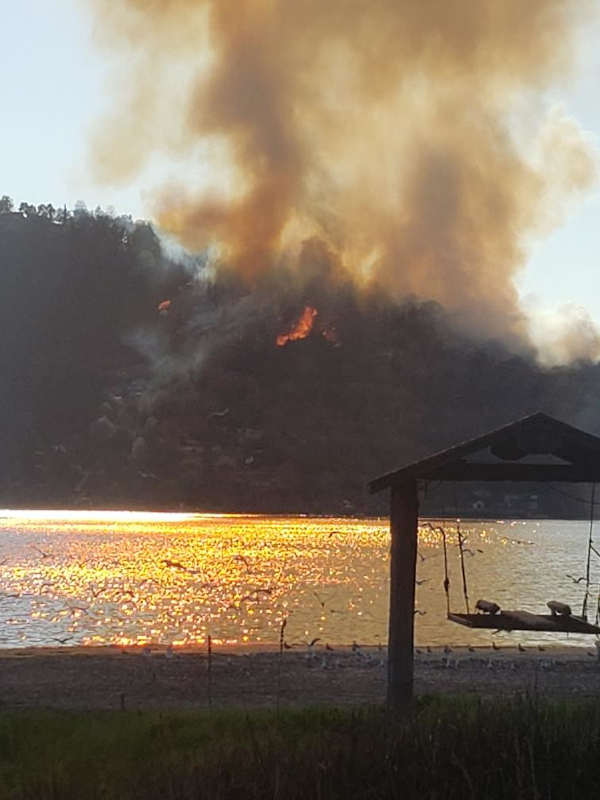
As of just before 6:30 p.m., the fire was reported to be 25 acres, with a moderate rate of spread.
At that point, structures were threatened but none were involved.
Tankers are working to drop retardant to stop the fire, with copters dropping water.
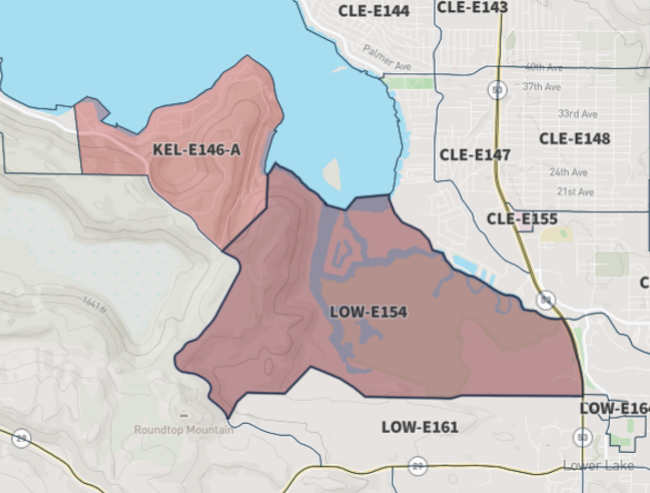
Shortly after 6:30 p.m., the Lake County Sheriff’s Office issued an evacuation order for two evacuation zones, KEL-E146 and LOW-E154.
Air attack reported shortly after 7 p.m. that forward progress was close to being stopped, with tankers making good progress on the head of the fire.
Copter 104 from the Boggs Helitack was at the fire and working to knock out a spot fire by structures just before 7:20 p.m.
Before 7:30 p.m., incident command gave orders for resources to work on the incident on Sunday, which included several crews, strike teams and at least one dozer.
Minutes later, the last tankers were being released, with two copters to continue to work the incident until dark.
Also at about 7:30 p.m., the sheriff’s office issued an evacuation warning for the area of Konocti Vista Drive to Anderson Road in the Jago Bay area, located in KEL-E146-B pm Zonehaven. Residents of the area are asked to maintain situational awareness and prepare to evacuate if necessary.
Shortly before 8:15 p.m., the sheriff’s office said the evacuation warning for the area west of Anderson Road was lifted.
However, all evacuation orders east of Anderson Road at Pt. Lakeview remained in effect at that time.
Email Elizabeth Larson at