How to resolve AdBlock issue?
Refresh this page
How to resolve AdBlock issue?
Refresh this page
Lake County News,California
  • Home
    • Registration Form
  • News
    • Education
    • Veterans
    • Community
      • Obituaries
      • Letters
      • Commentary
    • Police Logs
    • Business
    • Recreation
    • Health
    • Religion
    • Legals
    • Arts & Life
    • Regional
  • Calendar
  • Contact us
    • FAQs
    • Phones, E-Mail
    • Subscribe
  • Advertise Here
  • Login
How to resolve AdBlock issue?
Refresh this page

News

Clearlake Animal Control: ‘Rico’ and the dogs

Details
Written by: Elizabeth Larson
Published: 01 November 2025
“Rico.” Photo courtesy of Clearlake Animal Control.

CLEARLAKE, Calif. — Clearlake Animal Control has new puppies amongst the dogs available to loving homes this week.

The shelter has 52 adoptable dogs listed on its website.

This week’s dogs include “Rico,” a 2-month-old male mixed breed puppy with a short black coat. He is expected to be just over 40 pounds when fully grown.

The shelter is located at 6820 Old Highway 53. It’s open from 9 a.m. to 6 p.m. Tuesday through Saturday. 

For more information, call the shelter at 707-762-6227, emailThis email address is being protected from spambots. You need JavaScript enabled to view it. or visit Clearlake’s adoptable dogs here.

This week’s adoptable dogs are featured below.

Email Elizabeth Larson at This email address is being protected from spambots. You need JavaScript enabled to view it.. Follow her on Twitter, @ERLarson, and on Bluesky, @erlarson.bsky.social. Find Lake County News on the following platforms: Facebook, @LakeCoNews; X, @LakeCoNews; Threads, @lakeconews, and on Bluesky, @lakeconews.bsky.social. 

Daylight saving time ends Nov. 2

Details
Written by: LAKE COUNTY NEWS REPORTS
Published: 01 November 2025

LAKE COUNTY, Calif. – This Sunday, the clocks will fall back once more.

Daylight saving time ends at 2 a.m. Sunday, Nov. 2. It began on Sunday, March 9.

The change in the clocks will offer more daylight as the days grow shorter.

With that change, it’s a good time to check the batteries in smoke alarms and other home safety features. 

Because of the time change’s impacts on circadian rhythms and health, people are urged to pay special attention to the need to adjust for changed sleep patterns as the days continue to shorten.

It’s also important to be mindful while on the roads in the fall. Wildlife experts say that in the fall,  animals tend to be most active at dawn and dusk, making it necessary to be particularly watchful when driving to and from work, school or other activities. 

Space News: Solar storms have influenced our history – an environmental historian explains how they could also threaten our future

Details
Written by: Dagomar Degroot, Georgetown University
Published: 01 November 2025

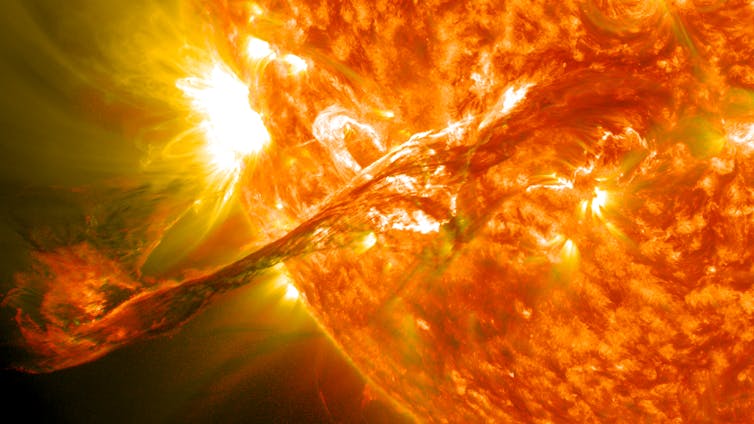
Coronal mass ejections from the Sun can cause geomagnetic storms that may damage technology on Earth. NASA/GSFC/SDO

In May 2024, part of the Sun exploded.

The Sun is an immense ball of superheated gas called plasma. Because the plasma is conductive, magnetic fields loop out of the solar surface. Since different parts of the surface rotate at different speeds, the fields get tangled. Eventually, like rubber bands pulled too tight, they can snap – and that is what they did last year.

These titanic plasma explosions, also known as solar flares, each unleashed the energy of a million hydrogen bombs. Parts of the Sun’s magnetic field also broke free as magnetic bubbles loaded with billions of tons of plasma.

These bubbles, called coronal mass ejections, or CMEs, crashed through space at around 6,000 times the speed of a commercial jetliner. After a few days, they smashed one after another into the magnetic field that envelops Earth. The plasma in each CME surged toward us, creating brilliant auroras and powerful electrical currents that rippled through Earth’s crust.

A coronal mass ejection erupting from the Sun.

You might not have noticed. Just like the opposite poles of fridge magnets have to align for them to snap together, the poles of the magnetic field of Earth and the incoming CMEs have to line up just right for the plasma in the CMEs to reach Earth. This time they didn’t, so most of the plasma sailed off into deep space.

Humans have not always been so lucky. I’m an environmental historian and author of the new book “Ripples on the Cosmic Ocean: An Environmental History of Our Place in the Solar System.”

While writing the book, I learned that a series of technological breakthroughs – from telegraphs to satellites – have left modern societies increasingly vulnerable to the influence of solar storms, meaning flares and CMEs.

Since the 19th century, these storms have repeatedly upended life on Earth. Today, there are hints that they threaten the very survival of civilization as we know it.

The telegraph: A first warning

On the morning of Sept. 1, 1859, two young astronomers, Richard Carrington and Richard Hodgson, became the first humans to see a solar flare. To their astonishment, it was so powerful that, for two minutes, it far outshone the rest of the Sun.

About 18 hours later, brilliant, blood-red auroras flickered across the night sky as far south as the equator, while newly built telegraph lines shorted out across Europe and the Americas.

The Carrington Event, as it was later called, revealed that the Sun’s environment could violently change. It also suggested that emerging technologies, such as the electrical telegraph, were beginning to link modern life to the extraordinary violence of the Sun’s most explosive changes.

For more than a century, these connections amounted to little more than inconveniences, like occasional telegraph outages, partly because no solar storm rivaled the power of the Carrington Event. But another part of the reason was that the world’s economies and militaries were only gradually coming to rely more and more on technologies that turned out to be profoundly vulnerable to the Sun’s changes.

A brush with Armageddon

Then came May 1967.

Soviet and American warships collided in the Sea of Japan, American troops crossed into North Vietnam and the Middle East teetered on the brink of the Six-Day War.

It was only a frightening combination of new technologies that kept the United States and Soviet Union from all-out war; nuclear missiles could now destroy a country within minutes, but radar could detect their approach in time for retaliation. A direct attack on either superpower would be suicidal.

Several buildings on an icy plain, with green lights in the sky above.
An aurora – an event created by a solar storm – over Pituffik Space Base, formerly Thule Air Base, in Greenland in 2017. In 1967, nuclear-armed bombers prepared to take off from this base. Air Force Space Command

Suddenly, on May 23, a series of violent solar flares blasted the Earth with powerful radio waves, knocking out American radar stations in Alaska, Greenland and England.

Forecasters had warned officers at the North American Air Defense Command, or NORAD, to expect a solar storm. But the scale of the radar blackout convinced Air Force officers that the Soviets were responsible. It was exactly the sort of thing the USSR would do before launching a nuclear attack.

American bombers, loaded with nuclear weapons, prepared to retaliate. The solar storm had so scrambled their wireless communications that it might have been impossible to call them back once they took off. In the nick of time, forecasters used observations of the Sun to convince NORAD officers that a solar storm had jammed their radar. We may be alive today because they succeeded.

Blackouts, transformers and collapse

With that brush with nuclear war, solar storms had become a source of existential risk, meaning a potential threat to humanity’s existence. Yet the magnitude of that risk only came into focus in March 1989, when 11 powerful flares preceded the arrival of back-to-back coronal mass ejections.

For more than two decades, North American utility companies had constructed a sprawling transmission system that relayed electricity from power plants to consumers. In 1989, this system turned out to be vulnerable to the currents that coronal mass ejections channeled through Earth’s crust.

Several large pieces of metal machinery lined up in an underground facility.
An engineer performs tests on a substation transformer. Ptrump16/Wikimedia Commons, CC BY-SA

In Quebec, crystalline bedrock under the city does not easily conduct electricity. Rather than flow through the rock, currents instead surged into the world’s biggest hydroelectric transmission system. It collapsed, leaving millions without power in subzero weather.

Repairs revealed something disturbing: The currents had damaged multiple transformers, which are enormous customized devices that transfer electricity between circuits.

Transformers can take many months to replace. Had the 1989 storm been as powerful as the Carrington Event, hundreds of transformers might have been destroyed. It could have taken years to restore electricity across North America.

Solar storms: An existential risk

But was the Carrington Event really the worst storm that the Sun can unleash?

Scientists assumed that it was until, in 2012, a team of Japanese scientists found evidence of an extraordinary burst of high-energy particles in the growth rings of trees dated to the eighth century CE. The leading explanation for them: huge solar storms dwarfing the Carrington Event. Scientists now estimate that these “Miyake Events” happen once every few centuries.

Astronomers have also discovered that, every century, Sun-like stars can explode in super flares up to 10,000 times more powerful than the strongest solar flares ever observed. Because the Sun is older and rotates more slowly than many of these stars, its super flares may be much rarer, occurring perhaps once every 3,000 years.

Nevertheless, the implications are alarming. Powerful solar storms once influenced humanity only by creating brilliant auroras. Today, civilization depends on electrical networks that allow commodities, information and people to move across our world, from sewer systems to satellite constellations.

What would happen if these systems suddenly collapsed on a continental scale for months, even years? Would millions die? And could a single solar storm bring that about?

Researchers are working on answering these questions. For now, one thing is certain: to protect these networks, scientists must monitor the Sun in real time. That way, operators can reduce or reroute the electricity flowing through grids when a CME approaches. A little preparation may prevent a collapse.

Fortunately, satellites and telescopes on Earth today keep the Sun under constant observation. Yet in the United States, recent efforts to reduce NASA’s science budget have cast doubt on plans to replace aging Sun-monitoring satellites. Even the Daniel K. Inouye Solar Telescope, the world’s premier solar observatory, may soon shut down.

These potential cuts are a reminder of our tendency to discount existential risks – until it’s too late.The Conversation

Dagomar Degroot, Associate Professor of Environmental History, Georgetown University

This article is republished from The Conversation under a Creative Commons license. Read the original article.

Judge upholds Interior’s ability to reevaluate Scotts Valley Vallejo casino plan, allows tribe to continue pursuing project

Details
Written by: Elizabeth Larson
Published: 31 October 2025

LAKE COUNTY, Calif. — On Thursday, a federal court handed down a decision in the ongoing legal battle over a Lake County tribe’s attempt to establish a casino in Vallejo, with both proponents and opponents of the project claiming victory in the ruling.

The United States District Court for the District of Columbia handed down the opinion in the Lakeport-based Scotts Valley Band of Pomo Indians’ lawsuit against U.S. Department of Interior Secretary Doug Burgum.

Judge Trevor McFadden allowed for Scotts Valley to continue pursuing the project while upholding the Department of Interior’s ability to reevaluate it.

The decision keeps alive the tribe’s plan for a massive casino project that is anticipated to generate hundreds of millions of dollars a year. However, the 35-page decision emphasizes that the Department of Interior is still in the process of conducting a review of its previous determination earlier this year that cleared the way for the project to proceed.

Both Scotts Valley and the Yocha Dehe Wintun Nation, one of the project’s principal opponents, hailed the decision as a victory for their respective sides.

Scotts Valley focused on the court restoring gaming eligibility to the tribe’s trust land in Vallejo after challenging the Department of Interior’s March decision to rescind and reconsider its prior determination that the Vallejo property qualified as “restored lands” under the Indian Gaming Regulatory Act, or IGRA.

The “restored lands” exception of the Indian Gaming Regulatory Act allows a casino off-reservation if a tribe can prove a historical connection to the land. 

 “This victory is about more than gaming — it’s about fairness, tribal sovereignty, and the fundamental right of our people to move forward in building a brighter future,” said Scotts Valley Chairman Shawn Davis in a statement released to Lake County News on Thursday “Today’s decision opens the door to new opportunities and prosperity for our tribal members and for our neighbors in Vallejo and Solano County.”

On the other side, the Yocha Dehe Wintun Nation applauded the court’s decision rejecting the Scotts Valley Band of Pomo Indians’ challenge to the Department of the Interior’s reconsideration of the project.

“Today’s court decision correctly reaffirms the Department of the Interior’s decision to reevaluate this proposed casino, which would destroy irreparable cultural and ecological resources and has already been rejected three other times by the Department,” said Yocha Dehe Chairman Anthony Roberts in a Thursday statement. “As the Department stated in its letter announcing its decision to reconsider the project, this process will assess all facts and evidence — revealing what history already makes clear: Scotts Valley has no historical connection to this land.”

The background to the legal decision

Scotts Valley is proposing a $700 million, 400,000-square-foot mega casino complex, along with 24 homes and an administrative building, on a 128-acre site near I-80 and Highway 37 in Vallejo.

The tribe said its casino plan underwent nearly a decade of litigation and agency review before it received a favorable determination on its fee-to-trust application from the Department of Interior on Jan. 10. 

That decision, in the final days of the Biden Administration, found the casino project eligible for gaming under IGRA.

Scotts Valley has estimated that its Vallejo casino project will generate $243.5 million a year.

However, the casino project has been vehemently opposed by many residents and leaders in the Vallejo area, and criticism due to Scotts Valley’s home territory being more than 100 miles away in Lake County.

Four neighboring tribes have led the opposition to the plan. They include the Yocha Dehe Wintun Nation, which owns Cache Creek Casino in Yolo County, and the Kletsel Dehe Band of Wintun Indians, a nongaming tribe based in Colusa County, both are Patwin tribes with ancestral ties to Vallejo. 

There also is the United Auburn Indian Community which has a casino on its traditional lands in Placer County and the Lytton Rancheria, which operates a casino in San Pablo.

Those tribes’ objections include the fact that the project would bulldoze a cultural site sacred to local Patwin tribes.

Despite Scotts Valley’s claims about previous review of the plan, the Yocha Dehe said the Department of Interior in January “decided to reconsider a rushed, last-minute approval of the project, noting that important evidence had not been considered, and despite “mass opposition” from other tribes, government officials and thousands of concerned citizens.

The Yocha Dehe also maintained that, prior to the January decision, the Department of Interior had determined on three separate occasions that Scotts Valley lacks the significant historical connection to the Bay Area needed to acquire land eligible for gaming, including to Vallejo specifically. 

On March 24, the Yocha Dehe and Kletsel Dehe filed a lawsuit against the Department of the Interior, challenging the decision to allow the casino to go forward.

On March 27, the Department of Interior informed Scotts Valley in a letter that it was rescinding the gaming eligibility determination granted to the tribe under the Biden Administration in January in order for it to be reconsidered.

That led to Scotts Valley suing the Department of the Interior on April 1, claiming that the agency’s decision to rescind the determination violates federal law and trust obligations, and was motivated by “unfounded opposition from competitors.”

Judge considers aspects of Interior’s action

The Scotts Valley suit against the Department of Interior was the focus of the memorandum decision handed down on Thursday by Judge McFadden.

McFadden wrote that the case “is about an agency’s reversal,” explaining the Department of Interior’s January decision followed, 11 weeks later, by the agency telling Scotts Valley “that it was temporarily rescinding and reconsidering the parcel’s gaming eligibility. The Department directed the Band not to rely on the previous determination while it reevaluates.”

Scotts Valley, the judge noted, was challenging both Interior’s rescission and reconsideration, asserting that each violated the Administrative Procedure Act and the Fifth Amendment’s Due Process Clause.

McFadden addressed those two actions separately, finding that the reconsideration, which is not final, is not subject to Administrative Procedure Act review. 

However, he found that the rescission constitutes final agency action. While he ruled against the tribe on its three claims that Administrative Procedure Act review also was required in that case, McFadden found in Scotts Valley’s favor on the due process claim. 

Judge McFadden acknowledged that in the case, “The interests are weighty on both sides.”

This includes Scotts Valley’s assertion about the benefits of the project. As McFadden noted, “Interior regulations require a tribe to submit ‘restored lands’ applications within 25 years of the tribe’s restoration,” which means in this case, “this is the Band’s last chance.”

McFadden found that, on the due process side, Interior, by its own admission, gave Scotts Valley no warning before rescinding its gaming eligibility. “While leaving Scotts Valley in the dark, the agency communicated several times and even met with the neighboring tribes before the March rescission. … Once it informed the Band, Interior explained simply that ‘the Secretary [wa]s concerned that the Department did not consider additional evidence submitted after the 2022 Remand.’”

The 2022 remand refers to a federal judge’s 2022 decision ordering Interior to reconsider the project after it had been turned down previously.

On the topic of due process as it related to Interior’s decision on the tribe’s gaming eligibility, McFadden found that Interior failed to provide sufficient notice to Scotts Valley.

“In short, the rescission violated due process. Once Interior took the Vallejo parcel into
trust and determined that it was eligible for gaming, Scotts Valley acquired a legitimate property
interest in that determination. Because the agency rescinded the parcel’s gaming eligibility with
barely any notice or hearing, it infringed the Band’s due-process right,” McFadden wrote.

He said he would vacate that rescission.

However, McFadden was clear that his ruling did not bar Interior “from continuing its reconsideration, nor does it stop the Department from revoking the Band’s gaming eligibility at the end of that process. For that reason, Scotts Valley would be ill-served by placing undue reliance on today’s decision. But Interior, too, must take seriously the Band’s reliance interests, and it must provide the required due process. The Court recognizes that this dispute is likely far from over, and it decides only the snapshot properly before it.”

In summary, McFadden granted summary judgment against Scotts Valley’s challenges to Interior’s reconsideration of the project and the tribe’s claims that the process violated Administrative Procedure Act requirements. At the same time, he granted summary judgment in favor of Scotts Valley on its due process claim.

“The Court’s decision reaffirms that the federal government cannot revoke a tribe’s rights without fair process,” said Patrick R. Bergin, counsel for the Tribe. “Scotts Valley welcomes this ruling, which restores the Tribe’s gaming eligibility and ensures that Interior must follow the law before taking it away.”

“For years we have worked with our federal, state, and local partners to shed light on the flaws in this process,” Yocha Dehe Chairman Roberts continued. “We are grateful the Department can continue doing the right thing by evaluating all evidence. We are confident this reconsideration process will reveal the truth Scotts Valley has attempted to hide from the very start – their ancestral lands are not in Vallejo, and they never were.”

The ruling takes immediate effect.

Another Lake County tribe locked in challenges over casino project

In related news, the Koi Nation of Northern California, formerly based in Lower Lake, has proposed a $600 million casino project in Windsor, but also has faced opposition from the community and tribes there.

Gov. Gavin Newsom opposed both the Scotts Valley and Koi projects, as his staff informed Interior in an August 2024 letter, which noted that Gov. Gavin Newsom, while having respect for tribal sovereignty, was concerned about Interior using “the ‘restored lands’ exception to support projects that are focused less on restoring the relevant tribes’ aboriginal homelands, and more on creating new gaming operations in desirable markets.”

Despite this opposition, like Scotts Valley, the Koi’s project was approved in January by the Interior Department in the last days of the Biden administration.

Last month, a judge set Interior’s land-to-trust decision on the Koi project aside.

The Koi have stated their intention to appeal the decision.

Email Elizabeth Larson at This email address is being protected from spambots. You need JavaScript enabled to view it.. Follow her on Twitter, @ERLarson, and on Bluesky, @erlarson.bsky.social. Find Lake County News on the following platforms: Facebook, @LakeCoNews; X, @LakeCoNews; Threads, @lakeconews, and on Bluesky, @lakeconews.bsky.social. 

  1. Fun facts about Halloween
  2. Cal Fire exclusive use helicopters depart the Sonoma-Lake-Napa Unit for the season
  3. Why is it so hard to adjust when clocks ‘fall back’?
  • 111
  • 112
  • 113
  • 114
  • 115
  • 116
  • 117
  • 118
  • 119
  • 120
How to resolve AdBlock issue?
Refresh this page