How to resolve AdBlock issue?
Refresh this page
How to resolve AdBlock issue?
Refresh this page
Lake County News,California
  • Home
    • Registration Form
  • News
    • Education
    • Veterans
    • Community
      • Obituaries
      • Letters
      • Commentary
    • Police Logs
    • Business
    • Recreation
    • Health
    • Religion
    • Legals
    • Arts & Life
    • Regional
  • Calendar
  • Contact us
    • FAQs
    • Phones, E-Mail
    • Subscribe
  • Advertise Here
  • Login
How to resolve AdBlock issue?
Refresh this page

News

All government shutdowns disrupt science − in 2025, the consequences extend far beyond a lapse in funding

Details
Written by: Kenneth M. Evans, Rice University
Published: 06 November 2025

The government shutdown will continue until Congress can pass a bill reopening it. Samuel Corum/AFP via Getty Images

U.S. science always suffers during government shutdowns. Funding lapses send government scientists home without pay. Federal agencies suspend new grant opportunities, place expert review panels on hold, and stop collecting and analyzing critical public datasets that tell us about the economy, the environment and public health.

In 2025, the stakes are higher than in past shutdowns.

This shutdown arrives at a time of massive upheaval to American science and innovation driven by President Donald Trump’s ongoing attempts to extend executive power and assert political control of scientific institutions.

With the shutdown entering its fifth week, and with no end in sight, the Trump administration’s rapid and contentious changes to federal research policy are rewriting the social contract between the U.S. government and research universities – where the government provides funding and autonomy in exchange for the promise of downstream public benefits.

As a physicist and policy scholar, I both study and have a vested interest in the state of U.S. science funding as a recipient of federal grants. I write about the history and governance of American science policy, including the nation’s investments in research and development.

In the context of broader policy reforms to federal grantmaking, student and high-skilled immigration, and scientific integrity, this shutdown has both known and unknown consequences for the future of U.S. science.

Funding freezes, data gaps and unpaid workers

Over the past two decades, the story of government shutdowns has become all too familiar. Shutdowns occur when Congress fails to pass an appropriations bill before the start of the new fiscal year on Oct. 1, and, paraphrasing Article 1, Section 9 of the U.S. Constitution, the government can no longer spend money.

This funding gap affects all but essential government operations, such as the work of postal workers, air traffic controllers and satellite operators. Nonessential employees, including tens of thousands of government scientists, are barred from working and stop receiving paychecks.

With scientists and program officers at home, activities at the nearly two dozen federal agencies participating in research and development, such as the National Science Foundation and the National Institutes of Health, come to a halt. New grant opportunities and review panels are postponed or canceled, researchers at government laboratories stop collecting and analyzing data, and university projects reliant on federal funding are put at risk.

Extended shutdowns accelerate the damage. They leave bigger gaps in government data, throw federal employees into debt or lead them to dip into their savings, and force academic institutions to lay off staff paid through government grants and contracts.

Funding, public services and the rule of law

Even for shutdowns lasting a few days, it can take science agencies months to catch up on the backlog of paperwork, paychecks and peer review panels before they return to regular operations.

This year, the government faces mounting challenges to overcome once the shutdown ends: Trump and the director of the White House budget office, Russell Vought, are using the shutdown as an opportunity to “shutter the bureaucracy” and pressure universities to bend to the administration’s ideological positions on topics such as campus speech, gender identity and admission standards.

As the budget standoff nears the record for the longest shutdown ever, agency furloughs, reductions in force, canceled grants and jeopardized infrastructure projects document the devastating and immediate damage to the government’s ability to serve the public.

President Trump and Russel Vought stand by a microphone. In the background is a painting of a Theodore Roosevelt on a horse.
President Donald Trump alongside Office of Management and Budget Director Russell Vought. Brendan Smialowski/AFP via Getty Images

However, the full impact of the shutdown and the Trump administration’s broader assaults on science to U.S. international competitiveness, economic security and electoral politics could take years to materialize.

In parallel, the dramatic drop in international student enrollment, the financial squeeze facing research institutions, and research security measures to curb foreign interference spell an uncertain future for American higher education.

With neither the White House nor Congress showing signs of reaching a budget deal, Trump continues to test the limits of executive authority, reinterpreting the law – or simply ignoring it.

Earlier in October, Trump redirected unspent research funding to pay furloughed service members before they missed their Oct. 15 paycheck. Changing appropriated funds directly challenges the power vested in Congress – not the president – to control federal spending.

The White House’s promise to fire an additional 10,000 civil servants during the shutdown, its threat to withhold back pay from furloughed workers and its push to end any programs with lapsed funding “not consistent with the President’s priorities” similarly move to broaden presidential power.

Here, the damage to science could snowball. If Trump and Vought chip enough authority away from Congress by making funding decisions or shuttering statutory agencies, the next three years will see an untold amount of impounded, rescinded or repurposed research funds.

A lab filled with scientific equipment but not staffed.
The government shutdown has emptied many laboratories staffed by federal scientists. Combined with other actions by the Trump administration, more scientists could continue to lose funding. Monty Rakusen/DigitalVision via Getty Images

Science, democracy and global competition

While technology has long served as a core pillar of national and economic security, science has only recently reemerged as a key driver of greater geopolitical and cultural change.

China’s extraordinary rise in science over the past three decades and its arrival as the United States’ chief technological competitor has upended conventional wisdom that innovation can thrive only in liberal democracies.

The White House’s efforts to centralize federal grantmaking, restrict free speech, erase public data and expand surveillance mirror China’s successful playbook for building scientific capacity while suppressing dissent.

As the shape of the Trump administration’s vision for American science has come into focus, what remains unclear is whether, after the shutdown, it can outcompete China by following its lead.The Conversation

Kenneth M. Evans, Fellow in Science, Technology, and Innovation Policy, Baker Institute for Public Policy, Rice University

This article is republished from The Conversation under a Creative Commons license. Read the original article.
Prop. 50 passes statewide; early count shows measure with narrow lead in Lake County

Details
Written by: Lingzi Chen
Published: 05 November 2025


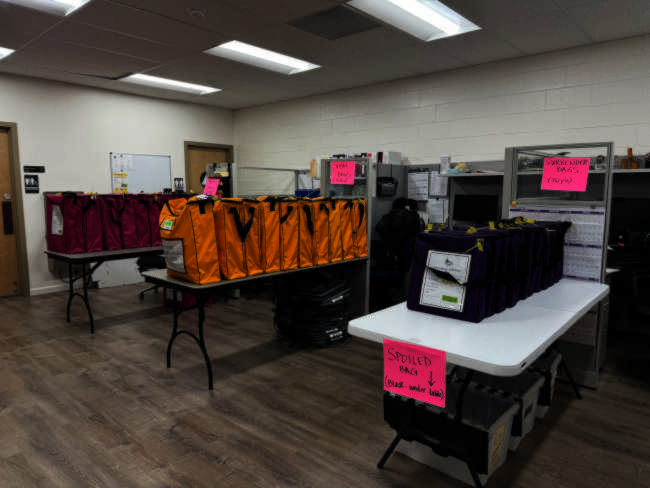
Bags of ballots for the special statewide election await processing at the Lake County Registrar of Voters Office in Lakeport, California, on Tuesday, Nov. 4, 2025. Photo by Lingzi Chen/Lake County News.  

LAKE COUNTY, Calif. — Californians on Tuesday overwhelmingly approved Proposition 50 to redraw congressional boundaries.

Based on the preliminary vote count, Lake County delivered only a narrow win in favor of the measure on election day. 

However, the vote count is expected to change during the official canvass, which will continue until the election is certified on Dec. 12, so how Lake County ultimately decided on the matter won’t be certain for weeks.

The passing of Proposition 50 means California will temporarily adopt new congressional district maps drawn by the Legislature, giving Democrats a better chance of winning up to five additional House seats from Republicans in the next midterm election.

For many, putting the matter on the ballot is a response to Republican gerrymandering, where President Trump urged GOP-led states to redraw their districts. 

“We put Prop 50 on the ballot and voters passed it today in direct response to Texas Republicans’ choice to draw and pass a new, rigged Congressional map without input from voters,” Congressman Mike Thompson said in a statement after its passage. “That’s anti-democratic, plain and simple.”

Statewide, the preliminary count as of 2 a.m. Wednesday showed that voters approved the proposition by nearly a 2-to-1 margin: 63.8% in favor and 36.2% opposed.

Whereas in Lake County, the results were much tighter, with a difference of just 236 votes. Of all the 10,358 votes counted by Tuesday night, 51.14%, or 5,297, were in favor and 48.86% or 5,061, opposed. 

These numbers include 8,732 vote-by-mail ballots received and counted by Nov. 4, and 1,630 ballots turned in to the 20 polling places around the county on the election day. 

They do not include ballots turned in at the six drop boxes around the county, because those ballots require signature verification before counting. 

The rest of the vote-by-mail ballots postmarked on or before Nov. 4 and received by Nov. 12 will also be counted at a later date upon receiving. 

Those who showed up at polling stations on Tuesday seem to display a differing preference: out of the 1,630 votes cast, 1,010, or 61.96% voted against the proposition — against both the local and state trends.  

Regardless of the final local results, however, congressional redistricting will take place. 

For Lake County, it means Thompson will cease to serve most of the county except for a portion in the south. 

“I love my current district, and I will continue to serve the people in our community with dedication and to work with the candidate elected to represent the First District,” Thompson said in a statement. “I am also excited and energized to work with the local leaders in our newly-formed Fourth District to serve our community and address the issues important to them.”

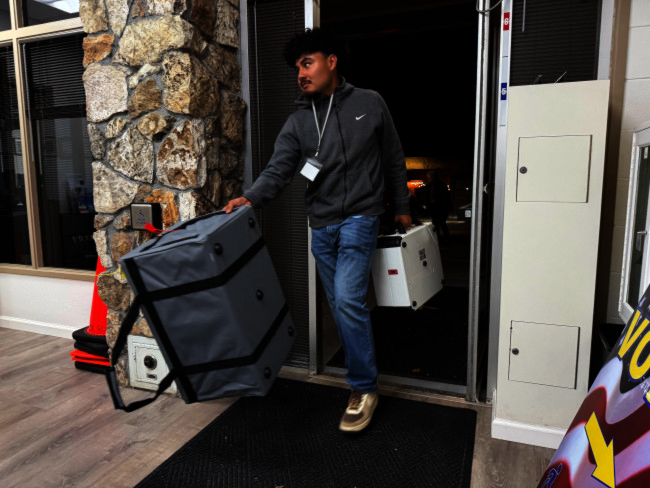
A precinct worker brings in bags of ballots to the Lake County Registrar of Voters Office in Lakeport, California, as part of the special statewide election on Tuesday, Nov. 4, 2025. Photo by Lingzi Chen/Lake County News.


Final hours of election night

As the statewide special election unfolded amid the debate over gerrymandering, the Lake County Registrar of Voters office on Forbes Street in Lakeport carried on with a sense of order, calmness as well as some warmth. 

While the office waited for vehicles delivering ballots from across the county, an unexpected visitor from the recent Halloween weekend — a black spider roughly an inch long — was spotted roaming the lobby. A young election worker took it out, declining the suggestion to kill it. 

Shortly after 9 p.m., cars began arriving intermittently, with one from Upper Lake arriving first. As soon as ballots came in and were sorted, counting started at the scanning machine, with two people operating at each station.

The office grew busier and quieter as waves of ballots were delivered and poll workers departed. 

For the special election, the registrar’s office deployed five permanent staff, five to six extra help personnel, and two IT staff, with supervisors Bruno Sabatier and Brad Rasmussen volunteering at the site, Registrar of Voters Maria Valadez told Lake County News. 

Valadez said throughout the day that seven people stayed on the phone answering voters’ questions, from lost ballots to changed addresses, just as in past elections. At least one person was always at the counter. 

Ballots were processed orderly and quickly once unloaded into the office.

“We have a great team here,” said Valadez. “We are really organized; we have to be organized.”

“Shoutout to our poll workers too because they rock,” she added. 

“We were doing great. We always have a good turnout but we don’t have lines. Our counting was perfect and there’s no mistake,” Precinct 381 Inspector India Akua Mendonca, who has worked at polling stations for over 10 years, told Lake County News as she signed off at the office after delivering the ballots. “We have a great team.”

The expected storm on the night didn’t materialize, but hints were dropped that it might just come soon.

“It starts sprinkling,” Valadez announced, panning in from the parking lot as staff continued waiting for the ballots. The clock had just turned 10:30 p.m.

The night ended after the final ballot was counted at 11:25 p.m.; counting to be continued.

Email Lingzi Chen at This email address is being protected from spambots. You need JavaScript enabled to view it.. 

Board of Supervisors appoints deputy county counsel as interim chief public defender

Details
Written by: Elizabeth Larson
Published: 05 November 2025

LAKE COUNTY, Calif. — The Board of Supervisors on Tuesday appointed a deputy county counsel to act as interim public defender.

Following a closed session discussion that began in the morning and was continued later in the late afternoon, the board appointed Senior Deputy County Counsel Carlos Torrez to fill the job temporarily.

The county reported that Torrez accepted the appointment, which took effect immediately on Tuesday, the day that outgoing Chief Public Defender Raymond Buenaventura’s tenure officially came to an end. 

Buenaventura, who joined the county two years ago, was hired Oct. 14 as chief public defender by the Monterey County Board of Supervisors.

He later submitted his resignation to the county of Lake, with the supervisors accepting it in closed session last week.

Torrez received his law degree from the University of Illinois College of Law and was admitted to the State Bar of California in 2009.

He was involved with the county’s conversion from an indigent defense contract to the new statutory Public Defender’s Office, which the county said “plays a vital role in ensuring effective client representation and the responsible stewardship of public resources.”

The county’s take on the office’s effectiveness is despite ongoing concerns from county defense attorneys and criticism from judges about the performance of the public defender’s attorneys in court since the office was restarted in 2023. A previous iteration of the Public Defender’s Office was abandoned 40 years ago due to the high cost of dealing with conflicts of interest among its attorneys.

The county’s announcement on his interim appointment said Torrez brings 10 years of dedicated public service experience, including extensive work in complex litigation, management, leadership and policy development. 

“During his tenure with the Office of the County Counsel, he has demonstrated unwavering professionalism, sound legal judgment, and a deep commitment to access to justice for all Lake County residents,” the county’s Monday evening announcement said.

As interim public defender, the county said Torrez will lead a team of “dedicated attorneys and professional staff,” overseeing the office’s criminal defense work including juvenile and probate/conservatorship divisions. 

The county congratulated Torrez on what it called a “well deserved appointment.”

Email Elizabeth Larson at This email address is being protected from spambots. You need JavaScript enabled to view it.. Follow her on Twitter, @ERLarson, and on Bluesky, @erlarson.bsky.social. Find Lake County News on the following platforms: Facebook, @LakeCoNews; X, @LakeCoNews; Threads, @lakeconews, and on Bluesky, @lakeconews.bsky.social. 

Sheriff’s new drone technology helps Search and Rescue find lost hiker

Details
Written by: LAKE COUNTY NEWS REPORTS
Published: 05 November 2025

LAKE COUNTY, Calif. — New drone technology the Lake County Sheriff’s Office is rolling out has helped its Search and Rescue team locate a lost hiker.

On Tuesday night at 7:20 p.m., Lake County Sheriff’s deputies were dispatched to the 1400 block of Big Canyon Road in Lower Lake after receiving a report of a lost hiker, the agency reported. The individual was tired and unable to make it out of the rugged terrain on their own.

When deputies arrived, they were unable to locate the hiker or determine which path they had taken. The hiker had been in the wilderness for approximately nine hours, temperatures were beginning to drop and rain was a possibility, said Lauren Berlinn, the sheriff’s spokesperson.

Berlinn said the Lake County Search and Rescue, or SAR, Team was called in to help, along with a member of the newly established Lake County Sheriff’s Office Drone Response Team.

“This search was the kind of real-world scenario the Sheriff’s Office’s new drone program was created to support,” Berlinn said in her report.

Although the program is still in its early stages, Berlinn said the operation showed just how valuable this technology can be for improving search efficiency and keeping both rescuers and community members safe.

The drone was launched in the area of the hiker’s last known location, and within a short time, the operator spotted the missing individual, Berlinn said.

With real-time guidance from the drone operator, Berlinn said two SAR members, Deputy Kaylene Strugnell and her K9 Sadie reached the hiker and safely led them out of the steep, rocky area.

“This successful rescue highlights the important role the Sheriff’s Office Drone Program will play in future operations,” Berlinn said.

She said the drone program “not only improves response capabilities and resource coordination but also increases the likelihood of saving lives.”

The program reflects the Sheriff’s Office’s ongoing commitment to leveraging modern technology in service to the Lake County community, Berlinn said.

“The Lake County Sheriff’s Office is proud of our deputies, dispatchers, search and rescue volunteers, and everyone who worked together to ensure a safe and successful outcome,” she said in her report.

  1. Winter season management in effect at Boggs Mountain Demonstration State Forest
  2. Social Services warns that SNAP/CalFresh benefits are still delayed
  3. First significant fall storms arrive this week
  • 106
  • 107
  • 108
  • 109
  • 110
  • 111
  • 112
  • 113
  • 114
  • 115
How to resolve AdBlock issue?
Refresh this page
