 How to resolve AdBlock issue?
News
- Details
- Written by: LAKE COUNTY NEWS REPORTS
The Business Walk program in Lakeport is designed to familiarize the business community with the city and other resources available to them.
City staff and members of the Lakeport Economic Development Advisory Committee, or LEDAC, contact local owners and managers, providing them with the opportunity to speak with representatives about issues of concern.
The goal is to help local businesses thrive and grow.
Last fall, 16 teams of staff and volunteers, totaling 29 individuals, surveyed 115 businesses in 16 areas of the city.
Findings from the visit have been compiled by LEDAC and will be presented to the Lakeport City Council at its meeting on April 4.
The city’s economic development strategic plan identified annual in-person visits as an important element in the support and retention of existing local businesses.
The walks were put on hold during the COVID-19 pandemic and were resumed to engage with and hear from the business community.
“Respondents were satisfied with business life in Lakeport, describing it as a laid-back, friendly, cooperative environment” in which to do business,” said Denise Combs, chair of the Business Walk Subcommittee.
“Significant challenges have changed since the last survey in 2019, with worries about lack of business declining considerably while the inability to find competent staff has more than doubled, reflecting national trends,” said Pam Harpster, another subcommittee member.
The report contains recommendations to the Council for action items to address specific findings.
The public is encouraged to attend the meeting in person at City Hall at 6 p.m. or via https://www.cityoflakeport.com/agendas_and_minutes/index.php.
LEDAC is an advocate for a strong and positive Lakeport business community, and serves as a conduit between the City and the community for communicating the goals, activities and progress of Lakeport’s economic and business programs.
The committee meets bimonthly on the second Wednesday, 7:30 to 9 a.m. All meetings are open to the public.
- Details
- Written by: Lucas Berenbrok, University of Pittsburgh; Janice L. Pringle, University of Pittsburgh, and Joni Carroll, University of Pittsburgh

On March 29, 2023, the U.S. Food and Drug Administration approved Narcan for over-the-counter sale. Narcan is the 4-milligram nasal spray version of naloxone, a medication that can quickly counteract an opioid overdose.
The FDA’s greenlighting of over-the-counter naloxone means that it will be available for purchase without a prescription at more than 60,000 pharmacies nationwide. That means that, for 90% of Americans, naloxone nasal spray will be accessible at a pharmacy within 5 miles from home. It will also likely be available at gas stations, supermarkets and convenience stores. The transition from prescription to over-the-counter status is expected to take a few months.
We are pharmacists and public health experts who seek to increase public acceptance of and access to naloxone.
We think that making naloxone available over the counter is an essential step in reducing deaths due to overdose and destigmatizing opioid use disorder. Over-the-counter access to naloxone will permit more people to carry and administer it to help others who are overdosing. Moreover, increasing naloxone’s over-the-counter availability will convey the message that risks associated with substance use disorder warrant a pervasive intervention much as with other illnesses.
Deaths from opioid overdoses across the U.S. have increased nearly threefold since 2015. Between October 2021 and October 2022, approximately 77,000 people died from opioid overdoses in the U.S. Since 2016, the synthetic opioid fentanyl has been responsible for most of the drug-involved overdose deaths in America.
What is naloxone?
Naloxone reverses overdose from prescription opioids like fentanyl, oxycodone and hydrocodone and recreational opioids like heroin. Naloxone works by competitively binding to the same receptors in the central nervous system that opioids bind to for euphoric effects. When naloxone is administered and reaches these receptors, it can block the euphoric effects of opioids and reverse respiratory depression when opioid overdose occurs.
There are two common ways to administer naloxone. One is through the prepackaged nasal sprays, such as Narcan and Kloxxado or generic versions of the drug. The other method is via auto-injectors, like ZIMHI, which deliver naloxone through injection, similar to the way epinephrine is delivered by an EpiPen as an emergency treatment for life-threatening allergic reactions.
The FDA will review a second over-the-counter application for naloxone auto-injectors at a later date. Although no interaction with a health care provider will be needed to purchase over-the-counter naloxone, when naloxone is purchased at a pharmacy, a knowledgeable pharmacist will be able to help people choose a product and explain instructions for use.
Research shows that when people who are likely to witness or respond to opioid overdoses have naloxone, they can save patients’ lives. This also includes bystanders as well as first responders like police officers and paramedics.
But until now, people in those situations could intervene only if they were carrying prescription naloxone or knew where to retrieve it quickly. Friends and family of people who use opioids are often given prescriptions for naloxone for emergency use. Over-the-counter naloxone will help make the drug more accessible to members of the general public.
Reducing stigma and saving lives
Naloxone is a safe medication with minimal side effects. It works only for those with opioids in their system, and it’s unlikely to cause harm if given by mistake to someone who’s not actively overdosing on opioids.
Since approximately 40% of overdoses occur in the presence of someone else, we believe public access to naloxone is extremely important. People may wish to have naloxone on hand if someone they know is at an increased risk for opioid overdose, including people who have opioid use disorder or people who take high amounts of prescribed opioid medications.
Community centers and recreational facilities may also keep naloxone on hand, similar to the placement of automated external defibrillators in public spaces for emergency use when someone has a heart attack.
There’s a long-held public stigma that suggests addiction is a moral failing rather than a chronic yet treatable health condition. Those who request naloxone or who have an opioid use disorder experience stigma and often aren’t comfortable disclosing their drug use to others, or seeking medical treatment. Removing naloxone’s prescription requirements by making it over the counter could decrease the stigma experienced by individuals since they no longer must request it from a health care provider or behind the pharmacy counter.
In addition, we encourage health care providers and members of the general public to use less stigmatizing language when discussing addiction.
Questionable accessibility
Often, medications switched from prescription to over the counter are not covered by insurance. It remains unclear if this will be the case with Narcan. If so, the costs will shift to the patient, highlighting the reason continued support of programs that offer naloxone free of charge remains important.
What’s more, over-the-counter access could paradoxically cause a decrease in the drug’s availability. A rise in purchases could make it harder to buy naloxone if manufacturer supply does not keep up with increased consumer demand. The U.S. experienced such shortages of over-the-counter drugs in late 2022 during the nationwide surges in flu, respiratory syncytial virus and COVID-19.
Federal and state governments could lessen these potential barriers by subsidizing the cost of over-the-counter naloxone and working with drug manufacturers to provide production incentives to meet public demand.
The effects of nationwide access to over-the-counter naloxone on opioid-related deaths remain to be seen, but making this medication more widely available is an important next step in our nation’s response to the opioid crisis.
Lucas Berenbrok, Associate Professor of Pharmacy and Therapeutics, University of Pittsburgh; Janice L. Pringle, Professor of Pharmacy and Therapeutics, University of Pittsburgh, and Joni Carroll, Assistant Professor of Pharmacy and Therapeutics, University of Pittsburgh
This article is republished from The Conversation under a Creative Commons license. Read the original article.
- Details
- Written by: Ananda Martin-Caughey
The COVID-19 pandemic led to major changes in employment for all types of U.S. workers, but these changes looked different for women and men.
Some employees transitioned to remote or hybrid work, while essential workers faced hazardous conditions in the workplace. Many workers had to adjust their schedules or leave their jobs. And sudden shifts in demand for goods and services led to fluctuations in employment across different occupations, leading to different changes for men and women.
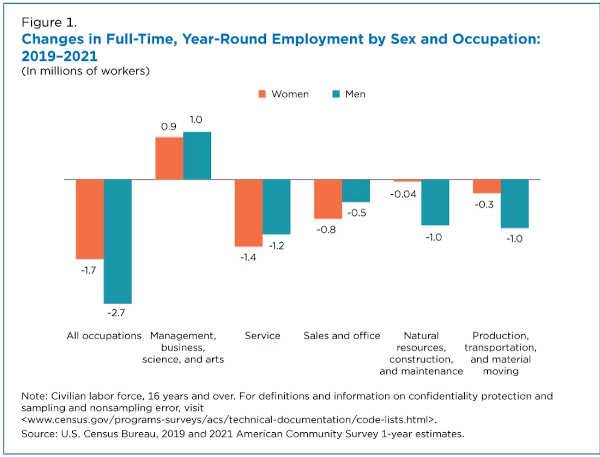
Overall, full-time, year-round employment declined by 4.4 million workers from 2019 to 2021, according to the Census Bureau’s 2019 and 2021 American Community Survey’s Women and Men’s Detailed Occupations and Median Earnings Tables.
Men lost more of these jobs than women but continued to outnumber women in the labor force. Women’s losses were concentrated in service and retail sales occupations, while men’s were distributed across a broader range of occupations, including construction, transportation, service and sales.
Some occupations grew during the pandemic. Both men and women’s job gains were mostly in the broad category of management, business, science and arts occupations in which men were paid 26% more than women, on average.
In recognition of Equal Pay Day on March 14 and Women’s History Month, this article examines differences in occupational employment shifts for women and men during the COVID pandemic.
Different occupations for women and men
Despite reduced occupational segregation over time, women and men continue to be separated in different kinds of work and receive unequal pay.
Men are much more likely to work in natural resources, construction and maintenance, as well as production, transportation and material moving occupations. And women are more likely to work in: sales and office; service; and management, business, science and arts occupations.
This segregation means that changes in the labor market affect men and women differently.
Between 2019 and 2021, the number of women working full-time, year-round declined 3.4%, and men’s employment declined 4.1%.
Figure 1 shows the total change in employment for all occupations and where these changes were concentrated for men and women. Only one major occupation group (management, business, science and arts) saw employment gains; the other four categories experienced dips for both men and women.
Women’s job losses were concentrated in service occupations (a decline of 1.4 million workers) and sales and office occupations (a decline of around 839,000 workers). Men’s losses were more evenly distributed across the occupational categories.
Declines for women, mostly service and retail
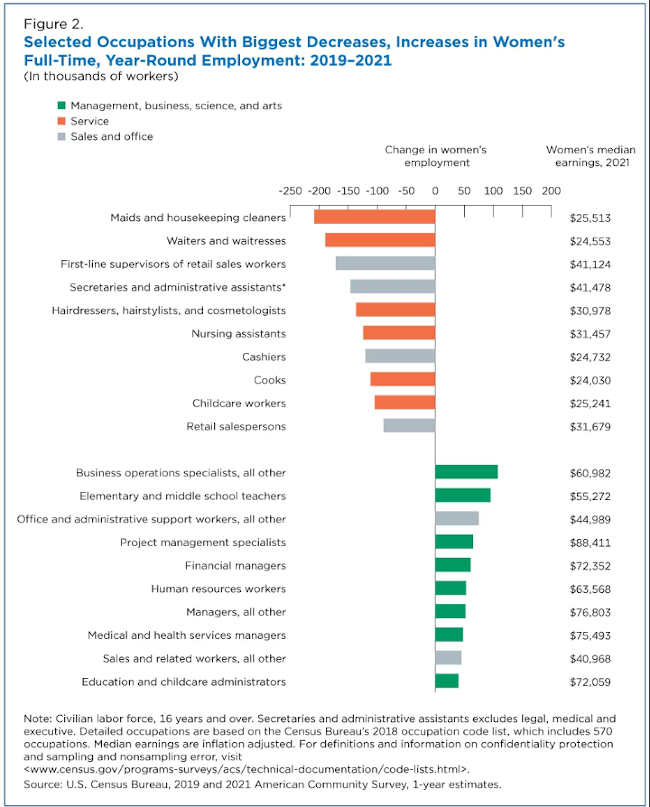
When looking at detailed occupations, the numbers highlight specific kinds of jobs that declined and grew for women between 2019 and 2021.
Service occupations were among those with major declines in women’s employment, including:
• Maids and housekeeping cleaners (an occupation that was 83% women in 2021) declined 31% among women.
• Occupations related to food service – waiters/waitresses and cooks (68% and 41% women, respectively) – also saw significant declines for women (39% and 22%, respectively).
• Hairdressers, hairstylists and cosmetologists (90% women) declined 35% among women.
• Nursing assistants (88% women), many of whom were employed in nursing care facilities, decreased 15% among women.
• Child care workers (94% women) declined 23% among women, as many day care and child care centers closed during the pandemic.
Women retail workers were also heavily affected. Cashiers, retail salespersons, and supervisors of retail workers all decreased from 2019 to 2021.
Service and retail sales occupations tend to involve face-to-face work, and many of the organizations that employed these workers closed or experienced reduced demand during the pandemic. These workers also tend to earn significantly less than the median earnings among all full-time, year-round workers ($54,339 in 2021).
While women’s overall employment numbers decreased, some occupations expanded from 2019 to 2021. Many were in management, business, science and arts – occupations that tend to pay more than the median earnings for all workers.
Examples include elementary and middle school teachers (median earnings $55,272 among women), project management specialists ($88,411), and financial managers ($72,352).
Many of these occupations likely allowed remote work and flexible schedules, making it easier for both men and women to accommodate pandemic-related health and family needs.
How men fared
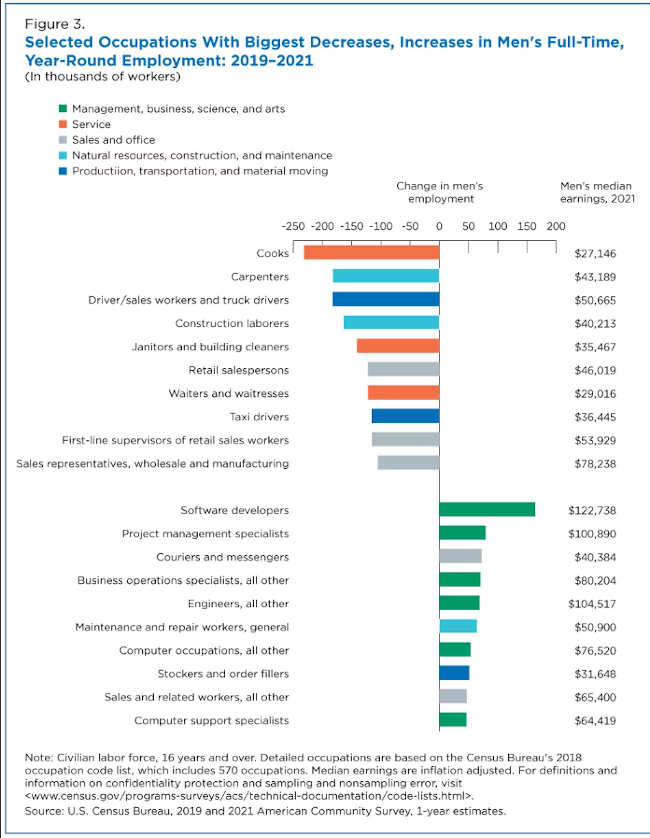
Men’s decreases in employment were more spread out across four occupational groups: service occupations; sales and office occupations; natural resources, construction and maintenance occupations; and production, transportation and material moving occupations.
Among jobs with steep declines: cooks, carpenters, truck drivers and retail salespersons (Figure 3). Men’s earnings in these occupations tended to pay less than the median across all workers.
Men saw increases in highly paid jobs like software developers and engineers (median earnings of $122,738 and $104,517, respectively, for men in 2021) and low-paid occupations like couriers/messengers and stockers/order fillers (median earnings of $40,384 and $31,648, respectively, for men).
Like women, most gains were in management, business, science and arts occupations, though the specific occupations with the biggest increases differed for men and women.
Continued disparities between men and women
Although men lost more jobs than women from 2019 to 2021, they continued to outnumber women among full-time, year-round paid workers: 61.7 million compared to 47.8 million.
In addition, men continued to earn more than women overall and in many of the occupations that grew during the pandemic. For example, among business operations specialists, an occupation that experienced large employment increases for both men and women, women’s median earnings were $60,982, compared to men’s $80,204.
The bottom line: overall, employment declined between 2019 and 2021. But the nature of the changes differed and inequalities persisted between men and women.
The full extent of the impact of the pandemic on employment is still unknown, but the ACS data provide a snapshot of the disparate changes to the labor market for women and men.
Ananda Martin-Caughey is a sociologist in the Census Bureau’s Social, Economic, and Housing Statistics Division.
- Details
- Written by: LAKE COUNTY NEWS REPORTS

LAKE COUNTY, Calif. — A Kelseyville teenager has been arrested after authorities said he was responsible for the shooting and attempted robbery of a man in Nice.
Jesse Running Gonzalez, 18, was arrested Tuesday afternoon and booked into the Hill Road Correctional Facility on charges of conspiracy to commit attempted murder and attempted robbery.
The Lake County Sheriff’s Office said deputies were dispatched to the area of Sentry Market in Nice at 12:30 a.m. Tuesday for a reported gunshot victim.
Deputies arrived on scene and located an adult male victim who was suffering from a gunshot wound to the arm, the sheriff’s office reported.
Authorities said the victim was transported to a hospital where he was treated for a non-life-threatening gunshot wound.
Deputies were able to locate the original scene where the shooting took place, which was in the 4400 block of Lakeview Drive in Nice, according to the sheriff’s office report.
The Lake County Sheriff’s Office Major Crimes Unit responded and took over the investigation, officials said.
The sheriff’s office reported that detectives were able to identify a suspect in the case and tracked him to the Lakeport area.
Late on Tuesday morning, detectives served a search warrant at a residence located on Red Feather Lane in Lakeport and gathered evidence related to the shooting, the sheriff’s office said.
It was at that time that detectives located and arrested Gonzalez, according to the sheriff’s office statement.
Gonzalez remained in custody on Tuesday night with bail set at $1 million.
Jail records show he is due to be arraigned in Lake County Superior Court on Thursday.
Detectives are asking anyone with additional information regarding this investigation to contact Det. Dean Preader by email at