 How to resolve AdBlock issue?
News
- Details
- Written by: Lake County News reports
This additional enforcement initiative aims to enhance the safety of the public on California’s roads during the busy travel period.
The MEP began at 6:01 p.m. on Friday, Dec. 22, and continues through 11:59 p.m. on Monday, Dec. 25.
While the primary focus of the MEP is on speed enforcement, CHP officers will also be vigilant for impaired drivers.
Throughout this period, all available officers will be deployed on the roadways, intensifying enforcement efforts, and assisting motorists.
"As we celebrate the joy of the season, let's make a collective commitment to prioritize safety on our roads,” said CHP Commissioner Sean Duryee. “Your loved ones are waiting for you at home — buckle up, drive responsibly, and have a plan that includes a safe, sober ride before you head out for the evening.”
The annual surge in holiday travel brings with it an increased risk of crashes and alcohol-related incidents on our roadways.
Poor choices behind the wheel such as speeding, driving under the influence, or distracted driving can have tragic results.
During last year’s Christmas MEP, 26 people were killed in crashes within the CHP’s jurisdiction and nearly half of all the vehicle occupants killed were not wearing a seat belt.
Additionally, during last year’s Christmas MEP, CHP officers made 639 arrests for DUI — the equivalent of one arrest for DUI nearly every seven minutes throughout the holiday weekend.
Celebrate responsibly to help ensure everyone reaches their destination safely. Always designate a sober driver or use public transportation, rideshare services, or taxi.
The CHP encourages the public to call 9-1-1 to report impaired drivers, excessive speeding, and unsafe behavior on the roadways. The life you save could be your own.
- Details
- Written by: Elizabeth Larson

CLEARLAKE, Calif. — Clearlake Animal Control has many dogs waiting for new homes at Christmas.
The Clearlake Animal Control website lists 34 adoptable dogs.
The adoptable dogs include “Brutus,” a male American pit bull terrier mix with a short white coat. He has been neutered.

There also is “Ninja,” a 1-year-old male pit bull terrier mix with a black and white coat. He’s also neutered.
The shelter is located at 6820 Old Highway 53. It’s open from 9 a.m. to 6 p.m. Tuesday through Saturday.
For more information, call the shelter at 707-762-6227, email
This week’s adoptable dogs are featured below.
Email Elizabeth Larson at
- Details
- Written by: Laura López González
Did you know that we often have more control over our feelings and anxiety than we think?
’Tis the season ... for stress. Between bright lights, airport security lines and fallen souffles, we are more overscheduled, overstretched and overwhelmed during the holiday season than at almost any other time of the year.
But there’s good news. We have much more control over stress and our emotions than we think, says UC San Francisco Professor of Psychiatry Elissa Epel, PhD. Epel’s book, The Stress Prescription: Seven Days to More Joy and Ease was recently named a favorite book of 2023 by Greater Good Magazine.
She explains how we can make taking control of our stress — and cultivating joy — a habit this holiday season.
What does stress do to our bodies?
We have looked at stress under the microscope, investigating how it can change our cells, right down to our telomeres — the “shields” at the ends of our chromosomes’ that protect the DNA inside. Telomere length is an important index of a cell’s health and ability to keep dividing. Telomeres naturally shorten with age, but chronic stress wears them out faster.
In short, when we’re too stressed for too long, it accelerates biological aging. Diseases like diabetes, heart disease and depression can develop or develop early.
What are micro-acts of wellness?
Micro-acts are quick practices of just a few minutes that can reduce stress and cultivate happiness, often involving focusing on the beauty and joy in life. People who performed just one micro-act daily for a week reported about a 25% increase in emotional well-being and feelings of connectedness to others, according to early results from a large, crowd-sourcing study we have conducted with colleagues at UC Berkeley. As part of the study, more than 20,000 people from 30 countries tried a micro-act for five minutes each day for one week. Anyone can join.
Why are micro-acts so powerful?
When we see that we can do something for just a few minutes, and that it can change how we feel, we actually alter our belief about our capacity to control our wellness. We call this a growth mindset: We increase our confidence in our ability to have some control over our well being. This new mindset, in turn, has a potent effect on whether we’re likely to make micro-acts a habit or not.
What are some examples of micro-acts?
Do something kind for someone. Think of people you might see today and list one thing you could do to brighten their day. For example, during the holidays it’s incredibly powerful to reach out to people we suspect don’t have friends, local family or social plans.
Tune in to what matters. Choose three values in your life — for example, kindness, community and social justice — and think of an example of how you are living them. Make a plan of how you want to embody one of them more in the coming year.
Reframe your perspective. Recall a recent moment when you felt upset and frustrated. Think about or write out three positive things about that experience. Focusing on the hidden positives is powerful. It can lessen your painful narrative of what happened.
The holidays are stressful, there are more demands on us, and we set higher expectations for how the holidays should go. But this is also an opportunity to realize the joy inherent in holiday stress and that it’s a privilege to be able to take time away from work to reflect and relax.
Breathe. People have used various breathing practices for millennia to energize, relax and even create ecstatic states.
Here’s a slow breathing technique that can calm our body immediately.
Try sitting up straight with your chest up, chin down.
Breathe slowly and gently with your mouth closed, drawing a deep breath into your diaphragm.
Breathe in for four seconds and out for six seconds for maximal stress release.
Meditate. Meditation has long been a part of my stress-management plan, both short daily practices and, when I am lucky, overnight retreats. Consider planning a retreat in 2024, for a deeper recalibration of your nervous system. There are many local opportunities in the Bay Area.
Dwell in awe. Watch an awe-inspiring video or, if possible, get out in nature. Make it a point to stop and marvel at the trees or views, feel the temperature of the air on your skin and listen to the birds chirping. If you don’t have a lot of nature near you, there’s always sky.
Our bodies are not only very attuned to having a relaxation response to nature, but increasing research shows that awe is a transformative emotion — the feeling of being in the presence of and part of something larger than oneself can snap things into perspective for us. When we are reminded of the world’s grandeur, personal issues that seemed large and looming may suddenly shrink.
If you can’t get out into nature, set up a quiet, comfortable “chill” space at home and search YouTube or Spotify for your favorite relaxing music with nature sounds.
Expose yourself to positive stress. When we are exposed to short-term manageable positive stressors, called hormetic stress, our body turns on different responses than it does with chronic stress. During our recovery period from hormetic stress, good things happen. It has an anti-anxiety effect on our nervous system, and an anti-aging effect in our cells. Hormetic stress triggers processes akin to cleaning crews gobbling up waste from the day’s metabolic processes and recycling it.
To create positive stress, try a quick seven-minute high-intensity exercise or take an ice-cold shower: After the ice-cold shower, wrap up in a warm towel: Stress then recover and relax. It feels good, and it’s good for our cells.
Make a gratitude list. List anything, big or small, you feel grateful about. Gratitude is one of the most potent ways to increase positive emotions. For a bigger boost, tell someone how much you appreciate them.
Celebrate another’s joy. Ask someone to tell you about something good that happened to them recently or about something they are happy about. “What made you smile today?” Let them tell the story. You will find their happiness is re-ignited, and you may smile too!
How can we make micro-acts a habit?
• Notice how it feels after you’ve completed a micro-act. Savor any positive feelings.
• Set aside a time each day to pause for a wellness micro-act. Put a reminder on your daily calendar and a Post-it note in the place where you want to practice it.
• Try “stapling” micro-acts to another habit you already do. For example, try two minutes of slow breathing while you start your commute or before you turn off your light at night.
Laura López González writes for the University of California, San Francisco.
- Details
- Written by: European Space Agency
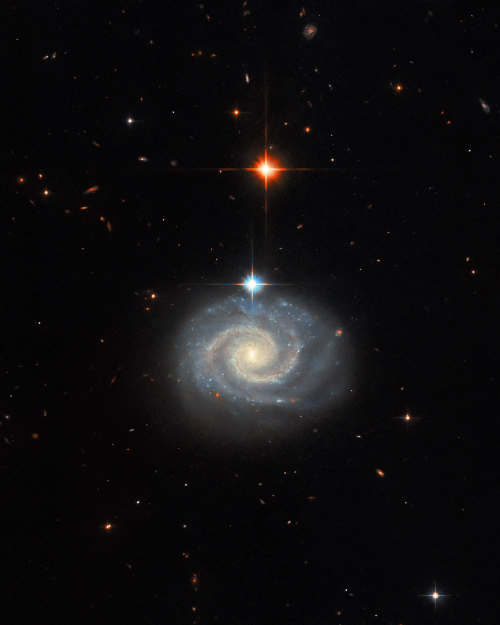
This whirling image features a bright spiral galaxy known as MCG-01-24-014, which is located about 275 million light-years from Earth.
In addition to being a well-defined spiral galaxy, MCG-01-24-014 has an extremely energetic core known as an active galactic nucleus, or AGN, and is categorized as a Type-2 Seyfert galaxy. Seyfert galaxies, along with quasars, host one of the most common subclasses of AGN.
While the precise categorization of AGNs is nuanced, Seyfert galaxies tend to be relatively nearby and their central AGN does not outshine its host, while quasars are very distant AGNs with incredible luminosities that outshine their host galaxies.
There are further subclasses of both Seyfert galaxies and quasars. In the case of Seyfert galaxies, the predominant subcategories are Type-1 and Type-2. Astronomers distinguish them by their spectra, the pattern that results when light is split into its constituent wavelengths.
The spectral lines that Type-2 Seyfert galaxies emit are associated with specific ‘forbidden’ emission lines.
To understand why emitted light from a galaxy could be forbidden, it helps to understand why spectra exist in the first place.
Spectra look the way they do because certain atoms and molecules absorb and emit light at very specific wavelengths.
The reason for this is quantum physics: electrons (the tiny particles that orbit the nuclei of atoms and molecules) can only exist at very specific energies, and therefore electrons can only lose or gain very specific amounts of energy.
These very specific amounts of energy correspond to the wavelengths of light that are absorbed or emitted.
Forbidden emission lines should not exist according to certain rules of quantum physics. But quantum physics is complex, and some of the rules used to predict it were formulated under laboratory conditions here on Earth.
Under those rules, this emission is ‘forbidden’ — so improbable that it’s disregarded. But in space, in the midst of an incredibly energetic galactic core, those assumptions don’t hold anymore, and the ‘forbidden’ light gets a chance to shine out toward us.