 How to resolve AdBlock issue?
News
- Details
- Written by: Elizabeth Larson
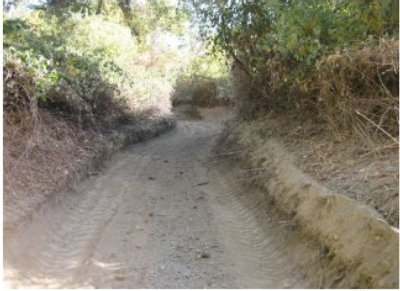
UPPER LAKE – The US Army Corps of Engineers has removed the Middle Creek levee from its list of levees around the nation that the agency said had not been properly maintained.
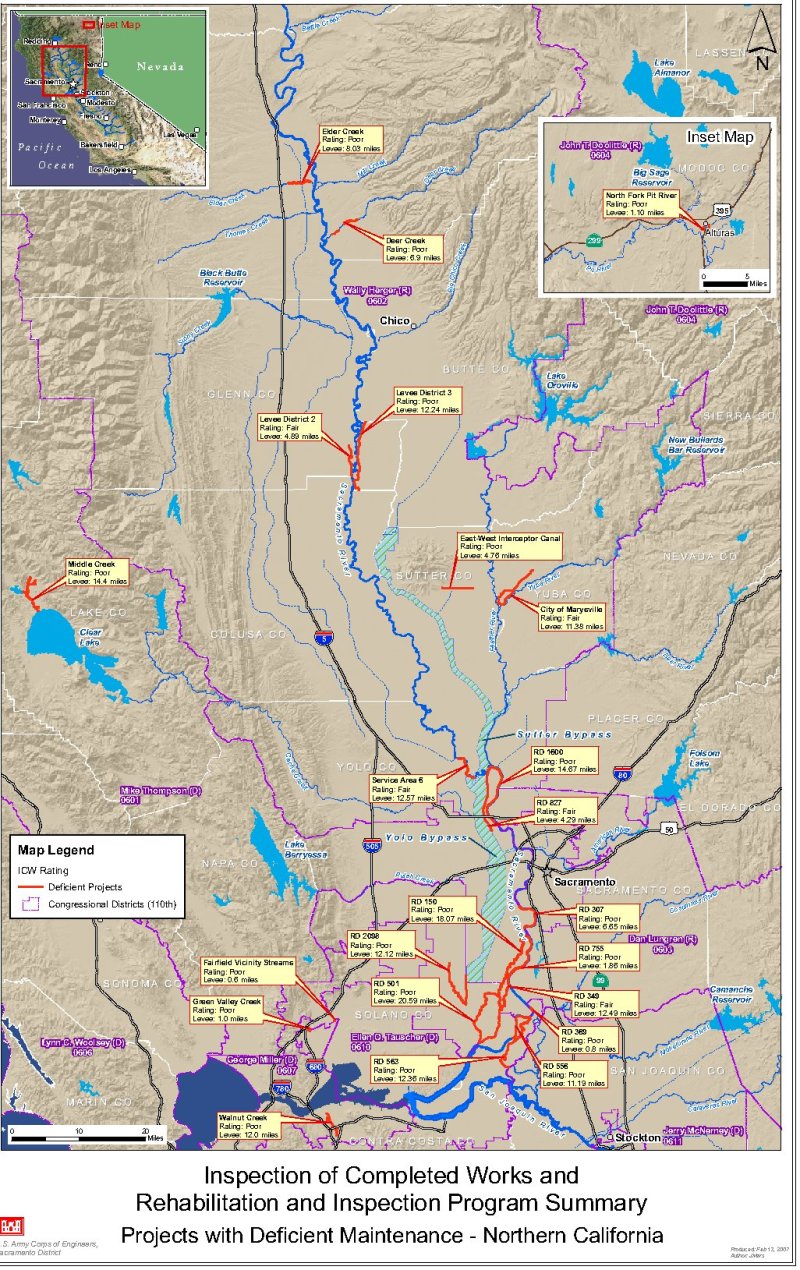
In late January, the Corps released a list of 122 levees across the U.S. that it said could fail to protect against flood events due to maintenance issues.
The 11-mile Middle Creek levee system near Upper Lake made that original list, much to the frustration of local officials, who said
Tom Smythe, water resources engineer with the Water Resource Division of Lake County's Public Works Department, said Middle Creek's low rating resulted from a Corps inspection conducted in 2005.
Smythe said the county's levees are inspected twice annually by the state Department of Water Resources, and that the county has remained in compliance with the state's maintenance standards over the past decade.
The Army Corps' low rating listed issues that Smythe said had already been addressed, such as trees and vegetation along the levees, and gravel bars that have been removed.
The Corps' list also incorrectly reported that the 3.5-mile stretch of levees in the Middle Creek Reclamation District is maintained by the Department of Water Resources was maintained by the county, Smythe said.
Since that January list was released, levee districts around the state began requesting reinspections.
On Feb. 14, the Army Corps and Department of Water Resources took another look at the Middle Creek levee system, said Smythe.
The inspection went well, he said.
“The inspectors saw that the system was being maintained and the deficiencies noted in the previous inspection were being addressed,” he said. “Attitudes were positive at the end of the inspection.”
An updated list of levees issued by the Corps on Feb. 16 shows that Middle Creek and seven other levees around the state were removed from the list.
However, the county didn't receive an official notification of that fact, said Smythe, only finding out about it unofficially earlier this month.
Dave Killam, a spokesman for the Sacramento Army Corps office, said those levees were removed from the list after being reinspected based on information provided by the levee owners.
Killam said a new list of poorly maintained levees will be released sometime this spring.
E-mail Elizabeth Larson at
{mos_sb_discuss:2}
- Details
- Written by: Elizabeth Larson
James Wade Roberts, 45, is facing murder charges for the death of Clearlake resident Ruth Donaldson, 63.
Roberts was in Judge Arthur Mann's court Monday to enter a plea, said District Attorney Jon Hopkins, who is prosecuting Roberts' case.
Hopkins said Roberts entered pleas of not guilty and not guilty by reason of insanity to the murder charge against him.
Roberts' defense attorney, Steve Carter, asked for a psychologist, who had previously been appointed to Roberts' case confidentially, to be reappointed as an expert consultant, said Hopkins.
Hopkins explained the Penal Code requires that two to three psychologists must be appointed to evaluate Roberts due to the insanity plea.
He said that Mann appointed two new psychologists to the case, and will continue the hearing March 19, when a third psychologist also will be appointed.
Clearlake Police found Donaldson's body in the Mullen Avenue home that she shared with Roberts on Oct. 15.
Roberts is being held in the Lake County Jail on $1 million bail.
E-mail Elizabeth Larson at
{mos_sb_discuss:2}
- Details
- Written by: Editor

WASHINGTON, D.C. – Ten years after Congress enacted the Electronic Freedom of Information Act Amendments (E-FOIA), only one in five federal agencies actually complies with the law, according to a new survey released today during Sunshine Week by the National Security Archive.
Passed in 1996 and effective in 1997, E-FOIA ordered federal agencies to post key records online, provide citizens with detailed guidance on making information requests, and use new information technology to publish information proactively. The act's intent: Expand public access and reduce the burden of FOIA requests.
But most federal agencies do not follow the law, according to the National Security Archive's government-wide audit, "File Not Found," conducted with support from the John S. and James L. Knight Foundation.
The Knight Open Government Survey systematically reviewed agency Web sites to cover all 91 federal agencies that have Chief FOIA Officers and the additional 58 agency components each of which handles more than 500 FOIA requests a year.
Key findings are:
– Only one in five federal agencies (21 percent) posts on the Web all four categories of records that the law specifically requires;
– Only one in 16 agencies (6 percent) posts all ten elements of essential FOIA guidance;
– Only 36 percent of agencies provide the required indexes of records;
– Only 26 percent of agencies provide online forms for submitting FOIA requests;
– Many agency Web links are missing or just wrong - one FOIA fax number checked in the Knight Survey actually rang in the maternity ward of a military base hospital.
"Federal agencies are flunking the online test and keeping us in the dark," said Thomas Blanton, the Archive's director. "Some government sites just link to each other in an endless empty loop."
"Public access on the Web to government information is the only long-term solution to the backlogs and delays that undermine the FOIA today," said the Archive's general counsel, Meredith Fuchs. "This audit plus Congressional oversight should provide a wake-up call to the agencies."
Fuchs cited the Education Department and NASA as "E-Stars" with excellent FOIA Web sites, and the Air Force, Immigration and Customs Enforcement, and Veterans Affairs as among the dozen "E-Delinquents." Last week, the Archive faxed the top FOIA officer at each of the E-Delinquents with advance notice of the Survey and the critical findings specific to that agency.
"It's appropriate that this important news is being released during Sunshine Week, when millions of Americans will be able to see it," said Eric Newton, vice president of the journalism program at the John S. and James L. Knight Foundation. "People need to know when their government is not obeying its own laws."
Download the full report at www.gwu.edu/~nsarchiv/NSAEBB/NSAEBB216/index.htm.
{mos_sb_discuss:6}
- Details
- Written by: Elizabeth Larson
LAKE COUNTY – The West Lake Conservation District has won a state grant that will help it complete assessments of three of the county's major watersheds.
Greg Dills, watershed coordinator, East Lake and West Lake Conservation Districts, said the West Lake District recently received a CALFED Watershed Committee grant of funds from Proposition 50, a state water bond.
The plan, said Dills, is to produce three watershed assessments for Middle Creek, Scotts Creek and Kelsey Creek, which will inventory historical and current data collected on the watersheds.
It was tough competition, said Dills; there were 120 applicants from agencies around the state that competed in a two-phased grant application process.
The district submitted a concept paper, Dills said, which explained its plan for the three assessments.
After making it past the first round of cuts, which took the number of applications down to 60, Dills said the district wrote a full proposal. The district, he said, was eventually named one of 28 projects funded statewide.
"It's highly competitive," said Dills. "We were fortunate to have done so well."
The watershed assessments the district proposes to complete will be a management tool, said Dills, and a building block in future work.
Once those planning documents are finished, he said, the district and/or its partners can use them to approach agencies for funds to pursue the projects identified in the assessments, such as restoration or fuel load reduction.
Together, Middle and Scotts Creeks are the most significant conveyance of water to Clear Lake, said Dills. They transport 57 percent of the water and 70 percent of sediment, he added.
The third largest watershed, said Dills, is Kelsey Creek.
The watersheds each have coordinated resource management and planning groups – called CRMPs – that have been meeting about the health of the county's watersheds, he said. For many years those groups have been compiling data and doing the background work necessary for watershed improvement projects.
“We've seen a lot of land use changes going on in the watersheds in recent years," said Dills, including shifts from agricultural usage to development, which impact watersheds.
The three watershed groups for Kelsey Creek, Middle Creek, and Scotts Creek, are now jumping into the assessment process, he said, which includes going into the Department of Public Works watershed data library, which stretches back to the 1940s.
That data, he said, includes loss of habitat, water quality data, fuel load management, stream bank erosion, nonnative and invasive weeds.
Dills said they'll identity missing data and try to fill in the gaps during the new assessment project.
There are many aspects to watershed management and assessments, said Dills. So, besides CRMP members examining data, there also will be help from engineers, hydrologists and other professionals in the watershed management field to help put the assessments together, "so we have the science behind it," he added.
There's a lot of work to be done, he said, and a deadline to do it by – June 2008 for assessment completion, with the grant expiring the following June.
Simultaneously, as the assessments are going on, said Dills, the Clear Lake Basin Management Plan will be completed under the grant. When the assessments are finished, he said, they will be incorporated into that finished management plan.
The grant also offers funds to provide capacity building for the Upper Cache Creek Watershed, said Dills. "Capacity building," said Dills, is a term used in reference to providing assistance and sustainability for the watershed groups, which includes training and educational workshops for watershed group members. Providing that assistance will be a function of the Upper Cache Creek Watershed Alliance, which was formed under this grant.
A few of those workshops have already taken place, he said. One, on Jan. 27 at the Scotts Valley Women's Clubhouse, was standing-room only, he said.
Interest in the health of watersheds – which has a direct impact on water quality – is interesting more people these days, Dills said.
"Back nine years ago when I started this whole journey, doing a kickoff meeting for a watershed group was a cold sell," he said.
He added, “This many years later, we have people coming in the office asking for help starting one.”
Education about water issues, and the success of local watershed groups, has helped generate the increased interest, he said. The Scotts Creek Watershed Council, he said, has been responsible for creek cleanups and a fire break on Cow Mountain.
The Big Valley CRMP, Lower Lake Watershed Council, Middle Creek CRMP, and Nice Watershed Group also participate in cleanup events each year removing thousands of cubic yards of trash from our landscape, according to Linda Juntunen, project coordinator for the West Lake Conservation District. The active groups are involved in a variety of projects and activities besides their cleanup events.
There are now nine CRMPs in various stages of activity throughout Lake County, Dills reported, with a 10th, in Lucerne, now beginning to form.
For more information about watershed issues, CRMPs and how to get involved, call the West Lake Resource Conservation District, 263-4180.
E-mail Elizabeth Larson at
{mos_sb_discuss:2}