 How to resolve AdBlock issue?
News
- Details
- Written by: Elizabeth Larson
LAKE COUNTY – The results of the state's fifth and final snow measurement of the season have led state officials to call for redoubling water conservation efforts, and devoting more energy to water storage plans.
Here in Lake County, plans also are under way to begin planning for future water projects.
The Department of Water Resources' snow measurement, held Tuesday, showed the state's snowpack average at 29 percent of normal, a number that by Friday had dropped to 27 percent.
Those are the lowest snowpack levels since 1988, officials reported.
The snowpack measurements help hydrologists forecast water supplies for the year, the Department of Water Resources reported.
It's been a sparse year for snowpack overall, with Mendocino National Forest officials last month reporting the driest April reading since measurements began in 1944.
California has enjoyed several years of strong rainfall and snowpacks, which means that the state isn't yet in a crisis, said Department of Water Resources Director Lester Snow. As well, in the last 20 years the state has put increasing emphasis on building water storage infrastructure, including reservoirs and conveyance.
However, Snow said climate change is leading to more drastic conditions, a pattern which he said has developed over the last 40 years.
The Department of Water Resources has estimated that the state's snowpack will decrease by 40 percent by the year 2050 due to climate change, a prediction that appears backed up by recent conditions.
Planning has become critical in offsetting serious drought events, said Snow.
"There is no question that these snowpack results indicate the need for conservation and more water storage," Snow said in a statement, which also called for support for Gov. Arnold Schwarzenegger's Strategic Growth Plan. That plan includes increased surface and groundwater storage and Delta preservation in light of the state's growing population.
Snow said the Department of Water Resources is working with local and regional agencies throughout the state to encourage and implement water conservation measures as a precaution against subsequent dry years.
The agency reported that some communities have begun voluntary rationing. Those include the San Francisco Public Utilities Commission, which called on their 2.4 million customers to reduce their water use by 10 percent or they could face water rationing this summer.
In addition, the East Bay Municipal Utilities District has asked their customers find and fix any plumbing that leaks, to water their laws only three days a week and never on consecutive days and to do so at night or in the morning, the Department of Water Resources reported.
“This is a reminder that climate change isn't going to happen for our children, it's happening now,” Snow said of this year's drier conditions.
Pam Francis, deputy director of the county's Water Resources Division, agrees. “We need to come to grips with that,” she said.
The county, Francis said, has met with the Department of Water Resources because they're concerned about water conditions.
She said Lake County is fortunate because it isn't tied closely to snowpack conditions. And while rain levels have been lower this year, recent groundwater monitoring has shown local wells are within average range, and the lake itself is about average, she added.
“I wouldn't say that we have any serious concerns locally,” Francis said.
The trends, however, suggest that the area is in the beginning stage of a dry period, she said.
While most people only think of conservation during crisis periods, Francis emphasized that conservation “is always a good thing for any resource.”
Locally, Francis said plans are under way to begin planning for the county's water future.
On May 16, the county will host its first integrated regional water management planning meeting for county stakeholders.
The group's goal, said Francis, is to work together to formulate a regional water management plan, which looks at water from both the supply and demand sides.
Several water bond measures were approved by voters last fall, but to receive those funds, said Francis, the county must have an integrated regional water management plan.
The meeting will be a step toward applying for a grant to aid the county in the planning process. “We expect to do that next summer,” said Francis. “That's our goal.”
The plan will include a list of local water projects, said Francis, which must meet certain criteria.
“Multiple beneficial uses are key to any project,” said Francis. Those multiple uses include groundwater recharge, increasing storage capacity, improving water quality and flood control.
Some of the projects Francis expects to see included in the management plan include the Middle Creek Restoration Project, which would restore 1,200 acres of wetlands and 500 acres of floodplain around the lake; the Full Circle Project, which seeks to transport the county's wastewater to The Geysers for injection; and the Lakeport Dam, which, among other things, would help recharge Scotts Valley's groundwater.
E-mail Elizabeth Larson at
{mos_sb_discuss:2}
- Details
- Written by: Editor
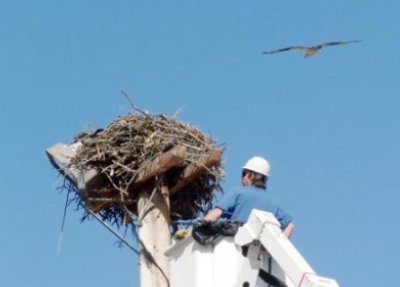
LAKE COUNTY – An osprey in trouble recently got a helping hand.
Pacific Gas & Electric Troubleman Bill Landers received a call April 26 that an osprey was in trouble. The bird was tangled and dangling from the nest.
Landers called SpiritWild, Lake County's wildlife center, to assist. By the time everyone arrived, the tangled adult had freed itself, but SpiritWild Director Sandie Elliott requested a nest check to be sure no babies were injured in the flap and struggle that had occurred.
While the mother circled, swooped and screamed, Landers quickly checked the babies and removed some hazardous twine and other debris.
The nest contained two hatchlings and one egg still unhatched.
SpiritWild has had an osprey egg in an incubator for nearly a month that was retrieved from an endangered nest by PG&E. The egg was due to hatch during the week of April 26-30, and this was the perfect nest in which to place the egg.
Landers and Elliott met again later in the day and Landers placed the egg in the nest.
The baby that will hatch will have a much better chance for survival with an osprey upbringing rather than one done by humans with puppets.
This is another example of the remarkable job PG&E has done assisting these magnificent birds time and time again, through its policies and its conscientious employees.
{mos_sb_discuss:2}
- Details
- Written by: Elizabeth Larson

CLEARLAKE – Police arrested a Clearlake man Friday in connection with an early morning homicide.
Clearlake Police reported that they arrested 42-year-old handyman Andre Lafayette Stevens on murder charges after officers found him with a weapon and the victim identified him.
A statement from Clearlake Police Lt. Mike Hermann said that officers were dispatched to the 14100 block of Lakeshore Drive shortly after midnight on a report of a stabbing in progress.
Sgt. Tim Celli and Officer Tim Hobbs arrived on scene within moments, Hermann reported, to find Stevens still holding the knife with bloody hands.
Celli and Hobbs detained Stevens and found the victim nearby with multiple stab wounds, Hermann reported.
The victim, who police initially found conscious, identified Stevens as his attacker before dying of his injuries, according to Hermann's statement.
Several residents of the area told police they witnessed the incident, Hermann reported, because the victim had called for help.
Clearlake Police detectives arrived at the scene, Hermann reported, and Stevens later provided police with a statement on the incident. Hobbs arrested Stevens, who was transported to the Lake County Jail and booked for murder.
Hermann's statement said police have not yet released the victim's name pending notification of family.
Police say the investigation is ongoing with no further information available at this time.
Anyone with information in the case is asked to call the Clearlake Police Department's Detective Division, 994-8251.
E-mail Elizabeth Larson at
{mos_sb_discuss:2}
- Details
- Written by: Elizabeth Larson
LAKE COUNTY – Foreclosure rates are growing across the country and California, and here in Lake County a new report shows that the number of people defaulting on their mortgages is increasing.
DataQuick Information Systems, a real estate information service, has reported that the number of default notices sent to California – and Lake County – homeowners last quarter increased to its highest level in almost 10 years.
That increase in foreclosures among the state's eight million homes and condos is attributed to flat appreciation, slow sales and riskier subprime loans, according to the report.
The report also noted that while foreclosure properties tugged property values down by almost 10 percent in some areas 10 years ago, the effect on today's market is negligible.
Foreclosure rates statewide jumped 148 percent in the first quarter of this year as compared with that period in March 2006, growing from 18,856 to 46,760.
Last quarter's default level was the highest since 47,912 Notices of Default (NoDs) were recorded statewide in second-quarter 1997, according to DataQuick.
Defaults peaked in first quarter 1996 at 61,541. An average of 33,847 NoDs have been filed quarterly since 1992, when DataQuick's NOD statistics begin.
Andrew LePage, a DataQuick spokesman, said in Lake County foreclosures in the first quarter of 2006 numbered 48, compared with 109 foreclosures in this year's first quarter, a 127-percent increase.
This year's first-quarter foreclosure rates are the highest recorded for the county since 1992, when DataQuick began tracking the information, said LePage.
The last big wave of foreclosure activity in the county appeared in the mid-1990s, he said.
Lake County's homeownership rate of 70.6 percent is higher than the state average of 56.9 percent, according to the US Census Bureau. The county's owner-occupied homes number 19,164, with the county's median home value listed at $255,300.
LePage noted Lake County's default rates have traditionally been “really low,” with a quarterly average of 41. In the third quarter of 2005, the county only had four foreclosures reported, he added.
He suggested that the growth in foreclosures likely correlates with a growing population.
LePage did not have a breakdown of foreclosures by the county's different communities.
The county's foreclosures appear to have started going up late last year, according to LePage. In the third quarter of 2006, foreclosures numbered 67, jumping to 102 the following quarter.
“When you have a slower market and not as much appreciation or no appreciation, that sets the state for rising foreclosure activity,” LePage explained.
In neighboring counties, the rates also have risen. Napa's foreclosures are up by 87 percent, and Sonoma's by 159 percent.
Risky loans a key
For people beginning to have financial problems who have little or no equity, those market characteristics make it much more difficult for them to pull out of a “financial tailspin” by refinancing, he said.
Home purchases statewide peaked in the summer of 2005, said LePage. Loans typically begin to go bad within the first year and a half, he said, and DataQuick's research shows that most of the loans that went into default last quarter were originated between April 2005 and May 2006.
Many risky subprime loans were being made at that time, said LePage. With foreclosure activity continuing to rise, he added, “It's probably telling us that some of the more creative financing and subprime financing is starting to fuel these numbers.”
On primary mortgages, homeowners were a median five months behind on their payments when the lender started the default process, DataQuick reported. The borrowers owed a median $10,784 on a median $331,200 mortgage.
Most homeowners emerge from the foreclosure process by bringing their payments current, refinancing, or selling the home and paying off what they owe. However, DataQuick's study found that about 40 percent of homeowners who found themselves in default last year actually lost their homes to foreclosure in the first quarter. A year ago it was nine percent.
Trustees deeds recorded, or the actual loss of a home to foreclosure, totaled 11,033 during the first quarter, up 81.5 percent from 6,078 for the previous quarter, and up 802.1 percent from 1,223 for last year's first quarter, according to DataQuick.
Foreclosure sales peaked at 15,418 in third-quarter 1996, and hit a low of 637 in the second quarter of 2005, DataQuick reported.
Lakeport attorney Steve Elias, a nationally recognized expert on bankruptcy who has written three books on the subject, said foreclosures and bankruptcy often go hand-in-hand.
Bankruptcy, Elias explained, slows down the foreclosure process, and in the case of Chapter 13 bankruptcy, it offers individuals the ability to repay overdue debts – along with current payments – over a five-year period.
He said he doesn't see many cases these days where people in bankruptcy actually lose their homes, with many managing to refinance or get extremely harsh “bridge loans.”
Bankruptcy, noted Elias, is a good way to let go of home rather than letting it be taken in foreclosure. That's because only the bankruptcy will show up on a credit report, not a foreclosure, he explained, which does less harm overall to one's future credit rating. Short sales, he added, can become a problem because the IRS counts them as taxable income.
Is the state at its foreclosure peak? “We don't think we're there yet,” said LePage, looking at the state as a whole, and noting that a peak would require conditions that would begin to seriously erode home values.
E-mail Elizabeth Larson at
{mos_sb_discuss:2}