 How to resolve AdBlock issue?
News
- Details
- Written by: Lake County News reports
William “Liam” Coburn of Upper Lake has been appointed to the 49th District Agricultural Association, Lake County Fair Board of Directors.
Coburn has been co-owner and culinary director of Crazy Quilt Farms since 2021. He has also been an In-Home Supportive Services provider since 2019.
Coburn was a kitchen manager at Lovejoy’s Tea Room from 2014 to 2018 and a business manager at Neiman Marcus from 2005 to 2014.
This position does not require Senate confirmation and there is no compensation.
Coburn is a Democrat.
- Details
- Written by: Tricia Wachtendorf, University of Delaware and James Kendra, University of Delaware
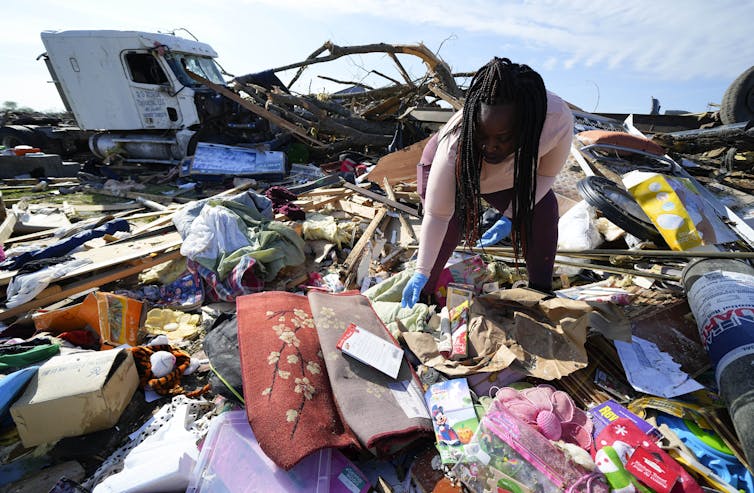
People often think of disasters as great equalizers. After all, a tornado, wildfire or hurricane doesn’t discriminate against those in its path. But the consequences for those impacted are not “one-size-fits-all.”
That’s evident in recent storms and wildfire disasters and in the U.S. Census Bureau’s newly released results from its national household surveys showing who was displaced by disasters in 2023.
Overall, the Census Bureau estimates that nearly 2.5 million Americans had to leave their homes because of disasters in 2023, whether for a short period or much longer. However, a closer look at demographics in the survey reveals much more about disaster risk in America and who is vulnerable.
It suggests, as researchers have also found, that people with the fewest resources, as well as those who have disabilities or have been marginalized, were more likely to be displaced from their homes by disasters than other people.
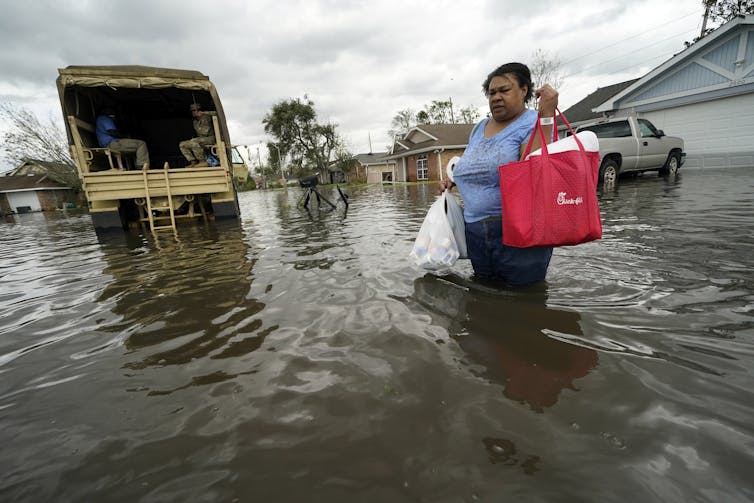
Decades of disaster research, including from our team at the University of Delaware’s Disaster Research Center, make at least two things crystal clear: First, people’s social circumstances – such as the resources available to them, how much they can rely on others for help, and challenges they face in their daily life – can lead them to experience disasters differently compared to others affected by the same event. And second, disasters exacerbate existing vulnerabilities.
This research also shows how disaster recovery is a social process. Recovery is not a “thing,” but rather it is linked to how we talk about recovery, make decisions about recovery and prioritize some activities over others.
Lessons from past disasters
Sixty years ago, the recovery period after the destructive 1964 Alaskan earthquake was driven by a range of economic and political interests, not simply technical factors or on need. That kind of influence continues in disaster recovery today. Even disaster buyout programs can be based on economic considerations that burden under-resourced communities.
This recovery process is made even more difficult because policymakers often underappreciate the immense difficulties residents face during recovery.
Following Hurricane Katrina, sociologist Alexis Merdjanoff found that property ownership status affected psychological distress and displacement, with displaced renters showing higher levels of emotional distress than homeowners. Lack of autonomy in decisions about how to repair or rebuild can play a role, further highlighting disparate experiences during disaster recovery.
What the Census shows about vulnerability
The 2023 census data consistently showed that socially vulnerable groups reported being displaced from their homes at higher rates than other groups.
People over 65 had a higher rate of being displaced than younger people. So did Hispanic and Black Americans, people with less than a high school education and those with low household incomes or who were struggling with employment compared to other groups. While the Census Bureau describes the data as experimental and notes that some sample sizes are small, the differences stand out and are consistent with what researchers have found.
Low-income and marginalized communities are often in areas at higher risk of flooding from storms or may lack investment in storm protection measures.
The morass of bureaucracy and conflicting information can also be a barrier to a swift recovery.
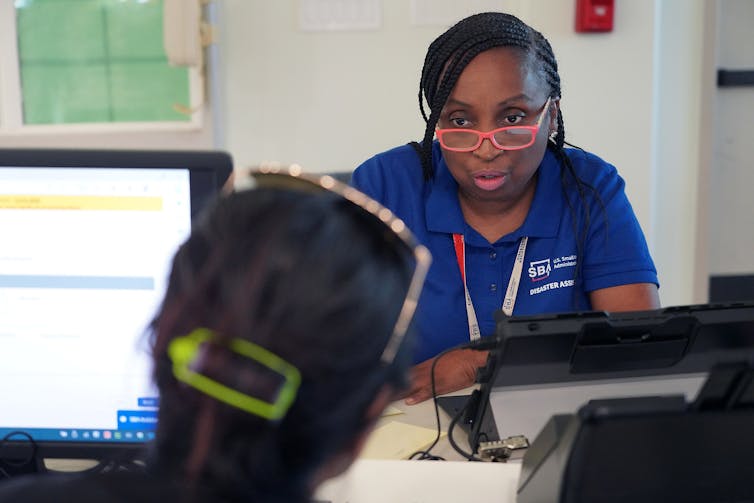

After Hurricane Sandy, people in New Jersey complained about complex paperwork and what felt to them like ever-changing rules. They bemoaned their housing recovery as, in researchers’ words, a “muddled, inconsistent experience that lacked discernible rationale”.
Residents who don’t know how to find information about disaster recovery assistance or can’t take time away from work to accumulate the necessary documents and meet with agency representatives can have a harder time getting quick help from federal and state agencies.
Disabilities also affect displacement. Of those people who were displaced for some length of time in 2023, those with significant difficulty hearing, seeing or walking reported being displaced at higher rates than those without disabilities.
Prolonged loss of electricity or water due to an ice storm, wildfire or grid overload during a heat emergency can force those with medical conditions to leave even if their neighbors are able to stay.
That can also create challenges for their recovery. Displacement can leave vulnerable disaster survivors isolated from their usual support systems and health care providers. It can also isolate those with limited mobility from disaster assistance.
Helping communities build resilience
Crucial research efforts are underway to better help people who may be struggling the most after disasters.
For example, our center was part of an interdisciplinary team that developed a framework to predict community resilience after disasters and help identify investments that could be made to bolster resilience. It outlines ways to identify gaps in community functioning, like health care and transportation, before disaster strikes. And it helps determine recovery strategies that would have the most impact.
Shifts in weather and climate and a mobile population mean that people’s exposure to hazards are constantly shifting and often increasing. The Coastal Hazard, Equity, Economic Prosperity, and Resilience Hub, which our center is also part of, is developing tools to help communities best ensure resilience and strong economic conditions for all residents without shortchanging the need to prioritize equity and well-being.
We believe that when communities experience disasters, they should not have to choose among thriving economically, ensuring all residents can recover and reducing risk of future threats. There must be a way to account for all three.
Understanding that disasters affect people in different ways is only a first step toward ensuring that the most vulnerable residents receive the support they need. Involving community members from disproportionately vulnerable groups to identify challenges is another. But those, alone, are not enough.
If we as a society care about those who contribute to our communities, we must find the political and organizational will to act to reduce the challenges reflected in the census and disaster research.
This article, originally published March 4, 2024, has been updated with severe storms in mid-March.
Tricia Wachtendorf, Professor of Sociology and Director, Disaster Research Center, University of Delaware and James Kendra, Director, Disaster Research Center and Professor, Public Policy & Administration, University of Delaware
This article is republished from The Conversation under a Creative Commons license. Read the original article.
- Details
- Written by: Douglas Vakoch, California Institute of Integral Studies
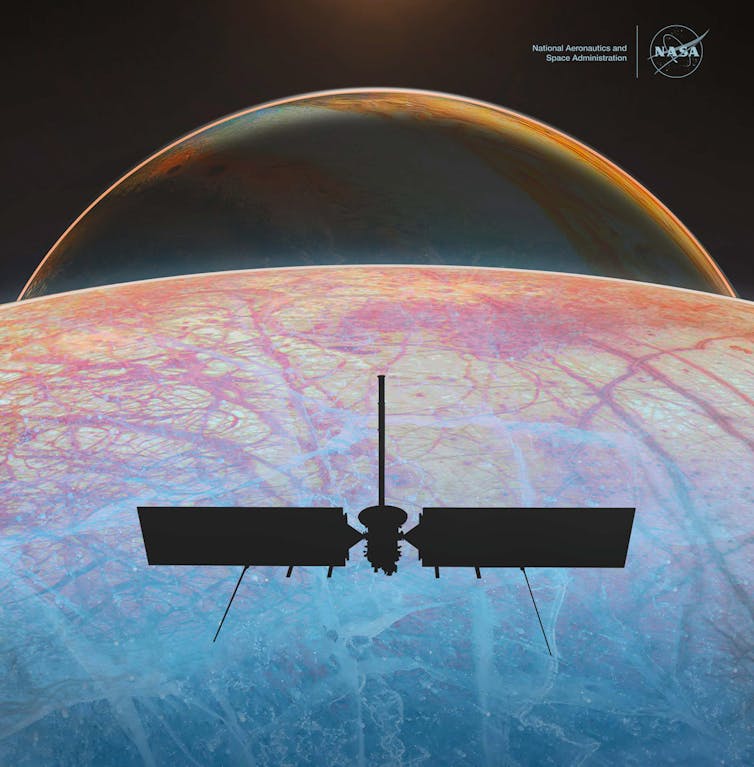
NASA’s Europa Clipper spacecraft, headed to Jupiter’s ice-covered moon Europa in October 2024, will carry a laser-etched message that celebrates humanity’s connection to water. The message pays homage to past NASA missions that carried similar messages.
As the president of Messaging Extraterrestrial Intelligence, or METI, International, I helped design the message on Clipper with two fellow members of our board of directors: linguists Sheri Wells-Jensen and Laura Buszard-Welcher. METI International is a scientific organization dedicated to transmitting powerful radio messages to extraterrestrial life.
We collected audio recordings in 103 languages, and we decided how to convert these into waveforms that show these sounds visually. Colleagues from NASA etched these waveforms into the metal plate that shields the spacecraft’s sensitive electronics from Jupiter’s harsh radiation.
I also designed another part of the message that visually depicts the wavelengths of water’s constituents, because water is so important to the search for intelligent life in the universe.
Etching messages into spacecraft isn’t a new practice, and Clipper’s message fits into a decades-old tradition started by astronomer Carl Sagan.
In 1972 and 1973, two Pioneer spacecraft headed to Jupiter and Saturn carrying metal plaques engraved with scientific and pictorial messages. In 1977, two Voyager spacecraft headed to Jupiter, Saturn, Uranus and Nepture bearing gold-plated copper phonograph records. These records contained tutorials in mathematics and chemistry, as well as music, photos and sounds of Earth and greetings in 55 languages.
Water words
As water is essential for life on Earth, searching for its presence elsewhere has been key to many NASA missions. Astronomers suspect that Europa, where Clipper is headed, has an ocean underneath its icy surface, making it a prime candidate for the search for life in the outer solar system.
Part of the Clipper message features the word for water in 103 languages. We started with audio files collected online, but we then needed to analyze those and find an output that could be engraved on a metal plate. I ended up going back to some of the techniques I used in some of my early psycholinguistic research, where I explored how emotions are encoded in speech.
The 103 spoken words we recorded represent a global snapshot of the diversity of Earth’s languages. The outward-facing side of the Clipper plate shows the words as waveforms that track the varying intensity of sound as each word is spoken.
Each person whom we recorded saying the word “water” for the waveform had a connection to water. For example, the lawyer who contributed the word for water in Uzbek – “suv” – organizes an annual music festival in Uzbekistan to raise awareness of the desertification of the Aral Sea.
The native speaker of the Catalan water word – “aigua” – hunts for exoplanets, discovering potentially habitable planets that orbit other stars.
The Drake Equation
Clipper’s message also pays homage to astronomer Frank Drake, the father of SETI – the Search for Extraterrestrial Intelligence – by bearing the Drake Equation, his namesake formula. By drawing on scientific data, as well as some best guess hunches, the Drake Equation estimates the number of extraterrestrial civilizations in the galaxy currently sending messages into the cosmos.
By one widely quoted estimate, there are a tenth as many of these extraterrestrial civilizations as one’s average lifetime in years. If civilizations survive for a million years, for example, there should be about 100,000 in the galaxy. If they last only a century on average, scientists would estimate that about 10 exist.
Radio astronomers study the universe by examining the radiation that chemical elements in space give off. They spend much of their time mapping the distribution of the most abundant chemical in the universe – hydrogen.
Hydrogen emits radiation at a certain frequency called the hydrogen line, which radio telescopes can detect. During Project Ozma, the first modern-day SETI experiment, Drake looked for artificial signals at the same frequency, because he figured scientists on other worlds might recognize hydrogen as universally significant and broadcast signals at that frequency.
The water hole
As our team developed our water words message, I realized that the message would only make sense if it were discovered by someone already familiar with the contents inscribed on the plate. The Drake Equation would only make sense if someone already knew what each of the terms in the equation stood for.
The Europa Clipper will crash into Jupiter or one of its other moons, with Ganymede or Callisto the leading candidates. But if for some reason the mission changes and it survives that fate, then humans far in the future with a radically different cultural background and different language conventions may retrieve it millennia from now as an ancient artifact.
To ensure we had at least one part of the message that a distant future scientist might be able to understand, I also designed a pictorial representation of the same frequency that Drake used for Project Ozma: the hydrogen line. We engraved this on the Clipper plate, along with a frequency called the hydroxyl line.
When hydrogen (H+) and hydroxyl (OH-) combine, they form water. Scientists call the range of frequencies between these lines the “water hole.” The water hole represents the part of the radio spectrum where astronomers conducted the first SETI experiments.
We displayed the hydrogen and hydroxyl lines using their wavelengths in the Clipper message. The metal plate also has diagrams showing what hydrogen and hydroxyl look like at the atomic level.
We’re hoping that future chemists would recognize these chemical components as the ingredients of water. If they do, we will have succeeded in communicating at least a few core scientific concepts across time, space and language.
Waveforms let our team tie the messages on the two sides of the Clipper plate together. On the water words side, over a hundred words are depicted by their waveforms. On the other side, the wavelengths of hydrogen and hydroxyl – the constituents of water – are etched into the plate.
METI International funded the collection and curation of the water words, as well as my design of the hydrogen and hydroxyl lines, providing these to NASA at no cost.
While designing the message for the Europa Clipper, we got to reflect on the importance of water on Earth, and think about why astronomers feel so compelled to search for it beneath the icy crust of Jupiter’s moon Europa. The spacecraft is scheduled to enter Jupiter’s orbit in April 2030.
Douglas Vakoch, President, METI International; Professor Emeritus, California Institute of Integral Studies
This article is republished from The Conversation under a Creative Commons license. Read the original article.
- Details
- Written by: Elizabeth Larson
The National Weather Service’s Eureka office said “a second round of wind and gusty showers will hit the southern half of the area on Friday with cool and clearing conditions through the weekend.”
Across the region, the heavier rainfall amounts are expected in Lake and Mendocino counties. “Wind turning east through the event will generally focus rain along higher terrain and rain shadow lower elevation areas such as Clear Lake itself,” the forecast said.
In addition, the forecast calls for increasing east-southeast winds on Friday afternoon and
evening, mainly focused over Mendocino and Lake counties.
Easterly winds may aid in funneling gusty winds in Lake County. Forecast models suggest wind gusts could be up to 45 miles per hour in Lake County, with the strongest winds over the higher elevations.
Lake County could see as much as 2 inches of rain on Friday, with less than a tenth of an inch expected on Saturday morning.
Conditions are forecast to begin clearing by Saturday night, with Easter Sunday expected to be mostly sunny.
Next week is supposed to remain clear and sunny, based on the forecast.
Daytime temperatures on Friday will be in the 40s, edging into the low 50s on Saturday and Sunday, before rising into the high 60s and low 70s for the rest of the week.
Nighttime conditions on Friday and Saturday will dip into the 30s before rising into the low 40s through Wednesday.
Email Elizabeth Larson at